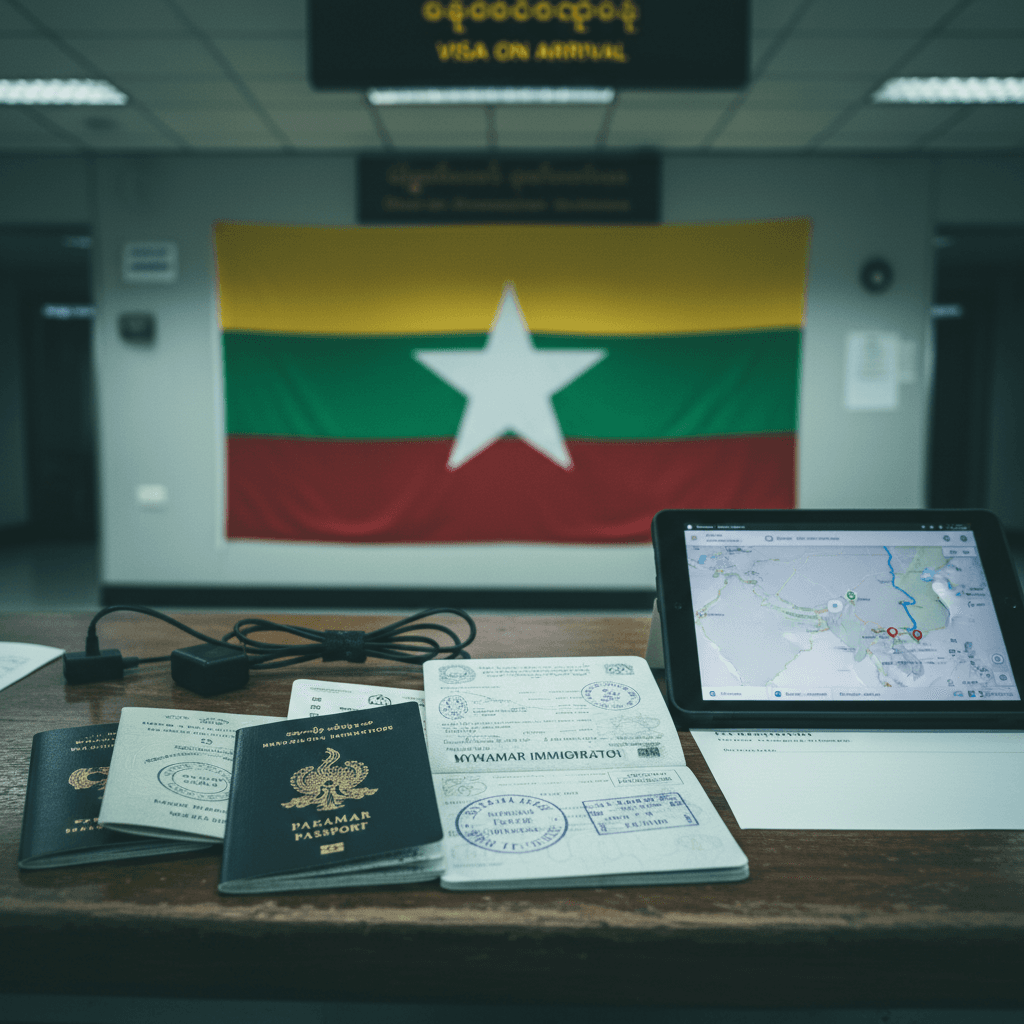
Myanmar
Complete Digital Nomad Guide

Policy Stability
Stamped Nomad ExclusiveHow likely visa and immigration policies are to remain unchanged
Quick Facts
Nomad Visa Cost
N/A
Max Stay
12 months
Renewable
Yes
Cost of Living
$1,000/mo
Avg Internet
25 Mbps
Safety Score
3/10
Healthcare
Low
Coworking
Medium
English Friendly
Low
Time Zones
UTC+6:30
Entry Methods Available
Best For
The Entry Strategy
Myanmar’s visa system is surprisingly diverse, offering over a dozen categories for travelers. For most digital nomads, the choice boils down to a Tourist or Business visa. While the country has faced various shifts in entry requirements lately, the process remains manageable if you have your paperwork in order. Most visitors arrive via major hubs like Yangon or Mandalay, as land border crossings can be unpredictable for international passport holders.
Tourist Visas and Extensions
The standard tourist visa grants a 28-day stay and typically costs $50 USD. While this is the most common entry method, it is designed for short-term travel rather than long-term residency. If you find yourself falling in love with the golden pagodas and need more time, you can often apply for monthly extensions at local immigration offices for a fee of approximately $25 to $30 USD. Approval is subject to the discretion of the immigration officer, but many nomads successfully secure multiple extensions by staying proactive with their paperwork.
The Business Visa Advantage
If you are planning a longer stint, the Business Visa is the gold standard. A single-entry business visa allows for a 70-day stay and costs $50 USD. The real value lies in the multiple-entry options, which can range from three months to a full year, with fees between $200 and $600 USD. To qualify, you generally need an invitation letter from a registered Myanmar company. These visas are also extendable, usually in monthly increments for about $35 to $40 USD, providing a more stable path for those working remotely while exploring the country.
Visa-Free and VOA Options
Travelers from select ASEAN nations enjoy visa-free entry for short periods. Singaporean citizens receive 30 days at any port, while citizens of Thailand, Cambodia, Vietnam, and the Philippines are typically granted 14 to 30 days when arriving by air. For many others, the Visa on Arrival (VOA) system is the primary gateway. You can check current processing times and eligible nationalities on the government's digital portal to see if your country qualifies for the $50 tourist VOA.
Recent Changes for 2025-2026
Myanmar has introduced several temporary measures to boost tourism from specific regions. New updates for the 2025 and 2026 seasons include:
- China and India: Temporary VOA tourist visas available from August 2025 to August 2026.
- Japan, South Korea, and Macao: Special VOA windows open from October 2025 to October 2026.
- Hong Kong: Temporary VOA access granted from March 2025 to March 2026.
- DICA Reporting: From May 2025, foreign workers on business or employment visas may face additional reporting requirements through the Directorate of Investment and Company Administration.
Key Visa Categories at a Glance
- Tourist Visa: $40-$50 fee; 28-30 days initial stay; eligible for VOA or e-visa.
- Business Visa: $50 (single) to $600 (one year); 70 days initial stay; requires company invitation.
- Social Visa: $50 (single) to $450 (multiple); 70 days to 1 year; designed for those with family ties.
- Education Visa: $50 (single) to $160 (multiple); 90 days to 1 year; requires school enrollment.
- Transit Visa: $20 fee; 24 hours maximum; requires proof of onward flight.
Keep in mind that while the e-visa system has historically been the easiest way to apply, it occasionally goes offline for maintenance or policy updates. Always verify the current status before booking non-refundable flights. If the e-visa is suspended, your nearest Myanmar embassy or consulate will be the point of contact for traditional paper applications.
The Hard Truth About the Nomad Visa
If you are looking for a shiny, official "Digital Nomad Visa" with a sunset logo and a streamlined application for remote workers, you won't find it here. Myanmar does not have a specific visa category for nomads. The country has had a turbulent few years, and its immigration policies reflect a focus on traditional business and tourism rather than the remote work revolution.
Most nomads who spend significant time here operate in a legal gray area. While the government doesn't explicitly target remote workers, they also don't provide a clear legal framework for them. You are essentially a guest who happens to have a laptop, so keeping a low profile regarding your work activities is the standard move for the community here.
The Business Visa Workaround
The Business e-Visa is the gold standard for anyone staying longer than a few weeks. While a Tourist e-Visa only gives you 28 days and is strictly for sightseeing, the Business e-Visa grants an initial stay of 70 days. This is the path you want if you plan to settle into a rhythm in Yangon or Mandalay.
To make this work long-term, you will eventually need to interface with the eStay system. This allows for extensions of 3, 6, or 12 months. Here is the catch: you generally need a sponsoring Myanmar-registered company to vouch for you. Many long-term nomads partner with local agencies or consultants who can provide the necessary invitation letters and company registration documents for a fee.
The Logistics and Costs
- Initial Stay: 70 days via the e-Visa.
- Extensions: Available for 3, 6, or 12 months through a registered sponsor.
- Application Fee: Usually between $50 and $70 for the initial e-Visa.
- Extension Fees: Prices range from $62 to $217 depending on the length of stay, plus additional costs for re-entry permits if you plan to leave and come back.
- Income Requirements: There is no specific monthly income threshold, but you should be prepared to show proof of funds or local accommodation if asked.
How to Apply
The process starts online before you ever pack a bag. You will need a passport valid for at least 6 months and a recent digital photo. You can submit your initial application through the official Myanmar e-Visa portal. Once you arrive, you have to report your address using a document called Form C, which your hotel or landlord usually handles.
If you decide to stay past the 70-day mark, the extension process happens via the eStay system. Your sponsor company submits a requisition letter and their MyCO registration. Once approved, which typically takes about 5 working days, you must go to the immigration office in Yangon within 5 days to get the physical stickers placed in your passport.
Taxes and Fine Print
Myanmar’s tax system is not currently set up to track remote income earned from foreign employers. Generally, if your money stays in a foreign bank account and you aren't competing in the local Myanmar job market, you won't be bothered. However, the political situation is fluid. Regulations can change overnight, and e-Visa services are occasionally suspended without much warning.
Always keep an eye on the Ministry of Immigration and Population website for the latest updates. Because of the current instability, it is wise to have an exit strategy and a secondary "base" in a nearby country like Thailand or Vietnam just in case your visa status or the local internet situation shifts unexpectedly.
The Basics of Entry
Entering Myanmar as a digital nomad requires a bit more foresight than hopping over to neighboring Thailand. While the country has reopened its doors to international travelers, the rules are specific and vary significantly depending on which passport you carry. Most visitors will arrive via major hubs like Yangon, Mandalay, or Nay Pyi Taw, as these are the primary gateways where visa policies are consistently enforced.
For most Western nomads, the E-Visa is the standard path. It is a digital process that saves you a trip to the embassy, though you should always verify the current operational status of the portal before booking non-refundable flights. If you are from a neighboring ASEAN nation, you might be able to skip the paperwork entirely for short trips.
Visa-Free Stays
A handful of nationalities can enter for short stints without any prior application. This is perfect for a quick scouting trip to check out the local co-working scene. These exemptions apply strictly to air travel through the three main international airports.
- Singapore and Vietnam: Citizens get a 30-day stay. Singaporeans have the added flexibility of using any international checkpoint.
- Brunei, Cambodia, Indonesia, Laos, Philippines, and Thailand: Citizens are granted 14 days.
If you plan to stay longer than these windows, you cannot simply extend your stay on arrival. You will need to apply for a formal E-Visa before you fly.
The Tourist E-Visa
This is the workhorse visa for the digital nomad community. You can apply through the official Ministry of Immigration website. The process is generally straightforward, but you need to have your documents ready to upload.
- Cost: $50 USD, paid via credit card.
- Processing Time: Usually 3 working days.
- Validity: Once approved, the letter is valid for 90 days, but it only allows for a single entry and a 28-day stay.
- Requirements: A passport with 6 months validity, a recent 3.8x4.6cm color photo, proof of a return ticket, and your hotel booking details.
Once you land, hand over your printed approval letter to the immigration officer to receive your entry stamp. Keep in mind that the tourist E-Visa is strictly non-extendable. When your 28 days are up, you must leave the country.
Visa on Arrival (VOA)
Myanmar has expanded its VOA program to include over 50 nations, including the USA, UK, Australia, India, China, and much of the EU. This is a convenient fallback if you did not have time to wait for an E-Visa. You will pay the $50 USD fee in cash at the airport. Make sure you have two 4x6cm photos tucked into your passport and your paperwork for onward travel and accommodation ready for inspection.
Business Visas for Long-Termers
If you find that 28 days is not enough to soak in the atmosphere, many nomads look into the Business Visa. While it is intended for those with local business dealings, it offers much more flexibility for long-term stays. These are available via E-Visa or VOA for eligible nationalities.
- Duration: Initial stay of 70 days.
- Extensions: Unlike the tourist version, business visas can be extended at immigration offices within the country.
- Extension Fees: These typically range from $50 to $200 USD depending on the length of the extension you are seeking.
Costs and Penalties
Budgeting for your visa is simple, as most entry types carry a flat fee. However, the costs of getting it wrong can add up quickly.
- Tourist E-Visa: $50
- Tourist VOA: $50
- Business VOA: $50
- Overstay Fine: $3 USD per day
While a $3 daily fine might sound negligible, overstaying is risky. It can lead to detention, deportation, or a permanent "black mark" on your record that makes future entries difficult. If you need more time, it is always better to do a border run or switch to a business visa than to let your stamp expire.
Border Runs and Re-entry
The "border run" is a common tactic in Southeast Asia, and it is possible in Myanmar, though it comes with caveats. You can exit via land borders like Tachileik or Kawthaung and re-enter to trigger a new visa. However, immigration officers have the final say. If they see a pattern of back-to-back tourist visas, they may question your intentions. There is no such thing as a guaranteed multiple-entry tourist visa, so treat every re-entry as a fresh application.
The Long Game in Myanmar
Myanmar doesn't make it easy for digital nomads to just drop an anchor and stay forever. Unlike neighboring countries with dedicated "digital nomad visas" or easy-to-get retirement schemes, Myanmar relies on a more traditional, bureaucratic framework. You’ll mostly be dealing with extendable business or social visas, which require a bit of paperwork and a local connection to keep active long-term.
The reality is that most remote workers here operate in a bit of a grey area. Since there isn't a specific freelancer visa, you'll likely need to secure a business visa through a local sponsor or an employment visa if you find a local contract. It’s a bit of a hurdle, but it’s the standard path for anyone wanting to stay more than a couple of months.
Your Visa Options
If you're planning on staying beyond a standard tourist stint, you’ll need to look at these four main categories. Most of these start as a 70-day single-entry permit that you later convert into a long-term multiple-entry stay.
- Business Visa: This is the most common route for serious long-termers. A single entry costs $50 USD for 70 days. Once you have a history of these, you can apply for multiple-entry versions: $200 for 3 months, $400 for 6 months, or $600 for a full year. You will need an invitation letter from a registered Myanmar company.
- Social Visa: If you have family ties or are a former resident, this is a solid option. It follows a similar price structure to the business visa, ranging from $50 for the initial stay up to $450 for a one-year multiple-entry permit.
- Employment Visa: This is for those actually hired by a local entity. You’ll need a formal work permit, a health check, and copies of your degree. It starts at $50 for 70 days and is extendable through your employer.
- Religious Visa: Specifically for those participating in meditation retreats or religious studies. It costs $50 initially and can be extended up to a year for $450.
Permits for the Long Haul
Getting the visa is only half the battle. If you plan to stay longer than 70 to 90 days, you have to enter the world of local registration. This involves two specific documents that effectively become your "local ID" while you're in the country.
The Stay Permit is what allows you to live in the country legally beyond your initial visa window. You usually apply for this at the same time you're extending your visa. If you want to leave and come back without canceling your permit, you’ll also need a Multiple Journey Special Re-Entry Visa (MJSRV).
The Foreigner Registration Certificate (FRC) is mandatory for anyone staying over 90 days. You apply for this at the township immigration office. It’s a small book that you should keep with you; it technically replaces your passport for domestic identification, though you’ll still need your passport and a valid visa to actually exit the country. Note that FRCs usually expire on November 30 every year, regardless of when you first got it.
The Path to Permanent Residency
Myanmar does have a Permanent Residency (PR) scheme, but it’s not a "pay to play" system like a Golden Visa. It’s aimed at experts, investors, and those with family ties who have already put in the time. You generally need to prove you’ve lived in the country for at least 3 years as a specialist or 2 years if you have family connections.
The application fee is $500 USD. You'll need to provide a mountain of evidence, including boarding passes from the last several years to prove continuous residence, a health certificate, and your CV. While this grants you the right to stay long-term, it doesn't offer a clear path to citizenship, which remains rare and entirely at the government's discretion.
Because local regulations can shift rapidly, always double-check the latest requirements through the official Myanmar e-visa portal or your nearest embassy before making a move.
Myanmar remains one of the most affordable frontiers for the remote work crowd. While the political situation requires a cautious approach, the sheer value for money is hard to ignore. You can live quite well here on a budget that would barely cover a single week in Singapore or Tokyo. Most nomads find their sweet spot between $500 and $1,000 per month, covering everything from a private apartment to daily cafe visits.
The Main Hubs: Cost Breakdown
Yangon is the undisputed heavyweight for infrastructure and community, though it carries the highest price tag. Mandalay offers a more traditional vibe with roughly 15% lower costs across the board. Naypyidaw is an outlier; it is slightly cheaper than Yangon but lacks the "soul" and nomad-friendly amenities found in the other two cities.
Yangon (The Premium Hub)
- Budget Rent: $130-$200 for a basic 1BR in Sanchaung or Kamayut.
- Comfortable Rent: $250-$350 for furnished units in expat-friendly zones.
- Premium Rent: $400+ for modern serviced apartments with backup generators.
Mandalay (The Cultural Alternative)
- Budget Rent: $100-$150 for central, simple living.
- Comfortable Rent: $150-$250 for well-located, newer builds.
- Premium Rent: $300+ for high-end downtown residences.
Naypyidaw (The Administrative Capital)
- Budget Rent: $130-$250.
- Comfortable Rent: $250-$350.
- Premium Rent: $500+ for sprawling villa-style setups.
Eating and Drinking
Food is where your budget goes the furthest. If you stick to local staples like mohinga or tea shop snacks, you will struggle to spend more than $6 to $8 a day. Western cravings will naturally hike your bill, as imported ingredients are expensive. Naypyidaw actually edges out Yangon here, with local food prices sitting about 17% lower.
- Budget ($150-$200/month): Heavy focus on street food and local markets.
- Comfortable ($250-$350/month): A mix of local eats and several Western-style dinners or brunch spots each week.
- Premium ($400+/month): Focusing on high-end hotel dining, imported groceries, and frequent cocktails.
Getting Around
Public transport is incredibly cheap, with bus tickets and short rides often costing between $0.24 and $0.78. Most nomads rely on rideshare apps for convenience and safety. A monthly transport pass for local systems averages around $10, but most people prefer the door-to-door ease of taxis.
- Budget ($50-$75/month): Utilizing local buses and the occasional tuk-tuk.
- Comfortable ($80-$100/month): Regular use of rideshare apps for most daily trips.
- Premium ($150+/month): Frequent long-distance private hires and air-conditioned taxis.
Workspaces and Connectivity
Reliable internet is the biggest hurdle in Myanmar, making coworking spaces a literal lifesaver. Yangon has the best selection with spots like Zayat and Impact Hub. These spaces provide the stable power and high-speed fiber that home setups often lack.
- Budget ($50-$100/month): Using daily drop-in passes or basic memberships.
- Comfortable ($150-$250/month): A dedicated hot desk with 24/7 access and faster speeds.
- Premium ($300+/month): Private office suites for teams or high-security needs.
Health and Insurance
Local medical visits are surprisingly affordable, with a standard doctor's consultation costing around $14. However, for anything serious, you want a global policy that can facilitate a flight to Bangkok. Since Myanmar-specific nomad plans are rare, most travelers use international providers.
- Budget ($45-$60/month): Basic emergency medical coverage via SafetyWing or similar providers.
- Comfortable ($90-$150/month): Comprehensive plans including routine check-ups and higher coverage limits.
- Premium ($200+/month): Full-tier international health insurance including dental and vision.
Yangon: The Urban Hub
Yangon is the clear frontrunner for anyone needing a semi-reliable professional setup. It is the country's largest city and the only place where you will find a legitimate "scene" of remote workers. You can bounce between dedicated offices like Rangoun Serviced Offices, area.39, or Zayat Coworking. If you prefer the background hum of a coffee shop, the city is packed with cafes that understand the "laptop for three hours" lifestyle.
Speeds here are the best you will find in Myanmar, generally ranging between 20 and 48 Mbps. While that is plenty for video calls, you have to account for the frequent power outages. Most high-end coworking spaces and hotels have backup generators, but it is a factor you cannot ignore. When the sun goes down, the city has a surprisingly resilient social life. You can grab a drink at the historic Sarkies Bar or head to Yangon Yangon for rooftop views.
- Monthly Living Cost: $477 to $802
- Internet Speed: 20-48 Mbps
- The Vibe: Busy, cultural, and the most "connected" option in the country.
Safety requires a bit of common sense here. Stick to central, well-traveled areas and be mindful of the midnight to 4 AM curfew. You will see military checkpoints occasionally, but they rarely interfere with foreigners unless you are in a restricted zone.
Mandalay: Cultural Immersion
If Yangon feels too chaotic, Mandalay offers a slightly slower pace without losing all the amenities. It is a city built on a grid, making it easy to get around, and it serves as the cultural heart of the country. For work, you have options like Shwe Waa and CCI France Myanmar, though the cafe culture is a bit more localized compared to the international feel of Yangon.
The internet is a step down, averaging between 7 and 31 Mbps. It is enough to get the job done, but you might struggle with heavy file uploads. The cost of living is comparable to Yangon, though certain imports can be pricier. Most nomads come here for the history; you can spend your sunsets at the U Bein Bridge or exploring the palace grounds.
- Monthly Living Cost: $540 to $972
- Internet Speed: 7-31 Mbps
- The Vibe: Traditional, historical, and less westernized.
Nightlife is pretty quiet here, so it is better suited for those who prefer an early start and a focus on sightseeing. Crime is a bit more of a talking point in Mandalay than in Yangon, so keep your wits about you when exploring outside the main tourist strips.
Nyaungshwe: The Nature Retreat
Nyaungshwe is the gateway to Inle Lake and is perfect for a "deep work" phase of your trip. It is a small town, so do not expect a sprawling list of coworking spaces. Instead, you will be working from lakeside cafes or your guesthouse. It is remarkably peaceful and offers a massive break from the noise of the bigger cities.
The internet holds up surprisingly well for a rural area, often hitting 15 to 30 Mbps in the better cafes. The best part about Nyaungshwe is the price tag. It is easily one of the most affordable spots in the region, with monthly costs often hovering around $500. Your "office" view will likely involve fishermen on the lake and rolling green hills.
- Monthly Living Cost: $500 to $600
- Internet Speed: 15-30 Mbps
- The Vibe: Relaxed, scenic, and very budget-friendly.
The nomad community is tiny here, so it can be a bit lonely if you are traveling solo and looking for networking. However, if your goal is to save money and hike or take boat tours during your downtime, it is hard to beat.
Quick Cost & Tech Breakdown
To help you decide where to plant your laptop, here is how the three stack up against each other:
Yangon
- Rent & Food: $477-$802 per month
- Average Speed: 20-48 Mbps
- Availability: Highest concentration of workspaces and 24/7 power backups.
Mandalay
- Rent & Food: $540-$972 per month
- Average Speed: 7-31 Mbps
- Availability: Moderate workspace options; similar costs to the capital.
Nyaungshwe
- Rent & Food: $500-$600 per month
- Average Speed: 15-30 Mbps
- Availability: Limited to cafes; best for those who don't need a formal office.
Staying connected in Myanmar requires a bit more strategy than in neighboring Thailand or Vietnam, but the infrastructure in major hubs like Yangon and Mandalay is surprisingly capable. While rural areas still struggle with connectivity, the urban digital nomad experience is supported by a growing fiber optic network and a solid selection of professional workspaces.
The Connectivity Breakdown
National internet speeds average around 25 Mbps for fixed broadband and 22 Mbps for mobile data. However, these numbers don't tell the full story for nomads. If you base yourself in Yangon, you can regularly find coworking spaces and high-end cafes pushing 48 to 50 Mbps. Hi-Internet currently leads the pack for fixed speeds, often hitting 40 Mbps on standard setups.
Fiber to the Home (FTTH) is the gold standard here. Providers like MPT, 5BB, and Ooredoo have blanketed most Yangon condos and business districts. If you are renting an apartment, check if a fiber line is already installed, as setup times for new lines can be unpredictable.
Top Coworking Spaces in Yangon
For guaranteed uptime and a professional atmosphere, skip the hotel lobby and head to a dedicated workspace. Most spots offer a mix of daily, weekly, and monthly passes.
- KLOUD Junction City Tower: Located in the CBD, this is the premium choice. It offers hot desks and private suites with direct access to a major mall for lunch breaks.
- Impact Hub Yangon: The best pick for community seekers. They host regular networking events and offer flexible hours for those working across different time zones.
- S-Point: A more budget-friendly option that features a rooftop area and affordable weekly packages.
- MingalaBase: Part incubator, part workspace. It has a creative energy and provides free coffee and tea to keep you fueled.
- The Nest - Space Hub: Known for its creative vibe and reliable high-speed WiFi, making it a favorite for designers and developers.
Membership and Usage Costs
Budgeting for your "office" is straightforward. You will find that prices align closely with regional standards in Southeast Asia.
- Monthly Unlimited Pass: Expect to pay between $80 and $200 USD depending on the luxury level of the space.
- Day Passes: Usually run between $5 and $15 USD.
- Home Fiber Plans: Basic 1 Mbps plans start around 100,000 Ks (approx. $45 USD) per month, while high-end 100 Mbps business lines can reach 7,000,000 Ks.
Mobile Data and SIM Cards
Mobile data is your safety net. Power outages can happen, and having a hotspot ready is a requirement for any serious remote work. Prepaid SIM cards from MPT, Ooredoo, or Mytel are cheap, usually costing between $1 and $3 USD for the physical card.
Data bundles are very affordable. Small packs start around $2, while heavy users can get ample monthly data for $10 to $20 USD. MPT generally offers the best coverage and the fastest mobile speeds, peaking at around 33 Mbps. For those who prefer to hit the ground running, eSIM providers like Yesim or Holafly offer tourist data plans, though these usually lack a local phone number.
Cafe Culture and Reliability
Working from cafes is common in Yangon, but it comes with caveats. Spots like Rangoon Tea House are nomad-friendly and offer usable WiFi, but public networks can get bogged down during peak lunch or dinner hours. Always have a backup data plan if you have a Zoom call scheduled. Most nomads use cafes for casual tasks and retreat to coworking spaces for "deep work" or high-bandwidth requirements.
Staying healthy in Myanmar requires a proactive approach. While the country has undergone significant changes in recent years, the healthcare infrastructure remains a tale of two worlds. You will find a stark contrast between the underfunded public wards and the shiny, international-standard private clinics in the major hubs.
Public vs. Private Care
The public healthcare system is generally not an option for digital nomads. It ranks among the lowest globally due to severe underfunding and a chronic lack of modern equipment. If you find yourself in a public hospital, expect long queues, a language barrier, and a shortage of basic medical supplies. This is especially true in rural areas where facilities are often rudimentary.
Private healthcare is where you will head for anything from a chest infection to a broken bone. These facilities, mostly located in Yangon, offer English-speaking staff and the kind of diagnostic tech you would expect back home. Even so, for complex surgeries or serious long-term illnesses, many expats choose to hop on a short flight to Bangkok or Singapore.
International Hospitals to Know
If you need medical attention, keep these names and numbers saved in your phone. They are the gold standard for foreigners in the country:
- Pun Hlaing International Hospital (Yangon): +95 1 697 777. This is often the first choice for surgery and advanced diagnostics.
- International SOS Myanmar Clinic (Yangon): +95 1 230 2500. Excellent for primary care and managing medical evacuations.
- Asia Royal Hospital (Yangon): +95 1 506 059. A reliable multidisciplinary hospital with a strong reputation.
- Victoria Hospital: Known for its modern facilities and 24/7 emergency services.
Insurance and Evacuation
You cannot rely on local public schemes as they generally exclude foreigners. You need a robust international health insurance policy that specifically includes medical evacuation. In a serious emergency, you want a plan that flies you to Thailand or Singapore rather than keeping you in a local ward.
Expect to pay between $50 and $200 per month for a solid expat plan. High-end group coverage can run closer to $2,100 annually. While local private insurance exists, it usually only covers treatment within Myanmar and has much lower payout caps, making it a risky choice for long-term nomads.
The Cost of Care
Medical costs are significantly lower than in the West, but they must usually be paid upfront in cash or via credit card if your insurance does not have a direct billing agreement with the hospital.
- Private Consultation: 15,000 to 50,000 MMK ($7 to $25).
- Hospital Stay: 30,000 to 200,000 MMK per day ($15 to $100).
- ICU Care: Can reach $214 per day, with severe cases totaling around $4,384.
Pharmacies and Prescriptions
Pharmacies are everywhere in Yangon and many stay open late. While you can find a wide range of medications, the post-2021 landscape has seen occasional shortages and a rise in counterfeit drugs. Always use reputable pharmacies attached to international hospitals when possible.
It is smart to bring a 3-month supply of any chronic medication you take. Carry your doctor’s notes and the original prescriptions to avoid any issues at customs or when seeking refills locally.
Emergency Services
The general emergency number for an ambulance is 192, but these public services are often slow and lack life-saving equipment. For a faster, more reliable response, call the emergency lines at Parami Hospital or International SOS. They provide 24/7 paramedics and bilingual support. If you are outside of Yangon or Mandalay, emergency response is extremely limited, so having that evacuation rider on your insurance is a literal lifesaver.
The Cash-First Reality
Money in Myanmar is a bit of a throwback. While the world moves toward digital payments, the local economy still runs on physical currency. You will find yourself dealing with the Myanmar Kyat (MMK) for daily expenses, but the US Dollar remains the unofficial secondary currency. If you are coming here as a nomad, your best strategy is to carry crisp, high-denomination USD bills. They often fetch a much better rate on the street than the official bank rates.
ATMs are available in major hubs like Yangon and Mandalay, but they are notorious for being temperamental. Power outages or connectivity issues can take them offline without warning. Most machines charge a flat fee of 5,000 MMK per transaction, and you will usually be capped at 300,000 MMK per withdrawal. Since your home bank likely adds its own foreign transaction fees, these small withdrawals can get expensive fast.
Opening a Local Account
For most nomads on a standard tourist visa, opening a bank account is a non-starter. If you have secured a work permit, however, things get easier. You can open a foreign currency account in USD, EUR, or SGD at institutions like CB Bank. You will need an initial deposit of 100 units of your chosen currency and must maintain a minimum balance of 20 units.
If you are planning a long-term stay and want a local Kyat account, the requirements are stricter. You will need a visa showing a continuous stay of at least 72 days or a 6-month work visa. Be prepared to bring the following:
- Your original passport and visa copies.
- Passport-sized photos.
- A completed application form.
- Sometimes, a letter of introduction from an employer or your embassy.
- An initial deposit of 1,000 MMK.
Digital Wallets and Fintech
Do not count on your favorite fintech apps working the same way here. Wise and Revolut do not offer accounts to residents of Myanmar. If you already have an account from your home country, your physical card might work at some ATMs, but the apps themselves are restricted for local users. Wise remains a solid option for sending money into the country for cash pickup, often with fees between 0.5% and 1%.
For local transactions, many residents use Wave Money. It is a mobile wallet that lets you transfer funds using just a phone number and ID. You can cash out at thousands of small shops across the country, which is often more reliable than hunting for a working ATM.
Transferring Funds
Moving money into Myanmar requires some planning. While SWIFT transfers are technically possible, they are slow and often get flagged or delayed. Most nomads use one of these services for better speed and lower costs:
- Wise: Best for bank-to-bank transfers or sending to local recipients.
- Remitly or Xoom: Reliable for digital transfers with transparent fees.
- Western Union or MoneyGram: The old-school choice, but they have the most physical pickup locations.
A Hard Line on Crypto
If you trade or hold digital assets, keep it entirely off the local grid. The Central Bank of Myanmar has declared all cryptocurrency activities illegal. This includes buying, selling, or even transferring Bitcoin and Ethereum. The penalties are severe, ranging from frozen bank accounts to heavy fines or imprisonment under anti-money laundering laws. Financial institutions are prohibited from processing any crypto-related transactions, and enforcement is active.
Quick Finance Reference
- ATM Fee: 5,000 MMK per withdrawal.
- Daily Withdrawal Limit: ~300,000 MMK ($140 USD).
- Local Account Minimum: 1,000 MMK.
- Foreign Currency Minimum: 100 USD/EUR/SGD.
- Best Practice: Carry "Series 2006" or newer USD bills in pristine condition; any folds or marks may lead to rejection at exchange counters.
Bringing your family to Myanmar is a decision that requires a massive amount of due diligence. While the country offers a rich cultural experience, the current reality involves significant safety risks. Major governments, including the US and UK, currently have Level 4: Do Not Travel advisories in place due to ongoing civil unrest and armed conflict. If you do choose to move here, you must be prepared for a lifestyle that involves high-end private enclaves and constant awareness of your surroundings.
Visa Logistics for Dependents
There isn't a streamlined "dependent visa" in the way many other SE Asian hubs offer. If you are on a business or work visa, you can bring your spouse and children, but each family member needs their own individual passport and visa application. You will need to provide original birth certificates to prove your relationship and several passport-sized photos for each child. Since requirements can shift without notice, always verify the current paperwork with the nearest Myanmar embassy before booking flights.
Education and International Schools
Yangon is really the only viable hub for international-standard education. Most expat families gravitate toward schools that offer the IB or American curricula to ensure credits transfer easily if you move elsewhere later. Prices vary wildly based on the grade level and the prestige of the institution.
- International School Yangon (ISY): A top-tier choice for ages 3 to 18.
- Yangon International School (YIS): Tuition for Early Childhood starts around $12,000 USD per year, while high school (Grades 11-12) can reach $26,000 USD.
- Yangon American International School: Another solid option for those seeking a US-based curriculum.
- Local Private Preschools: Options like Ka Gyi Kha Khway are much more affordable, costing roughly 7 million to 10 million MMK (about $3,000 to $5,000 USD) annually.
Keep in mind that many schools also charge a capital levy of around $1,000 USD per year. Most schools allow you to pay in installments rather than one lump sum, which can help with cash flow.
Healthcare for Kids
Public healthcare in Myanmar is generally not an option for expats. It suffers from severe medication shortages and substandard facilities. For pediatric care and routine vaccinations, most families use International SOS Yangon. It is expensive but provides the level of care you would expect in the West.
Medical insurance is a non-negotiable expense here. Expect to pay between $1,000 and $3,000 USD per person annually for a plan that includes emergency medical evacuation. Because local hospitals lack specialized equipment, any serious injury or illness usually requires a flight to Bangkok or Singapore.
Where to Live with a Family
While digital nomads often love the idea of remote villages, families should stick to the major hubs for safety and access to services. Rural and border areas are currently off-limits due to landmines and active conflict.
- Yangon: This is the primary expat hub. You will find parks, international grocery stores, and hotels like the Novotel that feature dedicated kids' play areas.
- Inle Lake: A more serene option for a short-term stay. The boat trips are a hit with kids, but the healthcare infrastructure is much thinner here than in the city.
- Mandalay and Bagan: These cities offer incredible cultural sites, but they lack the robust international school networks and specialized pediatric clinics found in Yangon.
Daily Costs and Safety
Childcare is relatively affordable if you look beyond the elite international schools. A private preschool or playgroup typically runs about $500 USD per month. However, your biggest "cost" will be the logistical effort of staying safe. Road accidents are common because of poor infrastructure, and overland travel is particularly risky during the rainy season.
Always register your presence with your home country's embassy. Avoid any political gatherings or protests, and stay updated on local news through expat networks. While the tourist zones like Bagan and Inle Lake are generally calmer, the situation across the country remains unpredictable.
The Reality of Life on the Ground
Living as a nomad in Myanmar right now is a complex balancing act. While the Burmese people remain some of the most hospitable you will ever meet, the political situation following the 2021 coup has created a volatile environment. Most Western governments currently advise against travel to large swaths of the country due to civil unrest and unpredictable conflict. If you decide to base yourself here, Yangon is your only realistic bet, but even there, you have to stay sharp.
Violent crime against foreigners is rare, but economic desperation has led to a rise in petty theft. Bag snatching and nighttime taxi robberies are becoming more common in urban centers. Police resources are stretched thin and often unresponsive, so your safety is largely your own responsibility. Keep your electronics out of sight, stick to well lit areas, and use ride hailing apps rather than flagging random cars after dark.
Navigating Scams and Cyber Risks
Most scams you will encounter are relatively low level. You might deal with "over friendly" locals offering fake gemstone deals or bogus tour guides in Bagan who lead you straight to high commission souvenir shops. Always verify temple ticket prices at official kiosks to avoid paying inflated "foreigner taxes" to scammers.
A more serious threat comes from regional cyber scam operations. Be extremely wary of unsolicited business offers or "investment opportunities" you receive online while in the country. These often originate from lawless border zones and can lead to dangerous situations. If a deal seems too good to be true, it almost certainly is.
Cultural Etiquette and "Face"
Burmese culture is rooted in "ah-na-de," a concept involving hesitation to disturb others or cause social friction. Staying calm is your superpower here. Raising your voice or showing public anger will cause locals to "lose face," which effectively ends any chance of a productive interaction. Always use both hands when giving or receiving items from elders or monks, and never touch anyone on the head, as it is considered the most sacred part of the body.
- Remove shoes and socks before entering any home or temple.
- Dress modestly; shoulders and knees should be covered in religious sites.
- Avoid discussing domestic politics in public spaces or with people you don't know well.
- Greet locals with a warm "mingalaba" and a slight bow of the head.
LGBTQ+ Safety and Discretion
Myanmar remains a deeply conservative society where homosexuality is technically illegal. While enforcement of these colonial era laws is inconsistent, the current political climate has made the environment more restrictive. Public displays of affection are generally frowned upon for all couples, but for LGBTQ+ travelers, they can lead to harassment or legal trouble. Discretion is the rule of thumb here. While there is a small, resilient community in Yangon, the scene is underground and moves cautiously.
The Expat Bubble and Integration
The nomad community has shrunk significantly, but a core group of expats and remote workers remains in Yangon. You will find them huddled in cafes with backup generators, as power outages are a daily occurrence. Integration can be tough because of the language barrier; English is common in business circles but rare on the street. Learning basic Burmese isn't just a courtesy; it is a necessity for navigating daily life and building genuine rapport with your neighbors.
Living Costs and Infrastructure
- Monthly Budget: Expect to spend between $1,300 and $1,400 for a comfortable lifestyle.
- Internet Speeds: Connections fluctuate between 17 Mbps and 48 Mbps, but reliability is the bigger issue.
- Coworking: Yangon has a few functional spaces, but always check if they have dedicated solar or fuel generators.
To integrate, try joining local sports clubs or attending festivals like Thingyan, the water festival. These shared experiences go a long way in breaking the ice. Just remember that as a foreigner, you are required to stay in registered accommodations. The authorities keep tabs on where guests are staying, so avoid "couchsurfing" or unofficial rentals that could get your host in trouble.
The 183-Day Rule
Myanmar follows a fairly standard playbook when it comes to tax residency. If you spend 183 days or more in the country during a single fiscal year, which runs from April 1 to March 31, you are officially a tax resident. This is the threshold that changes everything; once you cross it, the government expects a cut of your worldwide income, not just what you earn while sitting in a cafe in Yangon.
If you stay under that 183-day limit, things stay simpler. You are only taxed on "Myanmar-sourced income," which usually doesn't apply to nomads working for clients back home. However, you should keep a close eye on your calendar. Establishing strong ties or a permanent home can sometimes trigger residency even if you haven't hit the day count, though for most travelers, the physical presence test is the main hurdle.
Income Tax and Rates
For those who do trigger residency, Myanmar uses a progressive tax scale. It is relatively easy to understand once you get past the local currency conversions. Residents pay between 1% and 25% on their total income. There is a tax-free threshold of MMK 4.8 million (roughly USD 2,300) for salary earners, which provides a small buffer for your baseline earnings.
Non-residents face a different set of rules. If you earn local income as a non-resident, you are hit with a flat 25% tax on most types of income. If you are working for a company governed by the Myanmar Investment Law, you might qualify for resident tax rates regardless of how many days you have spent in the country. It is a specific niche, but worth checking if you are on a formal local contract.
Treaties and Avoiding Double Tax
Nobody wants to pay the same tax twice. Myanmar has active Double Taxation Agreements (DTAs) with several countries to prevent this. If you are from one of the following nations, you can often claim relief:
- United Kingdom
- Singapore
- Thailand
- Malaysia
- South Korea
- India
- Vietnam
- Laos
- Bangladesh
Incentives for Foreign Employers
There is a silver lining for nomads working for foreign companies. You can often claim exemptions on foreign-sourced income even if you are staying long-term. You might also be able to deduct specific costs like housing and transport from your taxable base. To make this work, you need to apply to the Internal Revenue Department (IRD) and provide proof of your visa status and employment contracts. It is a bit of paperwork, but it keeps your remote earnings shielded from local taxes.
The Crypto Situation
Myanmar’s stance on crypto is a bit of a paradox. The Central Bank has issued several warnings about trading, yet the tax code has specific provisions for it. Earnings from mining or staking are taxed under the progressive 1% to 25% income tax rates. When you sell or swap, you are looking at a flat 10% capital gains tax.
You have to report all gains, and you must convert the value to kyat at the time of the transaction. Keep in mind that individuals cannot carry forward losses to future years. If you lose money on a trade, it stays lost in the eyes of the tax man. Given the regulatory friction, many nomads choose to keep their crypto activities strictly tied to their home country accounts.
Filing Your Paperwork
The tax year ends in March, and you are expected to file your annual return by June. If you are a resident or a non-resident with local earnings, you will need to submit your forms to the IRD. Make sure you keep a folder with your residency proof, employment contracts, and any receipts for expenses you plan to deduct. If you are claiming specific nomad incentives, these documents are your best defense during an audit.
Connectivity and Communication
Staying online in Myanmar requires a bit of strategy. As soon as you land at the airport in Yangon or Mandalay, head to a kiosk for MPT, Ooredoo, or MyTel. You will need your passport for registration; it is a legal requirement and only takes a few minutes. Telenor offers a solid tourist SIM with 5GB of data for about $4.58, valid for 30 days. If your phone supports it, an eSIM from eSIMFOX is a great backup, providing instant data on local networks without the physical swap.
Top-ups are easy. Look for small shops displaying provider logos; they are everywhere. However, internet stability can be hit or miss. Always use a VPN to secure your data and bypass occasional social media restrictions. For work, do not rely solely on hotel Wi-Fi. Many nomads use local coworking spaces in Yangon to ensure a stable connection during important calls.
Getting Around and Eating Well
Forget hailing random cars on the street. Grab is the gold standard in Yangon. It works just like it does in the rest of Southeast Asia, offering upfront pricing so you do not have to haggle. For a local alternative that works well across multiple cities, download LOYAR. It uses kilometer-based pricing and is generally very affordable.
When you are deep in a flow state and cannot leave your desk, food delivery is your best friend. Easy Food has a great interface with real-time tracking and frequent promo coupons. If you find yourself in Tarchileik or expanding areas, CityOrder is the go-to for quick meals and drinks.
Where to Set Up Base
Yangon is the primary hub for nomads. It has the best concentration of cafes and reliable infrastructure. Look for apartments around Inle Road for budget-friendly stays, or the Kandawgyi Lake area if you want more greenery. Mandalay is the runner-up, offering a more traditional arts scene and incredible views from the U Bein Bridge. If you want total silence and a slower pace, Naypyidaw is an unconventional but functional choice.
To find a place, start with Airbnb or Booking.com to lock in a week or two. Once you are on the ground, join the "Yangon Housing" group on Facebook. This is where you will find the real local deals and long-term rentals that never make it to the big booking sites.
Language and Local Life
While many people in the cities speak some English, knowing a few phrases in Burmese goes a long way. Download the Learn Burmese app; it has over 500 native-audio phrases. For something more interactive, Simply Learn Burmese includes phonetic guides and quizzes that work offline, which is perfect for when you are traveling between cities.
Keep these emergency numbers saved in your phone just in case:
- 199: Local Police
- 191: Fire and Rescue
- 192: Ambulance
- 01-376166: Tourist Police
Avoiding Common Pitfalls
The biggest mistake newcomers make is overpacking. Myanmar’s domestic travel is much easier when you are light on your feet. Always keep an emergency fund in cash. While digital apps are growing, surprises happen, and having a stash of pristine US dollars or local Kyat can save your day. Finally, do not trust "verified Wi-Fi" labels blindly on booking sites. Always message the host and ask for a recent speed test before committing to a month-long stay.
Latest Nomad News
Myanmar Updates Passport Laws and Biometric Requirements
Myanmar's junta has introduced a new law mandating e-passports and establishing a new issuing body with the power to deny or revoke travel documents. While primarily targeting citizens, the increased surveillance and biometric data collection may impact long-term residents and immigration processing for foreigners.
Myanmar Updates Arrival Rules for Overseas Workers
Effective February 2026, all individuals entering Myanmar with a 'Passport for Job' (PJ) must report to Ministry of Labour counters at airports. While primarily targeting citizens, the move signals increased surveillance at ports of entry and strict enforcement of departure bans for non-compliance.
Understanding Myanmar’s Online Business Visa Extensions
Foreigners in Myanmar on business eVisas can continue to apply for stay extensions and re-entry visas through the official e-Stay portal. Applicants must be physically present in the country and sponsored by a DICA-registered company to utilize the digital service.
More Guides from Southeast Asia

Stay Updated on Myanmar
Get notified about visa changes, policy updates, and new information for digital nomads in Myanmar.