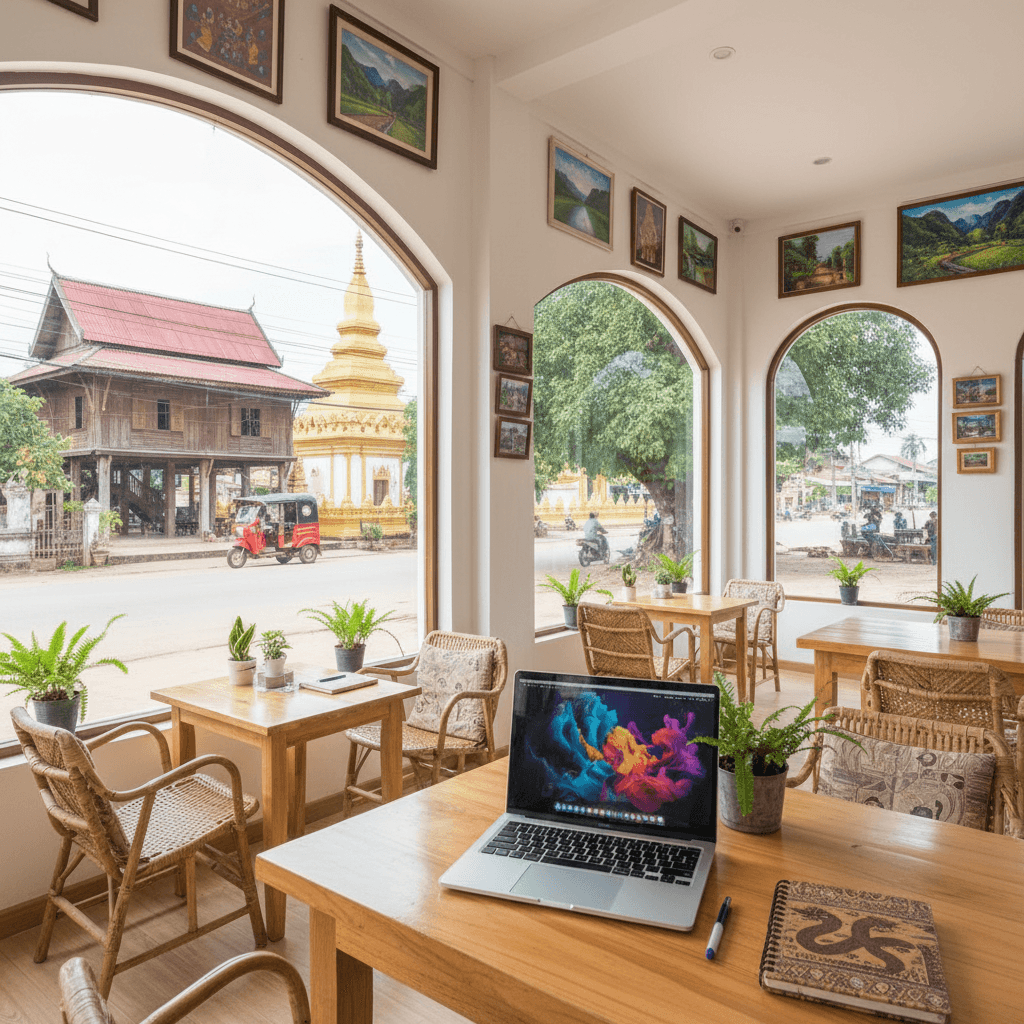
Pakse
🇱🇦 Laos
The Southern Slow-Down
If Vientiane is the sleepy capital, Pakse is the city that actually perfected the afternoon nap. Located at the meeting point of the Mekong and Xe Don rivers, this southern hub doesn't try to impress you with neon lights or high-speed infrastructure. Instead, it wins people over with a faded French colonial charm and a pace of life that feels like a deep exhale. Most nomads arrive here expecting a forty eight hour pitstop and end up staying for two weeks just because they forgot how good it feels to not be in a rush.
The vibe is decidedly un-touristy. Unlike Luang Prabang, where every second building is a boutique hotel, Pakse feels like a real town where people happen to live and work. You'll see monks walking for alms in the morning and locals gathering for Beerlao by the river at sunset. It's the kind of place where the "rush hour" involves a few extra motorbikes at a single intersection and the loudest noise you'll hear is the rhythmic chopping of papaya salad at a street stall.
The Nomad Reality Check
Let's be honest about the trade-offs. You aren't coming here for world-class networking or fiber-optic speeds. The internet can be temperamental, and the "coworking scene" consists of finding a corner in a cafe and hoping the power doesn't flicker during your Zoom call. Expats who settle here usually do so because they want to disappear into the local culture or because they use the city as a base to explore the Bolaven Plateau and the 4,000 Islands.
Socially, it's a bit of a DIY project. There isn't a massive expat bubble, so you'll need to be comfortable with your own company or be willing to strike up conversations with the small, tight-knit group of long-termers who hang out at the riverside bars. It's an ideal spot for deep-work phases, writing that book you've been putting off, or simply detoxing from the frantic energy of places like Bangkok or Bali.
What It Costs to Live Here
Pakse is one of the most affordable corners of Southeast Asia. Your dollar goes incredibly far, especially when it comes to fresh food and local housing. Most digital nomads find that a monthly budget of $800 to $1,200 buys a very comfortable lifestyle, including plenty of meals out and weekend trips.
- Studio Apartment (Center): $150 to $250 USD per month
- Serviced Apartment: $300 to $500 USD per month
- Street Food Meal: 30,000 to 50,000 LAK ($1.50 to $2.50 USD)
- Mid-range Dinner for One: 80,000 to 150,000 LAK ($4 to $7.50 USD)
- Local Beer: 10,000 to 20,000 LAK ($0.50 to $1 USD)
- Motorbike Rental: 100,000 to 150,000 LAK ($5 to $7.50 USD) per day
The Neighborhood Breakdown
Pakse is small enough that you're never truly far from the action, but where you park your laptop matters for your daily sanity.
Riverside & Downtown
- The Vibe: The heart of the city and where most of the colonial architecture remains. It's the most walkable part of town.
- Best For: Short-term nomads who want to be near cafes like Pakse Coffee Roasters and the night market.
- Pros: Easy access to the best food and the sunset views over the Mekong.
Sikhottabong District
- The Vibe: A more modern, residential feel located slightly away from the tourist center.
- Best For: Expats looking for quieter, serviced apartments with more square footage.
- Pros: Less traffic and a more authentic "living in Laos" experience.
Champasak Town
- The Vibe: Located about 40km south of the city, this is ultra-quiet and sits right near the Wat Phou temple ruins.
- Best For: True slow-travelers who don't mind a commute for major supplies.
- Pros: Incredible peace and a very traditional way of life.
Ultimately, Pakse is for the traveler who values soul over convenience. It's a place to trade your "hustle" for a hammock, at least for a little while.
The Bottom Line on Budgets
Pakse is one of those rare places where your dollar stretches so far it almost feels like a glitch in the system. It is significantly cheaper than Vientiane or Luang Prabang, making it a go-to for nomads who want to hunker down and save while enjoying a slower pace of life. Most expats find they can live a very comfortable, mid-range lifestyle here for between $800 and $1,200 per month, including a nice apartment and frequent dining out.
If you are on a tight budget, you can easily get by on $400 to $600 a month plus rent. This covers plenty of street food, local transport, and the occasional Beerlao by the river. For those who want the "high life" with a serviced apartment and upscale dinners at places like Le Panorama, you will struggle to spend more than $2,000 a month.
Housing and Rent
Rent will likely be your biggest expense, but even then, it is remarkably low. Most nomads stick to the Riverside or Downtown areas to stay close to the action. Here is what you can expect to pay monthly:
- Basic Studio (City Center): $150 to $250. These are usually simple but functional, often found above shops or in smaller local guesthouses.
- 1-Bedroom Apartment (City Center): $250 to $400. You will get more space and likely a small kitchen area at this price point.
- Serviced Apartments: $300 to $500. Popular with long-term expats in the Sikhottabong District, these usually include Wi-Fi, cleaning services, and sometimes a gym or pool.
- Outside the Center: If you don't mind a short motorbike commute, prices drop to around $150 for a decent one-bedroom setup.
Eating and Drinking
The food scene in Pakse is a mix of fiery Lao flavors and lingering French influence. You can eat like a king on a pauper's budget if you stick to the local spots. Street food meals, like a steaming bowl of Khao Piak Sen or grilled meats, usually run between 30,000 and 50,000 LAK, which is roughly $1.50 to $2.50.
For a sit-down experience at a mid-range spot like Daolin Restaurant, expect to pay $4 to $7.50 for a solid meal. If you are heading out for a date night or a three-course dinner for two, $20 usually covers the whole bill. Coffee culture is big here thanks to the nearby Bolaven Plateau; a high-quality local brew at Pakse Coffee Roasters costs about $1.00. Local beer is famously cheap, often priced under $1.00 for a large bottle at a riverside bar.
Getting Around
Since there are no ride-hailing apps like Grab, you will be relying on your feet, tuk-tuks, or your own wheels. Most expats eventually rent a motorbike because it is the most efficient way to navigate the city and explore the waterfalls nearby. Rental prices are:
- Motorbike Rental: 100,000 to 150,000 LAK ($5 to $7.50) per day. Long-term rentals can often be negotiated for much less.
- Tuk-tuks: Short hops around town usually cost 20,000 to 40,000 LAK ($1 to $2). Always agree on the price before you hop in.
- Bicycles: At 25,000 LAK ($1.25) a day, this is the cheapest way to get around the flat downtown grid.
Connectivity and Utilities
While rent is cheap, don't expect lightning-fast fiber optics everywhere. Most nomads rely on a mix of cafe Wi-Fi and mobile data. A local SIM card from Lao Telecom or Unitel is a necessity. Data plans are affordable, but you should budget about $10 to $20 a month for a beefy data package to use as a hotspot when the cafe Wi-Fi inevitably dips. Electricity can fluctuate, especially in the hotter months when everyone cranks the AC, so keep an eye on your usage if your landlord bills you separately.
For Digital Nomads: Riverside & Downtown
If you're coming to Pakse to work, you'll want to stay right in the heart of the Riverside and Downtown area. This is where most of the action happens, though "action" in Pakse is a relative term. Most nomads gravitate here because it's the only part of the city where you can walk from your apartment to a decent cafe with reliable power and somewhat stable WiFi.
Living here means you're steps away from Pakse Coffee Roasters and Saffron Coffee, which serve as the unofficial coworking hubs of the city. Since Pakse doesn't have dedicated coworking spaces yet, these cafes are your best bet for a productive afternoon. You'll also be close to the night market for easy dinners and the Mekong riverfront for evening walks when the heat dies down.
- Vibe: Convenient, social, and walkable.
- Workability: Highest density of WiFi enabled cafes.
- Rent: Central studios usually go for $150 to $250 USD per month.
- Pros: You won't need a motorbike for daily errands; easy access to the Chitpasong Bus Station for weekend trips.
- Cons: Can be slightly noisier due to tuk-tuks and tourist traffic.
For Long-Term Expats: Sikhottabong District
Expats who plan on staying for six months or more often migrate toward the Sikhottabong District. It’s a bit further out from the tourist center, offering a more residential and quiet atmosphere. This neighborhood is where you'll find the city's modern serviced apartments, which are a major draw if you're tired of guesthouse living.
Many expats recommend this area because it feels more like a community and less like a transit hub. The riverfront scenery is beautiful here, and the air feels a bit fresher than in the dusty center. You'll definitely need to rent or buy a motorbike if you live here, as it's not particularly walkable to the main grocery stores or the popular expat hangouts like Le Panorama.
- Vibe: Peaceful, residential, and modern.
- Rent: Serviced apartments range from $300 to $500 USD.
- Pros: Higher quality housing; quieter nights; better for those who want a "local" life.
- Cons: Requires a motorbike; fewer dining options within walking distance.
For Families and Slow Travelers: Near the Bolaven Plateau Foothills
While most visitors just do a day trip to the waterfalls, some families and slow travelers prefer staying on the outskirts toward the Bolaven Plateau. The elevation starts to rise here, which means slightly cooler temperatures than the sweltering river basin. It's a nature focused lifestyle where you can find larger homes with gardens for the price of a small apartment in Vientiane.
It's a niche choice, but for those who prioritize space and greenery over cafe hopping, it's a winner. You're closer to the coffee plantations and waterfalls like Tad Fane, making it easy to escape into nature on a whim. Just be prepared for a 15 to 20 minute commute into town for any specialized shopping or healthcare needs at the Provincial Hospital.
- Vibe: Rural, cool, and green.
- Housing: Larger houses can be found for $400 to $600 USD.
- Pros: Great for kids; easy access to nature; cooler climate.
- Cons: Isolated; limited internet options; requires a car or sturdy motorbike.
For Solo Travelers and Budget Seekers: Champasak Town
If you're a solo traveler looking for total serenity and don't mind a very basic lifestyle, consider Champasak Town, located about 30km south of Pakse. It's a tiny, dusty village that sits right next to the UNESCO Wat Phou temple ruins. It isn't technically a Pakse neighborhood, but many people use it as a base for a few weeks to truly disconnect.
The cost of living here is rock bottom. You can find basic guesthouses for $100 a month if you negotiate. It's the ultimate spot for writers or artists who don't need high speed internet and want to experience southern Lao culture in its purest form. Just keep in mind that social life is limited to a few riverside bars and the occasional chat with other travelers passing through.
- Vibe: Ultra-laid-back and historic.
- Rent: Extremely cheap, often under $150 USD for basic setups.
- Pros: Incredible scenery; very safe; zero city stress.
- Cons: Very poor internet; limited food variety; far from modern amenities.
The Connectivity Reality
If you're coming from a digital nomad hub like Chiang Mai or Bali, Pakse's internet scene will be a reality check. Speeds are generally moderate but can be frustratingly inconsistent. Most guesthouses and hotels offer free WiFi, but it's often better for sending emails than it is for heavy video calls or uploading large files. Power outages aren't a daily occurrence, but they happen often enough that you should keep your devices charged.
Most long term residents rely on mobile data as their primary backup. It's affordable and often more stable than landline connections. You'll want to pick up a local SIM card immediately. Unitel and Lao Telecom are the two heavy hitters. Unitel generally has the best coverage if you plan on exploring the Bolaven Plateau, while Lao Telecom works great within the city limits. For those who prefer a digital setup, Airalo offers eSIM plans that work well, though they're more expensive than buying a physical card at a local shop.
Coworking and Laptop-Friendly Cafes
Pakse doesn't have any dedicated coworking spaces yet. You won't find the ergonomic chairs or "community manager" vibes of Vientiane here. Instead, the nomad community gravitates toward a handful of reliable cafes with decent tables and power outlets. Most of these spots are used to people lingering for a few hours, provided you keep the coffee orders coming.
- Pakse Coffee Roasters: This is the unofficial headquarters for remote workers in town. The coffee is excellent, the WiFi is usually the most stable in the city, and there are plenty of spots to plug in.
- Bolaven Cafe: Located near the river, this spot offers a more relaxed atmosphere. It's a great place for deep work sessions when you need a breeze and a view, though the WiFi can occasionally dip during peak hours.
- Champasak Cafe & Bakery: A local favorite with plenty of seating. It's a bit more traditional but offers a solid environment for getting through your inbox.
- Saffron Coffee: Another reliable pick for decent speeds and a comfortable workspace. They take their beans seriously, which is a nice perk for a long afternoon of typing.
Mobile Data and SIM Card Breakdown
Since the WiFi in cafes can be hit or miss, having a robust data plan is non-negotiable. You can find SIM cards at the airport or at small mobile shops scattered throughout the downtown area. Prices for data are very low, making it easy to use your phone as a hotspot when the cafe router gives up.
- Unitel: Widely considered the most reliable for speed and rural coverage. Expect to pay around $5 to $10 USD for a generous monthly data package.
- Lao Telecom: Great for city use and often has competitive promotional packages for 4G data.
- Beeline: Another option, though coverage can be spotty once you head toward the waterfalls or the outskirts of town.
Expats generally recommend keeping two different SIMs from different providers if your work is mission-critical. If one network goes down, the other is usually still standing. It's a small investment for peace of mind while working from such a remote corner of the world.
The Safety Reality
Pakse is remarkably laid-back, even by Laotian standards. Most expats find that the biggest threat to their peace of mind isn't crime, but rather a stray dog or a pothole on a dark road. Violent crime is extremely rare here, and you'll generally feel comfortable walking the downtown streets after dinner. That said, petty theft like bag snatching can happen, so don't leave your phone sitting on an outdoor table while you're distracted by the Mekong sunset.
The most significant safety concern for nomads isn't in the city center, but out in the countryside. If you're heading to the Bolaven Plateau or exploring rural Champasak, stay on marked paths. Laos remains heavily affected by unexploded ordnance (UXO) from the 1960s and 70s. While the city itself is clear, the surrounding wilderness is a different story. Stick to well-trodden trails and always listen to local guides when venturing off the grid.
Healthcare and Medical Emergencies
Managing expectations is key when it comes to local medical care. Pakse has basic facilities, but it isn't a regional medical hub. For minor ailments, stomach bugs, or basic checkups, you can head to the Champasak Provincial Hospital. It's the main facility in town, though English proficiency among staff is hit or miss. Most expats prefer visiting smaller private clinics scattered throughout the downtown area for quicker service and more personalized attention.
For anything serious, the common nomad consensus is to cross the border. Ubon Ratchathani in Thailand is about 130km away and offers significantly higher standards of care, modern equipment, and more English-speaking specialists. If you have a major accident or a chronic condition flares up, you'll want to get to Thailand as quickly as possible. This makes high-quality travel insurance with medical evacuation coverage a non-negotiable part of your kit.
- Emergency Services: Dial 195 for an ambulance, but be aware that response times are often slow. In a real emergency, taking a private car or taxi to the hospital is usually faster.
- Pharmacies: You'll find plenty of pharmacies in the city center. Many medications that require a prescription in the West are available over the counter here, and prices are very low. Always check the expiration dates on the packaging.
- Water Safety: Never drink the tap water. Stick to bottled water, which is cheap and available at every corner shop for about 5,000 to 10,000 LAK.
Road Safety and Transport
If you decide to rent a motorbike to explore the waterfalls, be honest about your skill level. Road conditions outside the city can be unpredictable, and local driving habits are "fluid" at best. Most accidents involving foreigners in Pakse happen on two wheels. Always wear a helmet, keep your speed down, and make sure your insurance covers motorbike riding. If you aren't confident on a bike, stick to tuk-tuks for city travel; a short hop usually costs between 20,000 and 40,000 LAK.
Overall, Pakse is a place where you can let your guard down more than in most Southeast Asian cities. As long as you have a plan for major medical issues and stay mindful of the roads, it's a very low-stress environment for a long-term stay.
Getting around Pakse is a lesson in slowing down. Unlike the chaotic traffic of Bangkok or Saigon, this city moves at a pace that actually allows you to look around while you're in motion. The downtown core is small enough that you can handle most daily errands on foot, though the midday heat usually makes a set of wheels a necessity by noon.
The Tuk-Tuk Hustle
Tuk-tuks are the backbone of local transit here. You'll find them clustered near the markets and major hotels like the Pakse Hotel and Champasak Grand. Expect to pay between 20,000 and 40,000 LAK for a quick hop across town. Prices aren't fixed, so you'll need to settle on a number before you climb in. If you're heading further out, like to the Golden Buddha across the river, expect the price to climb accordingly.
Going Local with Songthaews
For the truly budget conscious or those wanting a local experience, songthaews (converted pickup trucks with benches) run fixed routes. They're incredibly cheap, usually costing between 5,000 and 10,000 LAK. They can be a bit confusing if you don't speak the language, but most drivers will point you in the right direction if you mention a major landmark.
Two-Wheeled Freedom
Most expats and long term nomads eventually rent a motorbike. It's the only way to really see the Bolaven Plateau or reach the hidden waterfalls at your own pace. A semi-automatic or automatic scooter typically runs between 100,000 and 150,000 LAK per day. If you're staying for a month, you can often negotiate a better rate with local rental shops near the riverside. Just keep in mind that while the roads in town are paved, the rural routes can get messy during the monsoon season.
If you prefer a workout, bicycles are a solid choice for 25,000 LAK a day. The terrain is mostly flat, making it easy to cruise along the Mekong or explore the quiet side streets of the French Quarter without breaking too much of a sweat.
Arriving and Departing
Pakse International Airport (PKZ) sits about 8km north of the center. Don't expect ride-hailing apps like Grab; they don't operate here yet. You'll rely on the following for airport transfers:
- Tuk-tuks: These usually cost 80,000 to 120,000 LAK depending on your luggage and bargaining skills.
- Private Transfers: Many hotels will arrange a car for around $10 to $15 USD, which is worth it if you're arriving late or have heavy gear.
- Motorbike Taxis: If you're traveling light, you can snag a ride on the back of a bike for a fraction of the car price.
The Bus Station Maze
Pakse is a major transit hub for Southern Laos, but it can be confusing because there are four different stations. Which one you need depends entirely on where you're going:
- Chitpasong Bus Station: Located right in the center near the Pakse Hotel. This is the "VIP" terminal where you'll find the comfortable sleeper buses to Vientiane.
- Kriang Kai Bus Station: This is your go to for international trips to Ubon Ratchathani in Thailand or long hauls to Bangkok.
- Northern Station: Use this for local buses heading toward Savannakhet or Vientiane.
- Southern Station: This serves local destinations and is where you'll find transport heading toward the 4,000 Islands (Si Phan Don).
Most travelers find that once they've spent a few days here, the layout clicks. It's a small city, and while the lack of apps might feel like a step back, the ease of just flagging down a driver or hopping on a bike quickly becomes part of the charm.
The Language Barrier
In Pakse, Lao is the heart of every interaction. Unlike the more tourist heavy streets of Luang Prabang, you won't find English spoken fluently by everyone you meet. In the markets and smaller street food stalls, communication often relies on a friendly smile and some creative gesturing. Most nomads find that learning basic Lao greetings and numbers is a game changer for daily life.
Because of the city's history as a French administrative center, you might occasionally run into older residents who speak a bit of French. However, this is becoming less common. Among the younger generation and staff at places like Pakse Hotel or Le Panorama, English proficiency is much higher. If you're planning a long stay, expats recommend downloading a translation app that works offline, as cell service can be spotty when you're out exploring the Bolaven Plateau.
Essential Local Phrases
Lao is a tonal language, which can be intimidating at first. Don't worry too much about perfect pitch; locals are generally patient and appreciate the effort. Here are the basics you'll use every day:
- Sabaidee: Hello (The universal greeting)
- Khop chai: Thank you
- Khop chai lai lai: Thank you very much
- Baw pen nyang: No problem or "It's okay" (You'll hear this constantly)
- Tao dai?: How much?
- Phet: Spicy (Crucial for ordering food)
- Baw phet: Not spicy
Connectivity and SIM Cards
Staying connected is the biggest hurdle for remote workers in Pakse. While most guesthouses and cafes provide free WiFi, the speeds rarely hit the levels needed for heavy video conferencing. Most digital nomads rely on a "belt and braces" approach, using a local SIM card as a backup for when the cafe router inevitably struggles.
You have a few solid options for mobile data. Unitel is widely considered to have the best coverage if you plan on heading out to the waterfalls or rural areas. Lao Telecom is another reliable choice for city use. You can pick up a SIM card at the airport or at various small shops downtown for about 10,000-20,000 LAK, with monthly data packages costing roughly 50,000-100,000 LAK for 5-12GB.
For those who prefer to hit the ground running, Airalo offers eSIM plans for Laos. It's more expensive than buying a local physical SIM, but it saves you the hassle of hunting down a shop the moment you land. Just keep in mind that even with a 4G connection, speeds can fluctuate during heavy rainstorms or peak evening hours.
Digital Nomad Workarounds
Since there aren't any formal coworking spaces, the local cafe scene is your office. Bolaven Cafe is a popular spot for expats needing to get a few hours of work done. It offers a relaxed atmosphere where nobody will chase you out for sitting with a laptop. If you have a high stakes meeting, travelers often suggest testing your connection an hour early or having a topped up Unitel hotspot ready to go. The lack of infrastructure is part of the charm for some, but for others, it requires a bit more planning than working from a hub like Chiang Mai.
The Three Seasons of Pakse
Pakse follows the classic Southeast Asian tropical pattern, but its location in the south and its proximity to the Bolaven Plateau give it a slightly different flavor than Luang Prabang or Vientiane. You'll deal with three distinct phases: the cool season, the hot season, and the monsoon rains. Each changes the city's vibe and your ability to get work done or explore the surrounding waterfalls.
The Sweet Spot: November to February
This is the peak window for nomads and travelers. The weather is dry, the skies are clear, and temperatures are actually pleasant. Daytime highs hover around 30°C (86°F), while evenings can drop to a refreshing 18°C (64°F). It is the best time for the Bolaven Plateau loop because you won't get caught in a downpour on a motorbike, though you will definitely need a jacket for the higher altitudes.
- The Vibe: The city feels more active, and riverside cafes like Bolaven Cafe are full of people enjoying the breeze.
- Visibility: This is the prime time for photography at Wat Phou and the Mekong sunsets.
- The Trade-off: It is the busiest time for tourism, so guesthouses in the Riverside area fill up faster and prices for short term stays might nudge upward.
The Heat: March to May
If you aren't a fan of sweating through your shirt by 9:00 AM, you might want to head elsewhere during these months. Temperatures frequently soar above 35°C (95°F) and can hit 40°C (104°F) in April. The humidity builds up, making it feel even heavier. This is the period when most expats retreat into air conditioned spaces like Pakse Coffee Roasters or spend their afternoons by a hotel pool.
April also brings Pi Mai (Lao New Year). It is a week of water fights, street parties, and total business shutdowns. It is an incredible cultural experience, but don't expect to get any serious remote work done during the festivities. Everything from banks to small cafes will likely be closed.
The Monsoon: June to October
The rains arrive in June, and while it doesn't rain all day every day, the downpours are intense. This is actually a favorite season for many long term residents because the landscape turns a brilliant, deep green. The waterfalls on the plateau, like Tad Fane and Tad Yuang, are at their most powerful and impressive during this time.
- Travel Logistics: Humidity is high, and dirt roads in rural areas can become muddy and difficult to navigate. If you're planning on biking the loop, be extra cautious.
- Internet Reliability: Heavy storms can occasionally cause power flickers or disrupt the already temperamental WiFi in the city.
- Prices: You can often find great deals on serviced apartments and guesthouses, as tourist numbers drop significantly.
When to Visit for Specific Goals
If your priority is outdoor adventure and motorbike trips, stick to November through January. You'll have the best road conditions and the most comfortable weather for long rides.
For those looking for solitude and low costs, the shoulder months of June and July are ideal. You'll get the lush scenery without the crowds, and as long as you have a rain poncho and a flexible schedule, the weather won't stop you. Most nomads find that avoiding the peak heat of March and April is the smartest move for productivity and general comfort.
Connectivity and the Remote Work Reality
If you're coming from a digital nomad hub like Chiang Mai, Pakse will be a reality check for your internet expectations. Speeds are moderate and can be frustratingly inconsistent. Most nomads find that relying on hotel or cafe WiFi alone is a gamble, especially during the rainy season or power dips.
Expats recommend picking up a local SIM card immediately. Lao Telecom and Unitel are the most reliable carriers. You can get a data plan for a few dollars, and using your phone as a hotspot is often faster than the local WiFi. If you prefer a digital setup, Airalo eSIMs work here, though local physical SIMs are usually cheaper for heavy data use.
While there aren't any formal coworking spaces in town yet, several cafes have become unofficial offices. Pakse Coffee Roasters is the top pick for remote workers because they understand the need for reliable power outlets and decent coffee. Bolaven Cafe is another great spot; it's right by the river, providing a breezy atmosphere that makes the slower internet speeds a bit more tolerable. Saffron Coffee and Champasak Cafe & Bakery also offer decent environments for a few hours of laptop time.
Money and Local Costs
Cash is still king in Pakse. While some upscale hotels and restaurants like Le Panorama might take cards, you'll need Laotian Kip (LAK) for almost everything else. ATMs are easy to find downtown, but they often have low withdrawal limits and high fees, so it's smart to pull out larger amounts at once.
Your money goes a long way here. A basic street food meal of noodles or grilled meat usually costs between 30,000 and 50,000 LAK, which is roughly $1.50 to $2.50 USD. If you're eating at a mid-range spot like Daolin Restaurant, expect to pay around 80,000 to 150,000 LAK for a full meal. A local Beerlao will only set you back about $1 USD, making it one of the cheapest places in the region for a sundowner.
Moving Around Town
Pakse doesn't have Grab or any major ride-hailing apps, so you'll be negotiating with tuk-tuk drivers. A short trip across the center should cost between 20,000 and 40,000 LAK. Always agree on the price before you hop in to avoid any awkwardness at your destination.
For more freedom, travelers often rent motorbikes for about 100,000 to 150,000 LAK per day. This is the best way to see the Bolaven Plateau, but be careful on the roads. If you're staying within the city limits, Pakse is flat and very bikeable. You can rent a bicycle for about 25,000 LAK a day, which is plenty for getting between cafes and the night market.
Safety and Health Essentials
Safety isn't a major concern in Pakse. It's a quiet town where violent crime is rare. Petty theft can happen, so don't leave your phone sitting on a table near the street. The biggest safety risk is actually off the beaten path; rural areas in this province still contain unexploded ordnance from the war. If you're hiking, stick to the marked trails and don't go wandering into the brush.
Healthcare is basic. Champasak Provincial Hospital can handle minor issues, but for anything serious, most expats and long-term travelers head across the border to Thailand or fly to Vientiane. Pharmacies are everywhere downtown and are surprisingly well-stocked, often selling medications without a prescription that would require one back home. For emergencies, you can call 195 for an ambulance, but don't expect the response times you'd see in a Western city.
Visa Logistics
Most travelers get a 30-day visa on arrival at the Pakse International Airport or the land borders. If you want to stay longer, visa extensions are available at immigration offices (often 30 days), and visa runs are common. Many nomads choose to do a "visa run" to the Thai border at Vang Tao, which is only about an hour away, to reset their stay.
Need visa and immigration info for Laos?
🇱🇦 View Laos Country GuideHidden Gem
Worth the effort