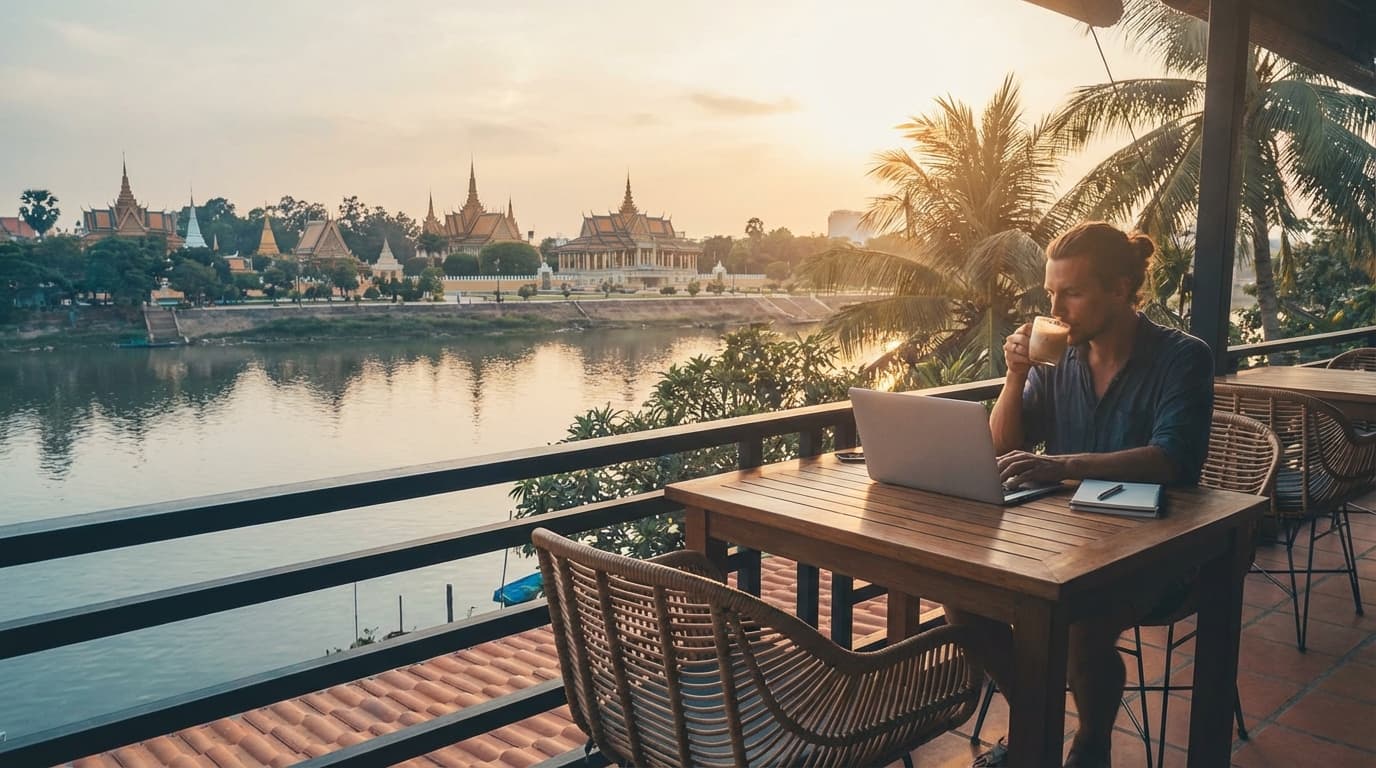
Cambodia
Complete Digital Nomad Guide

Policy Stability
Stamped Nomad ExclusiveHow likely visa and immigration policies are to remain unchanged
Quick Facts
Nomad Visa Cost
N/A
Max Stay
12 months
Renewable
Yes
Cost of Living
$900/mo
Avg Internet
51 Mbps
Safety Score
5/10
Healthcare
Medium
Coworking
Medium
English Friendly
Medium
Time Zones
GMT+7
Entry Methods Available
Best For
For digital nomads, Cambodia remains one of the most accessible and flexible hubs in Southeast Asia. Unlike neighboring countries that require complex "Digital Nomad Visas" with high income thresholds, Cambodia offers a straightforward path for long-term stays through its Ordinary Visa system. Whether you are planning a one-month scouting trip or a year-long residency in Siem Reap, understanding the distinction between the two primary visa types is the first step in your journey.
The Tourist Visa (Type T)
If you are just passing through to check out the coworking scene, the Type T visa is your best bet. This is a single-entry permit that allows you to stay for up to 30 days. It is designed strictly for leisure, meaning you cannot officially transition this into a long-term work or business extension later.
- Cost: $30 USD (plus a small processing fee if applying online).
- Extension: You can extend this visa exactly once for an additional 30 days, giving you a total of 60 days in the country.
- Requirement: A passport valid for at least 6 months.
The Ordinary Visa (Type E)
This is the "gold standard" for serious nomads. Despite the name, the Ordinary Visa (Type E) is not a tourist visa; it is the gateway to long-term residency. It initially grants you 30 days, but unlike the Tourist visa, it is infinitely more flexible once you are on the ground. When you go to extend this visa, you will choose from several sub-categories:
- EB (Business): The most common choice for remote workers and freelancers.
- EG (Job Seeking): For those looking for local employment.
- ER (Retirement): For those aged 55 or older who are not working locally.
- ES (Student): For those enrolled in a local institution.
The real power of the Type E visa lies in the extension options. You can apply for a 6-month or 12-month extension, both of which grant you multiple-entry privileges. A 12-month extension typically costs around $285 USD. This allows you to come and go as you please, making Cambodia an excellent home base for exploring the rest of Asia.
How to Apply
Cambodia has modernized its entry process significantly. You can secure your visa through the official immigration portal before you fly. This is the fastest way to clear immigration, as your data is already in the system. If you prefer to wing it, Visa on Arrival is still available at international airports in Phnom Penh, Siem Reap, and Sihanoukville.
If you choose the arrival option, bring $30 USD for a Tourist visa or $35 USD for an Ordinary visa. While many airports now accept credit cards, it is always smart to carry crisp, clean US dollar bills to avoid any technical hiccups at the border. You no longer need to provide physical passport photos, which simplifies the process considerably.
New Digital Requirements
Regardless of which visa you choose, there is a new mandatory step for all travelers arriving by air. You must complete an electronic arrival card between 1 and 7 days before you land. This replaces the old paper forms you used to fill out on the plane. Currently, this digital requirement only applies to international airports; if you are crossing via a land border from Thailand or Vietnam, you will still use traditional paper methods.
Key Details to Remember
- Passport Validity: Your passport must be valid for at least 6 months from your date of entry.
- Clean Bills: If paying in cash at the border, ensure your USD notes are pristine. Any tears or heavy folds may result in the bills being rejected.
- Extension Processing: Most nomads use local travel agents to handle visa extensions. It usually takes about one week, during which the immigration office will keep your physical passport.
The Current Visa Reality
If you are looking for a dedicated "Digital Nomad Visa" with a flashy name and a streamlined application, you won't find one here. Cambodia hasn't launched a specific remote work program yet. However, the country remains one of the easiest places in Southeast Asia to stay long-term because their existing visa system is remarkably flexible.
Most nomads operate in a bit of a grey area, using standard visitor or business visas to live in Phnom Penh or Siem Reap while working for clients back home. The government generally tolerates this as long as you aren't competing for local jobs or running a physical business on the ground without the right permits.
The Most Popular Paths
There are three main ways to handle your stay. Each has different costs and hoops to jump through, so choose based on how long you actually plan to stick around.
- Tourist Visa (Type T): This is the standard 30-day entry. It costs $30 USD and you can get it on arrival or online. You can extend it once for an additional 30 days, but after that, you have to leave the country. It is perfect if you are just passing through for a month or two.
- Ordinary Visa (Type E): Do not let the "Business" label scare you. This is the gold standard for nomads. It costs $35 USD initially and lasts 30 days, but the magic happens when you extend it. Unlike the Tourist Visa, this one can be extended for 3, 6, or 12 months without leaving the country.
- Job Seeker Visa: This is a specific extension of the Ordinary Visa. It allows you to stay for 6 months for roughly $160 USD. You just need a simple letter stating you are looking for work. It is a favorite for nomads who want a solid half-year of stability without much paperwork.
Key Requirements and the e-Arrival Card
Paperwork in Cambodia is getting more digital, but you still need to carry crisp, clean USD bills for any fees paid at the border. If your bills have even a tiny tear or a heavy crease, the officers might reject them.
Before you fly, you must complete the official e-Arrival Card. This needs to be done within 7 days of your arrival. It generates a QR code that you will show to immigration officers. Beyond that, make sure your passport is valid for at least 6 months and you have two passport-sized photos ready for your application.
Income and Work Permits
Since there is no official nomad visa, there is no official income floor. While some agents might mention a need to show $1,540 to $2,000 in monthly earnings for certain long-term extensions, it is rarely enforced for remote workers. If you are just tapping away on a laptop in a cafe for a London or New York firm, nobody is checking your bank balance at the airport.
The rules get a bit tighter if you want to be fully "legal" as a self-employed person living there. Technically, anyone staying long-term and working should have a work permit through the FWCMS portal. This requires a health certificate and a small fee, usually around $100 to $200 per year. Many nomads skip this, but if you plan to stay for more than a year or rent a high-end apartment, having that permit can save you from occasional bureaucratic headaches.
Taxes and Residency
Cambodia's tax system is mostly focused on people working for Cambodian companies. If your income comes from outside the country and you aren't registered as a local business, you generally won't be bothered by the tax man. However, if you stay for more than 182 days in a calendar year, you are technically a tax resident. Most nomads keep their tax life in their home country or a tax-neutral jurisdiction, but if you decide to make Cambodia your permanent base, it is worth chatting with a local consultant to avoid any surprises when you try to renew your visa for the third or fourth year.
Quick Reference Guide
- Tourist Visa (Type T): $30, 30-day stay, one-time extension.
- Ordinary Visa (Type E): $35, 30-day stay, renewable up to 12 months.
- 6-Month Extension: Approximately $160 via a local agent.
- 12-Month Extension: Approximately $280 to $325 via a local agent.
- Work Permit (Optional for most): Roughly $100 per year.
Applying is easiest through the official e-Visa portal. Stick to the official site to avoid the "service fees" that third-party agencies tack on. Once you are on the ground in Phnom Penh, you can find dozens of reputable travel agents who can handle your extensions for a small fee, saving you a trip to the immigration office.
The Entry Basics
Cambodia remains one of the most accessible hubs in Southeast Asia for digital nomads, largely thanks to its straightforward visa-on-arrival system. Most travelers enter on a Type-T tourist visa, which grants a 30-day stay. To get through the gates, your passport needs at least 6 months of validity remaining and one to two blank pages for stamps.
If you hold a passport from an ASEAN country like Thailand, Vietnam, or Malaysia, you can skip the paperwork entirely. These citizens enjoy visa-free entry for tourism. For everyone else, you have three primary ways to secure your stay.
Visa on Arrival (VOA)
This is the old-school favorite for those who don't like planning ahead. You can pick up a VOA at the international airports in Phnom Penh and Siem Reap, as well as most major land borders. It costs $30 USD, and while airports are increasingly accepting cards, carrying crisp US cash is still the safest bet.
- Cost: $30 USD.
- Requirements: One recent 2x2 inch passport photo. If you forget this at a land border, expect to pay a small "convenience fee" of a few dollars.
- Process: Head to the "Apply Visa" counter before hitting the immigration line. It usually takes 5 to 20 minutes to get your sticker.
Note that citizens of several countries, including Pakistan, Sri Lanka, and Nigeria, cannot use the VOA system and must apply through a Cambodian embassy in advance.
The E-Visa and E-Arrival System
For a smoother entry, the electronic visa is the way to go. You can apply through the official government portal. As of 2025, the government has streamlined the fee structure, making the e-visa $30 USD, the same price as the VOA.
The digital process usually takes about three business days. Once approved, you print out the letter and present it upon arrival. There is also a mandatory e-Arrival card that all travelers must complete within 7 days of landing. This digital form replaces the old paper immigration and health cards, and you can fill it out via the official Cambodia e-Arrival app.
Staying Longer: Extensions and Business Visas
A standard 30-day tourist visa can be extended once for an additional 30 days. The era of automatic extensions ended at the start of 2025, so you must now handle this manually. You can do this through the e-visa system or by visiting an immigration office. If you plan to stay for several months, the Ordinary Visa (Type-E) is a better choice. It costs $35 USD initially and is much easier to extend for long-term residency compared to the tourist version.
- Tourist Extension: One-time 30-day extension for approximately $30.
- Overstay Fines: If you miss your exit date, expect to pay $10 USD per day at the border. Avoid this if possible, as significant overstays can lead to detention or being blacklisted.
- Border Runs: While not officially promoted, exiting to a neighboring country and re-entering to trigger a new 30-day visa is common. However, immigration officers may scrutinize your passport if they see a pattern of back-to-back tourist visas.
Summary of Costs
- Tourist Visa (VOA): $30 USD (Single entry, 30 days)
- E-Visa: $30 USD (Single entry, 30 days)
- Ordinary/Business Visa (E): $35 USD (The best path for long-termers)
- Extension Fee: Roughly $30 to $50 depending on the duration and agent fees
Rules in Cambodia can shift with little notice. It is always wise to double-check the latest requirements on the official government site before you book your flight. Most nomads find that once they have the first 30 days secured, the local expat community and visa agents in Phnom Penh can help sort out the rest with minimal stress.
Cambodia has long been a favorite for digital nomads because it offers something increasingly rare in Southeast Asia: a relatively straightforward path to staying long-term without constant "visa runs." While many neighboring countries have tightened their borders or introduced complex wealth requirements, the Kingdom remains remarkably accessible for those who want to plant roots for a year or more.
The Ordinary Visa: Your Entry Point
Forget the standard Tourist (T-class) visa if you plan on staying more than 30 days. You want the Ordinary (E-class) visa. You can pick this up on arrival at the airport for $35. It is valid for 30 days initially, but it is the only visa type that allows for long-term extensions. Once you are in the country, you can drop your passport off at almost any local travel agency to handle the extension process for you.
- One month: $45 (Single entry)
- Three months: $75 (Single entry)
- Six months: $150 (Multiple entry)
- Twelve months: $285 (Multiple entry)
If you plan on traveling to Thailand or Vietnam during your stay, always opt for the six or twelve-month options. These allow you to leave and re-enter the country as many times as you like without voiding your visa status.
Choosing Your Extension Category
Once you are ready to extend that initial E-class visa, you have to pick a specific "Extension of Stay" (EOS) category. For most nomads and remote workers, the EB (Business) extension is the standard choice. While it does not grant you the right to work for a local Cambodian company on its own, it allows you to live in the country legally for up to a year at a time.
If you are over 55 years old, the ER (Retirement) extension is a fantastic path. You will need to show proof of financial self-sufficiency from your home country, but you won't be asked for a work permit. For those looking to sharpen their skills, the ES (Student) extension is available if you can provide an enrollment letter from a recognized Cambodian school or language center.
The Work Permit Reality
Even if you are working for a company back in London or New York, Cambodian law technically requires anyone on an EB extension to hold a work permit. In the past, authorities were lax with freelancers, but enforcement has become more digital and streamlined. You can apply through the Ministry of Labour's online portal. Most nomads find it easier to pay a registered agency a small fee to navigate the filing process for them. Expect to renew this annually along with your visa.
High-End Residency and Citizenship
If you have significant capital and want to skip the annual paperwork, Cambodia has introduced more permanent options. The My Second Home (CM2H) program is aimed at high-net-worth individuals. It requires a $100,000 investment in real estate and grants a 10-year visa. After five years, you are actually eligible to apply for Cambodian citizenship.
For those who want a passport even faster, there is a Citizenship by Investment route. This requires a donation of roughly $330,000 to the national budget. The process is surprisingly quick, often taking less than six months, though it requires several in-person visits to Phnom Penh for biometric data and paperwork submission.
Family and Heritage Links
If you have Cambodian heritage or are married to a Cambodian citizen, look into the K-class visa. This is a special category issued free of charge that grants lifetime multiple-entry access to the country. It is arguably one of the best "hidden" visa perks in the region, as it removes the need for annual renewals and exempts you from the work permit requirement entirely.
The Bottom Line
Cambodia remains one of the few places in Southeast Asia where you can live a high-quality lifestyle without a high-stress bank statement. For 2026, most digital nomads find their "sweet spot" between $800 and $1,200 per month. This covers a modern apartment, daily cafe visits, and plenty of weekend trips to the coast or the temples.
If you are looking to live like a local, you can scrape by on $500 to $700. However, if you want the "premium" expat experience with a luxury condo and nightly cocktails, expect to shell out $2,300 or more. Even at the high end, you are getting significantly more value for your dollar than you would in nearby hubs like Bali or Bangkok.
Breaking Down the Monthly Budget
To help you plan your move, here is how a comfortable, mid-range lifestyle typically looks:
- Accommodation: $350–$550 for a modern one-bedroom in a good neighborhood.
- Food & Groceries: $250–$400, depending on how often you use delivery apps.
- Utilities & Home Internet: $80–$150, largely driven by how much you run the AC.
- Transportation: $60–$120 for daily tuk-tuks and occasional taxis.
- Mobile Data: $6–$10 for more data than you could likely ever use.
- Entertainment: $250–$450 for gym memberships, weekend trips, and nightlife.
Housing and Neighborhoods
Phnom Penh is the heart of the nomad scene. You can snag a sleek one-bedroom apartment with a rooftop pool for $339 to $550. If you want a river view in a trendy area like BKK1 or Tonle Bassac, you will be at the higher end of that range, but the infrastructure is the best in the country.
For those who prefer a slower pace, Siem Reap and Kampot offer incredible value. You can find basic but comfortable studios for as low as $70 to $180. Prices are creeping up as these towns get more popular, but they remain steals compared to the capital.
Food, Data, and Getting Around
Eating out is often cheaper than cooking. Using apps like Grab Food or Food Panda, you can eat well for about $12 a day. Local street food will bring that cost down even further, while high-end French or Japanese fusion will obviously spike your budget.
The digital infrastructure is surprisingly solid. Home internet with speeds around 55 Mbps costs about $20 to $30 a month. On the go, providers like Smart offer massive data packages, often 80GB for just $6. It is cheap enough that many nomads use a local SIM as a backup hotspot without thinking twice.
You won't need to own a car here. Tuk-tuks are everywhere and very affordable. Most nomads spend between $60 and $120 a month on transport, which covers daily commutes to coworking spaces and late-night rides home.
City Comparison: Where to Plant Your Laptop
Choosing the right city changes your overhead significantly. Here is how the top spots compare:
Phnom Penh
- Monthly Cost: $929–$1,300
- The Vibe: Best infrastructure, fastest internet, and the most vibrant nightlife.
- Value: 30–50% cheaper than major regional hubs like Ho Chi Minh City.
Siem Reap
- Monthly Cost: $827
- The Vibe: Laid back, artsy, and surrounded by history.
- Value: Ideal for those who want a lower cost of living without sacrificing a community of fellow travelers.
Kampot
- Monthly Cost: Lower than Phnom Penh
- The Vibe: Riverside living with a growing expat community.
- Value: Prices are rising as it becomes a "digital nomad darling," so get in early.
Compared to the rest of the region, Cambodia is a powerhouse of affordability. While a comfortable life in Canggu, Bali might cost you $1,500 to $2,200, you can maintain a similar (or better) standard in Phnom Penh for nearly half that. It is the perfect middle ground for remote workers who want modern amenities without the "tourist tax" found in more crowded destinations.
Cambodia has quietly evolved from a budget backpacker stop into a legitimate base for remote workers. While the infrastructure doesn't always mirror the seamless experience of neighboring Thailand, the "Kingdom of Wonder" offers a raw, high-energy environment at a fraction of the cost. If you are looking for a place where your dollar stretches into a luxury apartment and a vibrant social life, focus your search on these three hubs.
1. Phnom Penh
The capital is the undisputed heavyweight for anyone who needs reliable infrastructure. It is a sprawling, chaotic, and fascinating city where high-rise condos sit right next to traditional street markets. For nomads, the BKK1 and Riverside areas are the primary magnets, offering the highest density of air-conditioned cafes and specialized workspaces.
The coworking scene here is surprisingly sophisticated. Suzy Time Café is a local favorite for its "pay by the hour" model, charging just $2 per hour or $5 for a full day, which includes unlimited drinks. For those who need a more professional vibe or networking opportunities, Impact Hub and Emerald Hub host regular events and workshops that help you break into the local expat and tech scenes. If you need a corporate environment, Regus has a strong presence in the major commercial districts.
- The Pros: The fastest internet in the country, a massive variety of international cuisine, and a community that leans more toward "professional" than "party traveler."
- The Cons: The traffic is intense, and the urban noise can be a lot to handle if you prefer a quiet work environment.
- Best Work Spot: La Belle Residence near the Russian Market is highly rated for nomads looking for a "work-from-home" setup with stable WiFi.
2. Siem Reap
Most people come for Angkor Wat, but they stay for the lifestyle. Siem Reap feels more like a large village than a city, making it much easier to navigate on a bicycle or a cheap tuk-tuk. It strikes a better balance between work and play than the capital, with a community that feels tightly knit and welcoming.
The standout here is AngkorHUB. It isn't just a desk; it's a community center that offers super-fast internet, social meals, and even hammocks for those afternoon slumps. They offer weekly packages that make it easy to commit without breaking the bank. When you aren't working, the nightlife centers around Pub Street, though there are plenty of hidden, upscale cocktail bars and quiet cafes for a more relaxed evening.
- The Pros: High safety ratings, culturally rich environment, and a very walkable city center.
- The Cons: It is a tourism town. During peak season, the crowds can be overwhelming and prices in central areas occasionally tick upward.
- Internet Tip: Connectivity is great in the city, but it drops off significantly if you head out toward the temples or rural areas.
3. Sihanoukville
Sihanoukville is currently in a state of massive transition. Once a sleepy beach town, it has transformed into a bustling port city with significant investment. It is the wildcard choice on this list. It doesn't have the established nomad "soul" of Siem Reap, but it offers unique business opportunities and proximity to some of the best beaches in Southeast Asia.
Work options are currently centered around professional spaces like Regus, which provides hot desks and meeting rooms in the newer commercial zones. While the cafe culture isn't as developed as Phnom Penh, the cost of living remains incredibly low, and the access to the coast is a major perk for your weekends.
- The Pros: Very affordable living and easy access to islands like Koh Rong for your days off.
- The Cons: Constant construction and a landscape that is changing faster than the maps can keep up with.
- Safety Note: Due to the rapid development, it’s wise to stay aware of your surroundings and stick to well-lit commercial areas at night.
Cost of Living Snapshot
While prices fluctuate based on your lifestyle, Cambodia remains one of the most budget-friendly nomad destinations in Asia. You can generally expect your monthly expenses to look something like this:
- Coworking: Expect to pay around $5 to $10 for a day pass or roughly $100 to $150 for a monthly membership at top-tier spaces.
- Accommodation: A modern one-bedroom apartment in a good area of Phnom Penh or Siem Reap typically ranges from $350 to $600 per month.
- Food: Local street meals are $2 to $4, while a meal at a mid-range expat cafe will run you $7 to $12.
- Internet: Most dedicated coworking spaces provide speeds sufficient for video calls, but always verify the connection at your specific guesthouse before booking long-term.
Staying connected in Cambodia is surprisingly easy, provided you stick to the urban hubs of Phnom Penh and Siem Reap. While the country's infrastructure is still developing, the fiber optic rollout in major cities has created a reliable environment for remote work. You can expect fixed broadband speeds to hover around 38 Mbps on average, though many coworking spaces and high-end apartments offer dedicated lines reaching 100 Mbps or more.
The Coworking Scene
Phnom Penh is the heart of the country's workspace revolution. If you prefer a professional, polished environment, BasisPoint in the Riverside area offers a Japanese-style luxury experience starting at $132 per month. For a more creative, local vibe, The Desk provides hot desks for as little as $60 per month, making it one of the most budget-friendly options for those staying near the railway station or central districts.
Siem Reap has a smaller but more tight-knit community. AngkorHUB is the gold standard here. It is more than just a desk; it is a community hub where packages often include meals, making it easy to focus on deep work without worrying about where to grab lunch. Garage Society is another solid choice for those who want a modern, collaborative atmosphere near the city center.
- SAHAKA Coworking (Phnom Penh): Beautifully designed space with monthly hot desks from $80.
- Regus (Phnom Penh): Best for corporate nomads, with locations in Canadia Tower and Exchange Square starting around $300 per month.
- Emerald HUB (Phnom Penh): A startup-heavy space perfect for networking with local entrepreneurs.
- Biolab Coffee & Office (Siem Reap): A hybrid concept that works well if you need a professional setup for a few hours without committing to a full membership.
Mobile Data and Connectivity
Don't rely solely on hotel WiFi. Cambodian mobile data is incredibly cheap and often more reliable than the router in a budget guesthouse. You can pick up a SIM card from Smart Axiata or Cellcard at the airport or any local shop for a few dollars. Most nomads opt for "unlimited" plans or heavy data bundles of 50GB to 200GB, which typically cost between $10 and $30 per month.
5G is beginning to roll out in Phnom Penh, but 4G remains the standard. If you plan on taking video calls from a cafe in BKK1 or near the Russian Market, always have your mobile hotspot ready as a backup. While many cafes offer free WiFi with speeds between 10 and 50 Mbps, these networks can get congested during the lunch rush.
Cost Breakdown for Remote Workers
Budgeting for your "office" costs in Cambodia is straightforward. The prices are competitive compared to neighboring Thailand or Vietnam.
Phnom Penh Work Costs
- Hot Desk Monthly: $60 – $132
- Dedicated Desk: $265 – $400
- Mobile Data (100GB+): $15 – $25
- Coffee at a Workspace: $2.00 – $3.50
Siem Reap Work Costs
- Hot Desk Monthly: $50 – $100
- All-inclusive Weekly Packages: $70 – $120 (often includes meals)
- Mobile Data (100GB+): $10 – $20
- Cafe Meal + Coffee: $5.00 – $8.00
If you need high-speed fiber for heavy uploads, look for accommodation in Phnom Penh's BKK1 or Toul Tom Poung (Russian Market) districts. Most modern apartment buildings in these areas include fiber internet in the rent, but it is always smart to ask for a speed test screenshot before signing a lease. In Siem Reap, staying close to Wat Bo or the French Quarter ensures you are within walking distance of the best-connected spots.
While Cambodia’s coffee shops and riverside views are world-class, the public healthcare system is still playing catch-up. For a digital nomad, the golden rule here is simple: skip the public wards and head straight for private facilities. While the government is working on reforms, public hospitals often struggle with overcrowding and a lack of specialized equipment. If you are in Phnom Penh or Siem Reap, you will find private care that rivals international standards, but once you head into the provinces, medical options thin out fast.
Public vs. Private: What to Expect
The gap between public and private care in Cambodia is significant. Knowing where to go before you need a doctor will save you a lot of stress.
- Public Healthcare: There are about 122 public hospitals nationwide. While they offer low-cost consultations, they are often under-resourced and plagued by long wait times. Language is a major barrier here, as most staff do not speak English. These facilities are best avoided for anything beyond a very minor scrape.
- Private Healthcare: This is the expat standard. There are roughly 47 private hospitals, mostly concentrated in urban hubs. You will find English-speaking doctors, many of whom were trained in Europe or the US. Facilities are modern, wait times are short, and they often have their own private ambulance fleets.
- Cost Reality: Private care is affordable compared to Western prices, but it is not "cheap" enough to pay for major surgeries out of pocket. Small visits might only set you back $30 to $50, but a serious incident can quickly escalate into the thousands.
Top Medical Facilities
If you feel a fever coming on or have a motorbike mishap, these are the names you should have saved in your phone. They are the most reliable options for foreigners in the country.
- Royal Phnom Penh Hospital: The gold standard in the capital. They offer specialist departments and medical evacuation services if things get serious.
- Khema Clinic: Located on Street 528 in Phnom Penh, this is a favorite for expats looking for reliable, high-quality outpatient care. You can reach them at +855 23 880 949.
- Naga Clinic: Another solid Phnom Penh option on Street 254 (+855 23 211 300), known for being very foreigner-friendly.
- Royal Angkor International Hospital: If you are based in Siem Reap, this is your primary destination for international-standard care (+855 63 761 888).
Insurance is Not Optional
The most important thing to understand about Cambodian healthcare is that for serious trauma or complex illnesses, you will likely be stabilized and then flown to Bangkok or Singapore. These medical evacuations can cost $20,000 or more. Without international insurance, hospitals may even delay treatment until you prove you can pay.
Local insurance plans exist, but they often lack the "medevac" coverage that nomads need. Stick with international providers who understand the lifestyle. SafetyWing Nomad Health is a popular choice because it covers you in over 175 countries and handles both routine visits and emergencies. Other solid options include AXA Global Healthcare, which offers virtual doctor consultations, and Mondassur for 24/7 expat support.
Pharmacies and Emergencies
You will find pharmacies on almost every corner in Phnom Penh. Most common medications are available over the counter, but counterfeit drugs can occasionally be an issue at smaller "mom and pop" stalls. Stick to reputable chains or the pharmacies attached to the private clinics mentioned above to ensure you are getting the real deal.
For emergencies, do not rely on the national 119 number. It is often slow and the dispatchers may not speak English. Instead, call the emergency line of the nearest private hospital directly. They have their own ambulances and will get to you much faster. Always keep your insurance card or a digital copy on your phone, and make sure you are registered on the FPCS app, as hospitals may check your legal residency status during admission.
The Dual-Currency Reality
Cambodia operates on a unique dual-currency system that makes life incredibly easy for digital nomads. The US Dollar (USD) is the primary currency for most transactions, from rent to restaurant bills. The Cambodian Riel (KHR), pegged roughly at 4,000:1 USD, acts as "loose change."
You do not need to convert your money to Riel before arriving. ATMs dispense USD, and you can pay for a coffee in Dollars and receive Riel back as your cents. Just keep an eye on your bills; vendors are notoriously picky. Any USD note with a tiny tear, ink mark, or significant wear will likely be rejected.
Opening a Local Account
While you can survive on international cards, opening a local bank account is the smartest move for anyone staying longer than a month. It grants you access to KHQR, the universal QR payment system used by every street food stall and tuk-tuk driver in the country. The process is famously straightforward for foreigners compared to neighboring Thailand or Vietnam.
Most banks require a physical visit to a branch, though the paperwork is minimal. You will generally need:
- A valid passport with at least 3 to 6 months of validity remaining.
- A long-stay visa (the 6-month or 12-month E-class visas are preferred).
- Proof of residence, such as a signed lease agreement or a utility bill.
- A local Cambodian phone number for SMS verification and app access.
- An initial deposit, which is often around $500 for premium accounts but can be lower for basic ones.
Top Bank Picks for Nomads
- ABA Bank: The gold standard for digital nomads. Their mobile app is world-class, and their "Instant Card" machines let you print a Visa or Mastercard in under two minutes. You will see their blue QR codes everywhere.
- ACLEDA Bank: Boasts the largest branch network in the country. They are a solid choice if you plan on venturing into more remote provinces where other banks might lack presence.
- Canadia Bank: A reliable local institution. They are often cited by European travelers as a "fee-free" ATM option for specific international cards, though this varies by card issuer.
Managing Fees and Transfers
Relying on a foreign debit card at Cambodian ATMs is an expensive habit. Most local machines charge a flat fee of $4 to $5 per withdrawal, on top of whatever your home bank hits you with. To avoid this, move your funds into a local account using a service like Wise or Revolut.
The most efficient flow is to wire USD from your home country to your Cambodian USD account via Wise. Once the money is in your local app, you can pay for everything via QR code or withdraw cash at your bank's own ATMs for free. If you are sending money home, international wires through ABA or ANZ Royal are competitive, though they may require more documentation regarding the source of funds.
Crypto and Digital Assets
Cambodia is an interesting spot for crypto enthusiasts. While the National Bank of Cambodia (NBC) has strict licensing requirements for businesses operating in the space, personal use occupies a bit of a gray area. Foreigners can technically own 100% of a crypto-related business if they secure the proper NBC licensing, which involves a 6-month approval process and significant capital.
For the individual nomad, peer-to-peer trading exists, but do not expect to pay for your lunch with Bitcoin just yet. Always verify the latest NBC regulations before moving large sums, as unlicensed operations can face massive fines. Stick to the local banking apps for your daily spending and keep your digital assets in your private wallets.
The Practicalities of the Dependent Visa
Moving your family to Cambodia is surprisingly straightforward from a bureaucratic standpoint. Most nomad families enter on an E-class (Ordinary) visa, which can then be extended for 6 or 12 months as a "EG" (looking for work) or "EB" (business) extension. Once the primary earner has their EB extension and a work permit, getting the rest of the family sorted is the next step.
The Courtesy Visa (C Class) is a fantastic path if you are working with a registered NGO or an organization that has a formal Memorandum of Understanding with the Cambodian government. This visa is free and usually takes about 3 to 5 working days to process. You will need to provide your original passport with at least 6 months of validity, a work contract, and a formal sponsorship letter from the organization.
For your dependents, the paperwork is standard but strict. You must provide a copy of your marriage certificate for your spouse and birth certificates for your children. If you are applying from outside the country, particularly through a Thai embassy, you might encounter the Non-Immigrant "O" Visa. This requires the same proof of relationship along with copies of the sponsor's passport and work permit.
Education and International Schools
If you are basing yourself in Phnom Penh or Siem Reap, you will find a wide range of international schools. Phnom Penh has the most "tier one" options, like the International School of Phnom Penh (ISPP) or Northbridge, though these come with Western price tags ranging from $15,000 to $25,000 per year.
For nomads on a more modest budget, there are plenty of "tier two" schools that follow British or American curricula for $5,000 to $10,000 annually. Siem Reap offers a smaller selection but has a tight-knit community feel that many digital nomad parents prefer. Many families also choose to homeschool or use online distance learning, taking advantage of Cambodia's low cost of living to hire private tutors for localized language or arts lessons.
Healthcare and Safety
Healthcare is the one area where you should not look for the "local" price. For family wellness and emergencies, stick to international clinics like Royal Phnom Penh Hospital or Naga Clinic. These facilities are staffed by foreign-trained doctors and meet international standards. It is vital to have a robust international health insurance policy that includes medical evacuation to Bangkok for serious procedures.
Safety in Cambodia is generally high for families. Khmer culture is incredibly child-centric; you will find that locals are exceptionally welcoming and patient with children. The primary safety concerns are less about crime and more about infrastructure. Sidewalks are often non-existent or blocked by parked motorbikes, so a sturdy baby carrier is often more practical than a stroller.
Cost of Family Life
Your biggest expenses will be housing and education. However, daily life is very affordable. A full-time, live-in or live-out nanny (locally called an "Ayi" or "Nanny") typically costs between $250 and $500 per month depending on their experience and English proficiency. This is a game-changer for nomad parents who need focused blocks of time to work.
- International Schooling: $5,000 to $25,000 per year
- Full-time Nanny: $250 to $500 per month
- Family-sized Apartment (3 bedrooms): $800 to $2,000 per month
- Pediatrician Visit: $50 to $100
Best Cities for Families
Phnom Penh is the choice for those who need the best amenities, malls, and indoor play zones. It feels like a hectic capital city, but it offers the most stability for long-term stays. Siem Reap is more laid back, with more green space and a slower pace of life, though it lacks the high-end medical facilities found in the capital. Most nomad families find their "sweet spot" in the gated communities known as Boreys, which offer quiet streets and communal parks away from the city noise.
Street Smarts and Security
Cambodia is a genuinely welcoming place for digital nomads, ranking 71st on the 2024 Global Peace Index. Violent crime against foreigners is very rare, but you need to keep your wits about you regarding petty theft. Bag snatching and phone grabbing are the most frequent issues, particularly in Phnom Penh and Siem Reap.
Motorbike thieves often target people walking near the Phnom Penh riverfront or those sitting in open-air tuk-tuks. If you are working from a cafe or walking between meetings, keep your phone tucked away. If you must use it on the street, stand far back from the curb and hold it with both hands. It is also a good idea to use apps like Grab or PassApp instead of hailing random rides, as these provide a digital trail and fixed pricing.
While the country is generally safe, Sihanoukville has become a bit of a wild card due to organized crime and employment scams. Most nomads choose to skip it entirely in favor of the more relaxed vibes in Kampot or the capital. In rural areas, policing is thin, so avoid wandering alone on dark, isolated roads after sunset.
Common Scams to Avoid
Most scams in Cambodia are avoidable if you listen to your gut. Be wary of overly friendly strangers who invite you to their home for a meal or a "friendly" card game; these often lead to rigged bets or forced ATM withdrawals. You might also encounter "border fees" at land crossings where officials ask for a few extra dollars. While annoying, it is usually easier to pay the small amount than to argue for hours.
- ATM Scams: Always use machines located inside bank branches rather than standalone ones on the street.
- Job Offers: Be skeptical of high-paying "digital marketing" roles advertised on social media, especially those based in Poipet or Sihanoukville, as these are often fronts for labor trafficking.
- The "Milk" Scam: If a mother asks you to buy expensive baby formula for her, be aware she may return it to the store for a refund as soon as you walk away.
Cultural Etiquette and Local Life
Cambodians are incredibly polite and generally go out of their way to help visitors. The culture is rooted in "saving face," which means getting angry or shouting in public will get you nowhere. A smile and a calm demeanor solve almost any problem here. When you are meeting locals or paying for your morning iced coffee, try to use both hands to give and receive items as a sign of respect.
Modesty is important, especially when visiting temples or government buildings. Always remove your shoes before entering a home or a pagoda, and keep your shoulders and knees covered. Public displays of affection are generally frowned upon, and it is best to avoid any critical talk about the monarchy or religion, as these are deeply respected institutions.
Language and Social Connection
Khmer is the national language, and while English is widely spoken in the nomad hubs of Phnom Penh and Siem Reap, it drops off quickly once you head into the provinces. Learning a few basic phrases like "Choum reap sour" (Hello) and "Arkoun" (Thank you) goes a long way in building rapport with the community.
The expat and nomad community is tight-knit and active. If you are looking to integrate, Facebook groups and local coworking spaces are the best places to start. While there is not a massive amount of data on LGBTQ+ specific safety, most expats report that Cambodia is a tolerant place for all travelers, provided you follow the general cultural norms regarding public affection.
Safety Snapshot by Incident Type
- Bag and Phone Snatching: Medium risk. Most common on the Phnom Penh riverfront and sidewalks in Siem Reap.
- Pickpocketing: Medium risk. Stay alert in crowded markets and during major festivals.
- Violent Crime: Very low risk. Only 22% of theft victims report injuries, usually sustained while trying to hold onto their belongings.
- Hotel Theft: Low risk. Stick to reputable guesthouses and use the provided safes for your passport and extra cash.
The 182-Day Rule
Cambodia’s tax system is relatively straightforward for the average traveler, but it gets more nuanced once you decide to stay long-term. The General Department of Taxation determines your residency status based on your physical presence. If you spend more than 182 days in the country within any 12-month period, you are officially a resident for tax purposes. This doesn't have to be a consecutive stay; those visa runs to Bangkok still count toward your total days if they fall within the same window.
Aside from the day count, you can also be classified as a resident if you maintain a "principal place of abode" or are domiciled in Cambodia. For most digital nomads, the 182-day mark is the primary trigger to watch. If you stay under this limit, you're generally viewed as a non-resident, which simplifies your life considerably.
Resident vs. Non-Resident Rates
How much you pay depends entirely on that residency status. If you cross the 182-day threshold, you are technically liable for tax on your worldwide income. Cambodia uses a progressive scale for residents that ranges from 0% to 20%. The good news is that the lower brackets are quite generous, meaning you won't see a massive bill unless you’re pulling in a high salary.
Non-residents, on the other hand, are only taxed on income sourced within Cambodia. This is usually a flat 20% rate. Since most nomads work for clients or employers based outside of Southeast Asia, they often fall into a gray area where their income isn't considered "Cambodian-sourced," leading to zero local tax liability if they stay on short-term visas.
Tax Deadlines and Reporting
The Cambodian tax year follows the calendar, running from January 1 to December 31. If you qualify as a resident, you’re expected to file your Annual Tax on Salary Declaration by March 31 of the following year. While enforcement for remote workers has historically been light, the government is increasingly modernized. It’s smart to keep a detailed log of your entry and exit dates alongside your income records to prove your status if ever questioned.
- Tax Year: January 1 to December 31
- Filing Deadline: March 31
- Resident Rates: 0% to 20% (Progressive)
- Non-Resident Rate: 20% (Flat, local source only)
The Double Taxation Gap
One thing to keep in mind is that Cambodia has a very limited network of double taxation treaties. Notably, there is no tax treaty with the United States. This means there isn't a formal mechanism in place to prevent both countries from wanting a piece of the same income. You won't find specific "nomad exemptions" or special tax holidays here like you might in some European or Caribbean jurisdictions.
For Americans, the IRS always wants its cut regardless of where you're sleeping. You’ll still need to file your US returns, though you can often use the Foreign Earned Income Exclusion to protect up to $126,500 (for 2025) of your earnings. This usually requires passing the physical presence test by being outside the US for 330 full days in a year.
Crypto and Digital Assets
If your portfolio is heavy on Bitcoin or Ethereum, Cambodia is still catching up on the regulatory front. There are no specific, dedicated rules for cryptocurrency taxation yet. Currently, any gains would likely be lumped into general income. For a resident, that means the 0% to 20% progressive rate; for a non-resident, it would be the 20% flat rate on any gains deemed to have a Cambodian source. Because the rules are still evolving, it's best to consult with a local professional if you're planning on moving large amounts of capital while living in Phnom Penh or Siem Reap.
Staying Connected
Getting online the moment you land at Phnom Penh or Siem Reap is your first priority. You have two solid paths here: the digital-first route or the local boots-on-the-ground approach. Both are incredibly affordable compared to Western standards.
If you want to skip the airport kiosks and have data the second your plane touches the tarmac, an eSIM is the way to go. It allows you to keep your home SIM active for two-factor authentication texts while using local data for everything else. Providers like Simsolo offer plans starting at $4.21, while Nomad starts around $6. These usually give you between 1GB and 20GB of 4G/5G data. You just scan a QR code, and you are ready to call a ride-share immediately.
For those staying longer than a week, picking up a local physical SIM often provides better value for heavy data users. You will find three main players dominating the market:
- Smart Axiata: Generally considered the best for urban nomads. You can get 30 GB of data valid for 15 days for just $5.
- Cellcard: Very reliable with plenty of official stores if you need tech support. Plans range from $5 to $20 for up to 20 GB.
- Metfone: Known for having the best coverage in rural areas. They offer massive data buckets, sometimes up to 100 GB, for $10.
Getting Around
Forget haggling with drivers on the street corner; it is a headache you do not need. Download Grab or PassApp immediately. These apps allow you to book a "Remorque" (the Cambodian version of a Tuk Tuk) or a standard car with fixed, transparent pricing. A typical cross-town trip in Phnom Penh usually costs between $1.50 and $3.
For travel between cities, like the popular route from Phnom Penh to Siem Reap, avoid the large public buses if you can afford the slight upgrade. Private minivans like Giant Ibis or Larryta Express are the gold standard for nomads. They offer Wi-Fi, seatbelts, and a much safer driving record for about $15 to $19 per ticket.
Where to Set Up Base
Choosing the right neighborhood determines your quality of life in Cambodia. Most nomads gravitate toward these three hubs:
- BKK1 (Phnom Penh): The upscale expat heart of the capital. It is packed with specialty coffee shops, high-end gyms, and coworking spaces. Expect to pay $500 to $900 for a nice one-bedroom apartment.
- Toul Tom Poung (Russian Market): A bit more "authentic" and slightly cheaper than BKK1. It has a fantastic food scene and a more laid-back, creative vibe. Rent here usually sits between $350 and $600.
- Wat Bo Village (Siem Reap): Recently voted one of the coolest neighborhoods in the world. It is quiet, leafy, and filled with boutique hotels and cafes that welcome remote workers.
Daily Life and Logistics
Cambodia runs on a dual-currency system. While the Cambodian Riel (KHR) is used for small change, the US Dollar is the primary currency for most transactions. However, the country is rapidly shifting toward KHQR, a mobile payment system. While as a tourist you might rely on cash, many long-term nomads open a Bakong or ABA Bank account to pay for everything via phone.
When you are too deep into a project to leave your desk, Foodpanda and Nham24 are the dominant delivery apps. You can get a solid meal delivered for $3 to $7, including the delivery fee. For groceries, Aeon Online or the Nham24 grocery feature will save you a trip to the supermarket.
Safety and Emergencies
Cambodia is generally safe, but petty theft like bag snatching can happen in crowded areas. Keep your phone away from the edge of the street when waiting for a ride. If you do run into trouble, keep these numbers handy:
- Police: 117
- Ambulance: 119
- Fire: 118
For medical issues, stick to international clinics like Royal Phnom Penh Hospital or Naga Clinic. They have English-speaking staff and meet international standards, which is not always guaranteed at smaller local clinics.
Latest Nomad News
Why Cambodia’s FPCS Matters for Digital Nomads
Strict enforcement of the FPCS system means expats in Cambodia must ensure their landlords have registered them or face immediate fines and potential visa renewal complications.
Understanding Cambodia's Work Permit Rules for Remote Workers
Cambodia is increasing enforcement of labor laws for remote workers, requiring digital nomads and freelancers to secure proper work permits. The annual March 31 deadline remains the critical cutoff for E-class visa holders to renew their employment documentation.
Cambodia Tightens Residency Rules and Immigration Oversight
The Ministry of Interior has launched a nationwide initiative to tighten oversight of foreign residents through regular inspections. Expats and digital nomads should ensure their visas, work permits, and address registrations are fully compliant to avoid penalties during spot checks.
Understanding Cambodia's Dual Citizenship Registration
Starting in 2026, Cambodia will enforce an amended Nationality Law requiring dual citizens to register their foreign passports. The update also establishes a formal statutory pathway for long-term residents seeking citizenship, providing more legal clarity for those looking to settle permanently.
More Guides from Southeast Asia


Stay Updated on Cambodia
Get notified about visa changes, policy updates, and new information for digital nomads in Cambodia.