Vigan
🇵🇭 Philippines
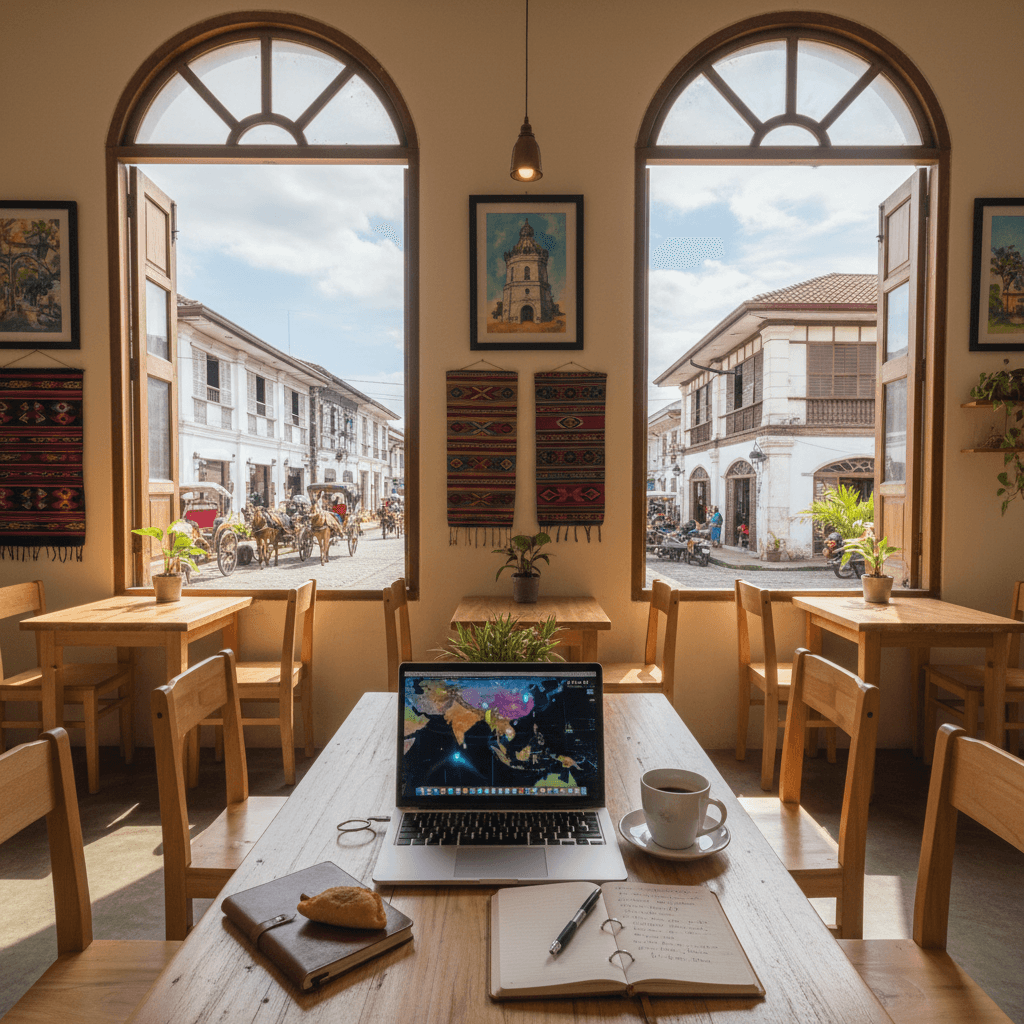
Walking into Vigan feels like a glitch in the timeline of the modern Philippines. While Manila and Cebu scream with neon and traffic, Vigan whispers through cobblestone streets and the rhythmic clip-clop of horse-drawn kalesas. It is a UNESCO World Heritage site that manages to feel lived-in rather than just a museum. For nomads, the vibe is uniquely meditative; it is a place where you swap the high-octane networking of typical hubs for a slower, more deliberate pace of life.
The Daily Rhythm
The city centers on the Heritage Village, specifically Calle Crisologo. In the early morning, before the day-trippers arrive from Laoag, the atmosphere is hauntingly beautiful. You'll see locals sweeping doorsteps of Spanish-era stone houses and the smell of toasted Vigan longganisa (garlic sausages) filling the air. By midday, most nomads retreat to air-conditioned sanctuaries like Coffee Break Vigan or the Plaza Hotel to get through their deep-work blocks. The heat is real, often hovering around 28°C to 30°C, so the city naturally naps in the afternoon before coming alive again under the soft glow of street lamps in the evening.
What It Costs to Live Here
Vigan is remarkably affordable, even by Southeast Asian standards. You can live a very comfortable life here on $1,500 to $2,000 a month, which is significantly less than what you’d spend in the country’s larger metros. Most travelers find that a mid-range budget allows for a private 1-bedroom or a suite in a historic guesthouse for about $400 a month, leaving plenty of room for dining out and weekend trips.
- Budget Tier ($800 to $1,200): This covers a shared room or a basic local apartment for $250, plenty of $1 street empanadas, and getting around via $0.50 tricycle rides.
- Mid-Range Tier ($1,500 to $2,000): Expect a nice private stay in the Heritage Village for $400 to $500, a mix of cafe work and home cooking, and frequent dinners at spots like Kusina Felicitas.
- Comfortable Tier ($2,500+): This buys you the best room at the Plaza Hotel, daily coworking fees of about $10, and upscale meals reaching $20 per person.
The Neighborhood Breakdown
Since the city is compact and highly walkable, where you stay depends on how much peace you need versus how much "action" you want. Most nomads stick to the core, but families often head slightly further out.
- Heritage Village (Calle Crisologo): This is the heart of the city. It’s perfect for short stays and solo nomads who want to be steps away from Kape Kesada Artisanal Coffee. The trade-off is the evening noise and tourist crowds.
- Near Vigan Cathedral/Plaza: This area offers the best balance. You’re close to the Plaza Hotel coworking space and essential amenities like ATMs and pharmacies. It feels safer and more central for long-term expats.
- The Outskirts (near Baluarte): If you’re traveling with kids, this is the spot. Rents drop to $200 or $300, and you’re near the Baluarte mini-zoo. You’ll need to rely more on tricycles to get into the center for work.
The Reality of Remote Work
You have to be intentional about your setup here. While the average internet speed is 101 Mbps, the reliability can be spotty once you leave the dedicated cafes. Smart nomads always carry a Globe or Smart SIM as a backup, or better yet, a portable hotspot like a Solis. There isn't a massive, organized nomad community here yet, so don't expect weekly meetups. Instead, social life happens organically at the Coffee Break or through local Facebook groups. It’s a "heads-down" kind of town where you get your best work done because there are fewer distractions than in the beach towns.
Safety and Local Nuance
Vigan is widely considered one of the safest cities in the Philippines. Petty theft is rare in the Heritage Village, and the locals are famously hospitable. English proficiency is high, so you’ll have no trouble negotiating a tricycle fare or asking for help. The biggest adjustment isn't the safety, it's the pace. People here value respect and a quiet demeanor. If you embrace the "slow" in slow travel, Vigan offers a cultural immersion that modern glass-and-steel cities simply can't match.
The Bottom Line
Living in Vigan feels like stepping into a time capsule, but your bank account won't feel the pressure of a typical tourist trap. Most people find they can live a very comfortable, mid-range lifestyle on $1,500 to $2,000. It is significantly more affordable than Manila or Cebu, allowing you to trade glass skyscrapers for Spanish colonial windows without breaking the budget.
Monthly Budget Tiers
- Budget ($800 to $1,200): You'll be staying in shared accommodations or local guesthouses for about $250. Most of your meals will come from street stalls, where an empanada sets you back just $1 or $2. You'll rely on tricycles and work mostly from your room or the occasional cheap cafe.
- Mid-range ($1,500 to $2,000): This is the sweet spot. You can snag a private one bedroom apartment or a historic guesthouse suite for $400 to $500. You'll mix home cooking with dinners at spots like Kusina Felicitas, where a solid meal costs $5 to $10.
- Comfortable ($2,500+): You're looking at premium stays in the heart of the Heritage Village for $600+. This budget covers daily coworking at the Plaza Hotel, upscale dining, and frequent weekend trips to nearby attractions.
Housing and Neighborhoods
The layout of Vigan is compact, so where you live dictates your daily rhythm. Most nomads gravitate toward the Heritage Village near Calle Crisologo. It is incredibly walkable and puts you steps away from the best cafes, though you'll pay a premium for the ambiance and deal with more foot traffic.
Heritage Village / Calle Crisologo
- Best for: Short stays and culture seekers.
- Rent: $400+ for historic guesthouses.
- Pros: Stunning cobblestone views and easy access to Kape Kesada.
- Cons: Can get noisy with tourists in the evenings.
The Outskirts (near Baluarte)
- Best for: Families and long term expats.
- Rent: $200 to $350 for larger spaces.
- Pros: Quiet, residential feel near the Baluarte mini zoo.
- Cons: Requires a tricycle ride to get to the main work spots.
Eating and Connectivity
Food is one of Vigan's biggest draws. You can survive on $1 Vigan longganisa or splurge $20 on a high end fusion dinner. For work, don't rely solely on your accommodation's WiFi. While the city averages 101 Mbps, the connection can be temperamental. Expats suggest grabbing a Globe or Smart SIM for about $10 to $20 a month as a backup.
When you need to get serious work done, Plaza Hotel offers a modern coworking environment for roughly $10 a day. If you prefer a more relaxed vibe, Coffee Break Vigan has reliable speeds and great caffeine for under $5. For a serene garden setting, Kusina Felicitas is the local favorite for an afternoon of focused laptop time.
Practical Expenses
- Transport: Tricycle rides are the standard way to get around, costing between $0.50 and $1. Jeepneys are even cheaper at $0.20.
- Health: Local clinics are clustered around the Plaza. For anything serious, you'll head to the Ilocos Sur provincial hospitals.
- Daily Life: Use the GCash or Maya apps for digital payments; they're accepted almost everywhere from cafes to small shops.
For Digital Nomads: The Heritage Village
If you are coming to Vigan to work, you want to be as close to Calle Crisologo as possible. This is the heart of the UNESCO World Heritage site where the cobblestone streets and Spanish colonial architecture create a focused, quiet atmosphere that is hard to find in the rest of the Philippines. Most nomads prefer this area because it is the only part of the city where you can walk to every major cafe and workspace in under ten minutes.
Expect to pay around $400 to $600 for a private stay in a converted historic guesthouse. While the aesthetic is old world, the internet in the Heritage Village is surprisingly decent, averaging 101 Mbps, though the thick stone walls of older buildings can kill your signal. Most people head to Coffee Break Vigan to work. If you need a professional setup, the Plaza Hotel offers a reliable coworking space for about $10 a day. It is the most modern facility in town and a great spot to meet the few other nomads passing through.
For Expats: Near the Plaza and Cathedral
Expats looking for a longer stay usually gravitate toward the area surrounding Vigan Cathedral and the Plaza Salcedo. This neighborhood sits right at the edge of the tourist core, offering a better balance between historic charm and daily convenience. You are within walking distance of the main banks, pharmacies, and the public market where you can grab fresh produce for much less than restaurant prices.
Living here puts you near the best dining options like Kusina Felicitas, where a mid range meal costs between $5 and $10. It is a very safe area with a low crime rate, and the presence of local clinics makes it practical for those staying a few months. For logistics, expats recommend setting up GCash or Maya for local payments and keeping a Globe or Smart SIM card as a backup for home internet. If you are planning to stay through 2025, keep an eye on the new Digital Nomad Visa which requires a $24,000 annual income and costs roughly $200 to $300 to process.
For Families: The Outskirts near Baluarte
The city center can get crowded with tourists and kalesas during the day, so families often prefer the quieter outskirts near Baluarte. This area is much more residential and offers significantly more space for your money. You can find larger rentals here for $200 to $350 a month, which is a steal compared to the $2,701 average monthly cost of living in more developed Philippine hubs.
The main draw for parents is the Baluarte Resort and Mini Zoo, which provides plenty of open space for kids to run around. The trade off is that this area is not very walkable. You will rely on tricycles, which cost about $0.50 to $1 per ride, or you can rent a scooter for around $5 to $10 a day to get into the city center. It is a peaceful, rural lifestyle that feels worlds away from the chaos of Manila.
For Solo Travelers: Calle Crisologo Core
If you are traveling alone and only staying for a week or two, stay directly on or adjacent to Calle Crisologo. Everything you need is concentrated in a few blocks. You can survive on a budget of $800 to $1,200 a month here if you stick to street food like the famous Vigan empanadas, which only cost about $1 or $2.
Solo travelers find it easy to navigate because English proficiency is very high. You can easily book bus transfers to Laoag or Manila via the 12go.asia app or catch a kalesa for a city tour for about $5. Since the nightlife is quiet, the social scene revolves around the cafes. It is a safe, slow paced environment where you don't have to worry about the typical scams found in larger cities. Just remember to pack light layers for the 28°C average heat and a good umbrella if you visit during the rainy season from May to October.
Connectivity Realities
Vigan is a place where you come to slow down, but that doesn't mean your workflow has to stall. While fixed broadband can reach over 100 Mbps in Philippines, mobile averages ~35 Mbps; test locally in Vigan. Don't let those national numbers fool you into complacency. The fiber infrastructure is solid in the city center, but the thick stone walls of Spanish era buildings in the Heritage Village can be absolute signal killers. Most nomads find that while the WiFi is generally better than in the remote islands, it can still be hit or miss during heavy tropical rainstorms.
You'll want a dual SIM setup to stay productive. Grab both a Globe and a Smart SIM card at the airport or a local shop for about $10 to $20 a month for unlimited data. If you're planning on serious deep work, travelers often recommend carrying a portable hotspot like Skyroam or Solis as a fail-safe. It's the best way to ensure you aren't scrambling for a signal when a Zoom call starts.
Top Coworking Spots
Vigan isn't a massive nomad hub like Canggu or Chiang Mai, so you won't find a dozen dedicated coworking spaces. However, the few options available are high quality and offer a focused atmosphere.
- Plaza Hotel: This is the gold standard for remote work in the city. It's cozy, modern, and offers reliable amenities for around $10 a day. It's located right in the heart of the action near the Cathedral.
- Coffee Break Vigan: If you prefer a more energetic environment, this cafe is a favorite. The WiFi is dependable, the coffee runs between $3 and $5, and the atmosphere is vibrant enough to keep you awake during a mid-afternoon slump.
- Kape Kesada Artisanal Coffee: Located near Calle Crisologo, this spot feels more like an art gallery than an office. It uses local beans and offers a quiet, inspiring space for those who don't need a corporate desk setup.
- Kusina Felicitas: For a change of pace, head to this garden setting at the Felicitas Resort. It's serene and perfect for clearing your head while catching up on emails.
Digital Nomad Logistics
Living here is incredibly affordable, especially compared to the capital. You can easily maintain a comfortable lifestyle on $1,500 to $2,000 a month. Most of your budget will go toward heritage stays if you choose to live in the historic core, but the convenience of being walkable to every major cafe makes it worth the premium.
- Budget Tier ($800 to $1,200): Stick to shared rooms for $250, eat $2 empanadas for lunch, and use tricycles for $0.50 rides.
- Mid-range Tier ($1,500 to $2,000): You can afford a private 1BR for $400 and a mix of cafe work and local dining.
- Comfortable Tier ($2,500+): This buys you a premium historic suite for $600, daily coworking at the Plaza Hotel, and upscale meals at places like Kusina Felicitas.
For long term stays, keep an eye on the upcoming Philippine Digital Nomad Visa expected in 2025. It's slated to cost between $200 and $300 with a $24,000 annual income requirement. Until then, most nomads rely on standard tourist visa extensions which are easily handled at the local immigration offices. For daily expenses, download GCash or Maya. These fintech apps are used everywhere from small stalls to larger restaurants, making it much easier to manage your cash flow without constantly hunting for an ATM.
Staying Safe in the Heritage City
Vigan is widely regarded as one of the safest urban environments in the Philippines. Because the heart of the city, especially the Heritage Village and Calle Crisologo, relies so heavily on tourism and its UNESCO status, there is a visible and reassuring security presence. Most nomads find they can walk the cobblestone streets late into the evening without any issues, as petty theft and violent crime are remarkably rare here.
While the core is secure, it is still smart to stick to well lit areas. The outskirts near Baluarte or the more rural barangays can get very dark after sunset. If you are staying outside the immediate center, use a tricycle for door to door service rather than walking long stretches of unlit roads. Local residents are generally warm and helpful, often going out of their way to assist travelers who look lost.
- Emergency Contacts: Dial 911 for general emergencies or 117 to reach the local police directly.
- Walking Safety: Stick to the pedestrian zones of the Heritage Village where kalesas (horse carriages) are the only traffic to worry about.
- Nightlife: Vigan isn't a party town. Most activity winds down by 10:00 PM, making the streets quiet and predictable.
Healthcare Access and Facilities
For minor ailments, you'll find plenty of well stocked pharmacies and small clinics clustered around the Vigan Cathedral and the Plaza Salcedo area. These are perfect for picking up basic antibiotics or treating a standard traveler's stomach bug. Most pharmacists speak excellent English and can recommend over the counter solutions for common issues.
If you require more serious medical attention or specialized care, the local facilities are functional but modest. Expats and long term nomads typically head to the Mariano Marcos Memorial Hospital in Ilocos Sur for higher quality diagnostic equipment and specialist consultations. For anything life threatening or complex, many foreigners choose to fly to Manila, though this is a rare necessity for most visitors.
Health Tips for Nomads
The heat is often the biggest health hurdle in Vigan. With temperatures averaging 28°C and humidity often spiking during the rainy season from May to October, dehydration and heat exhaustion are real risks. Keep a reusable water bottle with you, but stick to bottled or filtered water; the tap water in Ilocos Sur isn't recommended for drinking.
Mosquitoes can be a nuisance, particularly during the wetter months. While malaria isn't a concern in Vigan, dengue fever occasionally pops up in the region. Using a decent repellent and staying in rooms with screens or air conditioning will keep you comfortable and bite free.
Practical Safety Checklist
- Fintech Security: Most locals use GCash or Maya for daily transactions. These apps are safer than carrying large amounts of cash and are accepted at many cafes like Coffee Break Vigan.
- Insurance: Always carry a digital and physical copy of your travel insurance. Most local clinics expect upfront payment, usually in cash, which you can later claim back.
- Sun Protection: The midday sun on the open plazas is intense. If you're out exploring the Plaza Burgos food stalls, wear a hat and high SPF sunscreen.
The Heritage Core: A Walkable Time Capsule
In the heart of Vigan, particularly around the Heritage Village and Calle Crisologo, your own two feet are your best asset. The cobblestone streets are largely pedestrianized or restricted to slow moving traffic, making it one of the most walkable spots in the Philippines. Most major landmarks, from the Vigan Cathedral to the local museums, are less than a kilometer apart.
Walking here isn't just about utility; it's about the atmosphere. You'll find yourself sharing the road with kalesas (traditional horse-drawn carriages) rather than cars. While locals use them for short hops, they're primarily a tourist experience. Expect to pay about $5 to $10 for a guided tour of the city's main sights. It’s a slow, rhythmic way to see the architecture, though most nomads find it's a one time novelty rather than a daily commute.
Mastering the Tricycle and Jeepney
When you need to venture beyond the heritage core, the tricycle is the undisputed king of the road. These sidecar motorcycles are everywhere and function like a local taxi service. A standard ride within the city limits usually costs between $0.50 and $1. It's polite to have small change ready, as drivers rarely have large bills. If you're heading to the outskirts near Baluarte or the Pagburni pottery area, a tricycle is your most reliable bet.
For longer routes or if you’re heading toward the neighboring towns, look for jeepneys. These iconic, colorful vehicles follow set routes and are incredibly cheap, often costing as little as $0.20. You just hop on, pass your fare to the driver, and yell "Para!" when you're ready to get off. Just keep in mind that Vigan doesn't have ride-hailing apps like Grab yet. You'll need to flag down rides the old fashioned way.
Two Wheels and Regional Travel
If you prefer more autonomy, you can find bike or scooter rentals near the Plaza. Daily rates typically hover between $5 and $10. Having a scooter is a game changer if you want to explore the coastal areas or visit the Mindoro Beach area without haggling with drivers every time. The traffic in Vigan is far more manageable than Manila, so it's a relatively stress free place to ride.
For getting in and out of the city:
- Laoag International Airport: This is the closest air hub. You can catch a van or bus for the 1.5 hour trip to Vigan, which costs roughly $5 to $10.
- Inter-city Buses: Large bus lines like Partas and Viron connect Vigan to Manila and Baguio. For booking these or any ferries, most travelers use 12go.asia to check schedules and secure seats in advance.
- Digital Tools: While there's no Grab, Google Maps is fairly accurate for walking directions, and GCash is widely accepted for paying for various transport services and rentals.
Transport Cost Breakdown
- Tricycle Ride: $0.50 to $1.00 per trip
- Jeepney Fare: $0.20 for short distances
- Kalesa Tour: $5.00 to $10.00 per hour
- Scooter Rental: $5.00 to $10.00 per day
- Airport Transfer (Laoag): $5.00 to $10.00 via van
Most expats recommend staying within the Heritage Village or near the Vigan Cathedral to minimize transport costs. If you're living in the center, your monthly transport budget could easily stay under $50, even with occasional weekend trips to the beach or neighboring towns.
Getting by in Vigan
You won't have much trouble making yourself understood here. The Philippines is famously English-proficient, and Vigan is no exception. While Ilokano is the native tongue and Tagalog is the national language, English is the primary medium for business, government, and education. In the Heritage Village and around the Plaza, almost everyone you meet, from tricycle drivers to boutique hotel staff, speaks English fluently.
Expats often find that while they can survive entirely in English, learning a few Ilokano phrases goes a long way with the locals. It breaks the ice and shows you aren't just another tourist passing through on a kalesa. Try using Salamat for thanks or asking Mano? when inquiring about prices at the public market. Most nomads find that a friendly smile and a polite "Apo" (a term of respect for elders) earn them a lot of local goodwill.
Staying Connected
While the city's historic charm feels like a step back in time, your work schedule doesn't have to. You'll find average speeds of around 101 Mbps in the city center, which is surprisingly capable for video calls and heavy uploads. However, the reliability can be hit or miss once you leave the main cafes or move into the thicker stone walls of Spanish-era guesthouses. Smart nomads always carry a backup.
- Local SIMs: Grab a Globe or Smart SIM as soon as you land. You can get unlimited data packages for about $12 to $25 a month. If your phone supports it, a dual-SIM setup is the pro move here, as one carrier might have a dead zone where the other thrives.
- Mobile Hotspots: Many long-term travelers recommend keeping a Skyroam or Solis device in your bag. It’s a lifesaver when the cafe WiFi decides to take an unscheduled nap during a client meeting.
- Digital Payments: Download the GCash or Maya apps. These are the lifeblood of Pilippine commerce now. You can use them to pay for everything from your Ilocano empanada to your monthly rent in some cases. You'll find plenty of cash machines around the Plaza to top up your account.
The Best Work Spots
Vigan doesn't have a massive coworking scene like Cebu, but the few spots available are high quality. The Plaza Hotel has business facilities and free WiFi; inquire on-site for work space options. It's a professional environment in town and a great place to meet the small but growing community of remote workers.
If you prefer a more relaxed "cafe office" vibe, Coffee Break Vigan is a local favorite for its reliable WiFi and steady supply of caffeine for $3 to $5 a cup. For those days when you need total silence and a bit of inspiration, Kape Kesada Artisanal Coffee doubles as an art gallery. It’s tucked away near Calle Crisologo and offers a peaceful atmosphere that’s perfect for deep work sessions. If you want a garden setting, head to Kusina Felicitas at the Felicitas Resort. It's serene and spacious, though you'll want to check your signal strength before settling in for a long shift.
Long-Term Residency
For those looking to stay beyond a standard tourist visa, the Digital Nomad Visa is now available (launched 2025); check the official BI site for the $24k income requirement and $200-300 fee. You'll be able to apply through the official government e-visa portal. In the meantime, most nomads simply extend their tourist visas at the Bureau of Immigration, which is a straightforward process if you have the time and a bit of patience.
When to Pack Your Bags
Vigan is a year round destination, but the experience changes drastically depending on when you land. The city averages a balmy 28°C, though the humidity can make it feel much heavier. You will want to plan around the two distinct seasons to ensure your gear and your laptop stay dry.
The sweet spot for visiting is between November and April. This is the dry season, and it is when the city truly shines. If you can, aim for the window between December and February. During these months, temperatures hover between a comfortable 25°C and 30°C, and the rainfall is at its lowest. It is the perfect weather for morning walks down Calle Crisologo with a coffee from Kape Kesada before the afternoon heat settles in.
The rainy season kicks off in May and lasts through October. This is the time to be cautious. The months of July, August, and September are the peak of typhoon season. Expect heavy downpours, high humidity, and temperatures that often climb above 30°C. While the historic stone houses of the Heritage Village handle the rain well, the spotty internet can become even more temperamental during a storm. If you are working on tight deadlines, the wet season might be a challenge unless you are camped out at a reliable spot like the Plaza Hotel.
What to Bring
Packing for Vigan requires a mix of practical gear and respect for the local culture. Since you will be doing a lot of walking on uneven cobblestones, leave the fancy footwear behind. Here is what most nomads recommend having in your bag:
- Lightweight, breathable clothing: Linen and cotton are your best friends here. It is hot, and you will be grateful for fabrics that breathe.
- Rain gear: If you are visiting outside the peak dry months, a sturdy umbrella or a high quality light raincoat is mandatory. Sudden tropical downpours are common.
- Modest layers: While Vigan is relaxed, it is a traditional city. You will need something to cover your shoulders if you plan on visiting the Vigan Cathedral or other religious sites.
- Connectivity backups: Do not rely solely on your accommodation. Grab a Globe or Smart SIM card for about $10 to $20 a month. Many expats also carry a portable hotspot like Skyroam or Solis to stay online when the local cafe's WiFi decides to take a break.
- Power bank: Power fluctuations can happen, especially during the rainy season. A good battery pack ensures your phone stays charged for those essential tricycles rides or GCash payments.
Seasonal Practicalities
Travelers often say that the crowds peak during the December holidays and the Holy Week break in March or April. During these times, the Heritage Village can get noisy and accommodation prices in the historic center might jump from the usual $400 range to something much higher. If you prefer a quieter vibe for deep work, the "shoulder" months of November or late May offer a good balance of decent weather and fewer tourists.
Regardless of when you arrive, remember that Vigan operates on a slower clock. Whether it is waiting out a midday heatwave with an empanada or watching the rain from a garden at Kusina Felicitas, the weather dictates the pace of life here. Embrace the slow speed, and you will find it is one of the most serene places in the Philippines to get things done.
Connectivity and Workspaces
While Vigan boasts average speeds of 101 Mbps, the reality on the ground is a bit more nuanced. The internet is generally reliable in the city center, but it gets spotty once you head toward the outskirts. Most nomads we talk to recommend carrying a portable hotspot like Skyroam or Solis as a backup for those inevitable afternoon flickers.
For a dedicated desk, the Plaza Hotel is the go-to spot. It costs about $10 a day and offers a modern, quiet environment that feels a world away from the humid streets. If you prefer a more social vibe, Coffee Break Vigan has solid WiFi and great caffeine for $3 to $5 a cup. For deep work sessions in a more serene setting, Kusina Felicitas offers a garden atmosphere, while Kape Kesada Artisanal Coffee provides a unique art gallery backdrop near Calle Crisologo.
Cost of Living Breakdown
Living in Vigan is significantly more affordable than in Manila or Cebu. You can live very comfortably here on $1,500 to $2,000 a month, though budget travelers often manage on as little as $800.
- Budget ($800 to $1,200): Expect to spend $250 on a shared room or local guesthouse, $200 on street food like empanadas, and roughly $100 for cafe work and local transport.
- Mid-range ($1,500 to $2,000): This covers a private one bedroom apartment for about $400, a mix of home cooking and dining out for $300, and regular use of tricycles.
- Comfortable ($2,500+): You can snag a historic heritage stay for $600, dine out daily for $500, and use the Plaza Hotel coworking space every day.
Where to Plant Your Flag
The city is compact, but your choice of neighborhood changes the vibe of your stay. Most short term nomads stick to the Heritage Village area because it is walkable and right in the thick of the cafe culture. Expect to pay $400 or more for rent here, and be prepared for some tourist noise in the evenings.
If you have a family in tow, the outskirts near Baluarte are much quieter. Rent drops to between $200 and $300, and you are close to the mini zoo, though you will need to rely more on tricycles to get into town. For those who want to be near the action without the cobblestone crowds, the area near Vigan Cathedral offers a nice middle ground with easy access to banks and pharmacies.
Getting Around and Staying Safe
Vigan is incredibly safe, even for solo travelers. Petty theft is rare in the Heritage Village, though it is always smart to stay in well lit areas at night. For healthcare, local clinics are clustered near the Plaza, but for anything serious, you will likely head to the Mariano Marcos Memorial hospital in Ilocos Sur.
Walking is the best way to see the core, as most major spots are less than a kilometer apart. For longer distances, hop in a tricycle for $0.50 to $1.00. There is no Grab here, so use the 12go.asia app to book buses or vans if you are heading to the Laoag International Airport, which is about 90 minutes away.
Logistics and Local Customs
To stay connected, grab a Globe or Smart SIM card at the airport or a local shop. Unlimited data plans usually run between $10 and $20 a month. While cash is still king for street food, the GCash and Maya apps are widely accepted in shops and cafes. If you are planning a long term stay, look into the new Digital Nomad Visa launching in 2025, which requires a $24,000 annual income and a fee of $200 to $300.
The best time to visit is during the dry season from November to April. Aim for December to February to catch the coolest weather, usually around 25 to 30 degrees Celsius. Avoid the peak typhoon season from July to September if you don't want your work schedule dictated by the rain.
Need visa and immigration info for Philippines?
🇵🇭 View Philippines Country GuideEasy Landing
Settle in, no stress