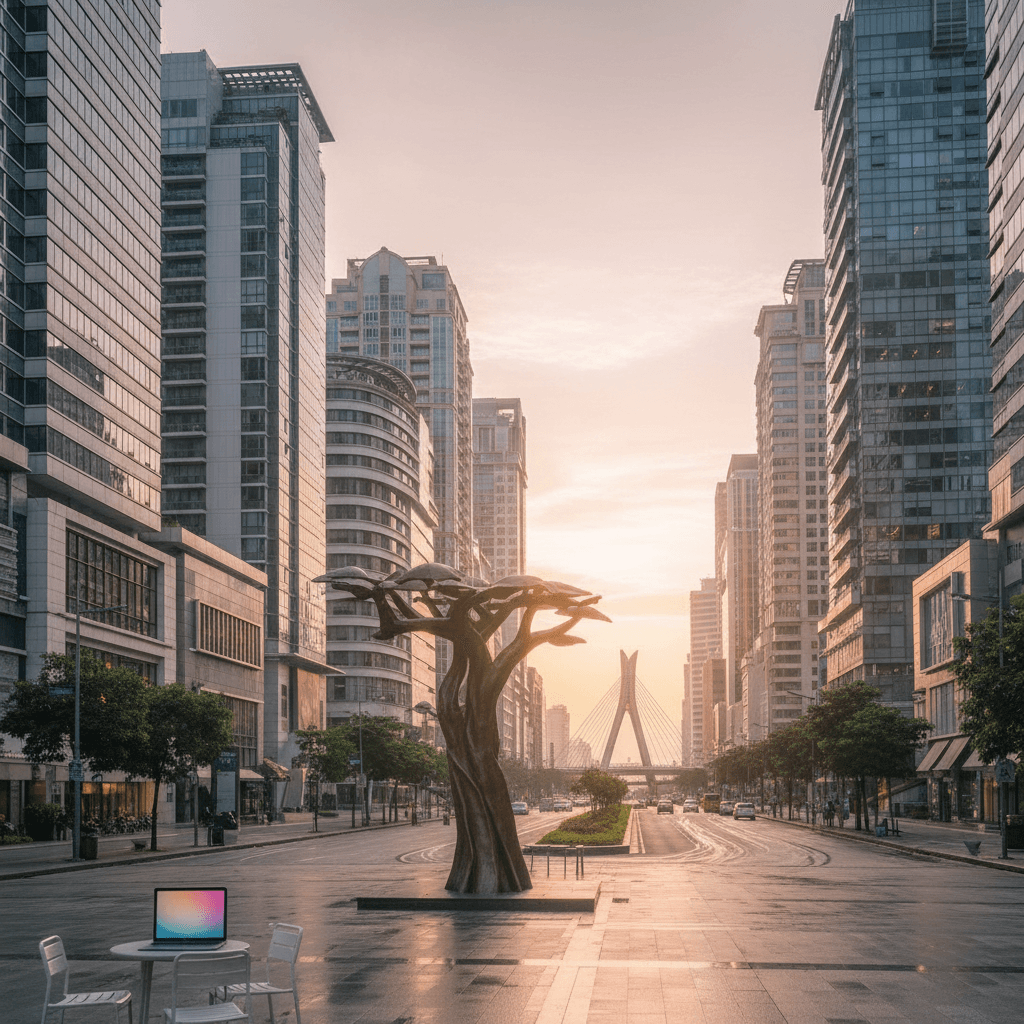
Taguig (BGC)
🇵🇭 Philippines
The Silicon Valley of Southeast Asia
Stepping into Bonifacio Global City (BGC) feels like you've accidentally teleported out of Manila and landed in a cleaner, greener version of Singapore or Irvine, California. While most of Metro Manila is famous for its chaotic charm and gridlocked traffic, BGC is a manicured bubble of high-rises, wide sidewalks, and public art. It is the undisputed heavyweight champion for digital nomads in the Philippines, mostly because it solves the two biggest headaches of tropical remote work: reliable infrastructure and walkability.
The vibe here is unapologetically corporate and upscale. You'll share the sidewalks with tech CEOs, young creative professionals, and a massive international expat community. It doesn't have the grit of Makati or the bohemian soul of the islands, but what it lacks in "edge," it makes up for in pure productivity. It's a place where you can actually walk to your favorite coworking space without breaking a sweat or dodging a jeepney.
What Makes the BGC Lifestyle Unique
Most nomads come here for the "BGC Bubble." It's a highly controlled environment where everything works. The streets are patrolled by private security, the parks are manicured daily, and the cafes are designed with remote workers in mind. You'll find yourself hanging out at High Street, a long outdoor pedestrian mall that serves as the city's lungs. It's the kind of place where people actually jog at 6:00 AM and walk their golden retrievers at sunset.
The emotional experience of BGC is one of relief. After navigating the intensity of other Southeast Asian capitals, BGC feels like a deep breath. You can find a WeRemote or Acceler8 coworking space, settle in with high-speed fiber, and know that your Zoom call probably won't drop. That peace of mind is why nomads often choose BGC as their "home base" before heading out to the islands for the weekend.
The Reality Check: High Stakes and Backup Plans
Living in the most modern district in the country comes with a price tag. BGC is easily the most expensive neighborhood in the Philippines. While a studio might run you around $750 a month, your total cost of living will be significantly higher than in places like Dumaguete or Siargao. You're paying for the privilege of reliable high-speed fiber (often 100+ Mbps) and the ability to find a salad or a craft cocktail within a five-minute walk.
Even in this gleaming district, the Philippines' Achilles' heel remains: internet redundancy. Seasoned nomads here don't just rely on their condo Wi-Fi. They carry a "survival kit" that usually includes:
- A primary fiber connection in their apartment.
- A Globe or Smart eSIM for mobile data.
- A backup pocket Wi-Fi device or a 5G router.
- A mental map of cafes with the strongest signals for when power outages hit during storm season.
Who It's For (and Who Should Skip It)
If you're looking for "authentic" Manila, BGC isn't it. You won't find many street food stalls or traditional markets here; for that, you'll need to head to Maginhawa or the outskirts of Makati. BGC is for the nomad who has a heavy meeting schedule, needs a professional networking scene, and values safety and convenience above all else. It's a polished, international playground that feels like the future of the Philippines, even if it feels a world away from the rest of the country.
The Price of Premium Living
BGC is the most expensive neighborhood in the Philippines, and for good reason. You’re paying for a bubble of Western-style infrastructure, manicured parks, and reliable safety that’s hard to find elsewhere in Manila. While it’s a bargain compared to Singapore or New York, it will definitely eat into your budget faster than the beach hubs like Siargao or Dumaguete.
Monthly Rent and Accommodation
Expect to pay a premium for the convenience of being within walking distance of High Street. While prices fluctuate based on the specific tower and its amenities, here is what you should budget for monthly stays:
- Modern Studio/1BR: Most nomads find decent condos starting around $750. If you want something in a newer building with a high-end gym and pool, budget closer to $1,000 to $1,200.
- Luxury Apartments: High-end units in buildings like those near Burgos Circle or Uptown can easily climb to $1,500+.
- Short-term stays: If you're booking via Airbnb for just a month, expect to pay a 20 percent markup over long-term lease rates.
Dining and Food Costs
The food scene in BGC is incredibly diverse, ranging from quick office lunches to high-end degustation menus. It's easy to overspend here because the "Western" lifestyle is so accessible.
- Local Turo-Turo or Food Courts: You can still find a solid meal for $3 to $5 if you head to the basement food courts in malls like Market! Market!
- Mid-range Dining: A standard dinner at a trendy bistro or a nice ramen spot usually lands between $12 and $20 per person.
- Coffee: A latte at a specialty cafe like Percent Arabica or Wildflour will cost you about $4 to $5.
- Groceries: Shopping at high-end supermarkets like Marketplace by Rustan's is convenient but pricey. Most expats spend about $300 to $400 a month on groceries if they cook at home frequently.
Coworking and Connectivity
Since internet reliability is the biggest hurdle in the Philippines, many nomads treat a coworking membership as a mandatory insurance policy rather than an optional luxury.
- WeRemote: A very popular choice for those on a budget, offering day passes around ₱300-500 ($5.50-$9) and monthly around ₱2500 ($45+).
- Acceler8: A top-rated spot with a more professional, corporate-chic vibe. Prices are higher, but the networking opportunities with local entrepreneurs are excellent.
- Mobile Data: Don't rely on just one provider. Most residents recommend getting both a Globe and a Smart SIM card. A heavy data plan will cost you roughly $20 to $30 a month.
Estimated Monthly Budgets
How much you spend depends entirely on how often you eat out and whether you insist on a view of the golf course.
- The Frugal Nomad ($1,400 - $1,600): You're staying in a slightly older studio, cooking most meals, and using public transport or walking. You work from cafes or a budget coworking space.
- The Comfortable Expat ($2,200 - $2,800): You live in a modern 1BR, eat out at nice restaurants four nights a week, frequently use Grab for transport, and keep a full-time coworking membership.
- The High Roller ($4,000+): You're in a premium high-rise, dining at the best spots in Uptown, and spending your weekends at high-end beach resorts outside the city.
Keep in mind that while BGC is pricey for the region, the quality of life is high. You're paying for the ability to walk home at 2:00 AM without a second thought and the luxury of having fiber internet that actually works most of the time.
For Digital Nomads & Professionals: Bonifacio Global City (BGC)
If you're coming to Manila to actually get work done, BGC is the gold standard. It feels less like the rest of the Philippines and more like a hybrid of Singapore and Los Angeles. The streets are laid out on a grid, the sidewalks are wide enough for two people to walk side-by-side, and you won't be dodging jeepneys or potholes every five steps. It's the most polished version of the city, dominated by glass high-rises and manicured parks.
Most nomads gravitate toward the area around High Street or Burgos Circle. High Street is a long, open-air pedestrian mall lined with flagship stores and cafes that don't mind if you sit with a laptop for an hour. Burgos Circle has a more residential, neighborhood feel with plenty of pet-friendly spots and bars that fill up during happy hour. For deep work, the area is home to several popular coworking hubs, with day passes starting around ₱300-500 and monthly memberships around ₱2500+.
- The Vibe: Corporate, polished, and very safe. You'll see people jogging at 6:00 AM and expats walking their dogs at midnight.
- Rent: Expect to pay a premium. A decent 1BR condo usually starts around $750 per month, but prices can climb quickly for newer buildings.
- Pros: The most reliable fiber internet in the country, high walkability, and a massive community of international remote workers.
- Cons: It can feel a bit sterile or "bubble-like" compared to the grit and soul of traditional Manila neighborhoods.
For Expats & Business Socialites: Makati (Salcedo & Legaspi Villages)
Just a short ride from BGC, Makati is the older, more established brother. While BGC is the shiny newcomer, Makati has more character. Expats usually choose between two specific pockets: Salcedo Village and Legaspi Village. These are quiet, leafy residential enclaves tucked inside the central business district.
Salcedo is famous for its Saturday Market, where you can grab local organic produce and gourmet street food. Legaspi is home to the Sunday Market and feels slightly more modern with a high concentration of specialty coffee shops. Both areas are extremely walkable and offer a better "neighborhood" feel than the high-rise canyons of BGC. You'll find plenty of networking opportunities here, as most major multinational companies are headquartered just a few blocks away.
- The Vibe: Sophisticated, established, and green. It's the "old money" side of the city's business world.
- The Perks: Access to the best hospitals, high-end shopping at Greenbelt, and a high concentration of coworking spaces for easy office access.
- Top Tip: Stick to the "Villages" to avoid the heavy traffic and smog of the main thoroughfares.
For Budget-Conscious Nomads & Solo Travelers: Maginhawa
If BGC is too "corporate" for you, Maginhawa is the antidote. Located in Quezon City, this area is the heart of Manila's indie food and arts scene. It's much further from the airport and the main business hubs, but it offers a local experience that you won't find in the glass towers of Taguig. It's a favorite for solo travelers who want to meet locals and younger creatives.
The neighborhood is famous for its "Eat Street" culture. Instead of global chains, you'll find tiny, family-run cafes, hole-in-the-wall bars, and backyard burger joints. It's significantly cheaper than BGC, making it ideal if you're trying to keep your monthly burn low while still enjoying a high quality of life. Just be prepared for slightly slower internet and less polished infrastructure.
- The Vibe: Bohemian, student-heavy, and casual. No one wears a suit here.
- Food Scene: Incredible variety of street food and experimental kitchens at a fraction of BGC prices.
- The Trade-off: You'll need a solid backup data plan. Grab a Globe or Smart eSIM immediately, as the local Wi-Fi can be hit or miss compared to the dedicated fiber lines in Taguig.
For Families & Long-Term Expats: Eastwood City
Eastwood is a self-contained "mini-city" that works well for families who want everything in one place. It's a residential and commercial township where you can live, work, and take the kids to the park without ever leaving the complex. It's very pet-friendly and has a high level of security, which gives parents peace of mind.
While it's a bit of an island in terms of location, it's packed with amenities like cinemas, bowling alleys, and grocery stores. Expats who move here often do so because their office is nearby, as it's a major hub for BPO and tech companies. It's generally more affordable than BGC but offers a similar level of safety and convenience.
- The Vibe: Busy, family-oriented, and convenient.
- Connectivity: Very strong. Like BGC, it was built specifically for the tech industry, so the infrastructure is solid.
- The Drawback: It can feel a bit claustrophobic. If you want to explore the rest of Manila, you'll be spending a lot of time in a Grab car.
The Connectivity Landscape
In BGC, the internet situation is a bit of a paradox. On one hand, you have access to the fastest fiber speeds in the Philippines, often reaching 132 Mbps or higher. On the other hand, the country's infrastructure is still prone to the occasional hiccup, especially during the rainy season when power outages can disrupt the grid. Most nomads who stay here long term don't just rely on their condo's WiFi. They build a "redundancy stack."
A typical setup for a serious remote worker involves a fiber line, a 5G pocket WiFi device, and two different SIM cards from Globe and Smart. If one network towers goes down, you just swap to the other. It sounds like overkill, but in the middle of a Zoom call during a tropical thunderstorm, you will be glad you have it. If you are just arriving, you can grab an eSIM or a local SIM at the airport. The staff there will help you register it, which is a legal requirement in the Philippines now.
Top Coworking Spots
BGC is the coworking capital of the country. The spaces here are professional, air-conditioned to the point of being chilly, and filled with a mix of tech entrepreneurs and corporate expats. You won't find many "laptop on the beach" vibes here; this is where people come to get actual work done.
- WeRemote: Located in the heart of the district, this is a favorite for those on a budget. Day passes are roughly €5 and monthly memberships sit around €44. It has a great pantry, private phone booths for calls, and a very colorful, high energy design.
- Acceler8: This spot is consistently rated as one of the best for networking. It feels a bit more "boutique" and upscale, attracting a crowd of serious professionals and established startups.
The Cafe Office Culture
If you prefer the hum of a coffee shop over a dedicated office, BGC has you covered. The neighborhood is incredibly walkable, so you can easily hop between spots if the WiFi at one isn't hitting the mark. Unlike some other cities where cafe owners might glare at you for staying too long, BGC has a very established "laptop culture."
Most cafes offer free WiFi for an hour or two with a purchase, but many nomads prefer to use their own 5G hotspots to ensure a stable connection. High Street and the areas around Burgos Circle are packed with options. You will see people working from Fully Booked (the massive bookstore) or the various Starbucks locations, but local chains like Wildflour or Single Origin offer better food and a more "BGC" atmosphere if you don't mind the premium prices.
Mobile Data and Backup Plans
For mobile data, Globe and Smart are the two giants. You can easily top up your data through apps like GCash or at any convenience store. A common pro tip among expats is to buy a 5G router for your apartment. Even if your building's main fiber line gets cut during roadwork, the 5G signal in BGC is usually strong enough to handle video calls without a stutter. It is a small investment that saves a lot of stress when deadlines are looming.
The General Safety Scene
BGC is widely considered the safest pocket of Metro Manila. It feels less like a chaotic Southeast Asian capital and more like Singapore or Irvine, California. The area is privately managed, meaning you'll see a constant presence of "BGC Marshals" in their neon vests patrolling the streets. Most nomads feel perfectly comfortable walking alone at night between Bonifacio High Street and their condos, thanks to the well lit sidewalks and CCTV coverage.
While violent crime is extremely rare here, you should still keep your wits about you. Pickpockets aren't common within the BGC "bubble" compared to areas like Manila City or parts of Makati, but it's still smart to keep your phone tucked away when walking near the borders of the district. The biggest "danger" you'll likely face is the aggressive humid heat or a sudden tropical downpour that turns the streets into a temporary splash zone.
Health & Medical Quality
If you get sick in the Philippines, BGC is exactly where you want to be. The healthcare here is world class, particularly at St. Luke’s Medical Center. It’s a massive, JCI accredited hospital located right in the heart of the district. Expats and locals alike consider it the gold standard for medical care in the country. Many of the doctors there have trained in the US or Europe, and English is the primary language for all staff.
For minor issues like a cold or a quick checkup, you don't need to visit the main hospital. You'll find several smaller clinics and diagnostic centers scattered around the neighborhood:
- Healthway Multi-Specialty Center: Located in Market! Market!, this is great for quick consultations and lab tests.
- Mercury Drug and Watsons: These pharmacies are everywhere. You can find one on almost every other block, and many are open 24/7.
- Centre Medicale Internationale (CMI): A premium, private outpatient clinic that many expats prefer for its shorter wait times and personalized service.
Practical Health Tips for Nomads
The most common health hurdle for newcomers is often "Manila Belly." While the water in BGC is treated, most nomads and expats stick to bottled or filtered water for drinking. Most high rise condos have a water delivery service where you can get a 5 gallon jug for about $1.00 to $1.50.
Air quality can vary, but because BGC has more green space and fewer old jeepneys than the rest of the city, it’s generally much better than neighboring districts. If you have asthma or respiratory sensitivities, you might notice the humidity more than the pollution.
Emergency Information
It’s a good idea to keep local emergency numbers saved, though the BGC Marshals are usually your first point of contact if something happens on the street. For medical emergencies, you can call St. Luke’s directly or use the national emergency hotline 911. Most travelers find that having a local SIM from Globe or Smart is vital for accessing these services quickly, as international roaming can sometimes be spotty during heavy storms.
The Walkability Win
BGC is a massive outlier in Metro Manila for one reason: you can actually walk here. While the rest of the city is often a gridlock of exhaust and narrow sidewalks, BGC was designed with a master plan. You'll find wide, paved pedestrian paths, green strips like Burgos Circle and Terra 28th, and a layout that makes sense. Most nomads find they can handle 90% of their daily life on foot if they stay within the central district.
The neighborhood is highly structured, so you won't be dodging jeepneys on every corner. It feels more like Singapore or Irvine, California than the chaotic charm of old Manila. If you're living near High Street, your gym, coworking space, and grocery store are likely within a 10 to 15 minute stroll.
Ride-Hailing and Apps
When the tropical humidity kicks in or you need to head to Makati, Grab is the undisputed king. It's the local version of Uber and it's incredibly reliable in BGC. You can book a car (GrabCar) or a taxi through the app. A short ride within BGC usually costs between 150 to 250 PHP ($2.60 to $4.40), though prices spike during the afternoon rush or heavy rain.
- Grab: The essential app for cars and food delivery.
- JoyRide or Angkas: If you're brave enough to hop on the back of a motorcycle to beat the traffic, these are the top-rated bike-hailing apps. They're significantly cheaper and faster for solo travelers.
- BGC Bus: This is a dedicated point-to-point bus system that loops around the district. You'll need a Beep Card (a reloadable tap card) to ride. It's affordable and clean, but the routes can be confusing for newcomers.
The Jeepney and Trike Gap
One thing you'll notice quickly is that BGC is a "closed" ecosystem. Traditional Philippine jeepneys and tricycles (motorbikes with sidecars) are generally restricted from entering the main high-end zones of the city. To catch a jeepney to other parts of Taguig or toward the EDSA main artery, you'll usually need to head to the "Market! Market!" transport terminal. This keeps the BGC streets quieter and less congested, but it means you lose out on the ultra-cheap 13 PHP local transport options right at your doorstep.
Getting to and from NAIA Airport
Ninoy Aquino International Airport (NAIA) is technically close, but Manila traffic is a legendary beast. Without traffic, you can get from BGC to Terminal 3 in 20 minutes. During peak hours, that same trip can easily take an hour or more.
- GrabCar: Expect to pay around 300 to 600 PHP ($5.30 to $10.60) depending on the terminal and demand. This is the most seamless way to go.
- Premium Airport Bus (UBE Express): These occasionally run routes to major BGC hotels and malls. They are comfortable and air-conditioned, costing roughly 150 PHP.
- Yellow Airport Taxis: Available at the arrivals curb. They are metered and generally safe, but most expats prefer the transparency of the Grab app to avoid any "fixed price" haggling.
Pro Tip for Digital Nomads
If you're planning to explore outside the BGC bubble, try to avoid moving between 5:00 PM and 8:00 PM. The exodus of office workers creates a bottleneck at every exit point of the district. Most seasoned nomads use this time to hit the gym or grab dinner, waiting until 9:00 PM when the roads clear up and Grab prices drop back to normal levels.
Will You Be Understood?
If you're worried about the language barrier in BGC, don't be. English is effectively the primary language of business, social life, and daily navigation here. Unlike other parts of Southeast Asia where you might need a translation app to order dinner, BGC operates almost entirely in English. You'll find that signage, menus, and official documents are all written in English, making it one of the easiest transitions for Western nomads in Asia.
The local dialect is often called Taglish, a seamless blend of Tagalog and English. Most locals you'll interact with, from condo concierge staff to baristas at % Arabica, speak English with a high level of proficiency. In fact, many Filipinos speak English with an accent that's very easy for Americans and Europeans to understand, largely due to the country's historical ties and the massive BPO (call center) industry centered in the district.
The Social Nuances
While everyone speaks English, there's a specific "conyo" culture in BGC. This is a local slang used by the affluent and urban crowd, characterized by mixing English and Tagalog in a very specific, sometimes sing-song cadence. You don't need to learn it, but you'll hear it constantly in the coworking spaces and high end bars around Burgos Circle.
Filipinos are famously polite. You'll often hear people add "po" or "oat" to sentences as a sign of respect, or address you as "Sir" or "Ma'am" regardless of your age. It's a cultural quirk that persists even in the ultra modern setting of BGC. If you want to show a little local effort, learning a few basic Tagalog phrases will go a long way in building rapport, even if the conversation immediately switches back to English:
- Salamat: Thank you (The most useful word you'll learn).
- Magkano?: How much? (Useful in markets, though most BGC shops have fixed prices).
- Ingat: Take care (A common way to say goodbye).
- Ayos lang: It's okay or I'm fine.
Communication for Remote Work
In a professional context, you'll have zero issues. If you're hiring local freelancers or using services like WeRemote or Acceler8, the standard of written and spoken English is professional grade. This is why BGC is the top choice for international companies. You can walk into any meeting or networking event at The Fort and expect the entire floor to be speaking English.
One thing to keep in mind is the Filipino "yes." Sometimes, a "yes" might mean "I understand what you're saying" rather than "I agree" or "I can do that." If you're giving instructions to a delivery driver or a technician, it's a good habit to ask them to repeat the details back to you just to ensure there's no miscommunication. Use apps like Viber or WhatsApp for most of your casual business communication; Viber is particularly popular with local businesses and condo admin offices for quick updates.
Staying Connected
Since English is the default, your biggest communication hurdle won't be the language, but the data. Most nomads recommend getting two different SIM cards, one from Globe and one from Smart. If one network's tower is congested or down, you can simply toggle your data to the other. You can pick these up at the airport or any 7-Eleven in BGC for just a few dollars. Most locals use GCash to top up their data plans, which is an essential app you should download as soon as you get a local number.
Understanding the Tropical Rhythm
BGC operates on a tropical schedule that dictates everything from your morning coffee run to how you plan your weekend getaways. While the district feels like a futuristic bubble, it's still subject to the Philippine climate, which generally splits into two main seasons: the dry season and the wet season. If you're planning a stint here, timing your arrival can make the difference between enjoying the walkable parks and being trapped in a cafe by a sudden downpour.
The Peak Season: December to February
This is widely considered the best time to be in Taguig. The humidity drops, the air is surprisingly cool, and the sun is out without being oppressive. It's the perfect window for exploring the Bonifacio High Street shops or walking to your desk at WeRemote without breaking a sweat.
The vibe during these months is electric. Filipinos take the holiday season seriously, and BGC transforms into a light show of decorations and outdoor events. Just keep in mind that this is also when everyone else wants to be here. You'll find that popular condos and short term rentals get snapped up quickly, so book your stay at least two months in advance if you're eyeing this window.
The Hot Season: March to May
As March rolls around, the heat cranks up. Temperatures often sit between 30°C and 35°C, and the humidity makes it feel even hotter. This is the "summer" for locals. While BGC is designed for walking, you'll find yourself sticking to the shade or hopping into air-conditioned malls like Market! Market! during midday peaks.
During this time, the city can feel a bit emptier during long weekends like Holy Week, as many expats and locals flee to beaches like Siargao or Boracay. If you stay in the city, the sunsets from the high-rise balconies are spectacular, but you'll definitely want a condo with a high-quality AC unit and a pool.
The Monsoon Season: June to November
This is the rainy season, characterized by sporadic but heavy afternoon rain showers and the occasional typhoon. While BGC has some of the best drainage infrastructure in Metro Manila, the rain still impacts daily life. Traffic in and out of the district can become a nightmare during a storm, and internet reliability can occasionally dip during heavy electrical activity.
- June to August: Frequent rain, but usually in short, intense bursts. It's manageable if you have a flexible schedule.
- September to October: This is peak typhoon season. Most nomads recommend having a backup power bank and a secondary SIM card (like Smart or Globe) because power flickers can happen even in premium buildings.
- November: The rains start to taper off, and the air begins to cool down again.
Monthly Climate Breakdown
- Coolest Months: January and February, with averages around 25°C to 27°C.
- Hottest Months: April and May, where midday heat can top 34°C.
- Wettest Month: August, which sees the highest volume of rainfall.
The Nomad Verdict
If you want the quintessential BGC experience, aim for January. You get the best weather for outdoor dining and networking without the holiday chaos of December. However, if you're on a tighter budget, the shoulder months of June and November often see slightly lower prices for mid-range condos, and you'll still get plenty of sunny days between the clouds.
Regardless of when you visit, remember that the "indoor" climate in BGC is consistently freezing. Offices, malls, and coworking spaces like Acceler8 keep the air conditioning on full blast. Most experienced travelers here carry a light hoodie or "office sweater" even when it's 33°C outside.
Connectivity and Power Redundancy
Internet reliability is the biggest hurdle for nomads in the Philippines. While BGC has the best infrastructure in the country, you shouldn't rely on a single source. Most professionals here use a "triple-threat" setup: a fiber line in their condo, a backup 5G pocket Wi-Fi, and two separate SIM cards from Globe and Smart.
Power outages can happen during the typhoon season. If you're booking an Airbnb or long term rental, always ask the host if the building has a 100 percent back up power system. Many of the newer high rises in BGC keep the outlets and Wi-Fi running during a blackout, but older buildings might only power the lights.
Getting Around the Fort
BGC is one of the few places in Metro Manila where you can actually walk. The sidewalks are wide, well lit, and maintained. For longer distances or trips to Makati, the Grab app is your best friend. It's the local version of Uber and it's incredibly reliable for both rides and food delivery.
- BGC Bus: These point to point buses have specific routes around the district. You'll need a Beep card to ride, which you can buy at the main terminals.
- Angkas or JoyRide: If you're brave enough to hop on the back of a motorcycle, these apps are the fastest way to beat the notorious Manila traffic.
- Walking: Stick to the "Greenway" or the high street paths if you want to avoid the heat as much as possible.
Managing Your Budget
BGC is the most expensive neighborhood in the country, so your money won't go as far here as it would in places like Dumaguete or Siargao. Expect to pay around $750 for a decent studio or one bedroom condo. If you want to save on food, look for "jollibee" for a quick local fix or head to the Market! Market! area for more affordable local eateries.
- Daily Coworking: Around €5 (approx. 300 PHP) at spots like WeRemote.
- Monthly Coworking: Around €44 for a hot desk.
- Mobile Data: You can get a solid data 5G package for under $20 a month.
Safety and Health
You'll notice a heavy security presence in BGC, which makes it feel very safe even late at night. It's a corporate hub, so the vibe is professional and orderly. For any medical needs, St. Luke’s Medical Center is located right in the heart of BGC. It's a world class facility and arguably the best hospital in the Philippines, so you're in good hands if you get sick.
Staying Connected
Don't wait until you get to your hotel to sort out your phone. Grab an eSIM or a local SIM card at the airport. The staff at the Globe or Smart booths will help you register it on the spot, which is a legal requirement in the Philippines. Having a local number is essential for using GCash, the mobile wallet that almost every vendor in BGC accepts.
Most nomads find that joining local Facebook groups like "BGC Community" or "Digital Nomads Philippines" is the fastest way to get real time updates on the best cafes to work from or which internet providers are currently having issues.
Need visa and immigration info for Philippines?
🇵🇭 View Philippines Country GuideNomad Haven
Your home away from home