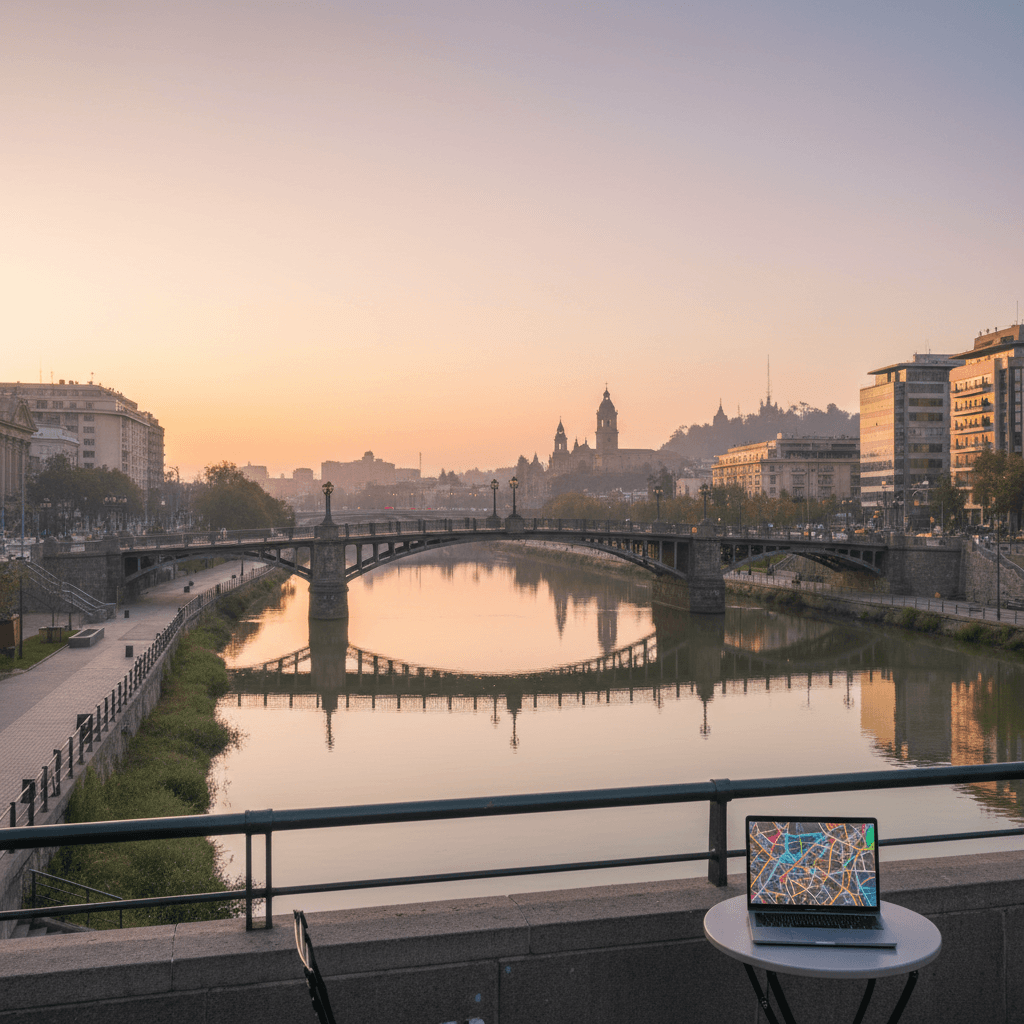
Santiago
🇨🇱 Chile
The Andean Metropolis
Santiago is a bit of a curveball for travelers expecting the typical grit and chaos of South American capitals. Sitting at 520 meters in a valley framed by the massive, snow capped Andes, it feels more like a clean, orderly European city than a tropical hub. It is polished, predictable, and remarkably stable. While it might lack the immediate, raw energy of Buenos Aires or the lush hills of Medellin, it makes up for it with a level of sophistication and infrastructure that is hard to beat on the continent.
The vibe here is professional yet relaxed. You can spend your morning working from a high rise in "Sanhattan," the sleek financial district, and your afternoon wandering the bohemian, cobblestone streets of Lastarria. It is a city of contrasts where glass skyscrapers reflect 19th century neoclassical architecture. For nomads, the real draw is the balance. You get top tier infrastructure, fast fiber internet, and a time zone that aligns perfectly with the US East Coast, all while being a short drive from world class vineyards or Andean ski slopes.
The Nomad Experience
If you are looking for a massive, pre packaged nomad community, you might find Santiago a little quiet. The scene is growing but remains smaller than the more famous hubs. You won't find a digital nomad meetup on every corner, but the community that does exist is high quality and deeply integrated into the local startup scene. Most remote workers gravitate toward Providencia, a neighborhood that strikes the perfect balance between leafy residential streets and a dense concentration of coworking spaces like Launch Coworking and WeWork.
The lifestyle is built on convenience. You can rely on a modern metro system that actually runs on time and a bus network with 10,000 stops tracked in real time. Prices are fixed and fair, so you won't spend your day haggling over taxi fares or market goods. However, the winter months bring a noticeable smog to the valley and heavy traffic that can test your patience. It is a city for the "grown up" nomad who values reliable utilities and safety over a wild party scene.
What Sets It Apart
The emotional core of Santiago is its proximity to nature. There is a specific kind of magic in seeing the Andes tower over the city skyline after a rainstorm clears the air. Most nomads use the city as a base camp for epic weekend trips. You can be hiking in the mountains, tasting bold reds in the Maipo Valley, or surfing on the coast in under two hours. It feels like a gateway to the rest of Chile, from the deserts of the north to the glaciers of Patagonia.
While the cafe culture for working is a bit hit or miss, with WiFi reliability fluctuating in smaller spots, the city offers a "plug and play" environment that is rare in the region. You aren't fighting for basic necessities here. Instead, you are figuring out which boutique brewery in Barrio Italia to visit after work or exploring the art galleries in the Gabriela Mistral Center (GAM). It is a place that feels less like a temporary stop and more like a city where you could actually build a life.
Quick Snapshot
- The Draw: High safety standards, 200 Mbps average internet speeds, and proximity to the Andes.
- The Challenge: A smaller nomad community and winter air pollution.
- The Cost: A mid range lifestyle usually runs between $1,300 and $1,700 per month.
- The Best Fit: Remote professionals who want a stable, modern base with easy access to outdoor adventure.
The Bottom Line
Santiago is a bit of a curveball for those used to the rock-bottom prices of Southeast Asia or even neighboring Buenos Aires. It feels more like Madrid or Barcelona than a typical Latin American capital, and the prices reflect that. You aren't going to live here on pocket change, but the trade-off is some of the most reliable infrastructure on the continent. Most nomads find that a monthly budget between $1,300 and $1,700 hits the sweet spot for a comfortable, mid-range lifestyle.
If you're on a tighter grind, you can scrape by on $750 to $1,000, but you'll be living further out and cooking most of your meals. On the flip side, $1,700+ puts you in a high-end apartment in the best parts of town with plenty of room for weekend trips to wine country or the coast.
Where You'll Hang Your Hat
Your biggest expense will be rent. Most remote workers head straight for Providencia because it’s the most balanced neighborhood for your wallet. It's walkable, safe, and packed with cafes. While specific studio prices fluctuate, expect to pay between $600 and $900 for a decent spot in this area.
- Providencia: The nomad gold standard. Expect to pay between $600 and $900 for a walkable, well-connected apartment.
- Lastarria: The cultural heart. Prices vary wildly here because the apartments are often older, characteristic builds.
- Barrio Italia: Upscale and trendy. You'll pay a premium here for the proximity to boutique shops and high-end dining.
Eating and Drinking
Food costs in Santiago are fair, but they aren't "cheap." You can find budget-friendly street food like completos (Chilean hot dogs) for a few dollars, but a sit-down meal in a mid-range international restaurant will feel closer to US or European prices. Expats recommend hitting the local markets for fresh produce if you want to keep your grocery bill under control. If you're into the social scene, the craft beer and cocktail bars in Bellavista are great, though a night out there can add up quickly.
The Cost of Getting Productive
Since the cafe culture for working is hit-or-miss, most nomads end up paying for a dedicated workspace. The good news is the internet is fast, often averaging 59 Mbps and hitting 200 Mbps in modern buildings. A dedicated desk in a solid coworking space usually runs between $150 and $300 a month.
- Launch Coworking: Highly recommended for its pay-as-you-go model and lack of red tape. It's perfect if you don't want to commit to a long contract.
- WeWork and Regus: These are the reliable, corporate fallbacks with multiple locations across the city.
- La Maquinita: A great local choice if you're looking to actually meet people and network with Chilean entrepreneurs.
Transport and Utilities
Getting around is one of the city's best bargains. The Metro is modern, clean, and covers most places you'll actually want to go. The Transantiago bus system is also massive, with over 10,000 stops. You'll want to download the local transit apps to track arrivals in real-time. If you stay in neighborhoods like Providencia or Lastarria, you'll find yourself walking most of the time anyway, which keeps your daily spend near zero.
Healthcare is another area where you get what you pay for. Chile's system is ranked #33 globally. While it's world-class, make sure you have decent travel insurance, as private clinics in Santiago aren't shy about charging for their top-tier services.
Choosing where to plant your flag in Santiago usually comes down to how much you value a short commute versus a late night out. The city is sprawling, but most of the action for internationals is concentrated in a handful of pockets along the Mapocho River. Here is where you should look based on your specific travel style.
The Digital Nomad Hub: Providencia
If you are coming to Santiago to work, you will likely end up in Providencia. It is the sweet spot of the city, offering a mix of high rise apartments and quiet, tree lined streets. It is incredibly walkable and serves as the city's unofficial coworking capital. Most nomads find this the easiest place to settle because everything just works.
- The Vibe: Professional yet relaxed, very safe, and extremely well connected by the Metro.
- Estimated Rent: Around $750 per month for a decent apartment.
- Work Spots: You are close to Launch Coworking on General Holley, which is a favorite for its "pay as you go" model and lack of red tape.
The Social & Solo Traveler Scene: Bellavista
Solo travelers looking to meet people fast should head to Bellavista. Located just across the river from the city center, this is the bohemian heart of Santiago. By day, you can visit La Chascona, the former home of poet Pablo Neruda. By night, the streets turn into a massive party with a heavy emphasis on craft beer and live music.
- The Vibe: Gritty, colorful, and loud. It is the center of the city's nightlife and social energy.
- Top Activities: You are right at the foot of Cerro San Cristobal, where you can hike or take the funicular for the best views of the Andes.
- Best For: Those who care more about being near the bars than having a silent night's sleep.
The Culture Seekers & Creatives: Lastarria
Lastarria is a tiny, picturesque neighborhood that feels more like a European village than a Latin American capital. It is packed with independent cinemas, high end cafes, and designer boutiques. Expats recommend this area for anyone who wants to be steps away from the Museum of Fine Arts and the GAM cultural center.
- The Vibe: Artistic and upscale. The streets are narrow, cobblestoned, and perfect for people watching.
- Social Life: It is a great spot for meeting other professionals and creatives over a glass of Chilean Carmenere.
- Pro Tip: Space is limited here, so apartments can be smaller and more expensive than in neighboring areas.
The Upscale Expat Choice: Barrio Italia
For those who have a bit more room in the budget and want a polished, aesthetic lifestyle, Barrio Italia is the move. It is a former industrial area where old workshops have been converted into chic furniture shops, galleries, and some of the best restaurants in the city. It is quieter than Bellavista but more stylish than Providencia.
- The Vibe: Sophisticated and trendy. It is the kind of place where you spend your Saturday morning at a specialty coffee roaster and your afternoon browsing antique shops.
- Dining: This is arguably the best food neighborhood in the city, with a high concentration of international cuisine and posh cocktail bars.
- Best For: Expats and couples who want a "neighborhood" feel without the frantic pace of the financial district.
The Coastal Alternative: Viña del Mar
If the winter smog in the Santiago valley gets to be too much, many nomads relocate to Viña del Mar. It is about 90 minutes from the capital and offers a full coastal lifestyle with much better air quality. You get the modern infrastructure of Santiago, including fast fiber internet averaging 59 Mbps, but with the beach right outside your door.
- The Vibe: Relaxed resort town with high rise condos and a solid local community.
- Connectivity: You can easily hop on a bus and be back in downtown Santiago for a meeting by lunchtime.
High-Speed Connectivity
Santiago stands out in Latin America for its digital infrastructure. While neighboring capitals might struggle with lag, Chile has invested heavily in fiber optics. Most nomads find that home internet and coworking spaces offer speeds between 150 Mbps and 300 Mbps. It is common to see fiber connections even in older apartment buildings in Providencia, making it one of the most reliable cities in the region for video calls and heavy uploads.
The mobile data situation is equally robust. You can expect 4G or 5G coverage throughout the metropolitan area. If you need a quick backup, local travelers often recommend ducking into a Copec petrol station. They have a surprisingly reliable reputation for stable WiFi if you buy a coffee or a snack, which can be a lifesaver if your apartment's router acts up during a deadline.
Top Coworking Spaces in Santiago
The coworking scene here is professional and corporate, leaning more toward a "San Francisco startup" vibe than a "Bali beach club" aesthetic. You will find a mix of global giants and local hubs, with dedicated desks typically ranging from $150 to $300 USD per month.
- Launch Coworking (Gral. Holley 133): This is a favorite for those who hate paperwork. They offer a "pay-at-reception" model with minimal bureaucracy and an app-based tracking system. It is located in a prime spot in Providencia with plenty of lunch spots nearby.
- Urban Station: If you need a more formal, quiet environment to focus, this is the place. It feels very professional and is popular with local consultants and remote executives.
- La Maquinita: This local chain is known for its community focus. If you want to network with Chilean founders and entrepreneurs rather than just sitting next to other foreigners, this is your best bet.
- WeWork & Regus: These have multiple locations across the "Sanhattan" financial district and Providencia. They are the most expensive options but offer the consistency you expect from a global brand.
- Impact Hub: A great choice for those working in social impact or the tech startup world, offering a more collaborative and mission-driven atmosphere.
The Cafe Culture Reality Check
While Santiago is full of picturesque cafes in neighborhoods like Lastarria and Barrio Italia, the "work from a cafe" culture is still a bit hit or miss. Many independent shops have WiFi, but the reliability can fluctuate wildly during peak hours. Some spots also have a "no laptop" policy during lunch rushes to keep tables turning.
If you prefer working from cafes, stick to the larger chains or modern specialty coffee shops in Providencia. These are more accustomed to people staying for a few hours. Just keep in mind that unlike Medellin or Mexico City, the nomad infrastructure here is still emerging, so you won't always find power outlets at every seat.
Practical Tips for Setup
When you arrive, your first move should be getting a local SIM card. While the airport has options, you will get much better rates at branded kiosks in malls like Costanera Center. Look for providers like Entel or WOM, which are known for solid urban coverage. Most plans are prepaid and easy to top up via their respective apps.
If you are planning a long stay, prioritize apartments in Providencia. Not only is it the most walkable area, but it also has the highest density of coworking spaces and the most modern internet cabling. This ensures you won't have to commute across the city just to find a stable connection for a Monday morning meeting.
Keeping Your Cool in the Capital
Santiago is often described as the most stable city in South America. It feels more like a European capital than a chaotic Latin American hub, and the statistics back that up. With a Safety Index of 36/100, it generally feels secure for remote workers and expats. You aren't going to deal with the same level of volatility here as you might in other regional capitals, but you still need to keep your wits about you.
Most nomads stick to neighborhoods like Providencia and Lastarria, which are well lit and have a heavy police presence. However, the city does struggle with heavy traffic and winter smog, which can be a genuine health concern if you have asthma or respiratory issues. During the colder months, the valley traps pollution, making the air quality noticeably poor.
Street Smarts and Common Scams
While violent crime is relatively rare in the popular expat bubbles, petty theft is the main annoyance. Phone snatching and bag dipping happen, especially in crowded metro stations or late at night in Bellavista. Travelers often say the best rule of thumb is to keep your phone out of sight while walking near busy intersections where someone on a motorbike could easily grab it.
- The Metro: It is exceptionally clean and modern, but keep your backpack on your front during rush hour.
- Nightlife: If you are heading out to the bars in Bellavista, take a ride-hailing app home rather than walking through dark side streets.
- Political Climate: Chile has a history of organized social demonstrations. These are usually localized to Plaza Italia. Most locals just check the news and avoid the area on protest days, and you should do the same.
World-Class Medical Care
One of the biggest perks of living in Santiago is the healthcare system. Chile's healthcare system ranks highly in Latin America, around top 50 globally. If you get sick here, you are in excellent hands. The private clinics (clinicas) offer a standard of care that matches or exceeds what you would find in the US or UK, often at a fraction of the price.
Expats recommend having private health insurance or a digital nomad policy, as the private system is much faster than the public one. Pharmacies are on almost every corner in the city center and Providencia, and they are usually well stocked with international brands. For minor issues, pharmacists are often knowledgeable enough to give advice without a doctor's visit.
Health and Emergency Quick Facts
- Healthcare Quality: Top-tier private facilities with modern infrastructure and English-speaking specialists.
- Emergency Services: Highly responsive and supported by the city's developed road networks.
- Tap Water: Technically drinkable in Santiago, though many nomads prefer bottled or filtered water because the mineral content is very high and can upset sensitive stomachs.
- Pharmacies: Look for Cruz Verde, Ahumada, or Salcobrand, which are the major chains found throughout the city.
Overall, Santiago offers a safety net that is hard to find elsewhere in the region. Whether it is the political stability or the high-end hospitals, it is a city where you can focus on your work without constantly looking over your shoulder.
Santiago feels surprisingly familiar if you are used to European capitals, but with the massive, snow capped Andes constantly reminding you exactly where you are. Getting from point A to point B here is a highlight of the experience, mostly because the city invested heavily in a transport network that actually works.
The Metro: Your Best Friend
The Santiago Metro is the crown jewel of the city's infrastructure. It is clean, modern, and incredibly efficient. Most nomads find that if they stay in Providencia or Lastarria, they rarely need to rely on anything else. The system covers almost everywhere you would want to go as a remote worker.
To use the Metro or the buses, you need a Bip! card. You can buy these at any station. You can't pay with cash on the buses, so keeping your card topped up is a must. During rush hour, the "red" and "green" express train system skips certain stops to move people faster, so keep an eye on the colored lights on the train cars before you hop on.
The Transantiago Bus System
If the Metro doesn't reach your specific street, the bus system will. With over 10,000 stops across the city, it is remarkably comprehensive. Local expats recommend downloading a transit app to track real time arrivals, as the schedules can be a bit unpredictable during the heavy afternoon traffic.
- Coverage: Total city access, including outskirts.
- Payment: Bip! card only; no cash accepted.
- Pro Tip: Avoid the buses between 6:00 PM and 8:00 PM if you can, as they get extremely crowded and the smog in winter months makes the commute less than pleasant.
Walking and Micromobility
Santiago is a very walkable city, especially in the "nomad bubble." You can easily spend your entire day on foot if you are bouncing between a Launch Coworking office and a cafe in Barrio Italia. The sidewalks are well maintained, and the street layout is intuitive.
While bike lanes are expanding, they aren't quite at the level of Bogota or Mexico City yet. However, the flat terrain in the valley makes cycling a great option for getting between Providencia and Bellavista. You will see plenty of electric scooters scattered around the wealthier districts, which are perfect for short sprints to a meeting when you don't want to descend into the Metro.
Ride-Hailing and Taxis
Uber and other ride-hailing apps are the standard for late nights after the Metro shuts down or for getting home from a craft beer spot in Bellavista. They are generally safer and more transparent than flagging down a random street taxi, where pricing can sometimes be "flexible" for foreigners.
Getting to and from the Airport
Arturo Merino Benitez International Airport is located to the northwest of the city. You have three main ways to handle the trek:
- Centropuerto or TurBus: These are the "blue buses" that run every 10 to 15 minutes. They are the cheapest way into the city, dropping you off at major Metro stations like Los Heroes.
- Official Airport Taxis: Look for the desks inside the terminal before you exit to the street. They have fixed rates, so you won't get a surprise when you arrive at your apartment.
- Private Transfers: Many nomads prefer booking a van service like TransVip, which offers shared or private rides directly to your door in Providencia for a reasonable mid-range price.
Overall, you don't need a car here. In fact, having one is usually more of a headache due to the traffic and parking costs. Stick to the Metro and your own two feet, and you'll find the city incredibly easy to navigate.
The "Chileno" Challenge
If you've spent time in Mexico or Spain, your first conversation in Santiago might be a bit of a shock. Chileans speak at a blistering pace and have a habit of dropping the "s" at the end of words. They also use a massive amount of "Chilenismos," which is their unique local slang. Most nomads find that while their textbook Spanish gets them through the airport, it takes a few weeks of living in Providencia to truly understand what's happening at the dinner table.
The good news is that Santiago is a modern, international hub. In the upscale "Sanhattan" financial district or trendy spots in Lastarria, you'll find plenty of English speakers, especially among younger professionals and staff at coworking spaces like Launch Coworking or WeWork. However, for daily life like talking to a landlord, visiting a pharmacy, or navigating the Transantiago bus system, you're going to need at least a survival level of Spanish.
Key Local Slang to Know
- Cachái: You'll hear this every three seconds. It means "Do you understand?" or "You get it?"
- Buena onda: Used to describe a person or a place with good vibes.
- Fome: Something that is boring or "lame."
- Luca: This is vital for money. One "luca" is 1,000 Chilean Pesos. If someone says a coffee is "tres lucas," they mean 3,000 pesos.
- Po: A filler word added to the end of almost everything (Sí po, No po). It doesn't really mean anything, it just adds emphasis.
Staying Connected: SIM Cards and Data
Getting online is relatively straightforward, but you'll need your passport. Most travelers recommend heading to a physical store in a mall like Costanera Center to get set up. The main providers are Entel, WOM, and Movistar. Entel is generally considered to have the most reliable coverage if you plan on heading into the Andes for weekend treks.
A prepaid SIM card usually costs around $5 to $10 USD, and you can top it off with data packages. For about $15 USD, you can typically get a generous 30 day data plan. If you're staying long term, look into "Planes" (contracts), though these often require a RUT (national ID number).
Digital Communication and Apps
Like the rest of Latin America, WhatsApp is the king of communication. You'll use it for everything: booking a hair appointment, messaging your Airbnb host, or joining local expat groups. If a business has a phone number listed, they almost certainly expect a WhatsApp message rather than a cold call.
For getting around, make sure you download the Red app (formerly Transantiago). It provides real time arrival information for the bus system, which is helpful because the 10,000 stops can be confusing for newcomers. While the metro is incredibly intuitive and modern, the bus system is where the app really saves you from getting lost.
The "RUT" Hurdle
One quirk of communicating and buying things in Chile is the RUT. It's a national tax ID number that locals use for everything from supermarket discounts to buying a bus ticket online. As a nomad, you won't have one initially. When a cashier asks for your "RUT," you can simply say you're a foreigner (extranjero). Most of the time, they'll just skip it, but for some online purchases, you might find your international credit card or lack of a RUT creates a digital roadblock. In those cases, it's often easier to pay in person or use a service like Cornershop for deliveries.
Seasonal Breakdown
Santiago sits in a high-altitude valley, which means the weather is a bit more dramatic than your average coastal city. Since it is in the Southern Hemisphere, the seasons are flipped. Summer runs from December to February, and it gets hot. Expect temperatures to hover around 30°C (86°F), though the lack of humidity makes it manageable. Most nomads find this the best time to be in the city, especially since the sky stays clear and the Andes look sharp against the horizon.
Winter arrives between June and August. It doesn't usually drop below freezing, but it stays chilly, often around 10°C to 15°C (50°F to 59°F). The biggest downside to winter isn't the cold, it is the smog. The valley traps pollution during the colder months, which can be tough if you have respiratory issues or just want those pristine mountain views. However, if you are a skier, this is your window to hit world-class slopes like Valle Nevado, which is just a short drive away.
The Sweet Spot: Shoulder Seasons
If you want the absolute best balance of weather and air quality, aim for the shoulder seasons. March to May (Autumn) and September to November (Spring) are the goldilocks zones. During autumn, the city turns various shades of orange and gold, and the wine harvest festivals in the nearby Maipo Valley are in full swing. Spring is equally beautiful, with blooming trees in Providencia and mild temperatures perfect for walking between cafes.
- High Season (Summer): Best for outdoor dining and rooftop bars in Lastarria.
- Ski Season (Winter): Best for mountain sports, though city air quality is at its lowest.
- Shoulder Season: Best for hiking, vineyard tours, and general exploration without the summer heat.
Air Quality and Practical Tips
Expats and long-term travelers often mention the "thermal inversion" during winter. Because the city is tucked into a bowl, the air can get stagnant. If you are sensitive to air quality, try to book your stay in neighborhoods with more greenery like Providencia or higher elevation areas like Lo Barnechea, though the latter is further from the nomad action.
Rain is rare in Santiago, but when it happens, it usually pours during the winter months. The city isn't always great at handling heavy drainage, so expect some traffic chaos on those few rainy days. For the rest of the year, you can pretty much count on sunshine. In fact, Santiago averages over 300 days of sunshine annually, which is a huge draw for remote workers fleeing gloomier climates.
What to Pack
Layers are your best friend here. Even in the height of summer, the desert-like climate means temperatures can drop significantly once the sun goes down behind the mountains. A light jacket is a year-round requirement. If you visit in winter, make sure your Airbnb or apartment has decent heating; many older buildings in neighborhoods like Bellavista or Lastarria aren't as well-insulated as you might expect, and those concrete walls get cold fast.
- Summer: Light linens, high-SPF sunscreen (the sun is intense at this altitude), and sunglasses.
- Winter: A solid windbreaker, warm sweaters, and perhaps a portable humidifier if you find the mountain air too dry.
- Year-round: Comfortable walking shoes for the cobblestones in Barrio Italia and a reusable water bottle to stay hydrated in the dry heat.
Connectivity and Power
You'll find some of the best internet speeds in South America here. Fiber is the standard in most modern apartments in Providencia and Las Condes, with average speeds hitting 59 Mbps and often reaching 200 Mbps. While the infrastructure is solid, don't rely solely on cafe WiFi. Most local coffee shops have a "hit or miss" reputation for stability. If you're in a pinch, the Copec gas stations are a surprisingly reliable backup for a quick connection, provided you buy a coffee or snack.
Coworking Hubs
The nomad scene is still growing, so you won't find a coworking space on every corner like you might in Medellin. Most expats head to Launch Coworking in Providencia. It's popular because they've cut out the usual red tape; you can pay at the reception or via an app and get straight to work. Other reliable options include:
- Urban Station: Preferred by those who need a more formal, quiet environment.
- La Maquinita: Great for networking if you're looking to meet local entrepreneurs.
- WeWork and Regus: These have multiple locations across "Sanhattan" and Providencia, usually costing between $150 and $300 USD for a monthly desk.
- Impact Hub: A solid choice if you want to be around the local startup community.
Getting Around the City
Skip the car rentals. The traffic in Santiago is notoriously heavy, especially during the winter smog season. The Metro is your best friend here; it's modern, clean, and covers almost every neighborhood a nomad would care about. For the bus system, known as Transantiago, there are over 10,000 stops across the city. Most residents use an app to track real-time arrivals so they aren't standing on the curb longer than necessary. Neighborhoods like Lastarria and Barrio Italia are small enough that you'll likely do most of your daily errands on foot.
Budgeting for Your Stay
Santiago isn't the cheapest city on the continent, but it offers high value for the infrastructure you get. Most mid-range nomads find they spend between $1,300 and $1,700 per month. Here is a rough breakdown of what to expect:
Monthly Living Costs
- Rent in Providencia: Around $750 for a walkable, well-located apartment.
- Coworking Desk: $150 to $300 depending on the level of access.
- Daily Living: Budget about $25 to $40 for a mix of street food and mid-range dining.
Health and Safety
Chile's healthcare system is top-tier, currently ranked #33 globally. You'll find pharmacies on almost every major block, and the private clinics in the eastern part of the city are world-class. On the safety front, the city carries a safety index of 71/100. It feels much more like a European capital than a chaotic metro area. Standard big-city precautions apply, but political stability is high and the streets are generally well-maintained and well-lit. One thing to keep in mind is the winter air quality; the valley traps smog, so if you have respiratory issues, you might prefer visiting during the spring or summer months.
Need visa and immigration info for Chile?
🇨🇱 View Chile Country GuideNomad Haven
Your home away from home