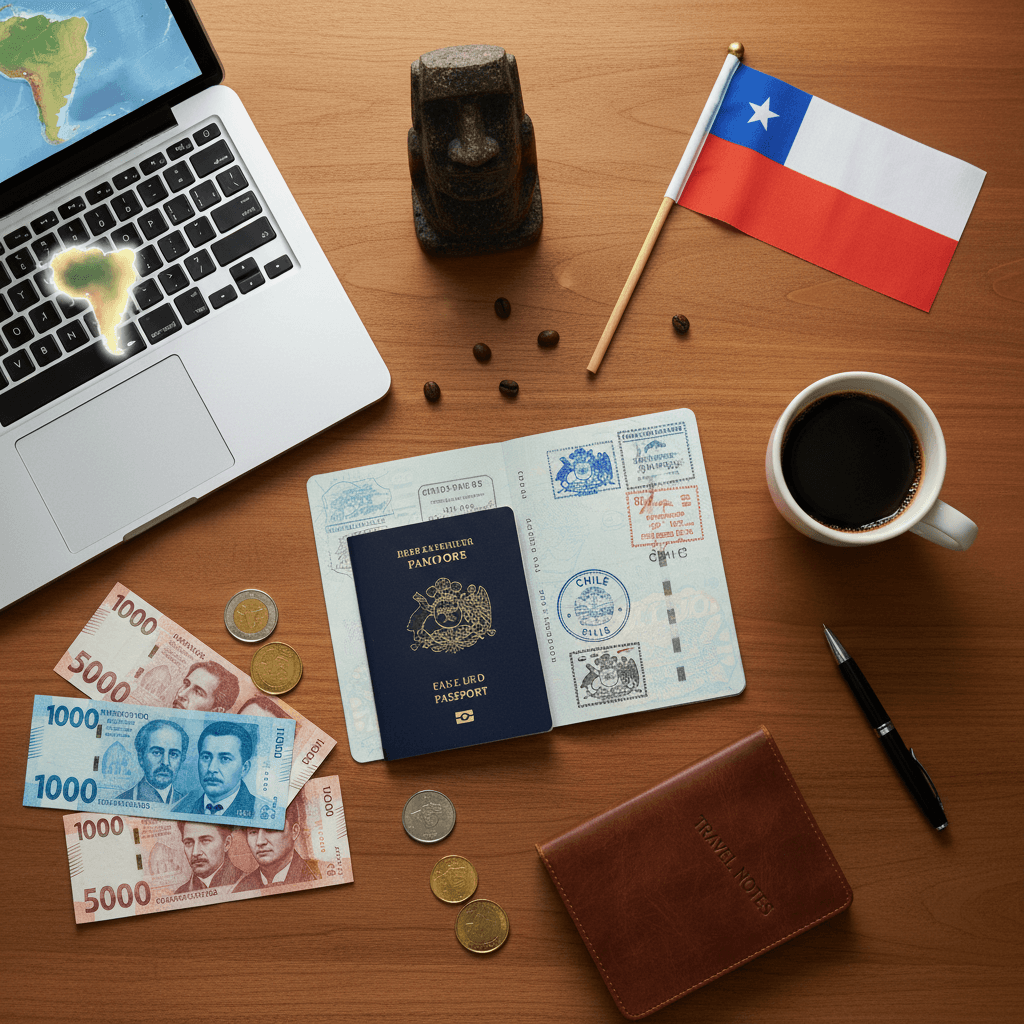
Chile
Complete Digital Nomad Guide

Policy Stability
Stamped Nomad ExclusiveHow likely visa and immigration policies are to remain unchanged
Quick Facts
Income Requirement
$1,500/mo
Max Stay
12 months
Renewable
Yes
Cost of Living
$1,310/mo
Avg Internet
300 Mbps
Safety Score
4/10
Healthcare
Medium
Coworking
High
English Friendly
Low
Time Zones
CLT, CLST
Entry Methods Available
Best For
The Tourist Route: Permanencia Transitoria
For most nomads, the journey begins with the Permanencia Transitoria. This is the standard tourist entry that grants you 90 days in the country. If you are from the US, Canada, the EU, or Australia, you typically get this stamped in your passport upon arrival at the airport without any prior paperwork.
If you find yourself falling in love with the Santiago coffee scene or the peaks of Patagonia, you can stretch your stay. You have two main paths for extensions, but you must apply at least 30 days before your initial stamp expires. If your original entry was for less than 90 days, you can request an Ampliación to reach that full three-month mark at no cost.
If you already have the full 90 days and want more time, you can apply for a Prórroga. This adds another 90 days to your stay, bringing the total to 180 days. This extension carries a fee of USD $100. Keep in mind that you can only do this once; after 180 days, you are required to leave the country or have a residency application already in flight.
Recent Shifts and the New Migration Law
Chile overhauled its immigration system recently, and the rules are much stricter than they used to be. The biggest change involves your ability to pivot. Under the current Migration Law (Law No. 21.325), you can no longer enter as a tourist and "convert" to a professional or work visa while remaining in the country. If you plan on staying long-term for work, you need to secure your status before you land on Chilean soil.
Additionally, as of September 17, 2025, the list of countries requiring prior authorization has expanded significantly. Nationals from 104 specific countries now need to secure a consular visa or prior authorization before arrival. Always check your specific nationality's requirements before booking your flight, as the "visa-free" list is smaller than it once was.
Business and E-Visas
If your visit is strictly for professional meetings or contract signings rather than general remote work, the Business Visa is your best bet. These come in two flavors: a single-entry version valid for 30 to 90 days, and a multiple-entry version that can last up to one year. You will need a formal invitation letter from a Chilean entity and proof of financial stability, such as 3 months of bank statements, to qualify.
For those who do require a visa before travel, you can submit your application through Chile's digital consular system. The process is entirely paperless. You will upload your passport scans, photos, and proof of funds, pay the fee via credit card, and receive your approval via email. This eVisa generally mirrors the tourist stay, offering 90 days with the option for a single 90-day extension.
Key Requirements for Entry
- Passport Validity: Your passport must be valid for at least 6 months from your date of entry.
- Proof of Onward Travel: Immigration officers frequently ask to see a confirmed flight out of Chile.
- Digitalization: All extensions and residency applications are now handled through the SERMIG online platform; physical immigration offices no longer handle walk-in visa renewals.
- Work Flexibility: For those on temporary residency, the old "visa subject to contract" is gone. You can now change employers without needing to notify the National Migration Service immediately.
While the days of the "border run" to Mendoza to reset a visa are mostly over due to stricter enforcement, the 180-day window provided by a tourist stay and a single renewal is usually plenty of time for most nomads to experience the diverse climates of the north and south.
Source 1 | Source 2
The Lowdown on Remote Residency
Chile is a heavy hitter in the Latin American tech scene, but they haven't jumped on the "Digital Nomad Visa" branding bandwagon just yet. Instead, the government offers something much more stable: the Temporary Resident Visa for Remote Workers. It functions exactly like a nomad visa, giving you the legal right to live in the country while working for employers or clients based outside of Chile.
This permit is a solid choice if you want to stay longer than a standard tourist entry. It is initially granted for 1 year and can be renewed if you decide the Andes are your permanent backdrop. You just need to make sure you file for that extension within the 90 days before your current permit expires.
What You Need to Qualify
The barrier to entry is actually quite reasonable compared to Europe or even some neighboring countries. The immigration office looks for a consistent monthly income, usually landing between $1,500 and $2,000. While they can be a bit flexible, having bank statements or a solid employment contract that proves you hit these numbers is your ticket in.
Here is the checklist of what you will need to gather before hitting the "submit" button:
- A valid passport with plenty of empty pages.
- Certified proof of remote work, like a contract or a letter from your company.
- Three to six months of bank statements showing that steady income.
- A clean criminal record certificate from your home country.
- Health insurance that covers you specifically in Chile.
- Recent digital photographs following the official passport specs.
The Application Process
Everything happens online through the official Chilean immigration portal. You will create an account, fill out the SAC Ciudadano Form, and upload your documents. Make sure any official documents, like your background check, are translated into Spanish and apostilled if your country requires it.
Once you submit, you will get a validation code. Keep this safe; it is the only way to track your status. Approval times vary, but most nomads see an answer within 30 to 90 days. Once approved, you can enter Chile and finalize your residency at the local immigration office to get your Chilean ID card, known as a RUT.
The Tax Perk
This is where Chile really shines for remote workers. If you are on this specific residency permit, you are generally exempt from paying Chilean income tax on your foreign-earned salary for your first three years in the country. This is a massive win for your bank account. If you stay longer, you can actually apply for an extension of this tax holiday for up to six years total through the Chilean Internal Revenue Service (SII).
Just remember the golden rule: you cannot work for Chilean companies or take on local clients while on this visa. If you do decide to pick up a local side project, that specific income will be hit with a 15% tax rate.
Other Ways to Stay
If the remote worker visa feels like too much paperwork, you have a couple of other paths to explore depending on your lifestyle and financial situation.
- The Tourist Route: Most nationalities get 90 days on arrival. You can extend this once for another 90 days for a fee of about $100, giving you nearly half a year. It is perfect for testing the waters in Santiago or Valparaíso without the commitment.
- The Rentista Visa: If you have passive income from investments or real estate totaling about $1,000 a month, this is a great alternative. It lasts for 2 years, allows for easier banking access, and puts you on a direct path to permanent residency if you fall in love with the country.
Understanding Your Entry Options
Chile is one of the most accessible hubs in South America for digital nomads, largely because their Permanencia Transitoria (short-term stay) permit is straightforward. Most visitors from Western nations can simply show up at the airport or a land border with a valid passport and get stamped in for 90 days. This isn't technically a "visa" in the traditional sense, but rather a permission to roam the country for tourism or business meetings.
Upon arrival, you will receive a Tarjeta Única Migratoria (PDI card). Keep this small slip of paper safe; you need it to leave the country and it often helps you avoid the 19% VAT at hotels if you pay in US dollars. While the rules for 2025 and 2026 remain welcoming, always ensure your passport has at least six months of validity left before you land in Santiago.
The Visa-Free List
If you hold a passport from any of the following regions, you generally do not need to apply for anything before your flight:
- North America: United States and Canada.
- Europe: All EU nations, the UK, Switzerland, and Norway.
- Oceania: Australia and New Zealand.
- Asia: Japan and South Korea.
- South America: All Mercosur members (Argentina, Brazil, etc.), where a national ID is often sufficient for entry.
The e-Visa and Consular Process
Chile does not offer a visa on arrival for those who aren't on the visa-free list. If your nationality requires a prior permit, you must use the e-Vistur system. This online process is generally efficient but requires some lead time. You will need to upload a digital scan of your passport, a recent photo, and pay a fee that varies depending on your home country's reciprocal agreements.
You can check your specific requirements and start an application through the Servicio Nacional de Migraciones portal. Once approved, you simply print the document and present it at the border. Most e-visas are valid for 90 to 180 days, but always check the specific "valid until" date on your approval notice.
Extending Your Stay
If three months isn't enough to see the Atacama and Patagonia, you can extend your stay once without leaving the country. This grants you an additional 90 days, bringing your total time to roughly six months. You must apply digitally through the SERMIG portal before your initial stamp expires.
- Timing: Apply at least 30 days before your first 90 days are up.
- Cost: Approximately $100 USD (or about $95,000 CLP), though some nationalities may pay less.
- Requirements: A digital copy of your passport and your PDI tourist card.
The Classic Border Run
Many nomads prefer the "border run" over the digital extension. Since Santiago is a short flight or a long bus ride from Mendoza, Argentina, it is common to exit Chile for a weekend and return to trigger a fresh 90-day stamp. While there is no written law forbidding this, doing it multiple times in a row might lead to questions from border agents. If you plan to stay longer than six months, it is worth looking into the specific Digital Nomad Visa rather than cycling tourist entries.
Overstaying and Fines
Chilean authorities are strict about expiration dates. If you overstay, you cannot simply pay a fine at the airport gate and board your plane. You must resolve the situation at an Extranjería office or online beforehand. Your passport may be temporarily flagged until the fine is settled.
Fines are calculated based on the Unidad Tributaria Mensual (UTM). A short overstay of 1 to 30 days might cost between $15,000 and $30,000 CLP. If you realize you have overstayed, use the autodenuncia (self-report) tool on the government website. Doing this voluntarily often triggers a 50% discount on the penalty and speeds up your authorization to leave the country.
Source 1 | Source 2
The Residency Reality
Chile doesn't have a flashy, dedicated "Digital Nomad Visa" like some of its neighbors, but that shouldn't deter you. The country uses a flexible system of Temporary Residency (Residencia Temporal) permits that cater to different financial profiles. Most of these permits last for one to two years and serve as a direct bridge to staying forever if you fall in love with the Andes.
Everything runs through the Servicio Nacional de Migraciones (SERMIG) portal. You'll need to get your paperwork in order before you arrive, as the days of switching from a tourist stamp to a residency permit while inside the country are largely over. Expect to pay government fees anywhere from $0 to $2,700 USD, depending entirely on your passport's country of origin.
The "Rentista" Route for Remote Workers
Since there isn't a specific nomad visa, most remote workers and freelancers apply under the Rentista category. This is designed for people who receive regular income from abroad, whether that's from remote employment, freelance contracts, or investments. You'll need to show you aren't a burden on the state by proving a monthly income typically between $1,000 and $2,000 USD.
- Income Proof: Bank statements or contracts showing stable foreign earnings.
- Clean Record: An apostilled criminal background check from your home country, usually valid for only 60 to 90 days from the date of issue.
- Experience: Evidence of at least one year of professional experience in your field.
- Health: Private health insurance with Chilean or international coverage.
Retirement and Passive Income
If you're looking to slow down, the Jubilados y Rentistas permit is your best bet. It's similar to the remote worker path but focused on passive income like pensions or rental dividends. For a single applicant, proving a steady $1,000 to $1,500 USD per month is the standard benchmark. If you're bringing family members, that financial bar moves higher to cover their costs too.
Investment and Business Pathways
Chile doesn't offer a "Golden Visa" in the sense of buying a condo and getting a passport. However, they are very welcoming to those bringing capital into the local economy. There are two main tiers for investors:
- Large Scale Investment: An investment of $500,000 USD or more into a Chilean business. This must be an active economic contribution, so sitting on a piece of vacant land won't count.
- Startup/Small Business: A more accessible $60,000 USD path exists for those actually starting a company on the ground.
The Path to Permanent Residency
Once you've held your temporary residency for one to two years, you can level up to Permanent Residency (Residencia Definitiva). This is the holy grail for long-termers. It allows you to stay indefinitely and only requires a fee of about 136,395 CLP (around $150 USD). To qualify, you need to show you've actually lived in the country, meaning you shouldn't be absent for more than 60 to 180 days during your temporary stay.
After five years of total residency, you become eligible to apply for Chilean citizenship. It's a long game, but for the stability and the access to the rest of South America, many nomads find the paperwork well worth the effort.
Quick Requirement Checklist
- Passport: Must be valid and apostilled where necessary.
- Background Check: Must be recent and federally issued.
- Translations: Any documents not in Spanish usually need official translation.
- Financials: At least six months of bank statements showing consistent deposits.
Source
The Bottom Line on Living in Chile
Chile sits in a sweet spot for nomads. It isn't as dirt cheap as parts of Southeast Asia, but the infrastructure and safety standards are leaps and bounds ahead of many neighbors. You get what you pay for here: drinkable tap water, blazing fast fiber internet, and a transport system that actually works.
For a solo nomad, a $1,200 to $1,500 monthly budget buys a very comfortable life in the capital. If you head toward the coast, you can shave a few hundred dollars off that total without sacrificing the quality of your coffee or your workspace.
Santiago: The High-Energy Hub
Santiago is where the action is, and the prices reflect that. It is the most expensive city in the country, but it offers the most robust coworking scene and the best connectivity. If you stick to nomad-favorite spots like Providencia or Las Condes, you are looking at a premium for convenience.
- 1-Bedroom Apartment: Expect to pay $450 on average, though central "Barrio Centro" spots can spike 20-30% higher for modern builds.
- Groceries & Food: Budget between $180 and $400. Shopping at local ferias (open-air markets) for produce will keep you on the lower end.
- Getting Around: The Metro is world-class. A monthly pass or consistent card top-ups will run you $40 to $100.
- Desk Space: Top-tier coworking spaces usually land between $50 and $200 depending on whether you want a hot desk or a dedicated setup.
Valparaíso: The Coastal Alternative
If the Santiago smog or the fast pace feels like too much, Valparaíso is the bohemian answer. It is grittier, more colorful, and significantly kinder to your bank account. It is the kind of place where you can live in a historic building with a sea view for less than a basement studio in North America.
- 1-Bedroom Apartment: City center flats average $410, but you can find solid options for as low as $351 if you look slightly further out.
- Daily Sustenance: Monthly food costs hover around $320, especially if you take advantage of the fresh seafood markets.
- Transport: The local system is affordable at roughly $45 a month.
- Coworking: You aren't sacrificing professional vibes here. Places like Paralelo Cowork offer hot desks starting between $81 and $102.
Lifestyle Tiers: What Will You Spend?
Your burn rate depends entirely on your "lifestyle creep." Here is how the numbers break down across three different styles of living in Chile.
The Budget Nomad ($864 – $1,105/month)
- Rent: $350 – $410
- Food & Groceries: $200 – $250
- Utilities & Web: $50 – $70
- Health Insurance: $39 – $70
The Comfortable Professional ($1,290 – $1,750/month)
- Rent: $450 – $550
- Dining Out & Leisure: $200 – $300
- Coworking Membership: $120 – $150
- Health Insurance: $90 – $150
The Premium Experience ($1,850 – $2,750/month)
- Rent (Luxury 1BR): $600 – $800
- Dining & Nightlife: $400 – $600
- Transport (Ubers & Private): $100 – $150
- Comprehensive Health Plans: $150 – $200
Staying Protected
Healthcare in Chile is excellent, particularly in the private sector. Most nomads opt for international coverage to skip the public queues. Budget-friendly options like SafetyWing cost about $60 a month for those under 40. If you want something more robust, Atlas Nomads offers plans ranging from $57 to $93. If you are staying for the full year, a comprehensive annual plan usually averages around $1,500.
The Big Three: Choosing Your Chilean Base
Chile offers a distinct "choose your own adventure" vibe for remote workers. Whether you want the high-energy pulse of a South American capital or the salty air of the Pacific coast, the infrastructure here is surprisingly robust. You will find some of the fastest fiber-optic speeds in the region, though the cost of living reflects that quality.
Most nomads find themselves gravitating toward the central region. This keeps you within striking distance of the Andes for weekend skiing and the Casablanca Valley for world-class wine tasting. Here is how the top three spots break down.
Santiago: The Urban Powerhouse
If you need maximum reliability and a deep pool of networking opportunities, Santiago is the obvious choice. It is a sprawling, modern metropolis where the "Sanhattan" financial district meets the bohemian charm of neighborhoods like Lastarria. It feels more European than many of its neighbors, and the infrastructure is top-tier.
Work-wise, you are spoiled for choice. Spaces like Urban Station and LAUNCH provide professional environments that make it easy to forget you are thousands of miles from your home office. The social scene is centered in Bellavista, where the nightlife runs late and the craft beer scene is booming.
- Monthly Cost: $1,300 to $1,700
- Internet Speeds: 10 to 200 Mbps
- Safety Index: 71/100
- The Draw: Best coworking options and a massive nomad community.
- The Downside: Winter smog and heavy traffic can be a grind.
Valparaíso: The Creative Soul
Valparaíso is Santiago’s gritty, colorful, and wildly artistic cousin. Built on dozens of steep hills overlooking the Pacific, this UNESCO World Heritage city is a maze of street art, funiculars, and hidden cafes. It attracts a more bohemian crowd of writers, designers, and digital nomads who prefer character over corporate polish.
The cost of living here is a bit softer on the wallet, usually landing between $1,100 and $1,500 per month. Most nomads settle into Cerro Concepción or Cerro Alegre, where the internet is reliable and the views are unmatched. Just keep your wits about you at night, especially in the lower port areas, as petty crime is a bit more frequent here than in the capital.
- Monthly Cost: $1,100 to $1,500
- Internet Speeds: Average 48 Mbps
- Safety Index: Moderate; use caution on the hills after dark.
- The Draw: Inspiring architecture and a lower cost of entry.
- The Downside: The hilly terrain is a daily workout for your legs.
Viña del Mar: The Coastal Retreat
Just a short train ride from Valparaíso, Viña del Mar feels like a different world. Known as the "Garden City," it is manicured, affluent, and considerably more relaxed. If you want to start your workday with a jog on the beach and end it with a quiet dinner at a high-end bistro, Viña is your spot.
It is the most expensive of the three, largely due to higher rents that often hit $600 for a decent apartment. While the nightlife is tamer than Santiago, the safety levels are higher, making it a favorite for families or those who value peace and quiet. It hosts the famous International Song Festival, so expect crowds and price hikes during February.
- Monthly Cost: $1,500 to $2,000
- Internet Speeds: 17 to 24 Mbps
- Safety Index: High for a coastal city.
- The Draw: Clean beaches, beautiful parks, and a safe environment.
- The Downside: Can feel overly touristy during the summer months.
Quick Comparison
Santiago
- Coworking: Many established hubs
- Community: Large and active
- Vibe: Fast-paced and professional
Valparaíso
- Coworking: Good availability in tourist zones
- Community: Growing and creative
- Vibe: Gritty, artistic, and lively
Viña del Mar
- Coworking: 8+ dedicated spaces
- Community: Moderate and low-key
- Vibe: Relaxed, upscale, and scenic
The Fastest Pipes in the South
If you have ever suffered through a buffering Zoom call in a tropical paradise, Chile is going to feel like a revelation. The country currently holds some of the highest fixed broadband speeds on the planet, often outperforming the United States and Europe. In fact, Valparaíso has recently been clocked as having the fastest fixed internet in any city globally. You are looking at median download speeds around 274 Mbps, which is plenty for heavy video editing or back-to-back meetings.
The backbone of this performance is a massive fiber-optic network. Roughly 75% of fixed connections across the country are now fiber, so as long as you are staying in an apartment or a dedicated workspace, the connection is rock solid. Mobile speeds are a bit more modest, sitting around 38 Mbps, but it is more than enough for a hotspot backup if the power flickers.
Top-Tier Coworking Hubs
Santiago is the undisputed king of the coworking scene, with most of the action centered in the Providencia and Las Condes neighborhoods. These spots are built for the long haul, offering everything from ergonomic chairs to onsite gyms.
- Co-Work Latam-BELLET: This is the home base for Startup Chile. It offers 24/7 access and sits right in the heart of Providencia. It is the best place to rub shoulders with the local tech scene.
- Nodo Cowork: A favorite for those who prioritize a quiet, professional atmosphere and high-end meeting rooms.
- LAUNCH Cowork: With locations in Millennium and Los Leones, these spaces are popular with the nomad crowd for their flexibility and community events.
- WeWork Apoquindo 5950: If you want a view with your coffee, the summer terrace here is hard to beat.
Budgeting for Your Desk
Prices vary depending on how much privacy you need. If you are just dropping in for a day, expect to pay around CLP $25,900. For those staying a month or more, the rates become much more reasonable. Here is a breakdown of what you can expect to pay for a monthly membership in Santiago:
- Nomadic Open Space: CLP $73,900 per month
- Dedicated Desk: CLP $154,900 per month
- Private Office: Starting at CLP $154,500 per month
- Premium Chains (Regus/WeWork): CLP $140,000 to CLP $289,500 per month
Cafes and Connectivity on the Go
While the coworking spaces are world-class, the cafe culture is a bit hit-or-miss for working. Most larger cafes and chains in Santiago offer free WiFi, but the reliability can fluctuate. If you are road-tripping, the Copec petrol stations are surprisingly reliable hubs for a quick connection, though you will usually need to buy a coffee or a snack to get the password.
Rural areas and small towns in the south are a different story. While fiber is expanding, the smaller villages still struggle with consistency. If you plan on heading to Patagonia or the Lake District, do not rely on cafe WiFi. Bring a local SIM and check the coverage maps first.
Mobile Data and eSIMs
Getting connected on your phone is cheap and straightforward. There are four major players: Entel, Movistar, Claro, and WOM. Entel is generally considered the gold standard for coverage, especially if you plan on exploring remote regions. You can grab 1GB for about USD $2, or a larger 40GB plan for roughly USD $5.
If you prefer to have data the moment you land, eSIMs are a great shout. You can find plans through MobiMatter starting at $2.10 per GB. For heavier users, Nomad offers larger packages, including a 50GB yearly plan for around USD $170. Having a local number is helpful for apps like Uber or food delivery, so a local prepaid SIM from a pharmacy or convenience store is usually the smartest move for long-term stays.
Chile's healthcare system is widely considered the gold standard in Latin America. It is a dual-track model where public and private systems run side-by-side, offering high-quality medical care that often rivals what you would find in North America or Europe. For nomads and expats, this means you can expect clean facilities, modern technology, and highly trained specialists, especially if you stick to the major hubs like Santiago.
Public vs. Private Care
The public system, known as FONASA, is what the majority of the population uses. It is funded by a 7% income contribution and is available to any legal resident with a RUT (national ID number). While it is affordable and covers emergencies well, the wait times for non-urgent specialist appointments can be frustratingly long. Facilities in the public sector are functional but often lack the amenities found in private clinics.
Most digital nomads opt for the private system, or ISAPRE. This is where you will find the "hotel-style" hospitals, English-speaking staff, and much faster turnaround times. If you are in Santiago, the quality in the private sector is world-class, though you will pay a premium for the convenience and comfort.
Top-Tier Hospitals
If you need serious care or a specialist who speaks fluent English, you should head to the eastern side of Santiago. These facilities have dedicated international patient departments and handle insurance claims efficiently.
- Clínica Alemana: Frequently ranked as the best hospital in Chile with excellent bilingual support.
- Clínica Las Condes: A massive, ultra-modern facility popular with the expat community.
- Clínica Santa María: Highly regarded for surgery and specialized treatments.
- Clínica Dávila: A great private option that is slightly more accessible than the top two.
Insurance for Nomads
Your insurance requirements depend entirely on your visa status. If you are entering on a tourist visa, you are not eligible for the local FONASA or ISAPRE systems. You will need a global policy that covers international travel.
- Digital Nomad Visa: This visa requires proof of health insurance that covers emergencies, hospitalization, and medical evacuation.
- International Plans: Companies like World Nomads or SafetyWing are popular choices. Monthly premiums generally range from $40 to $250 depending on your age and coverage limits.
- Local Private (ISAPRE): Once you have residency, you can pay into a local plan. These typically cost between $100 and $250 per month and cover the majority of costs at private clinics.
What You'll Pay
Healthcare costs in Chile are transparent but vary significantly between the public and private sectors. For reference, 1 USD is roughly 950 CLP. Here is a breakdown of what to expect for out-of-pocket costs:
Public System (FONASA)
- GP Visit: 0 to 18,000 CLP
- Specialist: 0 to 35,000 CLP
- Emergency Visit: Free for life-threatening issues
- C-Section: 0 to 300,000 CLP
Private Clinics
- GP Visit: 25,000 to 50,000 CLP
- Specialist: 60,000 to 120,000 CLP
- Emergency Visit: 50,000 to 200,000 CLP
- Major Surgery (Appendectomy): 1.5M to 3.5M CLP
Pharmacies and Prescriptions
You will see a pharmacy on almost every corner in Chilean cities. The big four are Cruz Verde, Salcobrand, Ahumada, and Knop. Many of these stay open 24 hours, and you can use the FarmaciaDTurno app to find the nearest one open late at night.
A surprising number of medications that require a prescription in the US are available over-the-counter here. Generics are very affordable, often costing around 12,000 CLP. If you have a specific prescription from home, bring the original bottle; most Chilean pharmacists are helpful and can find the local equivalent for you.
Emergency Services
In a crisis, you have a few numbers to keep in your phone. Dial 131 for a public ambulance (SAMU), which is free for life-threatening emergencies. You can also dial 133 for police or 132 for fire services. If you have private insurance, it is often better to call a private ambulance service directly, as they respond faster and cost between 100,000 and 300,000 CLP, which is usually reimbursable.
Money in the Southern Cone
Managing your finances in Chile is a bit of a mixed bag. The country has a sophisticated banking system, but it can be surprisingly bureaucratic for foreigners. While you can get by with international cards in Santiago and other major hubs, having a local strategy will save you a fortune in fees and exchange rate markups.
The Local Banking Scene
Opening a traditional bank account in Chile is possible for foreigners, but it usually requires some patience. You will need a RUT (Rol Único Tributario), which is your tax ID from the Servicio de Impuestos Internos. Most banks also ask for a valid passport, proof of a local address, and evidence of income.
Physical presence is almost always required to sign the paperwork. While some banks might consider non-residents, most prefer you to have at least temporary residency. If you are just passing through for a few months, a traditional account might be more trouble than it is worth. However, if you are settling in, look for banks that are friendly to expats or ask a local contact for a reference letter to smooth things over.
Digital Banking Alternatives
For most nomads, Wise is the clear winner here. It is fully operational in Chile and allows you to hold a multidivisa account with over 40 currencies, including Chilean pesos. You can receive payments in major currencies like USD and EUR with local bank details, and their conversion fees usually sit between 0.43% and 3%.
Revolut is a different story. Currently, they only offer "Revolut Lite" in Chile. This version is strictly for international money transfers and lacks the full features nomads love, like the debit card or multi-currency accounts. Stick with Wise if you want a comprehensive digital banking experience while exploring the Andes.
Handling Cash and ATMs
The official currency is the Chilean Peso (CLP). Large businesses and hotels usually accept cards, but you will need cash for small markets, rural transport, and street food. ATMs in Chile are notorious for high fees on foreign cards, often charging between CLP 4,000 and CLP 6,000 per withdrawal. This adds up quickly if you are taking out small amounts.
- Banco del Estado and Scotiabank are your best bets, as they often do not charge these ATM fees.
- Always choose to be charged in Chilean Pesos. If the ATM asks to do the conversion for you (Dynamic Currency Conversion), decline it. Your home bank will almost always give you a better rate.
- Withdrawal limits are typically CLP 200,000 per transaction, though some machines allow up to CLP 600,000.
Moving Money Across Borders
If you need to pay rent or send money to a local friend, avoid traditional wire transfers. They are slow and expensive. Use one of these services instead:
- Wise: Best for mid-market rates and transfers that usually land within two business days.
- Remitly: Great for variety, supporting bank deposits, cash pickups, and even home delivery.
- Ria Money Transfer: Excellent for cash pickups with over 500,000 locations globally.
- WorldRemit: Good for larger transfers, allowing up to USD 10,000 per month.
Crypto in Chile
Chile is quite progressive when it comes to digital assets. Under the Fintech Law (Law No. 21.521), Bitcoin and other cryptocurrencies are recognized as legal assets. You can buy, sell, and hold crypto freely, though it is not considered legal tender like the peso.
Keep in mind that the tax man is watching. Crypto transactions are subject to capital gains tax, which ranges from 0% to 40% for individuals. If you are mining or staking, that income is also taxable. All exchanges operating in the country must register with the Financial Market Commission (CMF), so the environment is regulated and relatively safe for users.
Making the Move with Kids
Chile is frequently cited as one of the most stable and family-friendly hubs in South America. While many nomads arrive solo, the country is well-equipped for those bringing a spouse or children. Most expat families gravitate toward Santiago for its infrastructure, though coastal cities offer a more relaxed pace of life with plenty of fresh air.
Visas for the Whole Crew
If you are securing a digital nomad visa or another form of temporary residency, your family can join you under a Residencia Temporal permit for dependents. This applies to spouses, children under 18, and even children up to age 24 if they are full-time students in Chile. The permit usually mirrors the expiration date of the primary holder's visa.
The application happens online through the SERMIG portal. You will need apostilled birth certificates to prove your relationship, passports with at least one year of validity, and clean criminal record checks for adults. You must also show you have the financial means to support everyone in the household.
Education and International Schools
If you want your kids to follow an American, British, or International Baccalaureate curriculum, Santiago is your best bet. Schools like Nido de Águilas and The Grange School are top-tier, though they come with a price tag to match. You can expect annual tuition to run anywhere from $5,000 to $20,000 USD.
- Enrollment Fees: These typically range from $1,500 to $3,600 USD.
- Incorporation Costs: Some elite schools charge a one-time "incorporation fee" that can reach $14,700 USD.
- Curriculum: Most international schools teach in English or are bilingual, making the transition easier for kids who don't speak Spanish yet.
Healthcare for Families
Chile’s healthcare system is divided into public (FONASA) and private (ISAPRE). Most nomads opt for ISAPRE or international private insurance to access the high-quality private clinics in Santiago and Viña del Mar. These facilities offer world-class pediatric care and are generally much faster than public options.
If you are working for a Chilean company, a 7% deduction from your salary covers your family under FONASA. However, many expats prefer to pay for private plans to ensure they can see English-speaking doctors. It is also a popular spot for "birth tourism" because children born on Chilean soil are granted citizenship automatically.
Where to Settle
Santiago
This is the urban heart of the country. You will find the best parks like Parque Metropolitano and interactive spots like the Mirador museum. It has the most amenities but also the highest cost of living.
Viña del Mar
Perfect for families who want a coastal lifestyle. It is famous for its beaches, botanical gardens, and the Artequin museum. It is much more laid back than the capital but still has great private schools.
Valparaíso
While known for its artsy, gritty vibe, it has excellent sports clubs and youth programs. It is ideal for families who want a more "authentic" and active cultural experience, though it requires a bit more street smarts than the suburbs of Santiago.
Childcare and Daily Costs
Childcare is surprisingly accessible compared to North American or European prices. For the youngest ones, a sala cuna (nursery) costs between $200 and $600 USD per month. If you prefer a private nanny to come to your home, expect to pay between $400 and $800 USD monthly.
When you factor in food, extracurricular activities, and healthcare, most families find they spend an additional $550 to $2,300 USD per month on child-related expenses. Preschools in the nicer neighborhoods of Santiago usually average around $450 USD per month.
Staying Safe
Chile is generally very safe for children. You won't have to worry about dangerous wildlife or major health outbreaks. The biggest concern is petty crime, like bag snatching or phone theft, particularly in crowded tourist areas of Santiago and Valparaíso.
Small towns are incredibly peaceful and feel like stepping back in time. Use basic common sense: don't leave strollers or bags unattended in public parks, and keep your phone tucked away while walking in busy city centers. Beyond that, it is a welcoming environment for kids of all ages.
Staying Safe in the Southern Cone
Chile holds the crown as the safest country in Latin America for remote workers. The rule of law is strong, and you won't see the same levels of violent crime found in neighboring countries. However, Santiago and Valparaíso have seen a rise in petty theft recently. Pickpocketing and phone snatching are common in crowded spots like Plaza de Armas or Bellavista, and residential break-ins tend to spike during the January and February summer holiday window when locals head to the coast.
Be particularly cautious in tourist-heavy neighborhoods like Providencia and Las Condes. While they are upscale, they are prime targets for "motochorros" (thieves on motorbikes). If you are driving, never leave valuables in the car, as vehicle theft remains a persistent issue. Express kidnappings, where victims are forced to withdraw cash from ATMs, are rare but have been reported in 2024; always stick to well-lit areas at night and use ride-sharing apps rather than hailing cabs off the street.
Outsmarting Local Scams
Most scams in Chile are crimes of opportunity. You might encounter "fake officials" who claim they need to check your bills for counterfeit currency, only to swap your real cash for fakes. In Santiago, the "mustard scam" or "bird droppings" trick is still used; someone spills a substance on your jacket and offers to help clean it, while an accomplice grabs your bag.
- The Taxi Trap: Unofficial taxis often overcharge or use rigged meters. Always use Uber or Cabify, or negotiate a flat rate before the wheels turn.
- Card Skimming: Only use ATMs inside banks. Skimming devices are frequently found on street-side machines.
- The Gold Ring: If someone "finds" a gold ring on the ground and offers it to you for a small fee, keep walking. It is brass, and it is worthless.
LGBTQ+ Life and Social Progress
Chile has transformed into an incredibly progressive hub over the last decade. With the Ley Zamudio anti-discrimination law and the legalization of marriage equality, the legal framework is world-class. Santiago’s Bellavista and Lastarria neighborhoods are the heart of the community, filled with queer-owned bars and safe spaces.
Even with these protections, some segments of society remain deeply Catholic and conservative. While you are unlikely to face legal trouble, public displays of affection can still draw stares in smaller towns. Most nomads find Chile to be one of the most comfortable places in the region for LGBTQ+ identity, though it is wise to remain aware of your surroundings in less cosmopolitan areas.
Cultural Etiquette and the "Once"
Chileans are formal but warm. When meeting someone, a handshake is standard, followed by a single kiss on the right cheek once a friendship is established. Don't be surprised if people stand closer to you than you're used to during a conversation; backing away can be seen as cold or rude.
One tradition you must embrace is Once (pronounced "on-say"). This is a late-afternoon tea time, usually between 6:00 PM and 8:00 PM, involving bread, avocado, cheese, and tea. It often replaces a traditional dinner. If you're invited to a home, remember to avoid clicking your fingers or beckoning someone with a single finger, as these gestures are considered vulgar. At the table, keep your hands visible and avoid eating with your fingers, even for foods that seem like finger food.
The Language Barrier
Chilean Spanish is a beast of its own. It is fast, drops the "s" at the end of words, and is packed with "Chilenismos" like "cachai?" (you get it?) and "po" (a filler word). Outside of the major tech hubs and high-end hotels, English proficiency is quite low.
You will struggle if you don't have at least a basic grasp of Spanish. Most locals appreciate the effort, even if you’re just using a translation app for daily errands. Learning a few local slang terms will go a long way in breaking the ice and earning respect from your neighbors.
Finding Your Community
The nomad scene is concentrated in a few specific pockets. If you want to hit the ground running, these are the best places to find your tribe:
- Santiago (Providencia & Lastarria): The undisputed center for coworking and networking.
- Valparaíso: A gritty, creative atmosphere favored by artists and digital creators.
- Viña del Mar: Home to over 600 expats with regular monthly meetups and a relaxed coastal vibe.
- Puerto Varas: The go-to spot for the "outdoor nomad" who prefers volcanoes and lakes over skyscrapers.
To integrate, skip the generic tourist bars and join local Facebook groups like "Expats in Chile" or use InterNations. Chileans can be reserved initially, but they are incredibly loyal friends. Joining a "Tandem" language exchange is the fastest way to bridge the gap between the expat bubble and the local culture.
Understanding the 183-Day Rule
Chile is a fantastic base for remote work, but the tax man keeps a close eye on the calendar. You officially become a tax resident if you spend more than 183 days in the country within any 12-month period. These days don't have to be consecutive, and even a partial day counts as a full day of presence. The tax authorities often cross-reference immigration data with tax filings, so it is best to keep your own log of entries and exits.
Residency can also be triggered by "domicile," which is more about your intent. If you sign a long-term apartment lease, move your family over, or enroll your kids in a local school, the government might consider you a resident regardless of how many days you've stayed. While you are a non-resident, you only pay tax on income earned from Chilean sources at a flat rate of 35%.
The Three-Year Grace Period
Chile offers a generous "honeymoon phase" for foreign arrivals. For your first three years of residency, you are only taxed on your Chilean-source income. Your foreign salary, dividends from back home, or rental income from another country remain untouchable by the Chilean Internal Revenue Service (SII). If you plan to stay longer, you can sometimes apply for a three-year extension of this benefit, giving you up to six years of foreign income exemption.
Once this grace period ends, you are taxed on your worldwide income. This transition is a big deal for long-term nomads, as it moves you into the progressive tax brackets that can climb quite high for high earners.
Income Tax Brackets
Chile uses a progressive system for residents called the Global Complementary Tax. The rates start at 0% and scale up based on your monthly or annual earnings. Here is a breakdown of what to expect for monthly income levels:
- Up to ~CLP 896,000: 0% (Tax-exempt)
- CLP 896,000 to CLP 1,990,000: 4%
- CLP 1,990,000 to CLP 3,318,000: 8%
- CLP 3,318,000 to CLP 4,645,000: 13.5%
- Highest Bracket (Over 310 UTM): 40%
Avoiding Double Taxation
The good news is that Chile has an extensive network of 37 tax treaties to prevent you from paying twice on the same dollar. This includes agreements with the US, UK, Canada, Australia, Spain, and Mexico. The treaty with the US is a recent addition, becoming fully effective in 2024. Even if your home country doesn't have a specific treaty, Chile often allows credits for foreign taxes paid on employment income. You will need to report these foreign assets and taxes via Sworn Statement 1929 once your initial three-year exemption expires.
The Crypto Factor
If you trade Bitcoin or Ethereum to fund your travels, keep in mind that Chile views cryptocurrencies as intangible assets rather than legal tender. Any profit you make from selling or exchanging crypto is treated as capital gains. For individuals, this is usually taxed at the standard progressive rates of 0% to 40%. The SII monitors local exchanges, and you are required to report these holdings in your annual return using Declaración 1891. Mining income is generally treated as ordinary income.
Filing and Paperwork
To stay legal, you will need to obtain a RUT (tax ID) and a password for the SII online portal. The tax year follows the calendar year, and the main filing window is in April.
- Annual Tax Return: Due by April 30 (or May 7 if you are expecting a refund).
- Foreign Asset Reporting: Form 1929 must be filed by June 30 for those past their three-year grace period.
- Monthly Filings: If you are earning Chilean-source income that isn't subject to employer withholding, you may need to file monthly self-withholdings.
Stay Connected Without Breaking the Bank
You can get online the moment you land, but don't settle for the overpriced roaming packages from back home. Head to a kiosk at the airport or a mall in Santiago or Viña del Mar to grab a local SIM. Entel, Movistar, and Claro are the big players here. Movistar is a great value, often offering 40GB of data and 200 minutes for 30 days at roughly 5,000 CLP (about $5 USD).
If you prefer a short-term fix, Entel has plans ranging from 600MB to unlimited data for 1 to 7 days, priced between 500 and 5,000 CLP. For those with newer phones, check if your device supports eSIMs. They allow for instant activation without fumbling with plastic cards. Regardless of which you choose, make sure to get your phone registered locally if you plan on staying long-term to avoid the device being blocked.
Where to Set Up Base
Santiago is the primary hub for nomads, but each neighborhood has a distinct personality. Providencia is the gold standard for remote work; it is safe, walkable, and packed with cafes and coworking spaces like WeWork or COWO. If you want something more upscale and corporate, Las Condes is the place to be, while Lastarria offers a historic, European feel with plenty of museums nearby. For a bit of grit and nightlife, Bellavista is the city's bohemian heart.
If you are heading to the coast, Valparaíso offers a totally different pace. Cerro Alegre is famous for its colorful street art and sweeping ocean views. If you want a more local, youthful vibe away from the heavy tourist crowds, Playa Ancha is a solid alternative. For booking your stay, Airbnb and Booking.com are reliable, but Selina colivings are perfect for meeting people, with monthly rates starting around $450. Budget travelers can find dorms at Hostal Forestal for about $15 a night.
Getting Around and Eating Well
Navigating Santiago is surprisingly easy thanks to the Metro and the Bip! card system. You will need a Bip! card for all buses and trains as they don't accept cash. Download the Transantiago Bus Checker app to see real-time arrivals. For late nights or direct trips, Uber, Cabify, and DiDi are the standard rideshare options. They are generally safer than hailing random taxis, as they include SOS buttons and trip-sharing features.
When hunger strikes and you don't feel like cooking, the delivery scene is booming. PedidosYa is the most popular choice, followed closely by Uber Eats and Rappi. These apps also handle grocery deliveries, which is a lifesaver on busy workdays. If you are looking to save money and reduce waste, try Cheaf, an app that lets you buy surplus food from local businesses at a discount.
Mastering the Local Lingo
Chilean Spanish is its own beast. It is fast, melodic, and full of unique slang that can confuse even fluent speakers. You will hear "po" added to the end of almost every sentence for emphasis, "cachai" for "you know?", and "al tiro" when someone means "right away." It is worth spending some time on Duolingo or Babbel before you arrive.
For more personalized help, iTalki can connect you with Chilean tutors who can walk you through the dialect. If you want to practice your pronunciation with an AI, Talkio AI is a great tool for getting comfortable with the local accent before you try it out at a feria.
Safety and Practical Habits
While Chile is one of the safer countries in South America, petty theft is common in crowded areas. Keep your phone tucked away and use the hotel safe for your passport. In restaurants, a 10% tip (propina) is usually added to the bill automatically; you can just confirm it when you pay. When using a credit card, the cashier will often ask "cuotas?" (installments). Unless you have a local bank account, always answer "sin cuotas" to pay the full amount at once.
Keep these emergency numbers saved in your phone just in case:
- 131: Ambulance (SAMU)
- 132: Fire Department
- 133: Police (Carabineros)
- 134: Investigations Police (PDI)
- 911: Unified Emergency Services
- 600 600 2828: Tourist Hotline
Finally, make sure to download WhatsApp. It is the primary way everyone communicates here, from your landlord to the local coffee shop. Most businesses will expect you to message them rather than call or email.
Latest Nomad News
Chile Tightens Border Controls and Halts Regularization
The new administration has frozen the legalization process for 182,000 irregular migrants and announced plans for large-scale deportations. New legislative measures aim to criminalize illegal entry, signaling a significantly stricter immigration environment for those without formal residency.
Chile Hardens Northern Borders Under Plan Escudo Fronterizo
President Kast has initiated the construction of physical barriers and enhanced military patrols along Chile's borders. While targeting illegal immigration, travelers and expats should expect stricter scrutiny at land crossings and potential delays due to increased drone and military presence.
Chile Toughens Northern Border Controls
The Chilean government has launched the Shield Frontier Plan, introducing physical barriers, drone surveillance, and biometric systems at borders. These measures aim to curb irregular migration and may lead to increased scrutiny and stricter enforcement of documentation for all foreigners entering or residing in the country.
Chile streamlines residency with a digital-first immigration portal
The Chilean Migration Service has introduced a new digital platform to streamline residency and work permit applications. The system aims to reduce processing backlogs and provides expats with better tools to track their application status in real-time.
Stay Updated on Chile
Get notified about visa changes, policy updates, and new information for digital nomads in Chile.