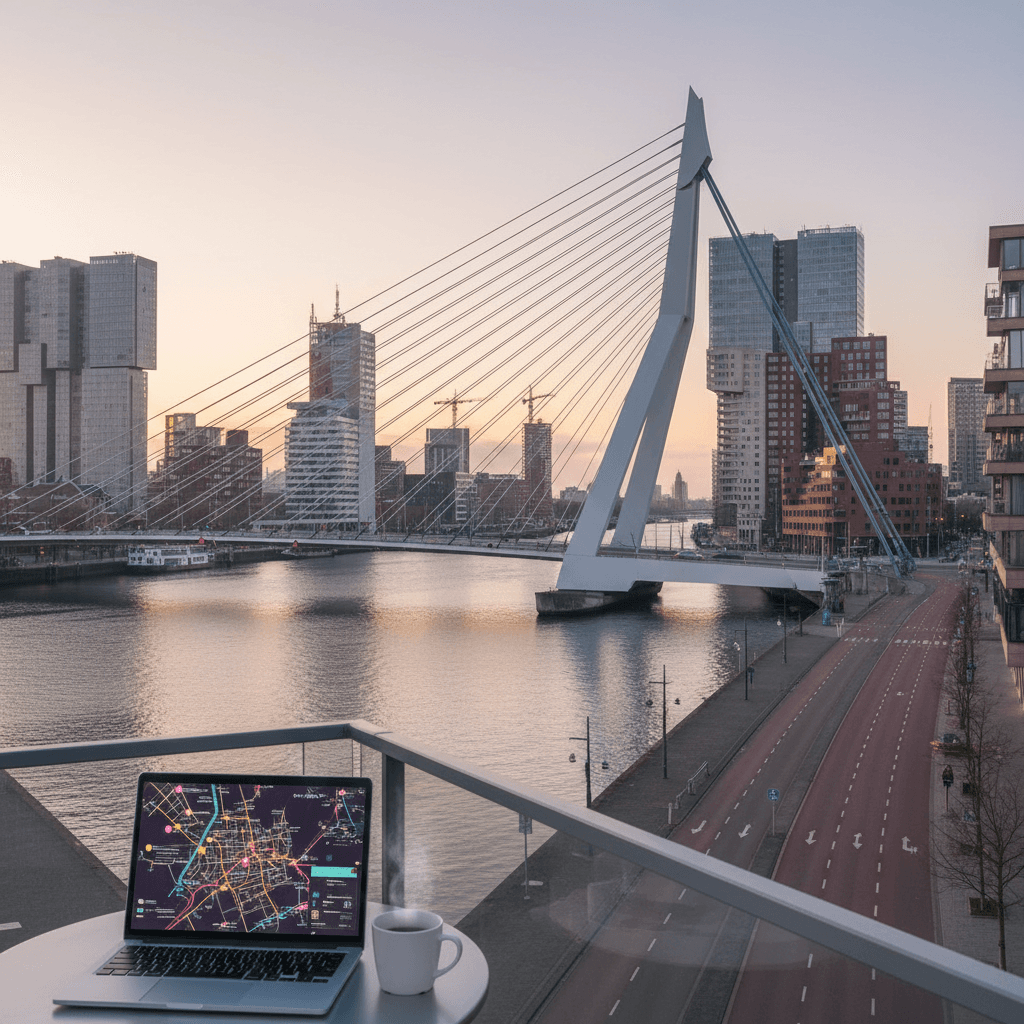
Rotterdam
🇳🇱 Netherlands
The Blueprint of the Future
If Amsterdam is a postcard of the 17th century, Rotterdam is a sketch of the 22nd. After being largely rebuilt following World War II, the city ditched traditional canal houses for a skyline that looks like a giant played with a set of avant-garde building blocks. You'll feel an unmistakable entrepreneurial energy here; it's a place that values "doing" over "talking."
Nomads often find that Rotterdam feels less like a tourist trap and more like a high-tech workshop. The vibe is industrial yet green, with a gritty harbor soul tempered by massive parks and experimental architecture. It’s a city that rewards curiosity, where a nondescript warehouse might house a world-class coffee roastery or a tech incubator.
The Daily Grind and Digital Life
You won't have to hunt for a signal here. With average speeds between 35 and 79 Mbps, the internet is rock solid. Most nomads gravitate toward CIC Rotterdam near the Central Station, where desks start around $475-515 per month (€475) and the networking is top-tier. If you prefer a more community-focused, event-heavy space, StarDock in the shipping district offers day passes for $20 and monthly private offices for about $450.
When you need to clear your head, the city is built for movement. You can bike almost anywhere in 15 minutes, or hop on a tram with an €11-12 day pass. The 112 emergency system and high-quality hospitals like Erasmus MC provide a safety net that makes solo stays stress-free. English is the unofficial second language; you’ll get by perfectly with a simple "Hallo" or "Dank je," though the locals appreciate the effort.
Breaking Down the Budget
Rotterdam isn't exactly a budget destination, but it offers significantly more breathing room than Amsterdam. Expect to spend between $3,000 and $5,000 per month for a comfortable lifestyle. While total monthly expenses for some can hit $5,406, smart planners can keep costs lower by staying just outside the city center.
Cost of Living Tiers
- Budget ($1,800/month): Shared housing in outer districts, lunching on $5 stroopwafels or $10 multicultural bites at Markthal, and relying on a second-hand bike.
- Mid-Range ($3,000/month): A one-bedroom apartment in neighborhoods like Delfshaven, a $100 monthly transport pass, regular coworking memberships, and dining out at mid-range spots for $25.
- Comfortable ($5,000+/month): A sleek studio near the Markthal or the harbor for $1,800, private office space, and upscale dinners at harborside bistros for $40 or more.
Where to Plant Your Flag
The city center, particularly around the harbor and the Markthal, is where the action is. It's walkable and packed with cafes, but you'll pay a premium for the convenience. Expats often recommend the areas near Het Nieuwe Instituut if you want a balance of culture and quiet, or the creative hubs near the port for a more "industrial-cool" atmosphere.
If you're traveling with family or just want more grass under your feet, look toward the outer edges. These neighborhoods are more affordable, with rents between $900 and 1,400, though you’ll trade away the late-night convenience of the central districts. No matter where you stay, grab an eSIM from Holafly or WorldSIM the moment you land to stay connected while you scout your permanent base.
Weather and Timing
The Dutch weather is a frequent topic of conversation, mostly because it’s unpredictable. It rains year-round, so a high-quality raincoat is more important than an umbrella, which will just flip inside out in the North Sea winds. May through September is the sweet spot; the city comes alive with festivals, and the temperatures sit comfortably in the 50s and 60s. December through February can feel bleak and damp, though the indoor cafe culture is designed specifically to combat the winter blues.
The Price of Modernity
Rotterdam isn't exactly a bargain basement destination, but compared to the eye watering prices in Amsterdam, it feels like a strategic win. You're paying for world class infrastructure, a hyper modern aesthetic, and a city that actually works. Most nomads find they need between $3,000 and $5,400 per month to live comfortably here, depending on how much they value a view of the Maas river.
The city operates on a tier system. If you're keeping things lean, you can get by on $1,800 a month by opting for shared housing and sticking to the legendary street food at Markthal. Mid range living usually sits around the $3,000 mark, which covers a private apartment outside the immediate city center, a solid coworking membership, and plenty of nights out at harborside cafes.
Breaking Down the Monthly Budget
- Studio or 1BR Apartment (Central): Expect to pay between €1,200 and €1,800. Areas near the Markthal or the Cube Houses are the most expensive.
- Studio or 1BR Apartment (Outer Neighborhoods): Prices drop to €900 or €1,400. These areas are quieter but still very well connected by tram.
- Coworking Space: A dedicated desk at CIC Rotterdam starts around $250, while a private office at StarDock can run up to $450.
- Food and Drink: A quick lunch at a market stall costs €5 to €10. A nice dinner for two at a mid range spot will set you back €40 to €60.
- Transportation: Most locals just buy a used bike and pay nothing after the initial investment, though you should verify current monthly transit pass pricing if you plan to use the metro and tram regularly.
Housing and Neighborhoods
Expats usually gravitate toward the City Center or the Cool District. It's walkable, packed with bars, and puts you right next to StarDock and other work hubs. The trade off is the noise and the price tag. If you want more space for your Euro, look toward the outer edges near the parks or Het Nieuwe Instituut. These spots are greener and more affordable, though you'll be trading the nightlife for a ten minute commute.
Finding a place can be competitive. Many nomads use platforms like WayToNomad or DigitalNomadHub to scout rentals before they arrive. If you're staying long term, remember that utilities and high speed internet are usually reliable but can add another €150 to €250 to your monthly overhead if they aren't included in your rent.
Eating and Socializing on a Budget
The Markthal is your best friend for affordable, high quality meals. It's a massive, arched hall filled with vendors selling everything from Dutch stroopwafels to Moroccan tapas. You can eat well here for under €15. For coffee and a place to open your laptop for an hour, the cafes around the harbor offer a great atmosphere without the pressure to constantly order more.
Socializing doesn't have to be expensive. The city is full of free summer concerts and festivals. Joining a coworking community like CIC is often the smartest financial move for solo travelers; the $250 monthly fee covers your workspace and gives you access to networking events and a built in social circle, saving you the cost of seeking out expensive expat meetups.
Connectivity and Utilities
Internet in Rotterdam is blazing fast, with speeds typically ranging from 35 to 79 Mbps. You won't struggle to find a connection in any cafe, but for serious work, the coworking spaces are worth the investment. For mobile data, skip the physical SIM cards and grab an eSIM from Holafly or WorldSIM. It's the standard move for nomads arriving at Rotterdam The Hague Airport, giving you instant data for the €10 train ride into the city.
The Nomad Hub: City Center and Markthal
If you want to be in the thick of Rotterdam’s architectural revolution, the Central district is your base camp. Most nomads gravitate here because it’s incredibly walkable and puts you within earshot of the city’s best coffee and workspace. You’re looking at rents between €1,200 and €1,800 for a studio or one bedroom apartment in this area, but the trade off is having everything at your doorstep.
The vibe around the Markthal is high energy. You can grab €5 street food for lunch and then head over to CIC Rotterdam, where desk rates start around €475 per month. It’s a favorite for its networking events and community cafe. If you prefer a more industrial, creative atmosphere, the areas near the port offer that modern energy Rotterdam is famous for. Just keep in mind that the center gets crowded during the summer festival season, and prices reflect the convenience.
- Average Rent: $1,300 to $1,950
- Coworking: CIC Rotterdam or StarDock
- Pros: Excellent WiFi, high bikeability, social atmosphere
- Cons: Higher cost of living, noisier at night
The Expat Choice: Creative Districts and the Port
Expats who are staying for the medium term often move slightly away from the tourist core toward the creative hubs near the water. These neighborhoods feel a bit more "real" and less like a postcard. You’ll find a strong community of international professionals here who value the city’s entrepreneurial spirit. It’s a great middle ground where you’re still close to the StarDock coworking space, which offers private offices for about $450 a month if you need more than just a hot desk.
The dining scene in these pockets is fantastic. You can find mid range meals for €15 to €25, and the harborside cafes are perfect for a Friday afternoon drink. Public transport is so efficient that living ten minutes further out doesn't feel like a chore. A monthly transport pass will run you about €80 to €100, though most expats just invest in a sturdy bike and call it a day.
- Monthly Budget: Approximately $3,000 for a mid range lifestyle
- Top Spot: Harborside cafes and renovated industrial spaces
- Connectivity: Reliable 35 to 79 Mbps speeds
Families: Green Spaces and Quiet Streets
For those traveling with a crew, the outer edges of the city center provide much needed breathing room. Look for neighborhoods near the larger parks or the Het Nieuwe Instituut. These areas are significantly quieter and offer more green space for kids to run around. Rent is also more forgiving here, often falling between €900 and €1,400 for decent sized apartments.
While the nightlife is quieter, the safety levels are excellent. You’ll find plenty of grocery stores and pharmacies nearby, and the air quality is generally better than in the high density center. The commute into the city for a museum visit or a dinner at the Markthal is simple via tram or bus, usually taking less than 20 minutes.
- Average Rent: $980 to $1,500
- Atmosphere: Residential, safe, and family friendly
- Practicality: Near parks and schools with easy tram access
Solo Travelers: Budget-Friendly Outer Rings
If you’re flying solo and trying to keep your burn rate low, the outer neighborhoods are your best bet. You can manage on a budget of about $1,800 a month if you opt for shared housing and stick to the legendary street food scene. It’s a more authentic way to experience the city, away from the $5,000 a month "comfortable" tier lifestyles found in the luxury high rises.
Solo travelers often meet people through local meetups or at cultural spots like Het Nieuwe Instituut, which has an entry fee of about €14. Even in the more affordable areas, English proficiency is nearly universal, so you won't feel isolated. Just keep an eye on your surroundings at night in the lesser known outer edges, though the city is generally very safe for solo explorers.
- Monthly Budget: $1,800 (Budget Tier)
- Transport: €10 day passes or $20 bike rentals
- Social: Best for meeting locals at parks and community cafes
Rotterdam is a powerhouse for connectivity, ditching the old world charm of Amsterdam for a high tech, industrial grit that suits the digital nomad lifestyle perfectly. You won't be hunting for a signal here. The city is blanketed in reliable, high speed fiber and 5G coverage, making it one of the most frictionless places in Europe to get work done.
Connectivity and Speeds
Expect average WiFi speeds to clock in between 35 and 79 Mbps, though many dedicated workspaces and modern apartments push well past 100 Mbps. Most cafes are work friendly, especially in the creative districts near the port. If you need to stay mobile, grab an eSIM from Holafly or WorldSIM before you land. Local providers offer excellent coverage, so you can take a Zoom call from the lawns of Museumpark without a glitch.
Top Coworking Spaces
The coworking scene reflects the city's architectural ambition. It's professional, sleek, and built for networking rather than just occupying a desk.
- CIC Rotterdam: Located right next to the Central Station, this is the heavy hitter. It's a massive innovation hub where you'll rub shoulders with tech entrepreneurs. Monthly desks start around $475-515 (€475/month). The community vibe is strong here, with a dedicated cafe and frequent networking mixers.
- StarDock Rotterdam: If you prefer a view of the water, this spot in the harbor area is a favorite. It feels a bit more intimate than CIC. A day pass will run you about $20, while a private office space for a small team scales up to $450 per month.
- Het Nieuwe Instituut: While it's a cultural center for architecture and design, many nomads frequent its cafe and public spaces for a few hours of deep work. It’s a great spot if you need a creative atmosphere without the commitment of a monthly membership.
Cafe Culture and Remote Work
Rotterdam's cafe culture is less about tourists and more about the local "work hard" mentality. In the central areas near the Markthal, you'll find plenty of spots with solid tables and accessible outlets. Most expats recommend sticking to the creative hubs around the port for a quieter afternoon session. While some smaller spots in the city center might have "no laptop" policies during the busy lunch rush, you'll generally find that if you buy a coffee and a snack, you're welcome to stay for a while.
Costs and Practicalities
Budgeting for your office setup is straightforward. A monthly hot desk in a professional space typically falls between $250 and $450. If you're on a tighter budget, many nomads rely on the city’s public libraries or the spacious lobbies of modern hotels. For banking and payments, Revolut and other fintech apps are the standard. Cash is rarely used; even the smallest street food stalls at the Markthal expect a card or phone payment.
The city's layout makes it easy to jump between your apartment and your office. If you're staying in a central 1BR, you'll likely be within a 10 minute bike ride of the major coworking hubs. Most nomads find that the efficiency of the local infrastructure justifies the higher price tag compared to Eastern Europe. You're paying for reliability and a community that is genuinely focused on the future of tech and design.
Rotterdam is often described as the gritty, cool cousin to Amsterdam. While it lacks the quaint canal houses of the capital, it makes up for it with a high standard of living and a safety profile that ranks among the best in Europe. For digital nomads, the peace of mind here is a major draw, though like any major port city, it requires a bit of local know-how to navigate smoothly.
Staying Secure in the City
Generally, you can walk through most of Rotterdam at any hour without a second thought. The city center, particularly around Markthal and the harbor, is well-lit and active. Most nomads feel perfectly comfortable working late at CIC Rotterdam and walking back to their apartments at midnight. The air quality is excellent and food safety standards are strictly enforced, so you won't have to worry about the basics.
That said, locals suggest staying aware in certain outer neighborhoods after dark. While violent crime is rare, petty theft can happen in crowded areas. To keep your gear safe, follow these tips:
- Watch your bike: This is the most common "crime" in the Netherlands. Always use two locks, a frame lock and a heavy chain, and secure it to a fixed object.
- Laptop safety: While cafe culture is big here, don't leave your MacBook unattended at a table while you grab a refill.
- Nighttime transit: Stick to the main tram lines or apps like Uber if you are heading to the further outskirts late at night.
Healthcare for Nomads
The Dutch healthcare system is world-class, and Rotterdam is home to several top-tier facilities. If you have an emergency, the number to dial is 112. For non-emergencies, you'll likely visit a "Huisarts" (General Practitioner). Most doctors speak perfect English, so there is rarely a communication barrier.
If you are staying long-term on a residence permit, you are legally required to take out Dutch health insurance, which usually costs around €140 to €160 per month. Short-term nomads should ensure their travel insurance covers private clinics. Pharmacies, or "Apotheek," are easy to find and are the only places where you can get prescription meds. For basic needs like ibuprofen or bandages, look for a "Drogist" like Kruidvat or Etos.
Practical Wellness Stats
Staying healthy in Rotterdam is easy thanks to the abundance of green spaces and the biking culture. Here is what you need to know about the local infrastructure:
- Emergency Number: 112 (Police, Fire, Ambulance)
- Tap Water: Completely safe and often tastes better than bottled water.
- Air Quality: High, despite being a major industrial port.
- Hospital Access: Erasmus MC is the primary university medical center centrally located.
Expats often mention that the biggest health challenge here isn't the medical care, but the weather. The gray, rainy winters from October to February can take a toll on your mood. Many nomads recommend taking Vitamin D supplements and joining a local gym or a coworking space like StarDock to stay social and active during the wetter months.
Insurance and Documentation
Always keep a digital copy of your insurance policy on your phone. If you need to visit a doctor, you will often have to pay upfront and claim it back later unless you have a local insurance card. A standard consultation with a GP usually costs between €30 and €50 for those without Dutch insurance. It is a small price to pay for the level of care you receive in a city that prides itself on efficiency and high-tech solutions.
The Logistics of Getting Around
Rotterdam is a dream for anyone who hates being stuck in traffic. The city was largely rebuilt after World War II with a grid like layout that makes it far more spacious and navigable than the cramped, canal lined streets of Amsterdam. Whether you are hopping on a tram or Joining the local bike lanes, moving from your apartment to a coworking space is usually the easiest part of your day.
Public Transport: The RET Network
The city runs on a highly efficient system managed by RET, consisting of trams, buses, and a very clean metro. If you are staying for a month or more, skip the single tickets. Most nomads grab an anonymous OV-chipkaart or just use the newer OVpay system, which lets you tap in and out with your contactless debit card or phone.
- Day Pass: Expect to pay around €11 to €12 for unlimited travel within the city.
- Monthly Subscription: If you are commuting daily, a monthly pass usually runs between €80 and €100.
- Metro Lines: The metro is particularly useful for reaching outer neighborhoods or heading toward The Hague. It is fast, frequent, and rarely feels overcrowded outside of peak rush hour.
Two Wheels Are Better Than Four
You haven't truly lived in Rotterdam until you've navigated a rainy afternoon on a bicycle. The bike infrastructure here is world class, with dedicated lanes that are often wider than the car lanes. It is the primary way locals get to the Markthal for lunch or meet friends at the harbor.
For short term stays, Donkey Republic is a popular app based rental service. If you are sticking around for a few months, look into Swapfiets. For a flat monthly fee, they provide you with a classic blue tired bike and handle all the maintenance. Just remember the local etiquette: always signal your turns and never stop abruptly in the middle of the path.
Ride Hailing and Walking
While the city is spread out, the central core is surprisingly walkable. You can easily trek from the futuristic Rotterdam Centraal station to the creative hubs near the port on foot. When the weather turns sour or you are heading home late at night, Uber is the go to app here. It is reliable and safe, though it can get pricey if you use it as your primary mode of transport. A quick trip across the center will usually cost you at least €15 to €20.
Arrival and Regional Travel
If you are flying into Rotterdam The Hague Airport, you are only about 20 to 30 minutes away from the city center. A bus or train link will cost you roughly €5 to €10, making it one of the most painless airport transfers in Europe. For those arriving via Schiphol in Amsterdam, the high speed Intercity Direct train gets you to Rotterdam Centraal in about 26 minutes.
Regional Connections
One of the best perks of living here is how close you are to the rest of the Randstad. The Dutch rail system (NS) is incredibly punctual. You can be in the historic streets of Leiden or the political hub of The Hague in 30 to 40 minutes. It makes day tripping easy without needing to pack a bag or plan weeks in advance.
- Rotterdam to The Hague: 25 minutes by train.
- Rotterdam to Utrecht: 40 minutes by train.
- Waterbus: For a more scenic route, take the Waterbus from the Erasmus Bridge to reach the windmills at Kinderdijk or the city of Dordrecht. It accepts the same OV-chipkaart as the trams.
The English Advantage
You can breathe easy in Rotterdam. While Dutch is the official language, the Netherlands consistently ranks at the top of global English proficiency charts. In this city, English isn't just a second language; it's a primary tool for business, tech, and social life. You'll find that almost everyone from the barista at Markthal to the librarian at the Erasmus University speaks English fluently and without hesitation.
Most nomads find they can live here for months or even years without mastering Dutch. Menus, transit signs, and government websites are frequently bilingual. However, the local culture appreciates the effort of a "Hallo" (hello) or a "Dank je" (thank you). It breaks the ice, even if the conversation immediately switches back to English the moment they hear your accent.
Digital Connectivity and Apps
Staying connected is seamless. Most cafes and public spaces offer fast, reliable WiFi with speeds often hitting between 35 and 79 Mbps. If you're working from hubs like StarDock or CIC Rotterdam, you'll get enterprise-grade fiber that handles video calls and heavy uploads without a hiccup.
For your phone, don't rely on roaming fees. Expats recommend grabbing an eSIM before you land. Holafly and WorldSIM are the go-to choices for nomads who want data the second they touch down at Rotterdam The Hague Airport. If you prefer a physical SIM, local providers offer excellent 5G coverage throughout the city center and the harbor areas. For quick translations of complex documents or grocery labels, Google Translate is your best friend, though you'll rarely need it for spoken interactions.
Social Etiquette and Communication Style
Rotterdammers have a reputation for being more direct than their neighbors in Amsterdam. They value honesty and efficiency. If someone disagrees with you, they'll tell you plainly. It isn't rudeness; it's a cultural preference for clarity. In a professional setting at a coworking space, expect meetings to start exactly on time and for feedback to be blunt.
Socializing often happens in "third places" like the creative hubs near the port or the greenery of the city parks. To meet people, look for nomad meetups at CIC or join expat groups that frequent the Het Nieuwe Instituut. Dutch social circles can sometimes feel tight-knit, but the international nature of the city's tech and maritime industries means there's always a rotating cast of outsiders looking to connect.
Key Phrases for Your Pocket
- Hallo: Hello (Your universal opener)
- Dank je: Thank you (Simple and polite)
- Alstublieft: Please / Here you go (Used when ordering or paying)
- Spreekt u Engels?: Do you speak English? (Though 99% of the time, the answer is yes)
- Lekker: Tasty / Nice (Used for food, weather, or a good vibe)
Practical Communication Tips
- Bike Etiquette: Communication on the road is mostly non-verbal. Always yield to pedestrians, but stay predictable in the bike lanes. Use hand signals for turns to avoid the ire of local commuters.
- Digital Payments: While not strictly language, communication with merchants is digital. Cards and fintech apps like Revolut are the standard. Some smaller shops are "Pin Only," meaning they won't even accept cash.
- Emergency Contact: If you need help, the EU standard 112 works here. Operators are trained to handle calls in English, Dutch, and often German or French.
The Seasonal Reality
Rotterdam has a temperate maritime climate, which is a fancy way of saying you should always have a raincoat in your bag. The weather here is unpredictable, often shifting from bright sun to a grey drizzle within an hour. Average monthly temperatures fluctuate between 11 and 53 degrees Fahrenheit, though the wind coming off the North Sea often makes it feel a bit sharper than the thermometer suggests.
The city doesn't really have a dry season. Rain is a year round companion, but the character of that rain changes. Fall and winter, specifically from October through February, bring a consistent, misty dampness and shorter days. If you're planning a deep work sprint where you don't mind staying tucked away in a cafe, this period is manageable. If you want to see the city's famous architecture in its best light, aim for the warmer months.
When to Touch Down
Most nomads agree that May through September is the sweet spot for a Rotterdam residency. The days are long, the city's many parks actually get some use, and the outdoor seating at harborside cafes becomes the primary social hub. This is also when the city's festival calendar kicks into high gear, transforming the industrial aesthetic into something much more lively.
While summer is peak season, Rotterdam doesn't suffer from the same claustrophobic tourist crowds you'll find in Amsterdam. You can still find a seat at a cafe in the Markthal or a desk at CIC Rotterdam without much drama. July and August are the warmest months, but even then, temperatures rarely become oppressive, making it an ideal escape if you're trying to avoid the heatwaves hitting Southern Europe.
The Low Season Grind
The months of December, January, and February are generally considered the worst time to visit. It's cold, grey, and the wind whipping through the wide, modern boulevards can be brutal. However, there's a certain "gezellig" (cozy) atmosphere in the bars around Witte de Withstraat during these months. If you're on a tighter budget, you might find slightly better deals on short term rentals through platforms like WayToNomad during this window, though Rotterdam's housing market remains competitive year round.
Packing and Preparation
Experience tells most expats that an umbrella is often useless against the Rotterdam wind; it'll just end up inside out. Invest in a solid, waterproof shell instead. If you're planning to adopt the local lifestyle and get around by bike, waterproof trousers are a lifesaver for those sudden afternoon showers.
- Best for Festivals: June to August. Expect mild weather and plenty of outdoor events near the port.
- Best for Budget: November or January. Flights and temporary housing are slightly more accessible.
- Best for Biking: May and September. The breeze is refreshing rather than freezing, and the paths are clear.
Seasonal Cost Expectations
While the weather changes, the cost of living stays relatively stable throughout the year, though social spending usually spikes in the summer when the terraces open up. Here is what to budget for your stay:
Monthly Budget Estimates
- Budget Tier: $1,800. This covers a room in a shared house, plenty of €5 to €10 meals at the Markthal, and relying on a public transport day pass for €11-12.
- Mid Range Tier: $3,000. This gets you a studio in an outer neighborhood, frequent mid range dining at €15 to €25 per meal, and a dedicated desk at a spot like StarDock for $450 a month.
- Comfortable Tier: $5,000+. This covers a central 1BR apartment near the harbor, upscale dining, and a private office space.
Making the Move
Rotterdam isn't your typical European postcard city. It's a high tech, grit meets glam hub where the cranes are as much a part of the skyline as the skyscrapers. While Amsterdam feels like a museum, Rotterdam feels like a laboratory. It's built for people who actually want to get things done, which is why the digital nomad community here is growing so fast. You'll find the vibe is direct, hardworking, and surprisingly green for an industrial powerhouse.
The Cost of Living
You'll need a healthy budget to live comfortably here. Most nomads find they spend between $1,800 on the low end and upwards of $5,400 for a high end lifestyle. Here is a breakdown of what to expect monthly:
- Budget ($1,800): Shared housing in outer neighborhoods, cooking at home with occasional street food at Markthal, and relying on a second hand bike.
- Mid-range ($3,000): A private one bedroom apartment outside the city center, regular dining out, a dedicated coworking desk, and a mix of public transport and cycling.
- Comfortable ($5,000+): A modern apartment near the harbor or Markthal, frequent upscale meals, a private office, and plenty of weekend travel.
Where to Set Up Base
Choosing a neighborhood depends on how much you value peace versus proximity to the action. The central areas near the harbor and Markthal are the most popular for expats because everything is walkable. You'll pay a premium though, with rents for a studio or one bedroom ranging from €1,200 to €1,800. It's busy, but you're steps away from the best coffee shops and networking events.
If you prefer a quieter life, look toward the outer edges near Het Nieuwe Instituut. These areas offer more parks and a slower pace for €900 to €1,400 a month. You'll have a longer commute, but the city's bike infrastructure is so good that "far away" usually just means a 15 minute ride.
Working and Connectivity
The internet is blazing fast, usually averaging between 35 and 79 Mbps. You won't struggle for a signal anywhere in the city. For mobile data, skip the physical SIM cards and grab an eSIM from Holafly or WorldSIM before you land. It’s the easiest way to stay connected the moment you hop off the train.
When you need a professional environment, Rotterdam has some of the best coworking spaces in the Netherlands:
- CIC Rotterdam: Located right by the Central Station, it's a massive innovation hub. Desks start around $475-515 per month (€475), and the networking opportunities are top tier.
- StarDock Rotterdam: A bit more intimate with a great community feel. A day pass is about $20, while a monthly private office can go up to $450.
Getting Around
Public transport is seamless. A day pass for the trams, buses, and metro costs about €10, while a monthly pass sits between €80 and €100. That said, do as the locals do and get a bike. The city is incredibly bikeable, just remember the golden rule: yield to pedestrians and keep to your lane. If you're coming from the airport, the transfer takes only 20 to 30 minutes and costs roughly €5 to €10.
Eating and Socializing
The Markthal is the city's culinary heart. You can grab multicultural street food for €5 to €10, or sit down for a mid range meal elsewhere for €15 to €25. For a night out, the harborside cafes are the place to be, especially during the summer festival season. If you're looking to meet people, skip the bars and head to the coworking events at CIC or join an expat group meeting up at Het Nieuwe Instituut.
Practicalities to Know
English is spoken almost everywhere with near perfect proficiency. You can get by without a word of Dutch, though a quick "Hallo" or "Dank je" goes a long way. For money, keep a card on you at all times. Fintech apps like Revolut are the standard here, and many places are becoming cashless. Finally, pack an umbrella. The weather is temperate but rainy year round, with the best window for visiting being May through September when the sun actually makes an appearance.
Need visa and immigration info for Netherlands?
🇳🇱 View Netherlands Country GuideEasy Landing
Settle in, no stress