Netherlands
Complete Digital Nomad Guide

Policy Stability
Stamped Nomad ExclusiveHow likely visa and immigration policies are to remain unchanged
Quick Facts
Nomad Visa Cost
N/A
Income Requirement
$1,742/mo
Renewable
No
Cost of Living
$2,700/mo
Avg Internet
240 Mbps
Safety Score
8/10
Healthcare
High
Coworking
High
English Friendly
High
Time Zones
CET
Entry Methods Available
Best For
The Netherlands is a powerhouse for digital nomads, but its visa system is famously precise. Whether you are planning a 90-day summer in Amsterdam or looking to plant roots in Utrecht for a few years, you need to understand the distinction between short-stay access and long-term residence permits.
Short-Stay and Schengen Access
For most nomads, the journey starts with a Schengen C-type Visa. This allows you to travel within the Schengen Area for a maximum of 90 days within a 180-day period. It is strictly for tourism or family visits, meaning you aren't legally permitted to take up local employment while on this visa.
If you are visiting for professional reasons, such as attending a tech conference in Eindhoven or meeting with a Dutch client, you can apply for a Business Visa. This also covers short-term training or seminars and follows the same 90-day limit. For those simply passing through, an Airport Transit Visa is required if you are changing flights at a Dutch airport without officially entering the country.
The 2026 ETIAS Shift
If you hold a passport from a visa-exempt country like the USA, UK, Canada, or Japan, you currently enjoy visa-free entry. However, a major change is arriving in the last quarter of 2026. The European Travel Information and Authorization System (ETIAS) will become mandatory.
Once implemented, travelers from visa-exempt nations must complete an online application before boarding a flight or ferry to the Netherlands. You will need to provide personal details and travel plans via the official app or website. It is a quick digital hurdle, but failing to have your ETIAS authorization ready will result in being denied boarding.
Long-Stay Options for Nomads and Expats
If 90 days isn't enough, you will need to look into a residence permit. Most long-term stays begin with an Authorisation for Temporary Stay (MVV). This is a provisional sticker in your passport, valid for 90 days, that acts as a bridge while your long-term permit is processed. Your passport must be valid for at least 6 months from the date you receive this sticker.
For those looking to work or start a business, the Netherlands offers several specific pathways through the official immigration portal:
Highly Skilled Migrant Permit: This is a popular route for tech talent. It costs €380 and is valid for 5 years. To qualify in 2026, you generally need a 12-month contract and a gross monthly salary of €5,942 (or €4,754 if you are a recent graduate).
Orientation Year Permit (Zoekjaar): If you recently graduated from a top-200 global university, this permit lets you live in the Netherlands for one year to find work or launch a startup with no minimum salary requirement.
EU Blue Card: Designed for highly qualified workers, this costs €380, is valid for 4 years, and offers the flexibility of self-employment.
General GVVA (Single Permit): A standard work permit costing €380, valid for 1 year and renewable for up to 5 years.
Startup Visa: Entrepreneurs with an innovative business idea can apply for a specific residence permit for foreign startups, which provides a year to get the business off the ground with the help of a facilitator.
EU/EFTA National Privileges
If you hold a passport from an EU country, Norway, Iceland, Liechtenstein, or Switzerland, the rules are much simpler. You do not need a work permit, study permit, or any form of visa to live or work in the Netherlands. Your valid national ID or passport is all you need to enter and stay indefinitely, though you will still need to register with the local municipality if staying longer than four months.
The Reality of the Dutch "Digital Nomad" Setup
Let’s start with a quick reality check. If you are looking for a specific, one-click "Digital Nomad Visa" in the Netherlands, you won't find one. The Dutch government hasn't hopped on the bandwagon of creating a dedicated remote work visa like some of its Mediterranean neighbors. However, that doesn't mean you can't live and work here as a freelancer or business owner.
Most nomads who decide to call the Netherlands home for more than three months use the Residence Permit for Self-Employed Persons. It is a bit more paperwork-heavy than a standard nomad visa, but it offers a stable path to living in one of Europe’s most connected hubs. If you are a US citizen, you have a massive advantage thanks to a specific treaty that makes this process much smoother.
The Self-Employed Residence Permit
For most non-EU citizens, this permit is the standard route. The Dutch Immigration and Naturalisation Service (IND) uses a points-based system to decide if your business adds value to the local economy. They look at your personal experience, your business plan, and whether your work is truly innovative or necessary for the Netherlands.
Here are the core requirements to keep on your radar:
- Income Minimums: You need to show a gross monthly profit of at least €1,613. In practice, most advisors suggest showing closer to €2,000 per month to ensure your application is viewed favorably.
- Business Registration: You must register your business with the Dutch Chamber of Commerce, known locally as the KVK.
- Investment: Usually, you need to show you are investing at least €4,500 into your business venture.
- Duration: This permit is typically granted for 2 years and can be renewed as long as your business remains profitable.
The application involves submitting a detailed business plan and proving you have the right qualifications. You will also need to handle biometrics and, depending on your nationality, apply for a provisional residence permit (MVV) before you arrive. You can check the specific requirements for your country on the official IND website.
The DAFT Shortcut for Americans
If you hold a US passport, the Dutch-American Friendship Treaty (DAFT) is your best friend. This treaty bypasses the difficult points-based system entirely. As long as you are starting a business and can maintain a minimum investment of €4,500 in a Dutch bank account, you are almost guaranteed approval.
Many American nomads set themselves up as a "sole proprietorship" (eenmanszaak) and use this to invoice their existing remote clients back in the States. It is one of the easiest ways for a non-EU citizen to gain residency in the Schengen Area. Plus, you might be eligible for the 30% tax ruling, which can significantly lower your tax burden for the first few years.
Taxes and Local Living
The Netherlands is a "high tax, high service" country. If you stay longer than 183 days in a year, you are considered a full tax resident. This means you will owe Dutch taxes on your worldwide income. You will also be required to take out Dutch health insurance, which is mandatory for all residents and usually costs around €130 to €150 per month.
While the paperwork can feel daunting, the payoff is a base in a country where English is spoken fluently by almost everyone, the trains run on time, and some of the world's best cafes are your new office. Just remember that this permit is for those running a business or freelancing; if you are a traditional remote employee for a foreign company, you may need to restructure as a contractor to make the legal side work.
Quick Summary of Requirements
- Proof of Funds: At least €4,500 in business capital.
- Monthly Profit: Minimum €1,613 (gross).
- Registration: Mandatory KVK (Chamber of Commerce) appointment.
- Health Insurance: Private Dutch policy required upon arrival.
- Criminal Record: A clean background check is mandatory.
For those just looking for a summer stint, remember that many nationalities can stay for up to 90 days within a 180-day period on a standard Schengen visa-free entry. If you want to stay longer and truly integrate, starting the self-employed permit process early is the way to go.
The Short-Term Reality
The Netherlands is a core member of the Schengen Area, which means your entry requirements depend entirely on the passport in your pocket. For many digital nomads from countries like the USA, UK, Canada, Australia, and Japan, you can roll into Schiphol Airport without a pre-arranged visa. You are granted 90 days of travel within any 180-day period. It is a rolling window, so if you spend 90 days in the Netherlands (or anywhere else in the Schengen zone), you have to leave the entire area for another 90 days before you can return.
Things are shifting slightly in late 2026. If you are from a visa-exempt country, you will soon need to apply for an ETIAS (European Travel Information and Authorisation System) before you fly. This is not a visa; it is a quick digital screening that costs €7 and stays valid for 3 years. It is free for travelers under 18 or over 70. Until that system fully launches, your valid passport is all you need to clear border control.
The Schengen Type C Visa
If your nationality is not on the visa-exempt list, you will need to apply for a Schengen Type C visa. Unlike some digital-friendly hubs, the Netherlands does not offer an e-visa or a visa on arrival. You have to do this the old-fashioned way by visiting a Dutch consulate or a designated visa center like VFS Global in person.
The standard fee is €80 for adults and €40 for children aged 6 to 12. Expect a processing time of about 15 days, though it is smart to apply at least a month before your flight. You will need to provide biometrics (fingerprints and a photo) during your appointment. To get the green light, you will generally need to show:
A passport issued within the last 10 years with at least two blank pages and 3 months of validity left after your planned departure.
Proof of travel insurance with at least €30,000 in medical coverage.
Bank statements proving you have enough funds to support yourself during your stay.
A confirmed return flight and proof of your accommodation or itinerary.
Staying Within the Lines
The Dutch are famously organized, and that extends to their borders. The new Entry/Exit System (EES), rolling out in late 2025, replaces manual passport stamps with a biometric database. This system tracks exactly how many days you have used, making it nearly impossible to "accidentally" overstay your 90-day limit. If you do overstay, you are looking at fines starting around €500 and a potential entry ban that could keep you out of Europe for up to 5 years.
Border runs do not work the same way here as they might in Southeast Asia. Since the 90-day limit applies to the entire Schengen Area, you cannot just hop over to Germany or Belgium to reset your clock. You have to leave the Schengen zone entirely, perhaps heading to the UK, Ireland, or Turkey, and you still have to respect that 180-day calculation. Extensions are almost never granted for tourism or remote work; they are reserved for genuine emergencies like medical crises or flight cancellations due to natural disasters.
Making the Move: Long-Term Residency
The Netherlands doesn't have a specific "digital nomad visa" yet, but that doesn't mean you're stuck with a 90-day limit. If you want to make the land of canals and bicycles your home base, you'll need to look at specific residence permits. For most non-EU/EEA citizens, this involves a two-step process: getting an MVV (provisional residence permit) to enter the country and a GVVA (single permit) to stay and work.
The Dutch immigration system is famously efficient, but it is also strict. You'll need to choose a path that fits your professional profile, whether you're bringing a business idea with you or looking to join a Dutch firm.
The Freelance and Startup Path
If you're self-employed, the Self-employed/Freelancer pathway is your most likely route. This isn't a "set it and forget it" application. You have to prove that your business serves a Dutch interest. The IND uses a point-based system to evaluate your experience, your business plan, and the added value you bring to the local economy.
For those with a scalable, innovative idea, the Dutch Start-up visa is a fantastic alternative. This gives you one year to launch your business under the guidance of an experienced mentor, known as a facilitator. It’s a lower barrier to entry for entrepreneurs who have the vision but might not meet the strict points requirement of the standard freelance visa yet.
The Highly-Skilled Migrant Route
If you prefer the security of a paycheck, the Highly-skilled migrant visa is the gold standard. To qualify, you must be hired by a company that is a "recognized sponsor" by the IND. There are also specific salary thresholds you must meet, which are adjusted annually based on your age.
- Employer Sponsorship: Your company handles most of the paperwork.
- Fast-Track Processing: These permits are often issued much faster than other categories.
- Official Requirements: You can check the specific criteria for highly qualified workers to see if your profession fits.
The Orientation Year (Zoekjaar)
If you’ve recently graduated from a top-ranked university globally or completed a degree in the Netherlands, you might be eligible for the Orientation Year visa. This is a massive win for young professionals. It gives you 12 months to live in the Netherlands and work for any employer without them needing to sponsor your permit. It’s essentially a one-year bridge to find a permanent role or start your own company.
Family and Other Options
The Netherlands has a very progressive view on family reunification. If your partner has a legal right to live and work here, you can often apply for a residence permit to join them. This applies to married couples, registered partners, and even long-term unmarried partners, provided you can prove the relationship is exclusive and stable.
Other niche options exist for scientific researchers and intra-corporate transferees. These are usually handled by the HR departments of large universities or multinational corporations. If you are being moved by your current company to a Dutch branch, this is the path of least resistance.
Key Logistics to Remember
Once you arrive, your to-do list will grow quickly. You must register with the local municipality (the Basisregistratie Personen or BRP) within 5 days of arrival to get your BSN (citizen service number). You cannot open a bank account, get health insurance, or receive a salary without this number.
- Biometrics: You'll need to visit an IND office shortly after arrival to provide fingerprints and a photo.
- Health Insurance: You are legally required to take out Dutch private health insurance within 4 months of your residence permit being granted.
- Tuberculosis Test: Depending on your nationality, you might be required to undergo a TB test at a local health authority (GGD) within 3 months of arriving.
While the Netherlands doesn't offer a "Golden Visa" or a simple retirement permit, the professional pathways are clear and well-documented. If you have the skills or a solid business plan, the Dutch government is generally eager to welcome you into the fold.
The Price of Dutch Living
The Netherlands isn't exactly a bargain basement destination, but it offers a high quality of life that often justifies the price tag. On average, you can expect to spend between $1,835 and $2,400 per month as a solo traveler. While that might sound steep, it actually sits about 25% cheaper than living in a major US metro area. Your biggest hurdle will be the housing market, which is currently tight across the entire country.
If you are coming from the US or UK, you will notice that while rent is high, your daily expenses like groceries and healthcare feel much more manageable. The trick to keeping your bank account healthy here is simple: live like a local. That means trading the Uber for a refurbished swapfiets and choosing the neighborhood market over the high-end expat grocery stores.
Breaking Down Your Monthly Budget
How much you spend depends entirely on your tolerance for shared bathrooms and how often you crave a restaurant meal. Here is how the tiers generally shake out for 2026:
- The Budget Nomad ($1,740/month): You are likely living in a secondary city like Enschede or Leeuwarden, or perhaps sharing a flat in the suburbs of a larger city. You cook most meals at home, use a bicycle as your primary transport, and use basic coworking memberships or cafes.
- The Comfortable Nomad ($2,600–$3,500/month): This is the sweet spot. You can afford a private one-bedroom apartment in cities like Utrecht or Haarlem. You eat out a few times a week, maintain a dedicated desk at a coworking space, and have enough left over for weekend trips to neighboring EU countries.
- The Premium Nomad ($4,570+/month): This tier is for those who want a canal-side apartment in the heart of Amsterdam. It covers high-end dining, premium coworking offices with all the bells and whistles, and private transport when the weather turns sour.
The Geography of Your Wallet
Where you plant your flag determines your overhead. Amsterdam is the undisputed heavyweight champion of high prices, but the rail system is so efficient that living thirty minutes away can save you a fortune.
Amsterdam
- One-Bedroom Apartment (Center): $2,500
- One-Bedroom Apartment (Suburbs): $1,300
- Coworking Space: $250–$600
- High-Speed Internet: $57
The "Big Three" Alternatives (The Hague, Utrecht, Haarlem)
- One-Bedroom Apartment: $1,000–$1,500
- Coworking Space: $150–$400
- Monthly Transport: $150–$200
The Nitty Gritty: Food, Transport, and Tech
Housing will eat up a large chunk of your change, but other costs are more flexible. Groceries are surprisingly affordable if you shop at chains like Albert Heijn or Jumbo, with a monthly bill averaging around $150 for a single person. Dining out is where things get pricey; a mid-range meal can easily run you $30 to $50, while a quick snack at a "FEBO" wall will only cost a few bucks.
Transportation is another significant line item, averaging about $465 monthly if you rely on trains and trams. However, the Netherlands is the world leader in cycling infrastructure. Investing $150 in a used bike or a monthly subscription service can almost eliminate your commute costs entirely. It is the single best way to lower your cost of living while getting a bit of cardio in.
For the digital side of your life, fiber broadband is the standard. Expect to pay between $30 and $70 depending on your speed requirements. If you are a resident, mandatory state healthcare is about $150 per month, which is incredibly consistent and provides excellent coverage compared to private international plans.
If you are ready to start looking for a place, check out listings on Pararius or Funda to get a real-time feel for the current housing market.
Amsterdam: The High-Octane Hub
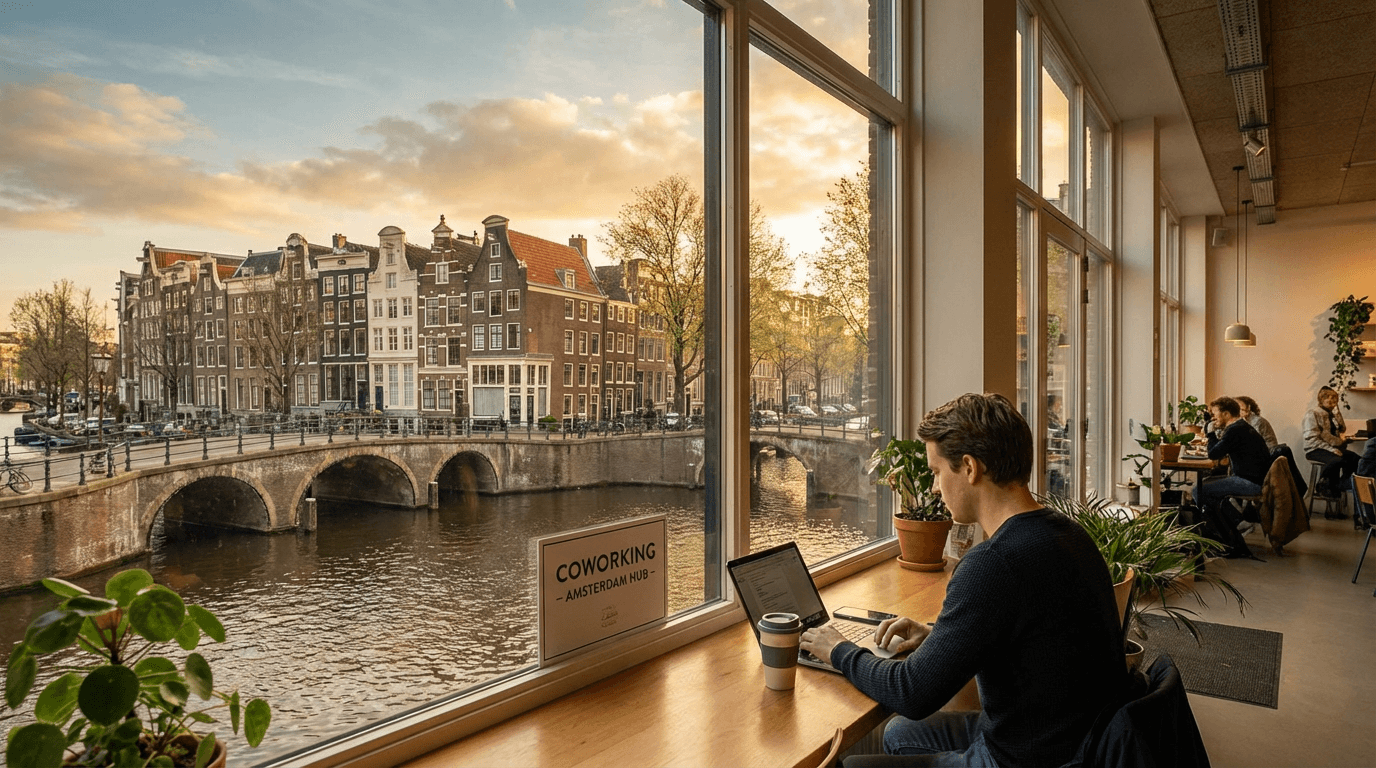
If you want to be at the center of the action, Amsterdam is the obvious choice. It is a world-class startup ecosystem where networking happens naturally over bitterballen and craft beers. The city feels like an open-air museum, yet it functions with ultra-modern efficiency.
- Monthly Cost: Approx. €3,000–€3,300
- The Vibe: Historic canals meet a relentless hustle. It is crowded and touristy, but the sheer volume of coworking spaces like Dam Coliving and The Social Hub makes it the easiest place to plug in and start working.
- Internet & Community: Speeds average 87+ Mbps. You will find the largest expat and nomad community in the country here.
- Pros: Unbeatable nightlife, world-class museums, and a massive international network.
- Cons: The housing market is brutal and prices are the highest in the Netherlands.
Utrecht: The Balanced Alternative
Often described as a smaller, more manageable Amsterdam, Utrecht offers a serene pace of life without sacrificing the "cool" factor. The medieval center is built around unique wharfside cafes that sit right at water level, perfect for an afternoon laptop session.
- Monthly Cost: Approx. €2,600
- The Vibe: Academic, historical, and decidedly local. It feels less like a tourist trap and more like a lived-in community.
- Internet & Community: Ultra-fast fiber is standard. The nomad scene is solid, though smaller than the capital.
- Pros: High quality of life, less hectic than Amsterdam, and perfectly central for train travel.
- Cons: A quieter nightlife scene that might feel too small for some.
Rotterdam: The Creative Powerhouse
Forget the traditional gabled houses; Rotterdam is all about bold, experimental architecture and a gritty, industrious energy. It was rebuilt after WWII, resulting in a skyline that looks more like New York than Old Europe. It is the best fit for designers, architects, and those who prefer a modern aesthetic.
- Monthly Cost: Approx. €2,500
- The Vibe: Edgy, spacious, and incredibly diverse. The food scene here is arguably the best in the country, thanks to the massive Markthal and various international neighborhoods.
- Internet & Community: A thriving creative hub with spaces like StarDock and CIC offering desks from $250 per month.
- Pros: More affordable than Amsterdam, less crowded, and home to a very welcoming creative class.
- Cons: It lacks the "quaint" Dutch charm some travelers expect.
Groningen: The Youthful Budget Pick
Located in the north, Groningen is a true university city. Since a huge portion of the population is students, the city stays vibrant, innovative, and relatively cheap. It is far from the Randstad bubble, giving it a distinct, independent character.
- Monthly Cost: Approx. €2,500
- The Vibe: Energetic and unpretentious. The nightlife is legendary because the bars here do not have mandatory closing times.
- Internet & Community: Excellent speeds with plenty of student-focused cafes and workspaces.
- Pros: Very budget-friendly and easy to navigate by bike.
- Cons: It is a 2-hour train ride from the major hubs of the south.
Eindhoven: The Tech Frontier
Known as the "Dutch Silicon Valley," Eindhoven is the place for hardware geeks and tech entrepreneurs. It is the home of Philips and dozens of cutting-edge design firms. While it is more business-oriented than the other cities, it is growing rapidly as a nomad destination.
- Monthly Cost: Approx. €2,500
- The Vibe: Industrial-chic. Much of the action happens in repurposed factories like the Strijp-S district, which houses lofts, cafes, and workspaces.
- Internet & Community: Highly tech-focused with a growing startup community.
- Pros: Great for networking in the tech and design sectors; very high safety ratings.
- Cons: The city center can feel a bit functional and lacks the "cozy" vibe of Utrecht or Amsterdam.
Regardless of which city you pick, the infrastructure remains consistent across the board. You can rely on 87+ Mbps internet, exceptional public transit, and a population that speaks near-perfect English. For more details on logistics, check the official immigration portal to see which city fits your visa requirements.
The Netherlands is a powerhouse of digital infrastructure, making it one of the easiest places in Europe to stay connected while you work. You aren't just looking at basic Wi-Fi here; the country is blanketed in high-speed fiber, especially in the "Randstad" area which includes Amsterdam, Rotterdam, and Utrecht. In these urban hubs, enterprise-grade speeds between 100 Mbps and 1000 Mbps are the standard for professional environments.
Reliability and Fiber Access
If your job involves heavy video rendering or constant Zoom calls, you'll want to stick to the major coworking brands. These spaces prioritize fiber connections and usually offer backup lines to ensure you never go dark during a meeting. Most dedicated desks also come with Ethernet ports if you prefer a hardwired connection for extra stability.
While the cities are a dream for connectivity, keep in mind that rural areas can still face broadband gaps. If you're eyeing a quiet farmhouse in the countryside, always ask for a speed test before booking. For those working from cafes, the Wi-Fi is generally decent but can get spotty during the lunch rush. It is a smart move to keep a local SIM or eSIM active for those moments when you need a stable hotspot while transit hopping between cities.
Top Coworking Hubs
Amsterdam is the heart of the scene with over 62 spaces, but the surrounding cities are catching up fast with specialized tech hubs and smart offices.
- Regus: This is your best bet for nationwide coverage. They offer flexible monthly plans that let you drop into locations across the country, which is perfect if you like to change scenery often.
- StartDock: With a growing presence in Amsterdam and Utrecht, they offer a more community-focused vibe. Day rates usually hover around €27 to €28.
- Tribes: Known for high-end interiors and ergonomic setups, their Amsterdam sites are great for client meetings, though they lean more toward the premium side at roughly €39 per hour for meeting spaces.
- B.Amsterdam: One of the largest startup ecosystems in Europe. It feels less like an office and more like a campus, complete with a rooftop restaurant and gym.
- Workspace6: A fantastic budget-friendly option in the capital, offering day passes for as low as €15.
The Cost of Staying Connected
Pricing is flexible depending on how long you plan to stay. If you're just passing through, day rates in the major cities typically fall between €15 and €40. For those staying a month or longer, the math changes in your favor.
- Hot Desks: Expect to pay around €150 to €250 per month for flexible seating.
- Dedicated Desks: These usually start at €300+ but often include 24/7 access and a locker.
- Regus Membership: Their global access plans can bring costs down to roughly €7 per day if you commit to a longer-term monthly arrangement.
Mobile Data and Connectivity Tips
Don't rely solely on public Wi-Fi. The Netherlands has excellent 4G and 5G coverage, and having a backup is vital for the occasional outage or for working on the Sprinter trains. You can find more listings and local recommendations through the I amsterdam portal, which is a great resource for scouting new spots.
The market is shifting toward "smart offices" and AI-integrated workspaces, with new projects like Norrsken House Amsterdam leading the way. Whether you need a quiet booth for a private call or a massive networking event, the Dutch infrastructure is built to handle it without a hitch.
Healthcare Quality and System Structure
The Dutch take their health seriously, and the system reflects that. You’ll find some of the highest medical standards in Europe here, with a heavy focus on primary care. Most of your interactions will start with a GP (Huisarts), who acts as the gatekeeper to specialists and hospitals.
One thing to keep in mind is that the Netherlands doesn’t use a centralized national database for patient records. If you move between cities or see different providers, your medical history won't automatically follow you. It’s a good idea to keep digital copies of your own records to show new doctors.
The Mandatory Insurance Rule
If you plan on becoming a resident, the law is clear: you must have Dutch health insurance (basisverzekering). This applies to anyone living in the country, including freelancers and self-employed nomads who have registered with the local municipality.
The timeline for getting covered is strict. EU and EEA nationals have four months from the date they register at city hall to sign up. Non-EU expats have the same four-month window, but the clock starts once you receive your residence permit. If you miss these windows, you could face significant fines.
Monthly Premiums: Expect to pay around €100 to €150 per month for basic coverage.
The Deductible (Eigen Risico): There is a mandatory deductible, usually set around €385 per year. You pay this amount out of pocket before the insurance kicks in for most services, though GP visits are typically exempt.
Coverage: The basic package covers GP visits, hospital stays, emergencies, and most prescription meds.
Insurance Options for Digital Nomads
If you are just passing through or haven't secured a BSN (Citizen Service Number) yet, you won't be able to sign up for the local Dutch insurance. For this middle period, you'll need international nomad insurance or expat health coverage. These plans are flexible and can usually be cancelled the moment your Dutch policy begins.
EU citizens on short-term stays can use their EHIC card for medical needs as long as they aren't working for a Dutch employer. If you’re a nomad working remotely for a company back home, this card is a lifesaver for temporary visits.
Emergency Care and Pharmacies
In a crisis, the Dutch system is incredibly efficient. Emergency services are available to everyone, regardless of their insurance status. The country uses a unique Accident Compensation Corporation (ACC) style of coverage that ensures people get help immediately after an accident.
For everyday meds, pharmacies (Apotheek) are everywhere. Most basic prescriptions are covered by your insurance, but keep in mind that Dutch doctors are famously conservative with prescriptions. They prefer your body to do the work, so don't be surprised if you're told to take some paracetamol and rest instead of getting a heavy antibiotic.
Registration and Getting Started
You can't get insurance without a BSN. To get one, you must register with your local municipality within five days of arriving in the country. This number is the key to your life in the Netherlands; you'll need it for your bank account, your housing contract, and your health policy.
Once you have your BSN, you can compare providers on sites like Independer or Zorgverzekering.org. Most nomads opt for a basic plan and add a "supplementary" module for things like dental care or physiotherapy, as these aren't fully covered in the standard package.
Approximate Costs
Standard Monthly Premium: €110 - €140
Annual Deductible: €385
GP Visit: Usually 100% covered by basic insurance
Dental Cleanings: €50 - €100 (if not covered by an add-on)
Managing your money in the Netherlands used to be a headache for anyone without a permanent Dutch address and a BSN (citizen service number). Traditional giants like ING still play by the old rules, requiring a mountain of paperwork and a local residency permit. For a nomad on the move, that is a non-starter.
The good news is that the Dutch fintech scene is one of the most advanced in Europe. You can get a local IBAN and a working debit card sorted before your flight even touches down at Schiphol. Here is how to handle your finances without getting stuck in the bureaucracy.
The Best Digital Banking Options
If you want to skip the BSN requirement entirely, stick to neobanks. These platforms allow you to open an account using a passport and a proof of address from your home country. Most of them provide a functional Euro account within minutes.
- bunq: Known as the "Bank of the Free," this Dutch-based neobank is a favorite for nomads. It offers multiple IBANs, which is incredibly handy if you are juggling payments from different countries. You can sign up via the bunq app and get your virtual card immediately.
- N26: A solid, reliable choice that offers a sleek interface and zero currency conversion fees. The standard account is free and usually takes about 8 minutes to set up.
- Revolut: Excellent for multi-currency support. It functions as a full bank account in the EU and lets you hold, exchange, and send money in dozens of currencies at the mid-market rate.
Required Documents
Digital banks have stripped the onboarding process down to the basics. You do not need to visit a branch or wait weeks for a letter in the mail. To get started, have these ready:
- A valid passport or national ID card for identity verification via a quick video call or photo.
- A digital copy of a utility bill or bank statement from your home country to prove your identity.
- A smartphone to download the banking app and complete the KYC (Know Your Customer) process.
Accessing Cash and ATM Fees
The Netherlands is rapidly becoming a cashless society. You can pay for almost everything, from a stroopwafel at a street market to a train ticket, with a contactless card or phone. However, keeping a little cash is smart for the occasional small shop that does not accept international credit cards.
N26 provides 5 free withdrawals per month within the Eurozone, while premium tiers offer unlimited access. Revolut and Wise have monthly limits on free withdrawals; once you pass those, expect a fee between 1% and 2%.
Always use Eurozone-affiliated ATMs to avoid predatory exchange rates. If an ATM asks if you want to be "charged in your home currency," always select EUR to let your own bank handle the conversion. It is almost always cheaper.
Moving Money Internationally
If you are getting paid by clients in the US or UK, or if you need to move savings into your Dutch account, avoid traditional wire transfers. They are slow and the hidden markups on exchange rates will eat your margins.
SEPA transfers are the gold standard here. They are usually free and instant between EU banks. For moving money from outside the EU, Wise is the most transparent tool available. It gives you a local EUR IBAN so you can receive payments like a local without actually being a resident.
For those working across various regions, Airwallex or Grey are great alternatives. They allow you to hold USD, GBP, and EUR simultaneously without the usual paperwork hurdles, making it easy to bridge the gap between your clients and your Dutch spending.
A Note on Crypto
The Netherlands is generally progressive regarding digital assets, though the central bank (DNB) keeps a close watch on exchanges. You can easily off-ramp your crypto into a bunq or N26 account. While these banks are crypto-friendly, always check the latest EU MiCA regulations to ensure you are staying compliant with reporting requirements if you are trading large volumes while living in the country.
Bringing the Whole Crew
Moving your family to the Netherlands is a major life pivot, but the Dutch immigration system is relatively straightforward if you meet the financial and housing benchmarks. If you hold a valid residence permit for at least one year, you can bring unmarried children under 18 through family reunification. You will need to show a minimum annual income of at least €24,174 to satisfy the 2025 threshold.
The authorities also look closely at your living situation. You must provide proof of suitable housing, which generally means at least 10m² per adult and 7.5m² per child under 12. If you have children over the age of 6 who are different genders, they are expected to have separate bedrooms. Make sure your birth certificates and marriage licenses have the proper apostille stamps before you leave home, as getting these remotely can be a bureaucratic headache.
Education and International Schools
The Netherlands is famous for its "bicycle trains" of kids heading to school, and you have several paths for education. While local Dutch schools are free and excellent for immersion, many nomads opt for international schools to keep their kids in an English-speaking curriculum like the IB or British GCSEs. These are concentrated in the major hubs like Amsterdam, The Hague, and Rotterdam.
- Tuition Rates: Expect to pay between €15,000 and €25,000 annually per child.
- Curriculum: Most offer the International Baccalaureate (IB), though American and British schools are available in the Randstad area.
- Waiting Lists: These schools are in high demand; it is smart to reach out to admissions offices six months before your move.
Childcare and Daily Life
Daycare, or kinderopvang, is professional and highly regulated, though it can be pricey. On average, you will see rates between €8 and €12 per hour. The good news is that if both parents are working, you are likely eligible for the kinderopvangtoeslag, a government subsidy that can significantly lower your out-of-pocket costs to around €4 to €8 per hour.
Safety is one of the biggest perks of Dutch life. The country consistently ranks as one of the safest in the world. Between the dedicated bike lanes and the "play street" culture, children often enjoy a level of independence here that is rare in North America or the UK. It is common to see young kids biking to the park or grocery store without a hovering parent.
Healthcare for Minors
Once you are registered at your local municipality, your children will be integrated into the universal healthcare system. You must add them to your Dutch health insurance policy, but the basisverzekering (basic coverage) is free for minors under 18. This covers standard GP visits, hospital stays, and the national vaccination program. If your child needs braces or specialized dental work, you might want to look into supplemental insurance packages, as these are not always covered by the base plan.
Where to Plant Roots
While Amsterdam is the obvious choice, other cities offer a slightly slower pace that suits family life perfectly.
- Utrecht: Often called a smaller, more manageable Amsterdam. It is incredibly central and has some of the best parks in the country.
- The Hague: The "International City of Peace and Justice" is home to most embassies and international schools, making it a very soft landing for English speakers.
- Eindhoven: A tech-heavy hub that is perfect for families looking for modern infrastructure and a slightly lower cost of living than the capital.
- Rotterdam: Known for its modern architecture and diverse, international community. It feels less like a tourist museum and more like a functional, evolving city.
For more details on specific visa requirements and to start your application, visit the Immigration and Naturalisation Service (IND) portal.
Street Safety and Theft
The Netherlands consistently lands in the top tier of global safety rankings, currently sitting as the 21st safest country on the planet. For most nomads, the biggest threat to your workday isn't violent crime; it is the opportunistic bike thief or a quick-handed pickpocket. Violent incidents are remarkably rare, and even in Amsterdam, crime rates have been trending downward for years.
If you are working from a cafe in Amsterdam, Rotterdam, or The Hague, keep your phone off the edge of the table. Street robberies do happen, usually involving someone grabbing a phone directly out of a person's hand. It is a minor risk, but keeping your tech secure in your bag when you are walking through crowded tourist hubs like Dam Square or near the central stations is just good practice.
- Amsterdam: Generally safe, but stay alert in the Red Light District and around Centraal Station at night.
- Rotterdam: Modern and well-lit, though some southern neighborhoods have a slightly "grittier" reputation.
- The Hague: Very secure, largely thanks to the heavy presence of international embassies and government buildings.
The Digital Front
Since you are likely spending eight hours a day online, you need to be more concerned with your firewall than a physical mugging. About one in ten internet users in the Netherlands reported being a victim of online crime in 2023. Internet fraud is the most common issue, often involving marketplace scams or phishing attempts.
Be skeptical of "too good to be true" apartment listings on social media or unofficial sites. If someone asks for a deposit via a non-traceable method before you have seen the keys, walk away. If you do run into trouble, you can report suspicious activity directly to the Dutch National Police.
LGBTQ+ and Social Climate
The Netherlands was the first country in the world to legalize same-sex marriage, and that progressive spirit remains a core part of the culture. It is an incredibly welcoming place for LGBTQ+ nomads. You will find "Regenbogenbuurt" (rainbow neighborhoods) in most major cities, and the social scene is inclusive by default rather than by exception.
The Dutch culture is defined by "poldermodel" thinking, which is essentially the art of consensus and cooperation. People are direct, sometimes to the point of being blunt, but it is rarely meant as an insult. They value honesty and efficiency. If a local tells you that your idea is bad, they aren't attacking you; they are just saving you time.
Language and Community
You do not need to speak Dutch to live a full life here. The English proficiency in the Netherlands is among the highest in the world for non-native speakers. You can handle everything from tax documents to grocery shopping in English without much friction.
That said, the "expat bubble" is real. While it is easy to meet other travelers in hubs like Groningen or Utrecht, breaking into Dutch social circles takes a bit more effort. Joining a "borrel" (after-work drinks) or a local sports club is the standard way to bridge that gap. The nomad community is thriving, particularly in the tech-heavy hubs of Eindhoven and the creative spaces in Amsterdam-Noord.
Economic Context of Safety
The high level of safety in the Netherlands isn't accidental. The country invests heavily in social programs and law enforcement, with crime-related costs estimated at about 4.1 percent of the national GDP. This investment translates to clean streets, reliable public transport even late at night, and a general sense of order that makes it one of the most stress-free environments for remote work in Europe.
The Reality of Dutch Tax Residency
The Netherlands doesn't have a specific "digital nomad visa" with a shiny, low tax rate. Instead, the Dutch tax office, known as the Belastingdienst, looks at where your life actually happens. If you register in the BRP (Personal Records Database) to get a local rental contract or open a bank account, you are generally considered a tax resident from day one.
Even if you avoid registration, staying for more than 183 days in a calendar year typically triggers residency. The authorities look at your "center of vital interests," which includes where your family lives, where you keep your primary workstation, and where you spend your weekends. If you are living the nomad life in Amsterdam for most of the year, they will expect a cut of your global earnings.
Income Tax Brackets
Once you are a resident, you are taxed on your worldwide income. The Dutch use a "Box" system, where work and home ownership fall into Box 1. The rates are progressive and among the highest in Europe, so you need to budget accordingly. By 2026, these rates are expected to range from 36.97% to 49.5%.
- Box 1: Tax on professional income, including freelance work and remote employment.
- Box 2: Tax on substantial interest in a company (usually if you own 5% or more).
- Box 3: Tax on savings and investments, including crypto holdings.
The 30% Ruling: A Potential Lifesaver
If you aren't just passing through but are recruited as a highly skilled migrant, you might qualify for the 30% ruling. This allows you to receive 30% of your gross salary tax-free for five years. It is not an automatic perk for every nomad; you generally need an employment contract with a Dutch company or a specialized entity that meets specific salary thresholds. You can find more details on the Belastingdienst website.
The DAFT Advantage for Americans
US citizens have a unique path thanks to the Dutch-American Friendship Treaty (DAFT). This treaty makes it much easier to move to the Netherlands as a self-employed person. You only need to invest a minimum of €4,500 into a Dutch business bank account and maintain a business presence. While it simplifies the residency permit, it does not exempt you from the standard progressive tax rates mentioned above.
Crypto and Reporting Requirements
The Netherlands is quite strict about reporting. You are required to file an annual income tax return (aangifte inkomstenbelasting). If you hold Bitcoin or other digital assets, these are typically taxed under Box 3 based on their value on January 1st of each year. The tax is calculated on a "deemed yield," meaning the government assumes your investments grew by a certain percentage and taxes you on that hypothetical profit.
Avoiding Double Taxation
The good news is that the Netherlands has a massive network of bilateral tax treaties. These agreements ensure you aren't paying full tax to two different countries on the same Euro. If you have already paid tax on your income in your home country, you can usually claim a credit or exemption in the Netherlands. However, you still have to report that income locally.
- Deregistration: If you leave the country for more than 8 months in a year, you must deregister from the BRP.
- KVK Registration: If you are freelancing for Dutch clients, you will likely need to register with the Chamber of Commerce (KVK) and handle VAT (BTW) filings.
- Professional Advice: Because the "center of vital interests" is a subjective test, it is a good idea to talk to a tax consultant who specializes in expat law before you sign a long-term lease.
Connectivity and Data
The Netherlands has some of the fastest internet speeds in Europe. You can jump on 5G almost anywhere, but rely on an eSIM for the smoothest start. Holafly offers unlimited data packages that save you the hassle of hunting for a physical SIM card at Schiphol. If you prefer a local number, head to a KPN, Vodafone, or Lebara store. Prepaid plans are affordable and coverage is excellent even in rural areas.
Public WiFi is common in cafes and trains, but always use a VPN for security. If you are working from a canal-side cafe in Amsterdam or a tech hub in Eindhoven, a secure connection is your best friend. Audit your two-factor authentication and subscriptions before you land to avoid being locked out of accounts while abroad.
Getting Around
Public transport here is synchronized and efficient. Download the 9292 app immediately; it is the definitive tool for planning trips across buses, trains, and trams nationwide. For dedicated rail travel, the NS app is your go-to for schedules and digital tickets.
Most locals use an OV-chipkaart to pay for rides. You can buy a disposable one or a reloadable plastic card at stations. For shorter stays, many systems now allow you to "check in" using your contactless debit card or phone. If you want to live like a local, rent a bike through Donkey Republic or get a monthly subscription with Swapfiets. Cities like Utrecht and Haarlem are incredibly bike-friendly and often faster to traverse on two wheels than by car.
Where to Set Up Your Base
Your choice of neighborhood will dictate your monthly burn rate. Amsterdam is the obvious draw, but it is expensive. If you want the vibe without the €2000+ rent, look at De Pijp or Oost for the best nomad-friendly cafes. For those watching their budget, Eindhoven is the "Silicon Valley" of the Netherlands. It offers cheaper housing, a massive startup scene, and plenty of networking events.
- Amsterdam: High energy, iconic canals, but expect a total monthly budget around €3000.
- Utrecht: A perfect middle ground with a historic center and a massive student population that keeps the workspace culture alive.
- Eindhoven: Best for tech nomads and those looking for more modern, affordable apartments.
- Maastricht or Haarlem: Great for a slower pace of life with high walkability and beautiful architecture.
Logistics and Administration
The biggest mistake nomads make is ignoring the paperwork. There is no specific "digital nomad visa" here. If you are from outside the EU, you will likely need a self-employed permit, which requires a solid business plan and proof of income of at least €1600 per month. US citizens have it easier thanks to the Dutch-American Friendship Treaty (DAFT).
If you stay longer than four months, you must register with the municipality (BRP) to get your BSN number. This number is your golden ticket for everything from opening a bank account to getting mandatory health insurance. Keep an eye on the 183-day rule for tax residency to ensure you aren't accidentally double-taxed on your global income.
Daily Life and Food
English is spoken fluently by almost everyone, so language barriers are rare. However, learning the basics via Duolingo or Babbel goes a long way with the locals. When it comes to food, Thuisbezorgd.nl is the dominant delivery app. It is reliable, takes international cards, and offers everything from Dutch snacks to high-end dining.
For emergencies, dial 112 for immediate help from police, fire, or ambulance services. For non-urgent police matters, use 0900 8844. Most shops and restaurants are cashless now, so keep a contactless card or Apple/Google Pay ready at all times.
Latest Nomad News
Inside the Netherlands's 30% Tax Ruling for Expats
The Dutch government will keep the expat tax discount at 30% for 2026, with new minimum salary requirements of €48,013 for general applicants. Starting in 2027, the benefit will decrease to 27% and feature higher income thresholds for eligibility.
Understanding Netherlands's Updated Highly Skilled Migrant Requirements
The Dutch Immigration and Naturalisation Service (IND) has confirmed the latest salary thresholds and sponsor requirements for the highly skilled migrant permit. Expats must ensure their employers are recognized sponsors and meet the updated 2026 income criteria to maintain or obtain residency.
Understanding the Updated Costs for Dutch Work Permits
Starting January 1, 2026, application fees for Highly Skilled Migrant permits and EU Blue Cards will rise to €423 due to annual wage indexation. This increase applies to first-time applications, extensions, and changes of purpose for foreign professionals in the Netherlands.
Preparing for Netherlands Travel and Residency Changes
The Netherlands will implement the ETIAS travel authorization for visa-exempt travelers starting in late 2026. Additionally, the gross monthly salary requirement for highly skilled migrant workers under age 30 will rise to €4,357.
Staying Ahead of Recent Policy Shifts in the Netherlands
Starting January 2026, the Netherlands will implement new minimum salary requirements for the Highly Skilled Migrant visa, set at €5,942 for those over 30 and €4,357 for those under 30. The update also includes a higher VAT on overnight stays and new permit requirements for second homes in Amsterdam.
More Guides from Europe
Stay Updated on Netherlands
Get notified about visa changes, policy updates, and new information for digital nomads in Netherlands.