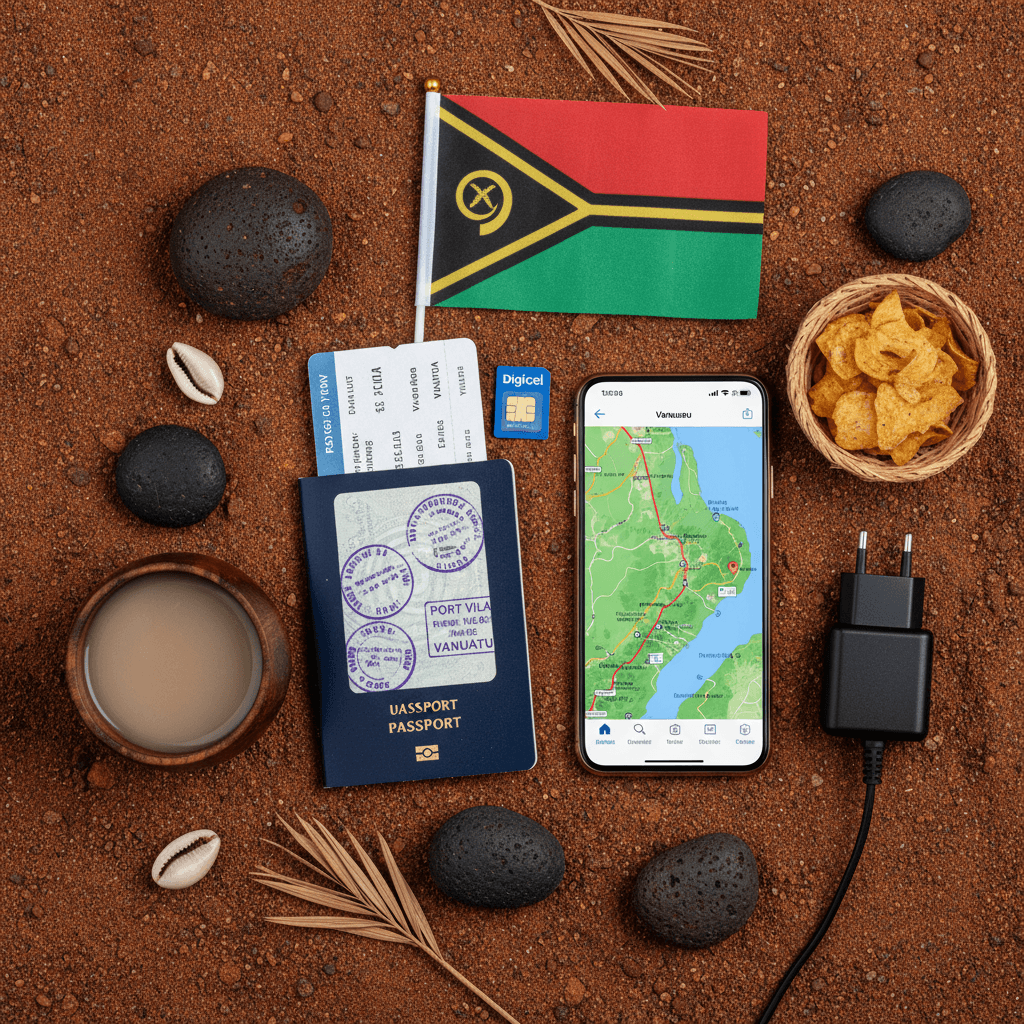
Vanuatu
Complete Digital Nomad Guide

Policy Stability
Stamped Nomad ExclusiveHow likely visa and immigration policies are to remain unchanged
Quick Facts
Income Requirement
$2,100/mo
Max Stay
12 months
Renewable
Yes
Cost of Living
$3,080/mo
Avg Internet
8 Mbps
Safety Score
6/10
Healthcare
Low
Coworking
Low
English Friendly
High
Time Zones
UTC+11
Entry Methods Available
Best For
Navigating the Entry Requirements
Vanuatu doesn't have a specific "Digital Nomad Visa" yet, but its current immigration structure is surprisingly flexible for remote workers looking to trade city lights for island life. Most nomads start their journey on a standard entry permit, which provides plenty of time to get a feel for the local infrastructure and community before deciding on a longer stay.
The Tourist Visa is the most common entry point. It allows you to stay for up to 120 days, though it is strictly non-extendable. You must depart before your time is up. For many, this four-month window is the perfect "season" to experience the archipelago. The application fee sits at 5,150 VUV, which is roughly $43. If you are from a visa-exempt country, you can typically secure this on arrival, while others will need to arrange it beforehand.
Short-Term Stays and Business Needs
If you are planning a shorter scouting trip or visiting for specific professional reasons, there are a few other paths to consider:
- Visitor Visa: Best for those from non-exempt countries staying up to 30 days. The fee is 7,420 VUV.
- Business Visa: If your remote work involves local negotiations, exploratory investments, or temporary employment, this is your best bet. It allows for stays of up to 90 days per entry.
- Transit Visa: Only necessary if you are hanging out in the airport for less than 24 hours during a layover. The cost is 1,855 VUV.
The Business Visa comes in two flavors. A single-entry permit costs 20,000 VUV, while a multiple-entry permit is 35,000 VUV. You will need a passport valid for at least 6 months, proof of your return flight, and a letter from your employer or company to qualify.
Longer Stays and Residency Paths
For those who decide Vanuatu is more than just a temporary stop, the Close Family Visa and Ni-Vanuatu Descent Visa offer longer-term stability. These are valid for 12 months, allow for multiple entries, and can be extended. The family visa costs 61,800 VUV for adults, while the descent visa is 20,600 VUV.
The country has also modernized its approach to permanent residency via the Capital Investment Immigration Program (CIIP). Relaunched in May 2025, this program requires an investment of $160,000 or more. Since July 1, 2025, all applicants must submit biometric data as part of the process. This is a significant financial commitment, but it is the primary route for those seeking a Vanuatu passport.
The Modernized E-Visa System
The days of mailing passports to distant embassies are largely over. Vanuatu launched a streamlined e-visa system in 2025. The online portal allows you to upload documents, pay fees securely, and receive your approval via email. It has made the logistics of moving your life to the South Pacific much more manageable for the average remote professional.
Travel Freedom and Local Policy
Recent shifts in the National Migration Policy, established in January 2026, mean the government is becoming more diligent about tracking who comes and goes. This is part of a broader effort to modernize their data collection.
For those holding a Vanuatu passport, there have been some changes in global mobility. As of February 4, 2025, citizens now require a visa to enter the Schengen Area. Furthermore, starting in late 2026, an ETIAS authorization will be required for European travel, which remains valid for 3 years and allows for stays up to 90 days. While the passport still offers visa-free access to over 100 countries, including Singapore and Thailand, the European landscape has become a bit more regulated.
The Reality of Remote Work in Vanuatu
Vanuatu doesn't have a flashy, dedicated "Digital Nomad Visa" with a sleek marketing campaign. If you search the official government portals, you won't find a remote worker permit or a "Silicon Beach" visa category. Instead, long-term nomads use the Self-Funded Resident pathway, which falls under the broader Residence Visa category. This is essentially a residency permit for people who want to live in the islands without taking a job from the local workforce.
For those who only want to stay for a few months, the standard Visitor Visa is the default. It's designed for tourism and social visits, but many nomads use it to test the waters before committing to the full residency process. Just keep in mind that a visitor visa is strictly temporary and requires you to have an onward ticket and proof of funds.
The Self-Funded Residence Pathway
If you plan to stay longer than a year, the Residence Visa – Self-Funded Resident is your best bet. This permit is designed for individuals who can prove they have a steady stream of income from outside Vanuatu. It allows you to settle in the country, rent a house, and enjoy the island life while your salary or investment dividends continue to land in your bank account from abroad.
- Initial Validity: Usually granted for 1 year, though it can often be renewed if you still meet the financial requirements.
- Local Employment: You are strictly prohibited from taking a local job. This visa is for people who bring money into the economy, not those looking to compete for local positions.
- Good Character: You'll need to provide police clearances from your home country to prove you have a clean record.
Financial Requirements
The government is primarily interested in making sure you won't become a financial burden on the state. While the official immigration site doesn't always post a fixed, public dollar amount, the current standard practice involves showing a monthly income of at least VUV 250,000. This works out to roughly USD 2,000 per month for a single applicant.
You should be prepared to show bank statements or official income letters as proof. In many cases, immigration officials prefer to see this income being transferred into a Vanuatu-based bank account once you arrive. If you're bringing a partner or family, expect the required income threshold to increase accordingly.
Application Steps
The process is relatively straightforward but requires some legwork. You can't just click a button and get instant approval; it involves paperwork and physical documentation.
- Gather Documents: You need a valid passport, recent photos, and a completed application form. Don't forget your police clearance certificates and, in some cases, a medical certificate.
- Proof of Income: Collate your bank statements or employment contracts that prove your remote income exceeds the USD 2,000 monthly mark.
- Submission: Applications are typically submitted to the Department of Immigration and Passport Services. You can do this yourself or hire a local representative to handle the bureaucracy for you.
- Wait for Processing: Times vary, but the department will review your background and financial standing before granting the residence permit.
The Tax Situation
One of the biggest draws for digital nomads in Vanuatu is the tax environment. The country has no personal income tax. There are also no capital gains taxes or inheritance taxes. For a remote worker, this means the money you earn from your home country or international clients stays in your pocket.
You will still pay Value Added Tax (VAT) on your local purchases, like groceries and dining out. It's also important to remember that living in Vanuatu doesn't automatically cancel your tax obligations to your home country. Most nomads still need to manage their tax residency status back home to ensure they aren't being taxed twice or breaking any laws.
Is it Right for You?
Vanuatu is perfect for the nomad who wants to get off the grid and doesn't mind a little bit of old-school paperwork. Since there isn't a streamlined "nomad portal," you have to be comfortable dealing with traditional immigration categories. If you have a stable remote income of at least $2,000 a month and a desire for a slow-paced, tax-friendly lifestyle, the self-funded residency is a powerful tool for making the South Pacific your home office.
The 120-Day Sweet Spot
Vanuatu offers one of the most generous entry policies in the South Pacific for travelers. Most digital nomads won't need to jump through bureaucratic hoops before landing. If you hold a passport from the USA, Canada, Australia, New Zealand, or the UK, you fall into the visa-exempt category. This allows you to stay for up to 120 days right off the bat.
While many countries offer 30 or 90 days, Vanuatu gives you a full four months to find your rhythm in Port Vila or explore the outer islands. It is a straightforward process where you get your stamp at the airport and head straight to your bungalow or rental.
Entry Requirements for the Visa-Exempt
Even if you don't need a formal visa application, the immigration officers at Bauerfield International Airport will want to see a few specifics before they let you through. To secure your 120-day stay on arrival, make sure you have the following ready:
- Passport Validity: Your passport must be valid for at least six months beyond your planned departure date.
- Proof of Onward Travel: You need a confirmed flight ticket out of Vanuatu. They rarely accept "I might take a boat later" as an answer.
- Financial Solvency: You should be able to show you have enough funds to support yourself without seeking local employment.
- Accommodation Details: Have the address or name of your first hotel or guesthouse handy.
The Pre-Arrival Process
If you aren't from one of the 90-plus exempted countries, you will need to apply for a visitor visa before you pack your bags. This process is handled through the Vanuatu Immigration portal or at their nearest consulate. The fee for this application is 5,150 VT.
The documentation for a pre-arranged visitor visa is a bit more involved. You will need a certified copy of your passport, two recent passport-sized photos, and a clear travel itinerary. If you are staying with a local or a long-term resident, a sponsor letter can often replace a hotel confirmation.
A Hard Limit on Extensions
One thing you need to plan for is the lack of flexibility once you are on the ground. The 120-day tourist visa is generally non-extendable. Unlike some Southeast Asian hubs where you can head to an immigration office and pay for another month, Vanuatu expects you to depart once your time is up.
For nomads looking to stay longer, this requires a bit of regional travel. Since there is no official "border run" policy listed in the government regulations, most people choose to fly to Fiji, New Caledonia, or Australia for a short break before attempting to re-enter for a new 120-day period.
Digital Nomad Reality Check
Vanuatu does not currently offer a specific "Digital Nomad Visa" or remote work permit. Most visitors working on their laptops do so under the standard tourist entry. As long as you aren't seeking employment from a Vanuatu-based company or competing in the local job market, the visitor visa remains the standard path for remote workers.
If you find yourself needing specific advice on overstaying or complex visa situations, the Immigration Department in Port Vila is located on the Kumul Highway in the Tamarama Building. They are generally approachable, but it is always better to stay within your stamped dates to avoid fines or issues with future entry. You can reach them by phone at (+678) 22354 if you need to clarify your specific status.
Vanuatu has long been a favorite for people looking to disappear into the South Pacific, but making that move permanent requires a bit of paperwork. While most visitors get by on a standard tourist entry, those looking to set up a home base for a year or more have several pathways to choose from. The immigration system is relatively straightforward, provided you can prove you aren't going to be a drain on the local economy.
The Self-Funded Resident Path
For the typical nomad with a steady remote income or a healthy savings account, the Self-Funded Resident Visa is the most popular route. To qualify, you need to show a certified monthly income of 250,000 Vatu (roughly $2,100 USD) landed in a Vanuatu bank account. If you are bringing a partner, that requirement jumps to 500,000 Vatu (about $4,200 USD) per month.
While the government often markets this toward retirees, there isn't actually a minimum age requirement. As long as the money is hitting the account and you have a clean record, you are generally good to go. It is a solid choice for freelancers who have moved past the "budget backpacker" phase and want a stable legal status.
Digital Nomad and Remote Work Options
Vanuatu recently rolled out a Digital Nomad Visa specifically for the laptop-lifestyle crowd. This permit is valid for one year and can be renewed. You will need to provide proof of employment or business ownership based outside of the country and show you earn enough to support yourself without seeking local jobs.
If you aren't ready to commit to a full year, many nomads simply use the visitor visa system. Depending on your passport, you can often stay for 30 to 90 days visa-free. This is a great way to "test drive" the island's internet speeds and lifestyle before committing to a longer residency permit.
Investing in Island Life
If you have some capital and want a more permanent stake in the islands, there are two main tracks for investors and property owners:
- Leasehold Property: You can secure a residence visa by owning leasehold property valued at 10 million Vatu (approximately $83,000 USD) or more.
- Foreign Investor Visa: This requires a certificate from the Vanuatu Investment and Promotion Authority (VIPA). The application fee is 120,000 Vatu, and they usually get back to you within 15 working days.
Permanent Residency and Citizenship
For those looking for the "Golden Visa" experience, Vanuatu offers one of the fastest citizenship-by-investment programs in the world. The Development Support Program (VDSP) can grant citizenship in about 30 days for a non-refundable donation of $130,000 for a single person or $150,000 for a couple.
If you prefer a slower approach, you can apply for a 10-year Permanent Residence (PR) Card. These permits start at around $10,000 USD. Once you have held residency for a full decade, you become eligible to apply for full citizenship through naturalization.
The Application Checklist
Regardless of which path you choose, the Department of Immigration and Passport Services will ask for a standard bundle of documents. Expect to provide the following:
- A valid passport with at least six months of validity.
- A clean criminal record certificate from your home country.
- Certified proof of income or assets.
- A health clearance certificate.
- An undertaking letter addressed to the Vanuatu Government.
- Two passport-sized photographs.
Processing times vary, but most residency applications are handled within 2 to 6 weeks. It is always a good idea to start the process while you still have plenty of time left on your initial visitor entry to avoid any last-minute stress with the local authorities.
Vanuatu offers a unique trade-off for the remote worker. While it lacks the rock-bottom prices of Southeast Asia, it provides a high-value lifestyle for those who prioritize tranquility and nature over neon lights. You should budget between $2,000 and $3,500 USD per month to live comfortably in Port Vila. If you opt for the slower pace of Luganville, that range drops slightly to $1,700 to $3,000 USD.
Port Vila is the primary hub where you will find the most reliable infrastructure, coworking spaces, and imported comforts. Luganville is more rugged and significantly quieter; while rent is lower there, the cost of groceries and transport remains similar because almost everything is shipped in from the capital or overseas.
Monthly Rent (1BR Furnished)
Finding a nomad-ready apartment usually means looking at the upper end of the local market. Most short-to-medium term rentals geared toward expats come fully furnished and often include basic utilities, though electricity can be a significant extra cost if you run the A/C 24/7.
- Port Vila Budget: 70,000 to 110,000 VUV ($580 to $900 USD). These are typically older units on the outskirts where you will likely need to arrange your own high-speed internet.
- Port Vila Comfortable: 120,000 to 190,000 VUV ($950 to $1,550 USD). This gets you a modern 1BR in expat-friendly areas like Nambatu or Malapoa with decent Wi-Fi.
- Port Vila Premium: 200,000 to 320,000+ VUV ($1,600 to $2,600+ USD). Expect luxury seafront serviced apartments or high-end Airbnb listings with all inclusive amenities.
- Luganville Budget: 55,000 to 90,000 VUV ($450 to $730 USD). Simple studios with basic furnishings; mobile data might be your only internet option here.
- Luganville Comfortable: 95,000 to 150,000 VUV ($770 to $1,220 USD). Nicer builds near the town center or beach with air conditioning.
Food and Groceries
Your food budget depends entirely on your shopping habits. Local markets are vibrant and affordable, offering fresh tropical fruits, vegetables, and root crops. However, imported goods like cheese, wine, and specific cereals from Australia or France carry a heavy price tag. Plan for about $570 USD per month on average for a mix of cooking and dining out.
- Budget: 35,000 to 55,000 VUV ($290 to $450 USD). Focus on local markets and street food like "tuluk" or basic bistro meals.
- Comfortable: 60,000 to 90,000 VUV ($500 to $730 USD). A balanced mix of home cooking and hitting up cafes or mid-range restaurants a few times a week.
- Premium: 95,000 to 140,000 VUV ($770 to $1,150 USD). High-end dining, frequent cocktails, and a cart full of imported treats from the supermarket.
Local Transport
Getting around is straightforward but lacks variety. There are no trains or formal bus stations; instead, you will rely on the ubiquitous minibuses marked with a "B" on their license plate. Taxis are plentiful but significantly more expensive for daily use.
- Single minibus trip: Approximately $1.40 USD.
- Standard taxi ride (8km): Approximately $8.50 USD.
- Monthly transport budget: Most nomads spend between $50 and $130 USD depending on how often they explore the islands or take private cars.
Working and Coworking
Port Vila is the only spot in the country with a dedicated coworking scene. Yumiwork is the primary player here, providing a professional environment with 24/7 access. In Luganville, you will be working from your accommodation or local cafes, so a strong data plan is a must.
- Home Internet: Basic monthly plans range from 2,000 to 5,000 VUV ($18 to $45 USD).
- Coworking (Port Vila): A hot-desk membership typically costs between 20,000 and 40,000 VUV ($160 to $320 USD) per month.
- Private Offices: High-end serviced office spaces can reach 150,000 VUV ($1,200 USD) for those needing a permanent, secure base.
Vanuatu is a cash-heavy society, though cards are increasingly accepted in major establishments in Port Vila. Always keep some Vatu on hand for buses and market stalls. While the costs are higher than other nomad hotspots, the lack of crowds and the incredible scenery often make the price tag feel justified.
The Reality of Nomading in Vanuatu
If you are looking for a list of half a dozen tropical hubs to bounce between, Vanuatu is going to be a short read. The reality is that this archipelago is a rugged, frontier destination for remote workers. While the country offers incredible natural beauty and a famous tax-free status, the infrastructure for digital nomads is concentrated almost entirely in one spot. Outside of the capital, you are looking at unstable electricity and internet speeds that would make a 1990s dial-up connection look like fiber optics.
Most travelers coming here for work should view Vanuatu as a "one-city" destination. You come here for the lifestyle, the diving, and the tax benefits, but you do so knowing that your options for a base are extremely limited.
Port Vila: The Only Real Contender
Port Vila is the capital, the heartbeat of the country, and the only place where you can realistically expect to join a Zoom call without a total meltdown. It sits on the island of Efate and serves as the primary hub for expats and the small but growing nomad community. It is a strange mix of high-end luxury, rugged island life, and a surprisingly cosmopolitan food scene.
Working here requires a specific strategy. You cannot rely on local public Wi-Fi or even the average hotel connection. While the official average speeds hover around a dismal 0.5 Mbps, the local coworking scene is trying to bridge that gap. Yumiwork is the main player here, offering a massive 2,000m² facility. It provides a professional environment that you simply won't find anywhere else in the country.
The Financial Breakdown
- Average Monthly Cost: Approximately $4,443 USD.
- Monthly Rent (1-bedroom): Around $1,387 USD in the city center.
- Coworking Hot Desk: Roughly $154 USD per month.
- Monthly Utilities: Between $90 and $165 USD.
- Starlink Internet: Expect to pay $90 to $115 USD per month for a reliable setup.
The Pros
- No personal income tax, which is the biggest draw for long-term residents.
- A tropical climate that stays between 25 and 28°C year-round.
- English is widely spoken, making it easy to handle logistics.
- A solid selection of international restaurants and bars, like Blue Marlin and Emily's Cafe.
- Incredible weekend access to world-class diving and beaches.
The Challenges
Cost is the biggest hurdle. Vanuatu is not a "budget" destination like Southeast Asia. You are paying premium prices for island logistics. Safety is also a nuanced topic. While the roads are safe and the air is clean, women travelers often report feeling uncomfortable or unsafe, particularly at night. Furthermore, the healthcare system is basic, and the city is not considered LGBTQ+ friendly.
What About Luganville?
You might see Luganville on the island of Espiritu Santo mentioned in some forums. While it is the second-largest town, it is a significant step down in terms of digital nomad viability. There have been attempts to establish coworking infrastructure there, but it lacks the consistent power and high-speed backups found in Port Vila. If you choose Luganville, you are essentially going "off-grid" and should not expect to maintain a traditional 9-to-5 remote work schedule.
The Final Verdict
If you are dead set on Vanuatu, Port Vila is your only choice. It offers a unique, tax-friendly lifestyle for those who can afford the high cost of entry. However, if your work depends on lightning-fast internet and a low cost of living, you may find better value in neighboring Pacific hubs like Fiji. If you do choose Vila, invest in a Starlink kit immediately; it will be the difference between a successful stay and a very expensive, frustrated vacation.
Connectivity Realities
Working from Vanuatu requires a shift in expectations compared to digital nomad hubs like Bali or Lisbon. While the island nation is stunning, the infrastructure is still catching up. Most local connections hover around 7.67 Mbps, which is fine for emails but will struggle with heavy video editing or large file uploads. If your work depends on high-bandwidth tasks, you need to be strategic about where you set up shop.
Port Vila is your best bet for stability. Within the town center, you can expect speeds between 5 Mbps and 20 Mbps. However, the real game-changer has been the arrival of Starlink. It has completely disrupted the local market by offering speeds up to 134 Mbps, making remote work feasible in areas that were previously off the grid. If you are booking an Airbnb, always ask the host if they have Starlink installed; it is the single most important question for your productivity.
The Coworking Scene
Vanuatu isn't exactly overflowing with coworking spaces, but what it lacks in quantity, it makes up for in quality with Yumiwork. Located in the heart of Port Vila, this is the undisputed hub for the local and expat professional community. It is a massive 1,500m² facility that feels more like a high-end office in Sydney than a tropical outpost. They offer over 30 private offices and desks for more than 90 members.
The space is open Monday through Friday from 7:30 AM to 5:30 PM. It is also home to V-LAB, a business incubator, so the networking opportunities with local entrepreneurs are excellent. Here is what you can expect to pay for a desk:
- Daily Pass: 3,500 VUV (roughly $30 USD). This includes high-speed internet, receptionist services, and access to meeting rooms.
- Monthly Memberships: While they don't publish flat rates online, local estimates suggest budgeting between $200 and $400 USD depending on your desk requirements.
Cafe Culture and WiFi
Don't count on "cafe hopping" as a reliable work strategy here. While many spots in Port Vila and Luganville advertise WiFi, the reality is often disappointing. Most cafes have connections that are prone to dropping out just as you join a Zoom call. Nambawan Cafe is a popular spot for the views, but the internet is famously temperamental.
Outside of the main towns, cafe WiFi is almost non-existent. If you aren't at a dedicated workspace or a high-end hotel, you will need to rely on your own data. Treat cafe work as a "bonus" rather than a plan.
Mobile Data and SIM Cards
Since public WiFi is a gamble, a local SIM card is your lifeline. You have two primary choices: Vodafone and Digicel. Both have booths at Bauerfield International Airport, and it is highly recommended to get sorted before you leave the terminal.
- Vodafone Tourist SIM: They often give out free SIMs with 2GB of data valid for 3 days. You can top this up with 10GB for about $30 USD.
- Digicel: Known for slightly better coverage in rural areas. They offer business packages with speeds up to 20 Mbps starting around 3,000 VUV per month.
- eSIM Options: If you prefer to skip the physical card, Nomad offers plans ranging from 1GB to 5GB for $9 to $45 USD. eSIMFOX also provides larger 20GB bundles for those staying a full month.
Fixed Internet and Fiber
Fiber-optic cables do reach Vanuatu, but the "last mile" connection to individual buildings is expensive and rare. Vodafone offers dedicated fiber lines, but the costs are astronomical for a solo traveler. A 5 Mbps dedicated line can cost upwards of 115,000 VUV ($1,000 USD) per month. For most nomads, Wantok Network Limited is a more realistic fixed-line provider, with basic plans starting at 2,300 VUV monthly for a 1 Mbps connection. Stick to Starlink or 4G LTE hotspots for the best price-to-performance ratio.
The Reality of Local Healthcare
Vanuatu is an island paradise, but its medical infrastructure is modest. The public system is universal but operates on a tiny budget of roughly $100 per person annually. This means public hospitals, including the Vanuatu National Hospital in Port Vila, often face shortages of basic supplies and modern diagnostic tools. While the staff is dedicated, the facilities are stretched thin.
Most digital nomads and expats gravitate toward private care. These facilities offer faster service and follow international hygiene standards. However, even the best local clinics have limits. For any procedure more complex than basic stitches or a standard infection, you will likely need to look beyond the islands.
Top Facilities in Port Vila
Port Vila is the only place in the country with healthcare infrastructure that meets Western expectations. If you are staying on a more remote island, you should plan to travel to the capital for anything beyond a minor scrape.
- Vila Bay Health Centre: This is the go-to for the expat community. They prioritize professional ethics and international safety protocols.
- Vanuatu Private Hospital (VPH): Located in the Nambatu area, this facility handles emergencies like cardiac issues or accidents. They also offer surprisingly affordable cosmetic procedures, including facelifts and liposuction.
- ProMedical: This is a 24-hour paramedic ambulance service operating on Efaté and Espiritu Santo. Dial 115 or +678 25 566 if you need immediate help.
The Necessity of Medical Evacuation
This is the most important part of your health planning: you must have medical evacuation insurance. Vanuatu simply does not have the specialized equipment for serious trauma or complex surgeries. If something goes wrong, you will be flown to Brisbane, Auckland, or Nouméa.
A private medevac flight can easily cost upwards of $10,000 USD. Without specific coverage, you will be expected to pay this upfront. Most nomads opt for international health plans that specifically include "repatriation and evacuation" clauses to avoid financial ruin during a crisis.
Insurance and Costs
Healthcare here is a "pay-as-you-go" system. Even with insurance, you should expect to pay in cash or by credit card at the clinic and then file a claim for reimbursement later.
- International Health Plans: Expect to pay between $700 and $1,300 USD annually for basic coverage, though premium plans can reach $3,740 or more.
- Dialysis: Patients at the National Hospital pay about $85-90 USD per session, though the actual cost is much higher and subsidized by the state.
- EU Citizens: If you are from the EU or France, the Caisse des Français de l'Etranger (CFE) provides reimbursements for expenses in nearby New Caledonia or Australia.
Pharmacy Access and Supplies
Finding specific medications can be a gamble. There are two main pharmacies in Port Vila, but the national supply chain is often inconsistent. If you rely on a specific brand-name prescription, bring a multi-month supply with you.
The government encourages generic prescriptions to keep costs down, but rural areas often run out of stock entirely due to transport issues. Always carry a basic first aid kit with antibiotics, bandages, and any maintenance meds you need to stay healthy while exploring the outer islands.
Managing Your Vatu
Vanuatu is a cash-heavy society where the local currency, the Vatu (VUV), reigns supreme. While you can swipe a card at high-end resorts in Port Vila or Santo, you will need physical cash for almost everything else, from market stalls to local transport. Balancing your digital nomad lifestyle here requires a mix of local banking knowledge and a solid backup plan for international transfers.
Opening a Local Account
If you are planning to stay for several months, opening a local bank account can simplify your life. Most banks are open to foreigners, provided you have your paperwork in order. You will generally need your passport, proof of a residential address, and a certificate of income or a document showing the origin of your funds. Some institutions might ask for a second form of ID or a reference letter from your bank back home.
The financial requirements for opening an account are relatively low. Depending on the bank, a minimum deposit for a checking account can range from 100 VT to 50,000 VT. While one bank currently allows non-residents to open accounts remotely, most people find it much faster to simply walk into a branch in Port Vila. The process is usually quick if your documents are ready.
ATM Access and Fees
Finding an ATM is easy in the main hubs, but fee-free withdrawals do not exist here. Local ATMs typically charge between 490 VT and 800 VT per transaction. On top of that, your home bank will likely hit you with its own fees. For instance, ANZ Australia users should expect a 3% foreign currency conversion fee on transactions.
- Daily Limits: Most ATMs have a withdrawal cap, so plan ahead if you are heading to the outer islands.
- Cash is King: Outside of Port Vila and Luganville, ATMs are rare to non-existent.
- Card Acceptance: Visa and Mastercard are accepted at major businesses, but expect a 2.5% to 5% surcharge on many transactions.
Digital Wallets and Transfers
Vanuatu is not yet fully integrated into the modern fintech ecosystem. You cannot sign up for Wise or Revolut if you are a resident of Vanuatu. However, if you already have these accounts from your home country, your cards will work for payments and ATM withdrawals until they expire. Just keep in mind that you cannot get a replacement card mailed to a Vanuatu address.
For moving larger sums of money, you have several reliable options:
- Wise: Useful for sending USD via SWIFT wire transfers to local accounts.
- Western Union and MoneyGram: Both are widely available for cash pickups or direct bank deposits.
- Remitly: A solid choice for bank deposits and mobile money options.
- Rocket Remit: Specifically designed for those sending money from Australia.
Cryptocurrency in Vanuatu
Vanuatu has a reputation in the crypto world, but the government has recently tightened the reins. While you can legally own, buy, and sell crypto as an individual, it is not recognized as legal tender. You cannot use Bitcoin to pay for your visa or your groceries at the supermarket.
The Virtual Asset Service Providers Act established a rigorous licensing framework for any business operating in the crypto space. These companies must follow strict anti-money laundering rules and keep a security deposit of 5,000,000 VT (roughly $45,000 to $50,000 USD) with the government. For the average nomad, this just means you should handle your crypto trading through international exchanges before converting it to fiat currency to use locally.
Residency and Visas for Your Family
Moving your family to Vanuatu requires understanding the specific nuances of the residence visa system. Most pathways, including employment contracts of at least 12 months, foreign investment, or leasehold property ownership valued at 10 million Vatu or more, allow you to include dependent children. These are defined as unmarried children under 18, or those up to 20 if they remain financially or physically dependent on you.
There is a specific catch for those looking at the self-funded resident route. While you can qualify for this visa by proving a monthly income of 250,000 Vatu (or 500,000 Vatu with a partner), this specific category does not allow for the inclusion of dependent children. Families usually find the investor or employee tracks more accommodating for a full household move.
Education Options in the Islands
Most expat families gravitate toward Port Vila or Luganville, primarily because that is where the international schools are located. These institutions offer smaller class sizes and facilities that mirror Western standards, though you should expect to pay a premium for the privilege. Space is often at a premium, so it is wise to start the enrollment conversation months before your arrival.
- Luganville International School (LIS): Tuition for 2025 ranges from 100,000 Vatu for part-time preschool to 600,000 Vatu for Years 7 through 10. They also offer a 10% sibling discount.
- Port Vila French Lycée: A great choice for bilingual families, with annual fees sitting between 159,936 and 209,811 Vatu.
- Port Vila International School (PVIS): This is one of the most established options in the capital, though you will need to contact them directly for their current fee schedule.
Childcare and Daily Support
For younger children not yet in school, childcare is available but localized. Port Vila’s All-Daycare is a popular choice for working parents, charging 3,200 Vatu per day for children aged three and up. Their hours are generous, running from 6:50 AM to 5:30 PM, and include breakfast and snacks. They also integrate French and English learning into their daily routine, which helps kids adapt to the local linguistic environment quickly.
Healthcare Realities
Healthcare is the area where you need to be most prepared. While the local Ni-Vanuatu people are incredibly resilient, the medical infrastructure is limited. There is roughly one doctor for every 30,000 people. Port Vila and Luganville have reasonable facilities and private clinics, like the Family Care Centre in Teouma Valley, which specializes in care for women and children.
If you are living outside these two hubs, access to specialized pediatric care becomes difficult. It is a non-negotiable for nomad families to carry premium expat health insurance that includes medical evacuation to Australia or New Zealand for anything beyond routine check-ups or minor illnesses.
Safety and Best Locations
Vanuatu is remarkably safe. Violent crime against minors is almost unheard of, and the general vibe is one of community and "island time." Most families choose Port Vila on Efate or Luganville on Espiritu Santo. These cities offer the best balance of modern amenities and safety. Gated residential complexes are common among the nomad community, providing 24/7 security and a built-in social circle for your kids.
- Port Vila: The top choice for first-timers, offering the most schools and the only private hospital.
- Luganville: Better for families who want a slower pace and immediate access to world-class beaches and diving.
- Safety Tip: While the islands are peaceful, teach your children to be cautious around stray dogs and to respect the ocean’s currents, which can be much stronger than they look.
Safety & Security
Vanuatu is widely regarded as one of the safest hubs in the South Pacific. Violent crime against foreigners is rare, and the U.S. Department of State maintains a Level 1 rating for the country, suggesting travelers exercise normal precautions. You can generally walk around Port Vila with peace of mind, though it is smart to stay vigilant in crowded markets or nightlife districts where petty theft like bag-snatching occasionally happens.
Scams are not a major industry here, but you should keep an eye out for minor overcharging at informal stalls. Credit card fraud and ATM skimming are the most significant financial risks. Stick to ATMs located inside bank branches or well-lit public areas, and always shield your PIN. If you are heading out to the bars in Port Vila, stick with a group and keep your belongings secure to avoid any opportunistic theft.
LGBTQ+ Considerations
While homosexual activity is legal, Vanuatu is a deeply conservative and 93% Christian nation where traditional values dominate public life. The environment for LGBTQ+ individuals is challenging. Same-sex marriage is banned, and there are no legal protections against discrimination or hate crimes. Recent government policies have even moved toward restricting LGBTQ+ advocacy.
For digital nomads in this community, discretion is a necessity. Public displays of affection are culturally taboo for everyone, but they can draw significant negative attention for same-sex couples. There are currently no legal pathways to change gender markers on official documents, which can sometimes complicate interactions with local bureaucracy or healthcare providers.
The "Kastom" Way of Life
Respecting kastom, the traditional Melanesian system of laws and culture, is the most important part of your social integration. Vanuatu is the most language-dense country on earth, boasting over 100 indigenous languages. While English and French are official, Bislama is the true lingua franca. It is an English-based creole that is easy to pick up; using basic Bislama phrases will immediately earn you respect from the Ni-Vanuatu people.
- Dress Code: Outside of tourist resorts, modesty is the rule. Women should keep shoulders and knees covered, especially when visiting villages. Save the swimwear for the beach.
- Village Entry: Almost all land in Vanuatu is customary. Always ask for permission before entering a village, crossing a field, or visiting a "hidden" beach, as you are likely on someone's private family land.
- Kava Etiquette: If you are invited to drink kava, treat it with reverence. Sit cross-legged, clap once before drinking the bowl in one go, and finish with three claps to show your thanks.
- Photography: Always ask a jif (chief) or individual for permission before taking photos, particularly during sacred ceremonies or inside villages.
Expat Life and Integration
The social scene for remote workers is expanding rapidly thanks to the 2025 Digital Nomad Residency program. This initiative offers tax benefits and reduced residency hurdles to attract professional talent. You will find most of the expat community centered in Port Vila and Luganville, where co-working spaces and high-speed internet are becoming the norm.
Integrating here takes patience because Ni-Vanuatu culture is built on long-term relationships and community ties. To find your footing, support local businesses and attend island festivals rather than sticking solely to expat hangouts. While the government is making it easier for nomads to move here, the most successful residents are those who balance their digital lifestyle with a genuine respect for the local jifs and the traditional way of life.
The Zero-Tax Appeal
Vanuatu is one of the few remaining true tax havens for the digital nomad community. The headline here is simple: there is no personal income tax. Whether you are coding for a client in London or managing a YouTube channel from a beach in Efate, the Vanuatu government does not take a cut of your earnings. This zero-tax policy extends to capital gains, inheritance, and wealth taxes as well.
While your income remains untouched, you should plan for indirect taxes. Most goods and services carry a 12.5% Value Added Tax (VAT). If you decide to invest in local property, rental income is taxed at 12.5% if you earn more than VT 200,000 (about $1,800) in a six-month period. Beyond that, the only regular deduction you might see is a 4% contribution to the National Provident Fund if you are locally employed.
Establishing Tax Residency
Simply landing in Port Vila doesn’t automatically make you a tax resident. To officially shift your tax home to Vanuatu and shield your global income, you generally need to meet several criteria:
- Spend at least 183 days per year within the country.
- Hold a valid residency permit, such as the Self-Funded Resident Visa.
- Maintain a permanent local address, whether you rent a villa or own a home.
- Show "economic ties" to the islands, which usually involves opening a local bank account.
The Best Visa for Remote Workers
The Self-Funded Resident Visa is the most common path for nomads. It avoids the need for local employment or massive business investments. To qualify, you need to show a certified monthly income of at least VT 250,000 (roughly $2,100) for an individual. Couples will need to show VT 500,000 (roughly $4,200).
You will also need to provide a clean criminal record and a health clearance. The beauty of this visa is its simplicity; it is renewable annually and allows you to live the island life while running your global business. For those with significant capital, the Citizenship by Investment program offers a shortcut to residency without the 183-day physical presence requirement for a minimum investment of $130,000.
Crypto and Digital Assets
Vanuatu has become a quiet favorite for crypto traders and blockchain startups. Because there is no capital gains tax, selling your Bitcoin or Ethereum for a profit triggers zero tax liability at the local level. For those looking to set up a formal crypto business, the Virtual Digital Asset Service License (VDSL) provides a legal framework. These licensed companies enjoy a 0% corporate profit tax and 0% withholding tax on payments to non-residents, provided they follow anti-money laundering protocols and keep clean books.
Double Taxation and Reporting
Vanuatu is not a place where you have to spend your weekends filing paperwork. Residents are not required to submit annual tax returns for personal income. However, the country does participate in Tax Information Exchange Agreements (TIEAs) with 13 nations, including Australia, New Zealand, France, and several Nordic countries. This means transparency exists between governments even if your local tax bill is zero.
There are also double taxation agreements in place with Australia, New Zealand, the UK, France, and Singapore. These treaties are helpful if you have income sources in those countries that might otherwise be subject to high withholding taxes. To benefit, you will need to grab a tax residency certificate from the Vanuatu Inland Revenue Department to prove your status to your home country's authorities.
Key Compliance Summary
- Personal Income Tax: 0%
- Capital Gains Tax: 0%
- VAT: 12.5%
- Monthly Income Requirement: VT 250,000 ($2,100)
- Physical Presence: 183 days for residency status
- Reporting: No annual personal return required
Mobile Internet and SIM Cards
You can get connected almost as soon as you step off the plane. Both Vodafone Vanuatu and Digicel have booths at the Port Vila airport. If you plan on island hopping, Vodafone generally offers the most reliable 4G/LTE coverage across the archipelago. Digicel is a solid runner-up and often runs aggressive data promotions.
For prepaid physical SIMs, expect a few different options depending on your stay:
- Vodafone: Tourist SIMs often start with 2 GB of data for 14 days plus some calling credit.
- Digicel: Their tourist bundles are often more generous, sometimes offering 15 GB plus SMS and calls for a 14-day window.
If you prefer to have data the second you land, eSIMs from providers like Airalo, GoMoWorld, or yesim work well here. They use local partner networks and save you the hassle of swapping physical cards or dealing with identity registration. Just keep in mind that these are typically more expensive per gigabyte than a local SIM card.
Keep your home SIM in an old phone or a secondary slot for 2FA messages. Signal strength can drop off fast once you leave Port Vila or Luganville, so download your maps and work documents for offline use before headed to the outer islands.
Transport and Getting Around
Forget about Uber or Bolt; they do not exist here. To get around Port Vila like a local, you have to go a bit more old-school or use local-specific apps. Digital nomads should download VuKart, which is the closest thing to a "super app" in Vanuatu. It lets you book and track taxis in real-time, similar to Grab or Gojek.
Another reliable option is ReGor Riders. They are great for scheduling airport transfers or finding a ride late at night when the streets are quieter. If you are just moving around during the day, you can flag down the minibuses with a "B" on the license plate. They cost a flat fee for most trips around town, but always confirm the price with the driver before you hop in.
Recommended Neighborhoods
Most nomads base themselves in Port Vila for the infrastructure. It is the only place you will find dedicated coworking spaces and the most stable power grid.
- Central Port Vila: This is best if you want to be near the harbor, cafes, and the main markets. It is walkable and puts you right in the middle of the action.
- Mele: A favorite for expats who want a beachier vibe. It is a short commute from the center but feels much more relaxed and secluded.
- The Resort Strips: Areas like Nasama or Iririki Island offer great views and swimming. However, you might find the Wi-Fi in these spots a bit hit-or-miss for heavy Zoom calls, so have a backup hotspot ready.
If you need a professional environment, Yumiwork in Port Vila is the go-to coworking spot. They offer day passes and monthly memberships, providing a much quieter atmosphere than the local coffee shops.
Accommodation Strategies
Finding a long-term base usually requires a mix of online searching and local legwork. Airbnb is the most reliable platform for finding apartments in Port Vila Harbour that actually have kitchens and dedicated desks. You can also find self-catering units on Booking.com, such as Pacific Lagoon Apartments or Fatumaru Lodge, which are known for being nomad-friendly.
Try booking a central spot for your first 7 to 14 days. This gives you time to check out different neighborhoods in person. Always ask the host for a speed test screenshot before committing to a monthly stay. Internet speeds can vary wildly from one street to the next.
Food and Groceries
While you won't find Foodpanda, VuKart handles food delivery from many local restaurants and can even bring groceries to your door. For everything else, the local markets are the heart of the city. They are the best place for fresh produce, though you will need to head to the supermarkets for imported staples.
Many local spots, like Port Vila Burger Co, do not use apps at all. You will often find yourself calling them directly to place an order. It helps to keep a small stash of "emergency" groceries, as many places close earlier than you might expect in a capital city.
Emergency and Safety
Vanuatu is generally safe, but you should keep these numbers saved in your phone just in case:
- Police: 111
- Ambulance (ProMedical): 115
- Fire: 113
English and French are widely spoken, but learning some Bislama goes a long way. Use "Hamas nao?" to ask for a price and "Yu save tekem mi go long..." when you need a taxi driver to take you somewhere specific. Most locals will appreciate the effort, and it makes daily interactions much smoother.
Stay Updated on Vanuatu
Get notified about visa changes, policy updates, and new information for digital nomads in Vanuatu.