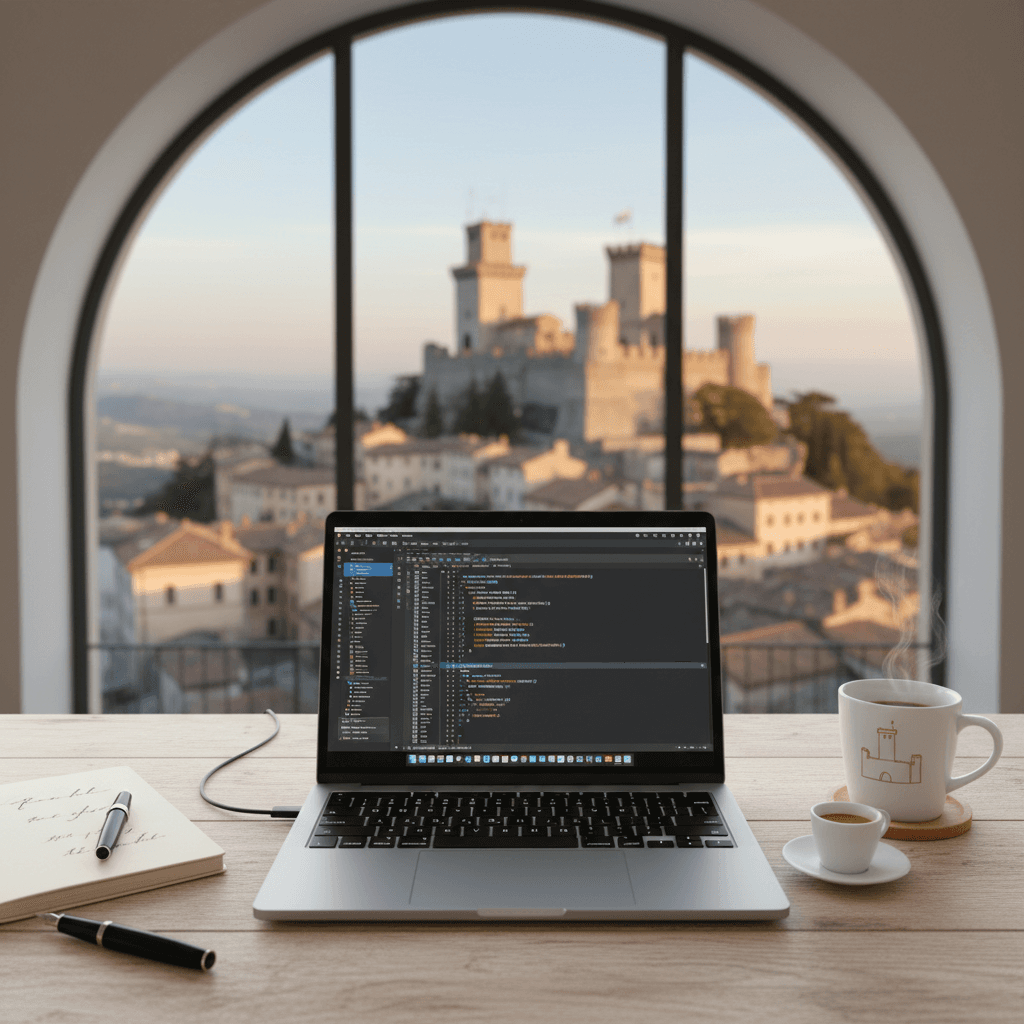
San Marino
Complete Digital Nomad Guide

Policy Stability
Stamped Nomad ExclusiveHow likely visa and immigration policies are to remain unchanged
Quick Facts
Nomad Visa Cost
N/A
Max Stay
1 months
Renewable
Yes
Cost of Living
$1,987/mo
Avg Internet
101 Mbps
Safety Score
9/10
Healthcare
High
Coworking
Low
English Friendly
Medium
Time Zones
CET, CEST
Entry Methods Available
Best For
The 90-Day Reality
San Marino is a bit of a geographic anomaly. Since it is landlocked by Italy and has no airport of its own, you effectively enter via the Schengen Area. This means the rules are surprisingly straightforward for most digital nomads. If you hold a passport from the EU, EEA, or a visa-exempt country like the United States, Canada, or Australia, you can stay for up to 90 days within any 180-day period without a formal visa.
There is no border control between Italy and San Marino, so you won't get a stamp on your way in. However, if you are a collector, you can head to the Tourism Information Office and pay €5.00 for a souvenir passport stamp. It has no legal weight, but it looks great on your pages.
Stays Beyond 30 Days
While the 90-day Schengen rule applies for entry, San Marino has its own internal clock. If you plan to stay in the Republic for more than 30 days, you need to make things official. You are required to submit an application to the Gendarmerie Foreigners' Office to regularize your stay. Think of this as a courtesy check-in that keeps you on the right side of local law while you hunt for the perfect workspace.
Stay Permits (3 to 12 Months)
If you have fallen in love with the views from Mount Titano and want to stay longer than a standard vacation, you will look into a Stay Permit. These are temporary, renewable documents that cover you for up to 12 months. They are generally issued for specific reasons:
- Tourism and Remote Work: Standard stay for those enjoying the lifestyle.
- Special Purposes: This includes education, healthcare, or international volunteering.
- Working Holiday Schemes: Available for citizens of specific countries with reciprocal agreements.
Long-Term Residence Options
For nomads looking to trade the "nomad" title for "resident," San Marino offers several formal residency pathways. These are more intense and usually require a significant financial commitment or a specific tie to the country.
Elective Residence is the most common path for high-net-worth individuals. You must prove you have health insurance with at least €30,000 in annual coverage and make a significant investment in local property or the financial system. You won't be allowed to work in the public sector, and it takes 10 years before this converts into a permanent registered residence.
Atypical Residence is designed specifically for those with high incomes generated abroad. This is a facilitated tax regime that appeals to successful entrepreneurs who have never lived in San Marino before. Like the elective version, it requires private health insurance and 10 years of residency before you can claim full registered status.
Upcoming Changes and ETIAS
The rules for atypical residency are tightening. Starting April 28, 2025, the government is raising the bar for income thresholds and requiring assets to be held within the San Marino banking system. If you are eyeing this path, you will need to move quickly or prepare for a higher financial hurdle.
For everyone else, keep an eye on the ETIAS rollout. This is a pre-screening system for visa-exempt travelers entering the Schengen Area. It will cost €20, stay valid for 3 years, and will be a mandatory requirement for your flight into Europe before you ever reach the San Marino border.
Business Visits
If you are just heading into town for a few meetings or a networking event, the rules remain simple. Business travelers from visa-exempt countries do not need a specific business visa for stays under 90 days. If you are from a country that does require a visa for Europe, you will need to process your application through an Italian Embassy, as San Marino does not issue its own independent entry visas.
The Reality of Remote Work in the Republic
If you are looking for a flashy, "one-click" digital nomad visa with a colorful logo, you will not find it in San Marino. This ancient microstate does not follow trends; it sticks to a traditional legal framework. While there is no specific visa category labeled for remote workers, the country offers several residency pathways that function perfectly for those bringing their own income into the Titano territory.
Because San Marino is not a member of the European Union, but is surrounded by Italy, the logistics of staying here are unique. You do not need a visa to enter if you are coming from the Schengen Area, but once you cross the 30-day mark, you need to transition into a formal permit system. Think of it as moving from a guest to a temporary resident.
Atypical Residence: The Nomad’s Best Bet
The most attractive option for high-earning remote workers is the Atypical Residence permit. This was designed specifically for people who generate their income outside of the Republic and want to benefit from a facilitated tax regime. It is the closest thing the country has to a nomad program, though it carries a bit more prestige and paperwork.
To qualify for this path, you must meet a few specific criteria:
- You cannot have been a tax resident in San Marino previously.
- You must prove you earn your income entirely from foreign sources.
- You must maintain private health insurance for the duration of your stay.
- You are prohibited from working for the San Marino public sector or receiving state subsidies.
The beauty of this permit is its longevity. It is not just a one-year stint; after 10 years of holding this status, it automatically converts into a permanent registered residence with full rights. It is a long game, but for those who fall in love with the mountain views, it is a clear path to citizenship.
Elective Residence for Investors
If you have significant capital and want a more "brick and mortar" connection to the country, Elective Residence is the alternative. This is less about your monthly remote salary and more about your assets. This permit is usually granted to those who purchase property in the Republic or make a significant financial investment in the local economy.
The rules mirror the Atypical Residence in many ways. You must cover your own healthcare costs and stay off the government payroll. Like the other permits, the 10-year rule applies here too, eventually leading to full residency status. It is a more expensive entry point, but it provides a high level of stability for those looking to settle permanently.
Temporary Stay Permits
For those who are not ready to commit to a decade of residency or a property purchase, there are standard Stay Permits. These are more flexible and are typically issued for durations ranging from 3 months to 12 months. They are renewable, provided you can continue to show a valid reason for staying, such as tourism or independent work.
The application process for these shorter stays is handled through the Gendarmerie. You will need to show proof of sufficient funds to support yourself without becoming a burden on the state. It is a great way to "test drive" life on Mount Titano before committing to the more rigorous Atypical Residence application.
Navigating the Paperwork
One thing to keep in mind is that San Marino’s bureaucracy is deeply rooted in the Italian language. While many officials speak English, the official documentation and the Ministry of Foreign Affairs website are primarily in Italian. If you are serious about applying, you might want to hire a local consultant or a translator to ensure your documents are filed correctly.
You can reach out to the Ministry of Foreign Affairs at info@esteri.sm to get the most current list of required documents. Generally, expect to provide a clean criminal record, proof of income, and a valid passport. Because the Republic is small, the authorities are thorough, so ensure every piece of paper is accounted for before you submit your application.
The Schengen Gateway
San Marino is a bit of a geographical quirk. This tiny republic is completely landlocked by Italy, and because there are no physical border controls between the two, San Marino does not issue its own entry visas. To get here, you have to play by Italy's rules.
For digital nomads, this means your entry into San Marino is governed by the Schengen Area regulations. If your passport allows you to enter Italy visa-free, you can walk, drive, or take the bus into San Marino without showing your passport to anyone. If you require a visa to enter Europe, you must obtain an Italian (Schengen) Visa from an Italian consulate before you travel. There is no such thing as a "San Marino Visa" or an e-visa; any website claiming to sell one is a private service and not an official government portal.
The 30-Day Rule
While the border is open, San Marino has its own internal clock for visitors. Even though you are technically within the Schengen zone, the San Marino government requires any foreigner staying in their territory for more than 30 days to regularize their stay.
This creates a two-tiered limit for nomads:
- The 30-Day Limit: You can stay in San Marino as a tourist for up to 30 days without any paperwork.
- The 90-Day Limit: Your total time in San Marino and the surrounding Schengen Area cannot exceed 90 days within any 180-day period (unless you have a specific long-stay visa).
- The Stay Permit: If you plan to stay in San Marino specifically for more than 30 days, you are legally required to apply for a permesso di soggiorno (stay permit) from the local authorities.
Longer Stays and Stay Permits
If you fall in love with the views from Mount Titano and want to stay past that first month, you'll need to deal with the Gendarmeria (the local police). San Marino offers stay permits for specific reasons like work, family, or elective residence. However, these are not handed out like standard tourist extensions. They are typically linked to a specific legal status or a significant financial investment in the country.
For most remote workers, the reality is that you will likely treat San Marino as a short-term base. Since there are no border guards, it is easy to lose track of time, but staying past 30 days without a permit puts you in an irregular status. While San Marino doesn't have a history of aggressive internal immigration checks for tourists, being undocumented can complicate future residency applications or legal matters.
The Border Run Myth
Because San Marino is surrounded by Italy, the "border run" strategy used in Southeast Asia or Latin America does not work here. Crossing from San Marino back into Italy does not reset your visa clock. You are still inside the Schengen Area.
To reset your 90-day tourist allowance, you must physically exit the Schengen Area entirely (for example, by flying to London, Tirana, or Istanbul) and wait until you have enough "unused" days left in your 180-day window. Moving between Rimini and San Marino city does nothing for your legal status.
Costs and Formalities
Since there is no San Marino visa, there are no San Marino-specific entry fees. Your only costs will be related to your Italian/Schengen visa if you need one. These fees are paid to the Italian consulate in your home country.
If you want a souvenir for your passport, you can head to the Official Tourist Office in the historic center. For a small fee (usually around 5 EUR), they will give you an official San Marino entry stamp. It looks great in a passport, but keep in mind it has no legal weight for immigration purposes; it is strictly for the memories.
Key Takeaways for Nomads
- Visa-free entry: Follows Italian/Schengen rules.
- Maximum tourist stay: 30 days internally; 90 days within the wider Schengen zone.
- Overstaying: Penalties follow Italian law, which can include heavy fines and entry bans for the entire EU.
- No e-visas: Only trust official Italian or Sammarinese government websites for paperwork.
Living the Sammarinese Life
San Marino is one of the world’s oldest republics, and it’s arguably one of the most exclusive places for a nomad to set down roots. It isn't part of the EU, though it sits right in the middle of Italy, which creates a unique legal bubble. Getting a long-term seat at the table here requires a clear plan and, in most cases, a solid financial foundation.
The government doesn't offer a standard "digital nomad visa" like some of its neighbors, but they have carved out specific pathways for remote workers, retirees, and entrepreneurs who want to trade the daily grind for views of the Adriatic coast from Mount Titano.
The Atypical Residence for Remote Workers
If you earn your living from clients or employers outside of San Marino, the Atypical Residence is your most likely path. This category is designed specifically for people who have never been tax residents in the Republic before. It’s a great fit for high-earning freelancers or remote executives who want a stable, safe base in Europe.
The perks are significant, especially regarding the tax regime. You’ll need to maintain private health insurance and prove you won't be a drain on the state’s public resources. This permit is your gateway to the local community, and after 10 years of living here under this status, you can apply to transition into full registered residence.
Retiring in the Republic
For those looking to spend their golden years in a medieval fortress city, the Pensioners' Atypical Residence is a premium option. It’s open to citizens of the EU, Switzerland, and a few other specific nations. The financial bar is set high to ensure the exclusivity of the program.
- Income Requirement: You must show an annual gross income of at least €120,000.
- Asset Requirement: You need to hold at least €300,000 in movable financial assets in a local San Marino bank.
- Tax Rate: Your pension income is taxed at a flat, attractive rate of 6%.
Business and Startup Residency
If you’re more of a builder than a remote employee, San Marino is actively courting entrepreneurs. By starting a company and owning at least 51% of the shares, you can secure residency. They limit this to 50 approvals per year, so it’s competitive. You’ll need to make a refundable security deposit of €150,000, though you can pay this in installments and even put it toward real estate or business expenses later.
For those in the tech space, the High-Tech Startup Residency is even more specialized. This is aimed at directors and partners of innovative firms. To qualify, you generally need to purchase property worth at least €300,000 or provide a guarantee of the same value. It’s a year-to-year renewal process that can eventually lead to a permanent home for you and your family.
The Elective Residence Path
If you don't plan on working locally but want to live in the Republic, Elective Residence is the "investor" route. This is strictly for those who can support themselves through existing wealth. You cannot work for the public sector or receive any state subsidies. You’ll need health insurance with a minimum coverage of €30,000 per year. Like the other atypical paths, this converts to full registered residence after a 10-year stint.
The Fine Print
Regardless of which path you choose, the paperwork remains fairly consistent. You’ll need a clean criminal record from your home country, a valid passport, and documented proof of your financial standing. The review process is thorough. Once you submit your application, expect a wait of about 120 days while the Commission for Foreign Affairs reviews your file. If you have specific questions about your eligibility, you can reach out to the immigration authorities at info@esteri.sm.
The Price of Living in a Microstate
San Marino is one of those rare European gems where the quality of life far outstrips the price tag. While it sits entirely surrounded by Italy, your bank account will notice a refreshing difference. You are looking at a cost of living roughly 20% to 30% lower than major European hubs like Milan or Paris. It is a place where you can enjoy a medieval mountain backdrop without the "tourist trap" pricing found in more famous neighbors.
A solo digital nomad can live quite comfortably here for around $1,987 per month, including rent. With average internet speeds clocking in at 101 Mbps, you are getting modern infrastructure at a fraction of the cost of a major capital city.
Monthly Budget Breakdown
Your biggest expense will be housing, but even that is surprisingly manageable. A one-bedroom apartment in the heart of the historic center or the bustling Borgo Maggiore typically runs between €450 and €700. If you are looking to save, heading just a few minutes outside the main tourist hubs can drop those prices significantly.
Eating out is a highlight here rather than a chore. A standard meal at a local trattoria costs between €10 and €25. If you prefer cooking at home, expect to spend about €50 to €75 per week on high-quality Italian-sourced groceries. Since San Marino is a tax-haven of sorts, you might find certain luxury goods and electronics are actually cheaper here than across the border.
For your workspace, the local coworking scene is small but dedicated. Membership fees generally range from €200 to €500 per month. Popular spots like Coworking San Marino or the more casual Caffè del Corso provide reliable Wi-Fi and a chance to meet the growing local nomad community.
Budget Tiers for Your Stay
Depending on your lifestyle, here is how the monthly math usually shakes out:
The Budget Tier (~$1,064 per month)
- Rent: €450 ($500)
- Food & Groceries: €150 ($167)
- Coworking: €200 ($222)
- Health Insurance: $42
- Utilities & Transit: €120 ($133)
The Comfortable Tier (~$1,577 per month)
- Rent: €550 ($610)
- Food & Groceries: €250 ($278)
- Coworking: €350 ($389)
- Health Insurance: $100
- Utilities & Transit: €180 ($200)
The Premium Tier (~$2,283 per month)
- Rent: €700 ($780)
- Food & Groceries: €400 ($445)
- Coworking: €500 ($556)
- Health Insurance: $224
- Utilities & Transit: €250 ($278)
Where to Plant Your Laptop
Choosing a neighborhood changes your daily overhead. Città di San Marino is the historic heart. It is walkable, packed with cafes, and puts you right next to the Three Towers. You will pay a slight premium for the view, but the convenience of having everything at your doorstep is hard to beat.
Borgo Maggiore sits just below the historic center. It is connected by a cable car and offers a more authentic, residential feel. It is generally quieter and slightly more affordable for long-term rentals. If you want something even more modern, Fiorentino is an up-and-coming area on the outskirts. It feels less like a museum and more like a modern suburb, often featuring newer apartment builds and additional coworking options.
Health and Logistics
Public healthcare is excellent but primarily serves local employees. As a nomad, you will need private international health insurance. Coverage can start as low as $42 per month for basic plans, while more robust packages can go upwards of $224. Transportation is the least of your worries; the country is tiny and the bus system is reliable, with tickets costing just €1.50 per ride. Many nomads find they rarely need a car unless they plan on frequent trips deep into the Italian countryside.
A Single-City Nation
San Marino isn't your typical digital nomad destination where you weigh the pros and cons of three different metropolitan hubs. This is one of the world's smallest republics, a microstate nestled inside Italy. When you choose San Marino, you are essentially choosing a single, dramatic mountain peak topped with medieval towers. While it is divided into nine administrative districts called castelli, most of your daily nomad life will revolve around the capital and its immediate surroundings.
The entire country houses only about 33,000 residents. This creates a unique atmosphere where you quickly become a familiar face in the local cafes. It is the perfect spot if you are tired of the frantic energy of Rome or Milan and want a home base that feels like a quiet, high-altitude sanctuary.
Where to Set Up Base
Since the country is so compact, your choice of neighborhood depends entirely on whether you want to live inside a fairy tale or closer to modern conveniences. Here are the three main areas to consider:
- Città di San Marino (The Historic Center): This is the iconic medieval core perched on Mount Titano. Living here means walking through cobblestone alleys and being steps away from the Three Towers. It is heavy on charm but can feel touristy during the day.
- Borgo Maggiore: Located just below the historic center, this is the country's commercial heart. It is more practical for long-term stays, offering better access to supermarkets, local bars, and the cable car that zips you up to the capital in minutes.
- Fiorentino: If you want a more residential, modern vibe, look toward Fiorentino. It is further out on the outskirts but offers more contemporary apartment layouts and a quieter, local feel away from the day-trippers.
The Cost of Living Breakdown
San Marino is a hidden gem for your wallet, often costing 20% to 30% less than major Italian cities. You get the Italian lifestyle without the "Big City" price tag. Here is what you should budget for a monthly stay:
- Housing: Expect to pay between €450 and €700 for a one-bedroom apartment in a central area.
- Groceries: A weekly shop for one person usually runs between €50 and €75.
- Dining Out: A standard meal at a local trattoria costs €10 to €25.
- Total Monthly Budget: Most nomads live comfortably here on $1,987 to $2,128 per month.
Connectivity and Coworking
Despite its ancient appearance, the digital infrastructure is modern. Internet speeds average around 101 Mbps, which is more than enough for video calls and uploading large files. If you need a professional environment, Coworking San Marino is the primary dedicated space. Memberships cost between €200 and €500 per month depending on your needs. For a more casual vibe, Caffè del Corso and Bar La Terrazza are reliable spots where you can camp out with a laptop and a strong espresso.
Safety and Social Life
Safety is perhaps the biggest draw here. The crime rate is virtually nonexistent, with a safety rating of 100% during the day and 93.75% at night. You can walk anywhere at 3:00 AM without a second thought. This makes it an ideal spot for solo travelers who prioritize peace of mind.
The social scene is intimate. While you won't find massive nightclubs, the nightlife is centered around high-quality wine bars and pubs. Tannino is great for local vintages, while Green Clover Irish Pub and Time Off provide a more relaxed, social atmosphere. To meet other remote workers, look for the San Marino Digital Nomads group on Facebook, as the community relies on these digital hangouts to organize in-person meetups.
The Trade-Offs
- Pros: Exceptional safety, lower costs than Italy, high-speed internet, and a stunning medieval backdrop.
- Cons: Very small social circle, limited nightlife, and a lack of variety in coworking spaces.
San Marino is a destination for the focused nomad. If you have a big project to finish and want a safe, beautiful, and affordable place to hunker down, this microstate is hard to beat. If you need a new club to visit every night, you might find it a bit too quiet.
Digital Infrastructure: A Microstate Powerhouse
San Marino might be small, but its digital backbone punches well above its weight. While many parts of Europe still struggle with rural connectivity, this microstate has turned its compact geography into a massive advantage. You can expect fixed broadband speeds averaging around 96.8 Mbps, and it is common to see local connections hitting 101.6 Mbps or higher. If you are coming from Italy, you will likely notice the upgrade immediately, as San Marino consistently outpaces its neighbor in both speed and stability.
The country is currently in the middle of an aggressive transition to fiber optics. Over 50% of the population is already on fiber, and the government plans to phase out old copper DSL lines entirely by 2027. Perhaps the most impressive feat for nomads is the mobile coverage. San Marino was the first country in Europe to achieve near-total 5G coverage, reaching 99% of the territory years ago. Whether you are working from a balcony in the historic center or a park on the outskirts, you are rarely more than a few feet away from a high-speed signal.
Coworking Spaces and Serviced Offices
Because San Marino is so small, the coworking scene is intimate rather than sprawling. The hub of the community is Coworking San Marino. It is a sleek, modern facility designed specifically for the professional nomad. You will find ergonomic workstations, private meeting rooms, and the kind of high-speed internet that handles video calls without a hiccup. It is the best place to find a desk if you need a dedicated office environment rather than a casual cafe setup.
If you need something more formal, there are several serviced office providers scattered throughout the business districts. These are ideal if you are running a small team or need a prestigious address for client meetings. The costs for these spaces vary depending on how much privacy you need:
- Coworking San Marino Membership: Between €200 and €500 per month.
- Basic Coworking Desks: Starting around £300 per month for flexible access.
- Virtual or Serviced Offices: Entry-level packages starting from £50 per month.
The Cafe Office Culture
If you prefer the hum of a coffee machine to the quiet of a dedicated office, San Marino has some fantastic spots with reliable Wi-Fi. The local culture is welcoming to laptop users, provided you are polite and keep the coffee flowing. Two standouts for nomads include:
- Caffè del Corso: A cozy, central spot known for its consistent Wi-Fi and excellent espresso. It is great for morning deep-work sessions.
- Bar La Terrazza: This is where you go when you want to show off your "office" on social media. It offers fast internet paired with some of the best views of the valley and the Adriatic coast.
Mobile Data and Connectivity on the Go
Staying connected outside your apartment or coworking space is straightforward. Local providers like TIM San Marino and Vodafone offer robust coverage. TIM is often cited as the speed leader, with broadband downloads reaching up to 130.1 Mbps. If you want a local physical SIM, you can find monthly plans starting at approximately €10.
For those who prefer the convenience of an eSIM before they even land, there are several digital-first options. These are perfect for short stays or as a backup to your main connection. Typical pricing for San Marino data packages looks like this:
- 1 GB Data (30 days): Approximately $4.99.
- 10 GB Data (30 days): Approximately $22.50.
- 20 GB Data (30 days): Approximately $37.15.
Between the 5G saturation and the reliable fiber rollout, San Marino is one of the few places where you can truly work from anywhere without checking a coverage map first. It is a high-tech sanctuary tucked inside a medieval fortress.
The Healthcare System
San Marino might be small, but its healthcare system is a powerhouse. It consistently ranks among the top three in Europe for quality and accessibility. The system is split between a robust public sector and a growing private sector, ensuring that whether you are here for a month or a year, you are in safe hands.
The public system, managed by the Azienda Sanitaria Locale, provides high-quality care to residents and employees. While the medical standards are exceptional, the public sector does face one common hurdle: waiting times. For non-emergency procedures, you might find yourself waiting longer than you would like. This is where private options become attractive for nomads.
Public vs. Private Care
Public healthcare is state-funded and covers everything from specialist treatments and prescription drugs to maternity care. If you are working for a local company, your contributions are handled via payroll deductions, giving you access to the State Hospital (Ospedale di Stato) in Cailungo.
Private clinics like Domus Medica offer a more streamlined experience. You get shorter wait times, more comfortable facilities, and often, more English-speaking staff. While private care is more expensive than the public route, it remains surprisingly affordable compared to Western Europe or North America. Many nomads choose private insurance to skip the queues and gain direct access to specialists in cardiology, orthopedics, and physiotherapy.
Facilities and Emergency Services
The country relies on one main hospital, the San Marino Hospital. It is well-staffed with a high ratio of doctors and nurses per capita. For highly specialized surgeries or rare conditions, the country has agreements to transfer patients to top-tier facilities in Austria or Switzerland.
In an emergency, you need to know these numbers:
- Ambulance: 118
- Police: 112 or 113
- Fire: 115
Insurance for Digital Nomads
If you are relocating to San Marino on a residency permit without a local job, you must have private health insurance. Even if you do qualify for the public system, international coverage is a smart move. It ensures you can choose your own doctors and covers medical evacuation, which is vital given the country's small size.
Providers like Cigna Global or April International are the standard recommendations. They offer 24/7 support and direct billing, so you aren't stuck paying large bills out of pocket and chasing reimbursements. Look for plans that include "outpatient" services to cover those quick clinic visits.
Typical Medical Costs
Medical expenses here are often 50% to 70% cheaper than in the US or UK. Here is what you can expect to pay for common services:
- General Consultation: $20–$40
- Routine Blood Tests: $50–$100
- Orthopedic Surgery: $2,000–$5,000
- Heart Surgery: $5,000–$15,000
- Cancer Treatment (Chemotherapy): $4,000–$10,000
Finding a Pharmacy
Pharmacies (Farmacie) are easy to find and very well-stocked. They provide consultations and can even perform basic checks like blood pressure measurements. If you need something in the middle of the night, the State Hospital Pharmacy in Cailungo is open 24/7.
Other convenient spots include:
- Atlante Shopping Center: Open Monday to Saturday until 14:45, with specific weekend and holiday hours.
- Borgo Maggiore Pharmacy: Open Monday to Saturday from 8:00 to 19:30.
Since Italian is the primary language, having a translation app handy for specific medical terms is helpful, though many pharmacists in the tourist-heavy areas speak functional English.
Managing Your Euros in the Microstate
San Marino is a unique financial bubble. While it is not a member of the European Union, it uses the Euro as its official currency and has aligned much of its banking infrastructure with European standards. For a digital nomad, this makes day-to-day spending relatively seamless, though setting up a local "brick and mortar" account is a bit more involved than just clicking a button on an app.
Opening a Local Account
You can open a bank account here as a non-resident, but the banks generally want to see a reason why you are choosing them over a giant Italian bank next door. Usually, this means showing some form of economic tie to the Republic. If you decide to go local, expect to make an in-person appearance at a branch. Most banks require a minimum deposit between €100 and €500 to get started.
The paperwork is standard for Europe. You will need to provide:
- A valid passport with at least 6 months of validity remaining.
- Proof of address, such as a utility bill or official letter from the last 3 months.
- Documentation showing your source of funds, like recent pay slips or bank statements.
- A brief selfie video for their identity verification systems.
One perk of San Marino's international outlook is that they accept documents in English, French, German, Italian, or Spanish without requiring expensive certified translations. If you want a traditional local experience, Cassa di Risparmi della Repubblica di San Marino (CRSM) is the biggest player, while Banca di San Marino is a solid choice for more private banking needs.
The Digital Nomad Setup: Wise and Revolut
Most nomads find that a local San Marinese account is overkill. Wise and Revolut are the gold standard here. They work perfectly across the country and often save you a fortune in hidden conversion fees. Wise is particularly useful if you are juggling multiple currencies, as it gives you local account details that make receiving payments from international clients much faster.
Revolut is a favorite for those who want extra perks. Their higher-tier subscriptions often include travel insurance and lounge access, which is handy if you are frequently flying out of nearby Rimini or Bologna. Transfers between Revolut users are nearly instant and free, making it the easiest way to split a dinner bill with other travelers.
Cash, ATMs, and Fees
San Marino is modern, but it still has a soft spot for cash. You will have no trouble using a card in tourist hubs or larger shops, but that tiny mountainside café might still insist on physical Euros. It is smart to keep a small amount of cash on you at all times.
When you head to an ATM, keep these tips in mind to avoid losing money to bad rates:
- Always decline "Dynamic Currency Conversion" (DCC). If the machine asks if you want to pay in your home currency or the local currency, always choose Euros.
- Local ATM surcharges typically range from €1 to €5. The machine must disclose this before you confirm the withdrawal.
- Wise users get two free withdrawals up to 200 GBP (or equivalent) per month, which is usually enough for a short stay.
Crypto and the Blockchain Hub
If you deal in crypto, San Marino is surprisingly forward-thinking. The government has worked hard to position the country as a blockchain-friendly jurisdiction. They have a clear regulatory framework that classifies stablecoins like USDC and USDT as regulated financial tokens. This legal clarity is a breath of fresh air compared to the "gray area" status of crypto in many other countries. If you are a resident moving crypto assets, be aware there is an 8% substitute tax on those transfers.
Moving Money In and Out
For larger transfers or sending money back home, you have several reliable options beyond the standard bank wire:
- Revolut: Best for instant transfers to other users and low-fee bank moves.
- Wise: The most transparent exchange rates for moving money between different currencies.
- Remitly: Great if you need options like cash pickup or specific delivery methods.
- MoneyGram: A reliable fallback for fast, secure international transfers.
Living with the Family in San Marino
San Marino is an outlier in the digital nomad world. It offers a level of safety and community that is almost impossible to find in larger European hubs. For families, the republic feels like a quiet, hilltop village where everyone knows each other. While the lifestyle is idyllic, the administrative side requires some planning, especially since many services for expats overlap with neighboring Italy.
Visas for Dependents
San Marino is not part of the Schengen Area, but there are no border controls with Italy. Most families enter on an Italian or Schengen visa and then handle their local status. If you are staying more than 10 days, you need to apply for a tourist permit. This permit can last up to 90 days and is extendable once.
To bring your spouse and children for the long term, you generally need to secure a "special permit" linked to employment or high-wealth residency first. Once you have lived there legally for 5 years, you can apply for a permanent residence permit. This status is the golden ticket for families, as it grants full access to the national social and health systems. You will need to provide translated birth certificates, marriage licenses, and police records for the whole family during this process.
The Education Trade-off
There are no international schools within San Marino's borders. If you want your children to follow an English-language or IB curriculum, you will be looking at a daily commute into Italy. Most families head toward Rimini or Bologna for these options.
- Local Public Schools: Free or very low cost for residents. The curriculum is in Italian, and the quality is excellent.
- Primary International School: Expect to pay between 6,000 and 15,000 euros per year.
- Middle School: Fees generally range from 8,000 to 18,000 euros annually.
- High School: Costs can climb to 25,000 euros per year, plus extra for books and uniforms.
Many expat families choose the local Italian-language schools for the immersion experience and then hire private tutors for English. This saves thousands in tuition and helps the kids integrate into the local community faster.
Healthcare for Kids
The healthcare system in San Marino is high-quality and operates on a universal model funded by taxes. Once you are a registered resident, your children are covered for almost everything, including pediatric visits, vaccinations, and hospital stays. The system is decentralized into small health centers that serve about 8,000 people each, ensuring you aren't just a number in a giant waiting room.
If you are there on a short-term tourist permit, you will be paying out of pocket for medical visits. Always carry private international health insurance until your residency is finalized. The local state hospital is well-equipped for emergencies, and the country places a massive emphasis on preventative care and child nutrition.
Where to Settle Down
The entire country is only about 60 square kilometers, so you are never truly far from anything. However, the choice of neighborhood changes your daily rhythm.
- San Marino Città: The capital offers incredible views and is very walkable, though it can get crowded with tourists during the day.
- Dogana: Located right on the border, this is a popular choice for families who need to commute to Rimini for international schools or Italian shopping.
- Borgo Maggiore: A good middle ground with plenty of local amenities and a more residential feel.
Rents are surprisingly manageable compared to Milan or Rome. A one-bedroom apartment usually costs between 600 and 800 euros per month. For a larger family apartment with three bedrooms, expect to pay 1,200 euros or more depending on how modern the building is.
Safety and Daily Life
Safety is perhaps the biggest draw for parents. Crime is nearly non-existent, and it is common to see children playing in public squares without constant supervision. It is a "doors unlocked" kind of culture. The only real downside is the pace of life for teenagers. While it is a paradise for toddlers and primary-aged children, older kids might find the quiet nights a bit dull and will likely want to take the bus into Rimini for entertainment and social life.
Safety and Security
San Marino is arguably one of the safest places you will ever drop your laptop bag. The crime rate is incredibly low, and violent incidents are practically unheard of. You can walk through the winding cobblestone streets at night without a second thought, which is a massive perk for nomads who like to work late in cafes or coworking spaces.
That said, don't let the fairytale atmosphere make you totally reckless. During the peak summer months, the crowds in the historic center can attract the occasional pickpocket. Keep your passport and backup cards in a safe place at your accommodation, and just keep your wits about you in tourist-heavy spots. Scams are almost non-existent here, but the local police have a zero-tolerance policy regarding illegal drugs. Even minor possession can lead to heavy fines or prison time, so it is best to stay on the right side of the law.
The Social Fabric
While San Marino is surrounded by Italy, the citizens, known as the Sammarinese, are fiercely proud of their independent identity. They are generally warm and polite, though perhaps a bit more reserved than their neighbors in Rimini at first. A firm handshake and direct eye contact are the standards for greetings. If you are invited into a local home, it is a sign of great trust; bringing a small gift like high-quality chocolates or a bottle of wine is a classy move.
The country is surprisingly progressive for its size. San Marino made history in 2022 by appointing the world’s first openly gay head of state, Paolo Rondelli. While it is a traditional society deeply rooted in Catholic heritage, LGBTQ+ travelers will find a respectful environment. Civil unions provide nearly all the same protections as marriage, and discrimination is prohibited by the constitution.
Breaking the Language Barrier
Italian is the heart of communication here. You will also hear the local Sammarinese dialect, which sounds like a melodic blend of Italian and Romagnolo. While younger people and those working in the tourism sector speak English, it isn't universal. To really thrive and move beyond the "tourist" bubble, you should learn the basics.
- Italian is the official language for all business and legal matters.
- English proficiency is moderate but varies wildly once you leave the main tourist hubs.
- Learning even ten basic phrases will completely change how locals treat you.
Digital Infrastructure and Integration
For a country built on a mountain, the internet is surprisingly snappy. You can expect speeds ranging from 46 Mbps to 101 Mbps, which is plenty for video calls and heavy uploads. If you get tired of working from your apartment, Coworking San Marino is the primary hub for the remote work crowd. It is the best place to find your "tribe" since there aren't many sprawling expat bars or clubs.
To really settle in, look for local events rather than just expat meetups. The community is tight-knit, and showing up to a crossbow tournament or a religious festival like the Feast of San Marino goes a long way. The Sammarinese appreciate people who take an interest in their 1,700-year history of independence. Joining a local sports club or a language exchange group is your fast track to making friends who aren't just passing through for the weekend.
Cultural Etiquette Tips
- Dress Code: People tend to dress well. While you don't need a suit to grab coffee, looking "put together" earns you more respect in professional and social settings.
- Dining: Lunch is a big deal and usually happens between 12:30 PM and 2:00 PM. Don't expect to get much business done during these hours.
- Respect: Always refer to the country as a Republic. Its status as the world's oldest republic is a point of immense national pride.
Tax Residency Rules
San Marino uses a fairly standard set of triggers to determine if you owe them a piece of your income. You are considered a tax resident if you meet any one of three criteria: living in the country for more than 183 days in a calendar year, having your habitual home there, or keeping the center of your economic interests (like your main business or investments) within the Republic.
In most cases, the 183-day rule is the primary benchmark. If you register your residence officially with the civil authorities for more than half the year, the tax office will consider you one of their own. If you are bouncing between San Marino and Italy, keep a close eye on your calendar, as even a few extra days can shift your tax status.
The Standard Tax Bite
If you fall under the ordinary tax regime, San Marino applies a progressive tax known as the IGR. The rates start at 0% and climb up to approximately 40%. While the top bracket sounds high, the lower tiers can be quite competitive compared to neighboring Italy.
For those running a formal company rather than working as a freelancer, the corporate tax rate is generally settled at 17%. This makes the country an interesting hub for founders who want a physical base in Europe without the heavy administrative overhead found in larger EU nations.
Special Regimes for Nomads and Expats
San Marino offers a few "niche" residency paths that might be more lucrative than the standard brackets. One specific regime mentioned by advisors targets people who move to the Republic but earn their money entirely from foreign sources. Under this setup, you might qualify for a flat 7% tax rate on all foreign income. There is even talk of a cap where income exceeding 100,000 EUR attracts no further tax, though you should verify the current status of this policy with a local professional before packing your bags.
There is also an "atypical residence" status. This is a preferential system that lasts for up to 15 years and involves paying a substitute flat tax instead of the progressive IGR. It was designed to attract high-net-worth individuals, so the entry requirements are steeper than your average digital nomad visa, but the long-term tax certainty is hard to beat.
The Italy Connection and Treaties
Despite its small size, San Marino has a robust network of 23 double tax treaties and 31 tax information exchange agreements. This includes deals with the UK, Singapore, and most of the EU. The treaty with Italy is the most significant for nomads. It helps ensure you aren't taxed twice on the same Euro and clarifies who gets to tax your remote work or business profits if you spend significant time on both sides of the border.
Crypto and Digital Assets
San Marino is positioning itself as a blockchain-friendly hub, but the tax rules for individuals are still catching up. Currently, crypto is generally treated as property. If you sell or exchange your coins, any gains are usually taxed as regular income under the 0-40% progressive scale.
However, the Republic has a specific blockchain decree that offers exemptions for certain types of tokens. Here is how they categorize them:
- Usage Tokens: Treated like foreign currency for tax purposes.
- Investment Tokens: Treated similarly to shares or debt securities.
- Tax Exemptions: Income from transactions involving tokens regulated under the official decree may be exempt from the IGR.
If your income is heavily crypto-dependent, structuring your holdings within the San Marino framework could lead to significant savings, but retail trading on a standard foreign exchange usually falls back into the higher standard tax brackets.
Connectivity and SIM Cards
Staying connected in the oldest republic in the world is relatively straightforward, but you need to be smart about which network you join. You will find two main local players: San Marino Telecom (SMT) and TIM San Marino. A physical prepaid SIM usually runs about €10, with monthly data packages landing between €15 and €30 depending on how much bandwidth you burn through.
If your phone supports it, an eSIM is the way to go. Providers like Nomad or Cellesim offer 4G and 5G plans starting as low as $4.50. This keeps your home number active for those annoying two-factor authentication texts while you use local data for Slack and Google Maps. Just make sure the plan covers both San Marino and Italy if you plan on crossing the border for weekend trips.
Getting Around the Mountain
San Marino is vertical, so your legs will get a workout. For longer distances, download SMUVI. It is an on-demand bus app that lets you book rides when you actually need them, which is a lifesaver compared to waiting for a traditional bus that might only show up once an hour. Moovit is also solid for checking real-time transit schedules.
You won't find Uber here. Taxis are available via local apps or old-school phone calls. If you are feeling adventurous, rent an e-bike for about €10 a day. The electric motor is mandatory unless you have the quads of an Olympic cyclist; those hills are no joke.
Where to Set Up Your Base
While the City of San Marino is beautiful, it can feel like a tourist museum after dark. For a better balance of real life and work, look at Borgo Maggiore. It is the main commercial hub with plenty of shops and a great market atmosphere. Plus, the funicular connects you to the historic center in minutes.
If you want more of a local, residential vibe, Serravalle is the most populated area. It is home to Dogana, where you will find more modern apartment options and easier access to the Italian border. It is less "fairytale" than the capital, but much more practical for long-term stays.
Finding a Home and Office
Standard platforms like Airbnb and Booking.com are your best bets. When browsing, filter for "dedicated workspace" and read the reviews specifically for mentions of the WiFi. Some stone buildings have walls so thick they kill a signal instantly. Nomad Stays is also a great resource because they verify internet speeds before listing a property.
If your apartment WiFi fails you, San Marino Office and Spaces provides professional coworking environments. Memberships start around €150 a month, which is a small price to pay for a reliable desk and a professional atmosphere when you have a big deadline.
Daily Life and Logistics
For those nights when you are deep in the "zone" and can't be bothered to cook, Glovo and Deliveroo operate here. You can grab a decent mid-range meal for around €15, or a quick street food fix for €6. Groceries are also easily ordered through these apps.
Since Italian is the language of daily life, spend some time on Duolingo or Babbel before you arrive. Most people in the tourism sector speak English, but knowing how to order a coffee or ask for the check in Italian goes a long way with the locals.
Navigational Hazards and Tips
- Don't trust Google Maps blindly: The elevation changes and narrow alleys often confuse GPS. Look up for landmarks or ask a local if you get turned around.
- Verify speeds: Never take a host's word that the "WiFi is great." Ask for a Speedtest screenshot if you have heavy video calls.
- Watch the roaming: If you wander too close to the Italian border, your phone might jump between networks. A local SIM prevents those surprise charges.
- Emergency Numbers: Dial 112 or 113 for Police, 115 for Fire, and 118 for an Ambulance.
Cost of Living Snapshot
- Monthly Budget: Approximately $4,680 for a comfortable nomad lifestyle.
- Home Internet: Around €25 a month for 50 Mbps speeds.
- Coworking: Starting at €150 a month.
- Daily Bike Rental: From €10.
More Guides from Europe
Stay Updated on San Marino
Get notified about visa changes, policy updates, and new information for digital nomads in San Marino.