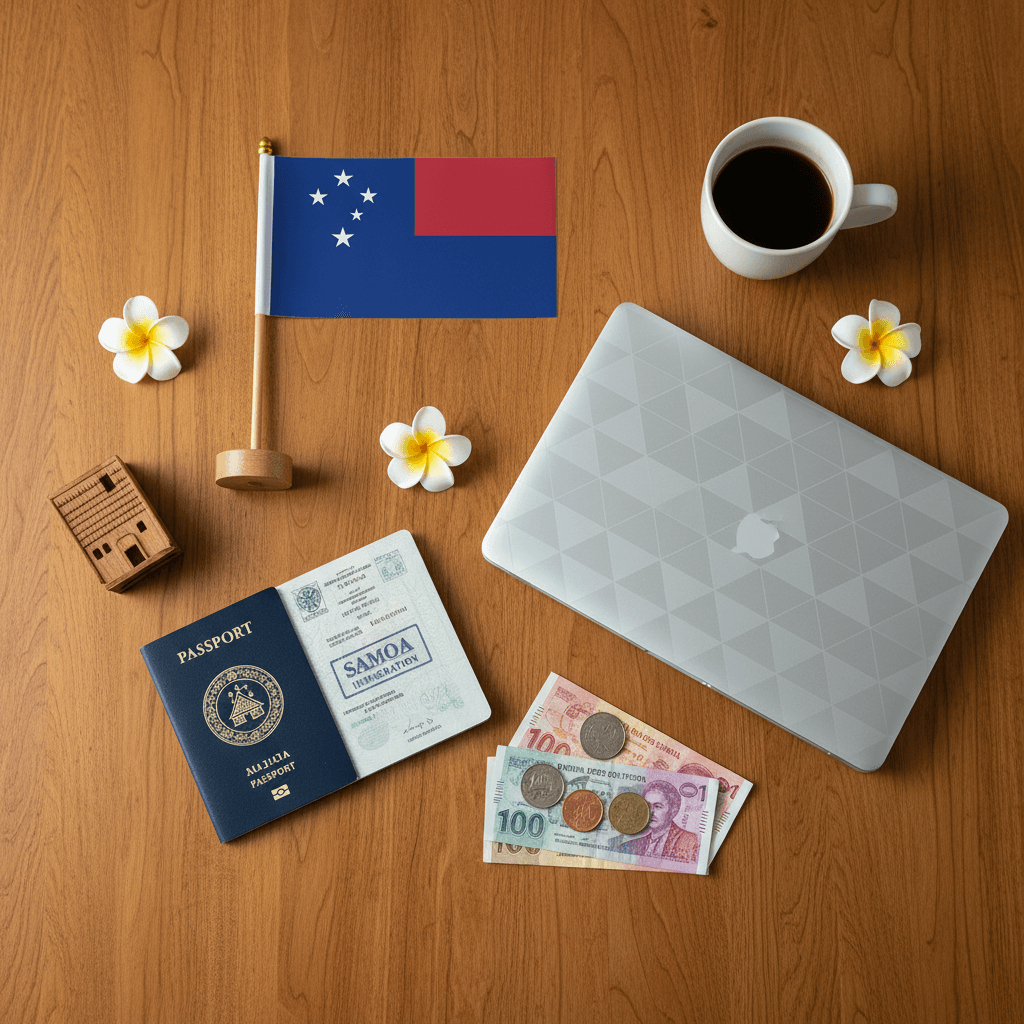
Samoa
Complete Digital Nomad Guide

Policy Stability
Stamped Nomad ExclusiveHow likely visa and immigration policies are to remain unchanged
Quick Facts
Nomad Visa Cost
N/A
Max Stay
6 months
Renewable
Yes
Cost of Living
$1,100/mo
Avg Internet
46 Mbps
Safety Score
6/10
Healthcare
Medium
Coworking
Low
English Friendly
High
Time Zones
UTC+13
Entry Methods Available
Best For
The 90-Day Entry Standard
Samoa is remarkably welcoming to digital nomads, offering one of the most straightforward entry processes in the South Pacific. There is no complex e-visa system to navigate before you fly. Instead, citizens from over 100 countries, including the US, UK, Australia, New Zealand, and most of the EU, receive a free Visitor Permit on arrival. This permit is good for up to 90 days, giving you three full months to settle into the island rhythm without any upfront paperwork.
To secure your entry at Faleolo International Airport, you need a passport with at least 6 months of validity remaining. Immigration officers will also want to see a confirmed return or onward ticket out of Samoa, proof of sufficient funds to support your stay, and a confirmed accommodation booking. While the process is usually quick, having digital or printed copies of these documents ready will save you time at the desk.
Extending Your Stay
If three months feels too short, you can apply to extend your stay while you are on the ground. You will need to visit the Immigration Division office in Apia in person. The extension requires filling out form MPMC100 and providing updated proof of funds and your onward travel plans. The fee for an extension is approximately ST$100 (around USD 38).
While there is no hard cap on the total number of days you can stay through extensions, approval is at the discretion of the immigration officers. It is a manual, face-to-face process, so a polite attitude and organized paperwork go a long way. Keep in mind that the Visitor Permit strictly prohibits any local employment; your income must come from sources outside of Samoa.
Business vs. Remote Work
For most digital nomads, the standard Visitor Permit is the correct choice. If you are coming for short-term professional activities like attending a conference, negotiating a contract, or meeting with offshore clients, you are covered under the 90-day visitor rules. However, if you plan to start a local business or provide services to Samoan companies, the requirements change significantly.
Active business operations require a Temporary Resident Permit. This is a much more involved process that requires pre-approval before you arrive. You will need several documents to qualify for this path:
- A valid Investment Certificate and Business License
- Official Company Registration documents
- Certified medical and police reports
- A completed MPMC100 application form
Long-Term Residency and Special Permits
If you intend to stay for a year or more for specific projects, research, or family reasons, you will need to look into Temporary Resident status. This category covers everything from study and cultural research to religious work. These permits generally cost between ST$200 and ST$300 and take about 10 days to process. Most of these require a local sponsor or an employer to sign off on form MPMC101.
The rules for Chinese citizens are also becoming more flexible, with a new visa waiver taking effect in April 2025. For US non-citizen nationals, specifically those from American Samoa, the process is slightly different; applications should be handled through the Samoa Consulate in Pago Pago before travel.
Permit Summary at a Glance
- Visitor Permit: Free on arrival, valid for 90 days for most nationalities.
- Extension Fee: Approximately ST$100, applied for in Apia.
- Temporary Resident Fee: Between ST$200 and ST$300 depending on the category.
- Processing Time: On-arrival is instant; residency permits take roughly 10 business days.
- Key Requirements: 6 months passport validity, onward ticket, and proof of accommodation.
Samoa does not currently offer a dedicated "Digital Nomad Visa" like some Caribbean or European nations. However, the 90-day window and the ability to extend locally make it a very accessible destination for remote workers who want to test the waters of the Polynesian lifestyle without a massive bureaucratic headache.
The Reality of Remote Work in Samoa
If you are looking for a flashy, official "Samoa Digital Nomad Visa" to stick in your passport, you are out of luck. Samoa has not joined the ranks of countries offering a specific remote work permit. However, that does not mean you cannot work from a beach fale in Upolu or Savai'i. It just means you have to work within the existing immigration framework, which is surprisingly straightforward if you are planning a shorter stay.
Most nomads choose to enter under a Visitor Permit. It is the path of least resistance for anyone testing the waters or staying for a single season. If you are looking to plant roots for a year or more, the Temporary Resident Permit is your only real option, though it requires a bit more paperwork and a specific "purpose" that fits into their traditional categories.
The Visitor Permit: Your Best Bet
For the majority of digital nomads, the Visitor Permit is the go-to solution. Most nationalities are granted this permit automatically upon arrival. To get that stamp, you need a passport valid for at least 6 months, a confirmed onward ticket to leave Samoa, proof of sufficient funds to support yourself, and a local address where you will be staying.
- Duration: Up to 90 days for eligible nationalities.
- Cost: Free on arrival; SAT$200 (roughly USD$75) for extensions.
- Processing: Immediate at the border; 10 days for extensions.
- Constraint: You are strictly prohibited from local employment. While remote work for an overseas company is generally tolerated, you cannot take a job with a Samoan business.
If you fall in love with the island pace and want to stay longer than your initial 90 days, you can apply for an extension while you are in the country. You will need to fill out form MPMC100 at the immigration office in Apia and provide proof that you still have the funds and a ticket home.
Temporary Resident Permits
If you are planning to stay for a year or two, things get more complicated. Samoa’s Temporary Resident Permit does not have a "remote work" category. These permits are usually reserved for business investors, students, researchers, or those with family ties. If you try to apply under the employment category, you will need a local sponsor and approval from the Ministry of Commerce, which requires proving that no local person can do the job.
For those determined to go this route, the costs and requirements jump significantly. You will need to provide medical reports (form MPMC102) and police clearances (form MPMC103). Fees range from SAT$300 to over SAT$1,800 depending on your specific situation and whether you apply from outside the country.
The Fine Print: Taxes and Restrictions
Samoa’s tax system is relatively simple for visitors. If you are on a Visitor Permit and stay for less than 183 days in a calendar year, you are generally considered a non-tax resident. This means your foreign-sourced remote income usually stays out of the local tax man’s reach. However, if you transition to a Temporary Resident Permit, you might trigger residency for tax purposes, which could include taxes on your worldwide income. It is wise to check with the Samoa Revenue Services if you plan on staying long-term.
One thing the Samoan authorities do not take lightly is overstaying. If you lose track of time and your permit expires, expect a fine of at least SAT$300 and potential issues if you ever want to return to the islands. Always keep a copy of your MPMC100 form handy if you are in the middle of an extension process.
How to Apply
The process is mostly manual, so do not expect a high-tech portal. For a Visitor Permit, you just show up. For extensions or residency, you will need to visit the Ministry of the Prime Minister and Cabinet (MPMC) immigration office in Apia. You can download the necessary forms from their official site before you head over. Most applications are processed within 10 business days, so do not wait until the last minute to submit your paperwork.
The 90-Day Entry Standard
Samoa is remarkably welcoming for digital nomads, offering one of the most straightforward entry processes in the South Pacific. Most travelers don't need to apply for anything before they fly. When you land at Faleolo International Airport, the immigration officer typically grants a 90-day Visitor Permit right on the spot. This applies to citizens from the United States, United Kingdom, Australia, New Zealand, China, and the European Union.
The process is free and requires no prior paperwork or e-visa applications. You just need to show up with a passport valid for at least 6 months beyond your stay and a few supporting documents. While they don't always ask to see every single item, you should have your return or onward flight confirmation and a copy of your accommodation booking ready to go. They also like to see proof of sufficient funds, so a recent bank statement on your phone is usually plenty to satisfy the "financial means" requirement.
Extending Your Stay in Apia
If three months isn't enough time to explore Savai'i and Upolu, you can extend your stay while you're on the ground. You'll need to head to the Immigration Division office in Apia before your initial 90 days run out. Extensions are usually granted in 30 to 90-day increments, potentially allowing you to stay for up to 180 days total.
To get an extension, you'll fill out the MPMC100 form, which is the standard application for temporary residence. The Immigration Division typically processes these in 3 to 5 business days. While the initial entry is free, the extension carries a modest fee of approximately WST 100 (about USD 36). It’s a much more reliable route than trying to leave and come back immediately.
Entry Requirements Checklist
- Passport: Valid for at least 6 months after your planned departure.
- Onward Travel: A confirmed ticket out of Samoa to a country you have the right to enter.
- Financials: Evidence of enough money to support yourself without local employment.
- Accommodation: A confirmed address for at least your first few nights.
- Health and Conduct: No serious criminal record or major health issues that could burden local services.
The Reality of Border Runs
Technically, Samoa doesn't have a written rule against leaving the country and flying back in to reset your 90-day clock. However, border officers have full discretion. If they see a pattern of someone living in the country indefinitely on visitor permits, they may question whether you are a genuine tourist. If you plan on staying longer than six months, it’s better to speak with the Immigration Division about a more formal residency permit rather than risking a denial at the border.
Overstays and Penalties
Samoa takes its visa expiration dates seriously. Overstaying your permit can lead to fines, deportation, or being banned from re-entering the country in the future. The government does perform occasional inspections at private residences and hotels to ensure visitors are compliant. If you realize your permit is about to expire and you can't get to Apia in time, it's always better to contact the Immigration Division immediately rather than waiting until you're at the airport trying to leave.
Permit Costs at a Glance
- Standard Visitor Permit (90 days): Free
- Permit Extension: ~WST 100
- Temporary Resident/Employment Permits: WST 600+
For most digital nomads, the free 90-day permit is the path of least resistance. It gives you plenty of time to find a rhythm, test the local Wi-Fi speeds, and decide if the island life is a good fit for your workflow without the headache of a complex visa application.
Samoa doesn't have a flashy digital nomad visa or a specific "sun and sea" retirement scheme. If you want to stay here long-term, you have to play by the traditional rules of the Immigration Division under the Ministry of the Prime Minister and Cabinet. It is a bit old-school, but for the right person, the path is clear as long as you have your paperwork in order.
The Temporary Resident Route
Most nomads or expats start with a Temporary Resident Permit. This is the standard move if you are staying longer than the 90-day visitor allowance. These permits cover everything from business and investment to study or family reunions. If you are working remotely for a company back home, you will likely find yourself looking at the business or "other" categories, but remember that these permits generally prohibit you from entering the local Samoan job market.
- The Cost: Expect to pay between SAT$900 and SAT$1,800 for the main applicant, depending on whether you apply from outside the country or while already in Samoa.
- Dependents: Bringing family costs extra, usually between SAT$200 and SAT$450 per person.
- Paperwork: You will need Form MPMC100, a clean police report, a medical check, and proof that you have enough money to support yourself without local employment.
- Timeline: Processing is surprisingly quick, usually taking about 10 working days.
Making it Permanent
If you fall in love with the islands and want to drop anchor, the Permanent Resident Permit is the next step. Samoa doesn't just hand these out; they want to see that you bring economic or social value to the country. There is an annual quota for these spots, and if you don't make the cut the first year, the government keeps your application on file for up to three years.
To keep this status, you have to actually live in Samoa for more than 50 percent of the year. The fees for those without a direct blood connection to Samoa are SAT$3,200 per adult and SAT$500 per child. If you have Samoan heritage, that principal fee is usually cut in half.
Investment and Business Stays
While there is no formal "Golden Visa" program, money talks. Investors can secure temporary residency and eventually permanent status by putting capital into the local economy. This usually requires getting a business license or an investment certificate first.
- Investment Thresholds: While not set in stone by official decree, expect to look at figures around $500,000 USD for real estate or over $1 million USD for broader development projects.
- The Citizenship Carrot: One of the biggest perks of the investment path is the shortcut to citizenship. You can often apply after 3 years of permanent residency, provided you have spent at least 15 days in the country each year.
The Freelancer and Retiree Reality
If you are a freelancer, you won't find a specific "Digital Nomad" box to tick on the application. You will likely apply under a temporary permit for business purposes. You must prove you are self-sufficient and not taking a job from a local.
Retirees face a similar situation. There is no dedicated retirement visa category. Most expats in their golden years apply under the "family support" or "self-sufficiency" umbrellas. You will need to show a consistent pension or investment income to prove you won't be a burden on the state's resources.
The Path Forward
The typical journey involves starting with a series of one-year temporary permits. Once you have established a footprint and shown you are a benefit to the community, you move toward the Permanent Resident application. It is a process that rewards patience and a clean record. Make sure your medical and police reports are recent, as the Immigration Division is strict about those 12-month validity windows.
The Nomad Hub: Apia vs. The Islands
Living in Samoa as a remote worker means finding a balance between tropical isolation and the practicalities of a stable connection. Most nomads settle in Apia, the capital on Upolu island. It is the only true urban center where you can find reliable coworking spaces, diverse grocery options, and walkable neighborhoods. While the larger island of Savai'i offers a cheaper, more traditional way of life, it lacks the infrastructure needed for a full-time professional setup. If you head to Savai'i, expect costs to drop by roughly 20% to 30%, but be prepared for slower internet and fewer amenities.
Monthly Housing and Rent
Rent is surprisingly affordable compared to other Pacific hubs, though quality varies significantly. In Apia, nomad-friendly neighborhoods near the city center or the beach are the standard choice. Prices are generally quoted for one-bedroom apartments or small bungalows.
- Budget: $175 to $250 per month for a basic, no-frills apartment outside the immediate city center.
- Comfortable: $250 to $350 for a standard 40m² flat in the heart of Apia with modern fixtures.
- Premium: $350 to $550 for fully furnished, modern units that often include utilities, better security, and ocean views.
Dining and Groceries
Your food budget depends entirely on how much you rely on imported goods. Local markets are a goldmine for fresh produce, but anything in a cardboard box from overseas comes with a hefty price tag. A liter of milk runs about $1.78, while fresh chicken is roughly $3.57 per kilogram.
- Budget: $250 to $300 per month by sticking to local markets and cooking at home.
- Comfortable: $350 to $400 for a mix of home cooking and regular lunches out, which usually cost around $4.60 per meal.
- Premium: $450+ for those who prefer imported brands and frequent dinners at high-end restaurants, where a meal for two averages $36.
Transportation and Getting Around
Apia is relatively compact and walkable, but you will need wheels to explore the rest of the island. Public buses are colorful and iconic, though they operate on "island time" rather than a strict schedule. Taxis are plentiful for short hops around town.
- Budget: $22 to $50 per month using the local bus system. A monthly pass is roughly $22, while single tickets are about $3.55.
- Comfortable: $80 to $100 for a mix of buses and occasional taxis. An 8km taxi ride typically costs around $48.
- Premium: $150+ for frequent taxi use or renting a car for weekend trips. Gasoline stays around $1.08 per liter.
Staying Connected: Coworking and Internet
Reliable internet is the biggest hurdle outside of Apia. You can expect to pay between $36 and $60 per month for a home connection with speeds of 50Mbps or higher. For a more professional environment, Apia has a few dedicated spots and nomad-friendly cafes.
- Hot Desks: Basic memberships in shared spaces range from $80 to $120 per month.
- Dedicated Desks: Premium options with full amenities and high-speed backups start at $120.
Health and Wellness
Samoa’s public healthcare system is basic and often lacks specialized equipment. A standard visit to a local doctor costs about $24.50, but for anything serious, you will want a policy that covers medical evacuation to New Zealand or Australia.
- Basic Travel Insurance: $56 to $90 per month for standard nomad coverage.
- Full Medical: $220 to $250 for comprehensive plans that include evacuation and private clinic access.
- Premium Health: $250+ for global plans including dental, vision, and broader regional coverage.
Estimated Monthly Totals
These figures represent the total cost of living for a single nomad based in Apia. Remember to set aside an extra 10% for utilities and data overages, as these can fluctuate based on air conditioning use.
- The Budget Nomad: Approximately $630 per month. This covers a basic room, local food, and bus transport.
- The Balanced Nomad: Approximately $1,040 per month. This allows for a private city apartment, a mix of dining out, and a coworking membership.
- The Premium Nomad: Approximately $1,470 per month. This supports a modern furnished home, frequent taxi travel, and top-tier health insurance.
Samoa isn't your typical digital nomad hub with a coworking space on every corner. It is a place where the pace of life slows down to "island time," and the urban centers reflect that. While you won't find sprawling metropolises, there are three key areas where the infrastructure meets the needs of a remote worker without sacrificing the Polynesian charm.
Apia (Upolu Island)
Apia is the undisputed heavyweight for nomads in Samoa. As the nation’s capital, it offers the most reliable infrastructure and the only dedicated coworking environment in the country. Onelook Studio provides a professional base with hot desks, but if you prefer the laptop-and-latte lifestyle, Milani Caffe and Nourish Cafe are the go-to spots for high-speed sessions.
The community here is small but surprisingly active. You’ll find regular nomad meetups and a social scene that centers around spots like The Edge for sunset drinks. It is incredibly safe, with a visible police presence and a welcoming local population, though it pays to remember the conservative culture; keep the PDA to a minimum and dress modestly when you’re away from the beach.
- Monthly Cost: $753 to $1,600
- Internet Speed: Average 46 Mbps
- Pros: Best coworking options, active nightlife, and the most consistent power grid.
- Cons: Can feel a bit "busy" compared to the rest of the islands; internet is adequate but rarely lightning-fast.
Salelologa (Savai'i Island)
If Apia feels too much like a "city," catch the ferry to Salelologa on Savai'i. This is the main township on the larger, more rugged island. It feels more like a collection of villages than a town, making it perfect if you want to disappear into a rural community while still staying connected via Starlink or Vodafone mobile hotspots.
There are no formal coworking spaces here, so you’ll be working from your accommodation or local haunts like Harbourside Cafe & Pizza Bar. The vibe is significantly more relaxed than Upolu. Friday nights usually mean karaoke, which is about as wild as the nightlife gets here. It is a fantastic base for someone who wants to spend their weekends exploring lava fields and blowholes.
- Monthly Cost: $700 to $1,500
- Internet Speed: 20 to 50 Mbps
- Pros: Deeply immersive cultural experience and lower living costs.
- Cons: Very limited cafe culture and spotty internet in certain pockets.
Mulifanua Area (Upolu/Ferry Port)
Mulifanua is often overlooked as just a transit point for the ferry, but for the budget-conscious nomad, it’s a hidden gem. Located near the western tip of Upolu, it offers a tranquil, beach-focused lifestyle at the lowest price point in the country. You won't find a "nomad scene" here, but you will find peace.
Working from here usually means setting up at a resort or a small guesthouse. The infrastructure is basic, and you’ll need to be self-sufficient with your data needs. This area is for the nomad who prioritizes a morning swim over a morning macchiato. It is quiet, safe, and incredibly affordable if you negotiate a long-term stay at a local lodge.
- Monthly Cost: $600 to $1,200
- Internet Speed: 20+ Mbps
- Pros: Exceptional value for money and immediate beach access.
- Cons: Almost no nightlife and very few places to work outside of your room.
Quick Comparison
Apia
- Monthly Cost: $753 - $1,600
- Internet: 46 Mbps
- Safety: High
- Community: Growing
Salelologa
- Monthly Cost: $700 - $1,500
- Internet: 20 - 50 Mbps
- Safety: High
- Community: Small
Mulifanua
- Monthly Cost: $600 - $1,200
- Internet: 20+ Mbps
- Safety: High
- Community: Tiny
Connectivity in the Pacific
Working from Samoa requires a shift in expectations. While you won't find the lightning-fast infrastructure of Seoul or Singapore, the country has made massive strides thanks to undersea fiber cables. In the capital of Apia, you can find reliable enough speeds to handle video calls and cloud uploads, but the further you stray from the urban center, the more you'll rely on your own data backups.
Average fixed broadband speeds hover around 26 Mbps download. If you are lucky enough to be in a fiber-enabled zone, usually serviced by Vodafone, you can see speeds reach up to 100 Mbps. However, the reality for most nomads is a bit more modest. Expect a baseline of 17 to 18 Mbps in most guest houses. It is enough to get the job done, but you should definitely download your heavy assets before heading out to a remote beach fale on Savai'i.
The Go-To Coworking Hub
Samoa is not a place with a coworking space on every corner. In fact, there is really only one dedicated game in town: Onelook Studio. Located on the ground floor of the OSM HQ Building on Lotopa Road in Apia, it is the undisputed headquarters for the local and visiting remote work community.
The setup here is professional and polished. You get the staples that are often missing in island cafes: consistent air conditioning, ergonomic seating, and most importantly, unlimited high-speed WiFi. They also offer meeting rooms for private calls, a kitchen, and even showers if you are coming straight from a morning surf. It is the only place in the country where "island time" doesn't apply to the internet connection.
Membership and Day Pass Costs
Pricing at Onelook is structured around "passes" rather than a simple flat monthly fee, which is helpful if you plan on spliting your time between the office and the beach. All prices are in Samoan Tala (WST), which is roughly 0.36 USD per 1 WST.
- Day Passes: Options include half-day (4 hours) or full-day (8 hours) access.
- Kickstarter (1 Month): Includes 8 full-day passes, valued at 1,120 WST with a savings of 320 WST over daily rates.
- Standard (3 Months): Includes 12 full-day passes, valued at 2,075 WST.
- Premium (6 Months): Includes 16 full-day passes, valued at 2,900 WST.
- Duo Plan: A dedicated desk option for teams or pairs needing unlimited weekday access.
Cafe Culture and WiFi Reliability
Apia has a charming cafe scene, but using them as an office is hit-or-miss. Most cafes offer WiFi, but it is rarely "unlimited" or fast enough for intensive tasks. Speeds often drop below 20 Mbps, and connections can be fickle during peak lunch hours or tropical storms. Power outages, while less frequent than in years past, still happen, so always keep your laptop charged.
If you decide to work from a cafe, treat it as a spot for clearing emails or casual writing rather than client presentations. It is standard etiquette to buy a coffee or meal every couple of hours, and it is wise to show up early to snag one of the few tables near a power outlet. Always have a backup plan in your pocket.
Mobile Data and Backup Solutions
Because fixed line internet can be temperamental, a local SIM card is your best friend. Vodafone and Digicel are the two main providers. Vodafone generally has the edge on speed, while Digicel often offers competitive data bundles.
- Vodafone Tourist SIM: 20 GB of data for 15 days at 49 WST (about 18 USD), including local calls.
- Digicel Visitor SIM: 100 GB for 28 days at 100 WST (best for heavy users).
- Smaller Digicel Packs: 10 GB for 7 days (15 WST) or 20 GB for 14 days (30 WST).
- eSIM Options: Providers like Nomad or Saily offer 1 GB starting around 8 USD, though local physical SIMs are significantly cheaper for large data amounts.
If you have a phone that supports 5G, you might find pockets of high-speed coverage in Apia, but 4G/LTE is the standard elsewhere. Tethering to your phone is often more reliable than using public WiFi in rural areas, so factor the cost of a high-limit data plan into your monthly budget.
Navigating the Healthcare System
Samoa offers a laid-back lifestyle, but its medical infrastructure is modest. The system is split between public facilities and a small handful of private clinics. While the public sector provides the backbone of care, most digital nomads and expats gravitate toward private providers for faster service and more modern amenities.
The Ministry of Health oversees the public hospitals, with the main hub being Tupua Tamasese Meaole Hospital (TTMH) in Apia. On Savai'i, the primary facility is Malietoa Tanumafili II Hospital. These spots handle everything from general checkups to emergency trauma, but they often grapple with specialist shortages and long wait times. For day-to-day issues like a flu or a minor infection, private clinics in Apia are your best bet for getting in and out quickly.
International Standards and Evacuation
You won't find a massive international-standard hospital here. While TTMH is competent for basic surgeries and stabilization, the country lacks the tech for complex cardiac care or advanced oncology. If things get serious, the standard procedure is a medical evacuation to New Zealand, Australia, or Fiji. This makes a solid insurance policy a non-negotiable part of your kit. The MedCen private hospital, once a beacon for specialist care, remains shuttered, so don't rely on finding a high-tech private hub on the island.
Insurance for Nomads
Public healthcare is heavily subsidized for citizens, but as a non-resident, you'll be paying out of pocket or through your provider. Local plans are available for around $20 to $50 per month, but these only cover the basics at public facilities. For true peace of mind, look into international private insurance or nomad-specific policies like SafetyWing or World Nomads.
- Basic Local Plans: $20–$50 per month
- Comprehensive Private Plans: $100–$300 per month
- Full Expat/International Coverage: $200–$500 per month (includes global repatriation)
Typical Out-of-Pocket Costs
Healthcare costs in Samoa are generally lower than in the US or Europe, but they can climb quickly in private settings. Here is what you can expect to pay for common services:
- GP Visit: $20–$50 (Public) / $50–$100 (Private)
- Specialist Consultation: $50–$100 (Public) / $100–$200 (Private)
- ER Visit: $100–$300 (Public)
- Hospital Stay (per night): $200–$500 (Public)
- Basic Surgery: $1,000–$3,000 (Public)
- MRI: $500–$1,000 (Very limited availability)
- X-Ray: $20–$50 (Public)
Pharmacies and Prescriptions
Most pharmacies are clustered around Apia, specifically on Vaea Street. Niu Pharmacy and Maria’s Healthcare Pharmacy are reliable spots for picking up prescriptions or over-the-counter meds. Signage is in English, and the pharmacists are generally very helpful. Most shops open around 8:00 am and close by 5:30 pm on weekdays, with shorter hours on Saturdays.
Stock levels for common antibiotics and maintenance meds are usually fine, with monthly prescriptions costing between $20 and $50. However, if you rely on specialized or rare medication, bring a three-month supply with you. Availability in rural areas is almost non-existent, so stock up before heading to the outer villages.
Emergency Response
If you find yourself in a crisis, dial 911. The Samoa Fire & Emergency Services Authority (SFESA) operates the ambulance service. Response times are fairly reliable within the Apia urban area, but expect significant delays if you are staying in a remote coastal village or on Savai'i. For any life-threatening situation, your first move after calling the ambulance should be contacting your insurance provider to put an evacuation plan in motion.
The Local Currency
In Samoa, you will be dealing with the Samoan Tala (WST), which is symbolized locally by the $ sign. Don't let the dollar sign confuse you; always assume prices are in Tala unless specified otherwise. One Tala is divided into 100 sene. You will mostly carry notes ranging from WST 5 to WST 100, along with various coins for smaller transactions. While the airport and major banks offer exchange services for USD, AUD, and NZD, you will get much better utility out of a travel card or local ATM withdrawal.
Opening a Local Bank Account
For most digital nomads staying on a standard visitor visa, a local bank account is probably more trouble than it is worth. However, if you are planning a long-term stint or have a residency permit, you can open a personal account at major institutions like ANZ Samoa, Bank South Pacific (BSP), National Bank of Samoa, or Samoa Commercial Bank. Online applications are virtually non-existent, so you will need to walk into a branch in person.
Expect the approval process to take several days. To get started, you will generally need to provide:
- A valid passport.
- Proof of a local address or a recent utility bill.
- A residency or work permit.
- A bank reference from your home country.
- A minimum deposit, usually between WST 50 and WST 200.
Using Wise and Revolut
If you already use Wise or Revolut, you are in luck. While these services do not offer local accounts for Samoan residents, their international cards work quite well for visitors. You can use your Wise card to spend WST directly or withdraw cash at ATMs without needing to hold a specific Tala balance in your app; the conversion happens automatically at the mid-market rate.
Revolut is equally handy for everyday spending and low-fee transfers. It is a smart move to keep one of these cards as your primary payment method to avoid the heavy foreign transaction fees typically charged by traditional big-name banks. Just be sure to confirm with your provider that your card is cleared for use in the South Pacific before you fly out.
ATM Access and Fees
Cash is still king in Samoa, especially once you leave the capital city of Apia. You will find that while hotels and larger restaurants accept Visa and Mastercard, smaller vendors and beach fales require physical Tala. Unfortunately, there is no such thing as a fee-free ATM for foreigners here.
- Standard withdrawal fees: WST 15 (approx. USD 5.50) per transaction.
- ANZ specific fees: An additional WST 10 for international cards.
- Withdrawal limits: Usually capped around WST 2,000 per day.
When the ATM asks if you want to use its conversion rate, always decline. Let your home bank or travel card handle the currency exchange to avoid predatory "convenience" markups.
Moving Money Efficiently
If you need to move larger sums of money or pay a local landlord, skip the traditional wire transfers. Wise is the top choice for speed and low fees, usually charging a markup of around 0.6%. Revolut is also a solid contender with flat fees for bank transfers, often around 21 WST. If you need to send money for instant cash pickup, Remitly or Western Union are reliable but significantly more expensive. Most nomads find that funding their Wise or Revolut accounts via ACH or debit card and then spending locally is the most cost-effective path.
Crypto Regulations
Samoa is not a crypto-friendly hub. The Central Bank of Samoa does not recognize cryptocurrency as legal tender and has issued stern warnings about the risks involved. Under the Money Laundering Act, unlicensed promotion or trading of digital assets can lead to heavy fines or even imprisonment. Since 2023, any exchange or wallet operating in the country must follow strict KYC and AML registration rules. For your own safety, stick to fiat currency and traditional digital transfers while you are on the islands.
Visas for Your Crew
Moving your family to Samoa is relatively straightforward if you are already coming for work or business. If you hold a temporary residence permit, you can include your children on your application for SAT$450.00 per child. For those who already have residency or citizenship and are bringing dependents later, the family reunion visa is the way to go. This specific visa for children under 18 costs SAT$200.00 and usually takes about 10 working days to process.
You will need to gather the standard paperwork: original birth certificates, valid passports, and proof of your relationship. The government also requires evidence that you can financially support your kids while living in the islands. Keep these documents handy as you'll need them for school enrollments too.
Education and Schooling
While Samoa is a small nation, you have a few solid choices for schooling, particularly in the capital. Most expat families opt for private or international schools that follow the IB or Cambridge curriculum. These schools provide a smoother transition if you plan on moving elsewhere later, though they come with a higher price tag.
- International Schools: Expect to pay between $5,000 and $10,000 USD annually.
- Private Secondary Schools: These usually range from $2,000 to $5,000 USD per year.
- Private Primary Schools: These are more affordable, costing between $1,000 and $3,000 USD annually.
Public schools are available and very cheap, often costing less than $300 USD a year for secondary levels. However, lessons are mostly taught in Samoan, which might be a steep learning curve for older kids. For the little ones, daycare and preschool options are almost exclusively found in Apia, costing a modest $50 to $100 USD per month.
Keeping the Kids Healthy
The healthcare hub of the country is the Tupua Tamasese Meaole Hospital in Motootua. It is a 200-bed facility equipped with dedicated pediatric clinics and inpatient wards. If you decide to live in more rural areas, there are district hospitals in spots like Lalomanu, Poutasi, and Sataua, though these are better for minor issues rather than specialized care.
Samoa has made big strides in child health lately. Immunization rates for MMR are steadily climbing, and the country has high coverage for prenatal care. That said, for any very serious or complex pediatric surgeries, families often travel to New Zealand. It is a good idea to have a solid international health insurance policy that covers medical evacuation just in case.
Where to Set Up Base
For most nomad families, Apia is the only realistic choice. It is the heart of the country’s infrastructure, housing the best schools, the main hospital, and the expat community. With a population of about 36,000, it feels more like a breezy coastal town than a crowded city. You can expect a monthly budget of around $2,303 USD to cover a family's needs here.
The lifestyle is famously relaxed. You won't have to worry about malaria or dangerous wildlife like snakes or crocodiles. It is a place where kids can actually spend their time outdoors in 28°C (82°F) weather year-round. While the islands are generally very safe, keep an eye on your home security. Petty theft and residential break-ins have ticked up recently. In Apia, it is best to avoid the harbor-front and downtown bar areas late at night, but during the day, the vibe is overwhelmingly welcoming and communal.
Childcare and Daily Life
If you are working remotely, you might need a hand with the kids during the day. Beyond the formal preschools in Apia, many families hire local help. Because the cost of living for childcare is low, often around $100 USD a month for organized care, it is an affordable luxury compared to Western prices. The Samoan culture is incredibly child-centric, so you will find that locals are generally very patient and helpful toward families traveling with young children.
Staying Safe in the Islands
Samoa is generally one of the safer corners of the Pacific, but it isn't a place where you should leave your common sense at the airport. Petty theft and opportunistic break-ins are the most frequent issues, particularly in Apia. If you are staying in a traditional fale or a rental house, make sure your doors are locked at night and keep your electronics out of sight from windows.
Violent crime is rare, but things can get a bit rowdy around downtown bars and restaurants late at night. It is best to avoid these areas after hours if you are alone. When it comes to your wallet, watch out for credit card skimming at ATMs and restaurants. Stick to machines located inside banks when possible. If you are taking a taxi, always agree on the fare before you get in, as drivers sometimes quote inflated "tourist prices" to unsuspecting arrivals.
The Fa'a Samoa (The Samoan Way)
Samoan culture is built on a foundation of profound respect and tradition. You will hear the term Fa'a Samoa often; it refers to the traditional way of life that governs everything from village politics to family dinners. To get along well here, you need to slow down. Rushing people or showing outward frustration is considered rude and will likely get you nowhere.
If you are invited into a home or a village meeting space, always remove your shoes before entering. Never stand while elders or chiefs are seated, and if you must walk past someone, a slight bow and a quiet "tulou" shows you know the local etiquette. Sundays are sacred. Most of the country shuts down for church and family time. Avoid loud activities, swimming in village areas, or any strenuous work on Sundays to avoid offending your neighbors.
- Dress Code: Keep it conservative. Save the bikinis and board shorts for the beach. In villages and town, shoulders and knees should ideally be covered.
- Photography: Always ask permission before snapping photos of people or private property. Many beaches and natural spots are family-owned and require a small entry fee of 5 to 10 WST.
- Tipping: Haggling and tipping are not part of the culture. Pay the asked price, as bargaining can be seen as disrespectful.
LGBTQ+ Considerations
Samoa has a unique social structure regarding gender. The fa'afafine (biological males who live as women) are a recognized and integral part of traditional society. They have been a part of the culture for centuries and are generally well-respected. However, this acceptance doesn't always extend to the broader LGBTQ+ spectrum.
Public displays of affection between same-sex couples are likely to draw negative attention or even legal trouble, as certain acts remain technically criminalized under old laws. While these laws are rarely enforced against tourists, the culture remains deeply religious and socially conservative. Discretion is the best policy here to ensure a smooth stay.
Communication and Community
Language is rarely a barrier for digital nomads. English is an official language and is spoken fluently by most people in Apia and the younger generations across the islands. You might hear "Samlish," a local blend of Samoan and English, in casual conversation. Learning a few basics like Talofa (Hello) and Fa'afetai (Thank you) goes a long way in building rapport with locals.
For social life, the expat and nomad scene is concentrated in the capital. There are a few coliving spots and cafes that have become unofficial hubs for remote workers. The Apia Expats group is your best bet for finding housing leads or weekend meetups. When working from local cafes, remember that the "digital nomad" lifestyle is still relatively new here. Be a considerate guest by ordering more than just one coffee if you plan to stay for hours, and keep your video calls quiet.
Integration Tips
- Embrace the pace: Things move slowly. If a meeting starts 20 minutes late, just roll with it.
- Village protocol: If you hear a bell or shell blowing around dusk, this is Sa, a time for prayer. If you are walking through a village, stop and wait quietly until it is over.
- Community ties: If you are staying long-term, attending a local church service or community event is the fastest way to be accepted as part of the neighborhood.
The 183-Day Rule
Understanding your tax liability in Samoa starts with a simple calendar check. You are considered a tax resident if you spend 183 days or more in the country within any 12-month period. This is a rolling window, meaning it can start or end in different tax years, so you need to keep a close eye on your entry and exit stamps if you plan on a long-term stay.
Samoa also uses a "permanent home" test. If you establish a primary residence here, the authorities may deem you a resident regardless of your day count. For most nomads bouncing between beach fales and villas, the 183-day threshold is the primary trigger to watch. If you stay under that limit, you are generally only taxed on income sourced directly within Samoa.
Income Tax Brackets
If you cross the residency threshold, Samoa taxes your worldwide income on a progressive scale. The rates are straightforward, though the top tier kicks in relatively early compared to Western standards. All figures are in Samoan Tala (SAT).
- 0% on annual income up to SAT 15,000
- 20% on income between SAT 15,001 and SAT 25,000
- 27% on all income above SAT 25,000
For non-residents, you only pay tax on money earned inside Samoa. If you are strictly working for foreign clients and getting paid into a foreign bank account while staying on a standard visitor permit, you typically remain outside the local tax net. However, if you take on local consulting work or physical services, expect withholding taxes to apply.
Business Structures and Territorial Benefits
Samoa maintains a territorial lean for certain corporate structures. Non-resident companies often find favorable treatment for foreign-sourced income. If you run a location-independent business, setting up a specific entity type might shield your international earnings from local taxation, though you should seek professional advice to ensure your structure aligns with the Income Tax Act 2012.
There isn't a specific "Digital Nomad Visa" with built-in tax holidays yet. While the government offers incentives for the tourism and manufacturing sectors, remote tech workers generally fall under standard tax laws. If you are looking for a long-term path, investment migration offers permanent residency after three years, which can solidify your status and provide clearer territorial tax benefits.
Crypto and Capital Gains
Samoan tax law treats cryptocurrency as property rather than currency. This means any profit you make from selling or exchanging crypto is subject to capital gains tax, which is calculated at the standard progressive income rates up to 27%. If you are mining or staking while resident in Samoa, that income is valued at the time you receive it and added to your assessable income.
Keep meticulous records of your transaction dates and values. The tax authorities require documentation for audits, and since Samoa participates in Common Reporting Standard (CRS) protocols, financial data exchange with other countries is a reality. Don't assume your digital assets are invisible to the local revenue service.
Treaties and Filing
Samoa has a significant Double Taxation Agreement (DTA) with New Zealand, which helps prevent you from being taxed twice on the same dollar. For nomads from other countries, Section 105 of the Income Tax Act allows for various relief arrangements. You can often claim credits for taxes paid abroad to offset your Samoan liability.
The tax year follows the calendar year. If you are required to file, you’ll use the IR forms provided by the Ministry of Customs and Revenue. Residents must report their global earnings, while non-residents only deal with Samoa-source income, often handled through final withholding taxes on interest or local service fees.
Connectivity and SIM Cards
Staying online is your top priority, and Samoa makes it relatively straightforward. Digicel and Bluesky are the two primary providers you will see everywhere. You can grab a physical SIM at the airport or in Apia, but if your phone supports it, an eSIM is the way to go. You can get set up before you even land, with prices starting around USD 8 for 1GB (valid for 7 days) or USD 45 for 5GB (valid for 30 days).
Getting Around
Public transport exists, but for reliable work meetings or late-night grocery runs, you will want a few apps on your phone. The MAUA Taxi App is the local version of Uber, offering transparent pricing and real-time tracking. You can pay via cash, card, or Vodafone MTALA. If you are looking for alternatives, Vave Mai Services is great for quick trips, while Sameway Rides offers a carpool and bikepool option if you want to save money and meet locals.
Where to Base Yourself
Most nomads gravitate toward one of two vibes:
- Fugalei: This is the heart of Apia. It is lively, walkable, and home to the Fugalei Market. If you want to be near the best coffee shops and dining options, stay here.
- South Upolu: If your work schedule allows for a slower pace, head south. It is remote and unpopulated compared to the capital. You will find stunning beachfront resorts that feel worlds away from a cubicle, yet it is still a manageable drive back to the city.
Finding a Home
Standard platforms like Airbnb are active here, but there are local and niche alternatives that might serve you better. Mapmelon is a solid choice for curated coliving spaces that prioritize high-speed internet and communal kitchens. For more traditional houses or longer-term rentals in neighborhoods like Vailima or Vaitele, check out Holiday Homes Samoa. They offer a more local feel than the big international booking sites.
Food and Dining
When you are deep in a project and cannot leave your desk, SekiEats is the go-to delivery service. It has the largest selection of local restaurants and a mobile app with live driver tracking. Just keep an eye on the clock; while the app handles orders late into the evening, website orders usually wrap up by 4:30pm on weekdays and 12:00pm on Saturdays.
Learning the Language
Samoans are incredibly welcoming, but learning a few phrases of Gagana Sāmoa goes a long way. Use these apps to get started:
- Asalei: A game-based app that includes cultural notes and clear audio clips.
- Gagana Sāmoa: Excellent for mastering pronunciation, including those tricky glottal stops.
- Drops: Best for quick vocabulary building, featuring over 2,600 words and high-quality voice acting.
Safety and Emergencies
Samoa recently streamlined its emergency services. You no longer need to remember different numbers for different problems. Just dial 911 for police, fire, or ambulance services. If you are on Upolu and need a hospital specifically, the Tupua Tamasese Meaole Hospital can be reached at (685) 21212.
Pro-Tips to Avoid Common Headaches
The biggest pitfall for newcomers is overcommitting to a long-term rental sight unseen. Internet speeds vary wildly from one street to the next. Book your first 3 to 5 days at a hotel or guesthouse, then test the WiFi yourself before signing anything long-term. Always have a backup mobile hotspot ready; even the best connections can flicker during a tropical storm.
Pack lighter than you think you should. Focus on high-quality, breathable fabrics and versatile gear. You do not need a massive suitcase for island life, but you do need a solid routine. Joining a coworking space or designating a specific "office" area in your home will keep you from drifting into a permanent vacation mode that kills your productivity.
Stay Updated on Samoa
Get notified about visa changes, policy updates, and new information for digital nomads in Samoa.