Norway
Complete Digital Nomad Guide

Policy Stability
Stamped Nomad ExclusiveHow likely visa and immigration policies are to remain unchanged
Quick Facts
Nomad Visa Cost
N/A
Max Stay
3 months
Renewable
No
Cost of Living
$2,543/mo
Avg Internet
150 Mbps
Safety Score
7/10
Healthcare
High
Coworking
Medium
English Friendly
High
Time Zones
CET
Entry Methods Available
Best For
The Schengen Basics
Norway is a core member of the Schengen Area, which means your entry requirements depend largely on your passport's origin rather than your status as a remote worker. The Norwegian Directorate of Immigration, or UDI, manages all permits. They generally categorize stays into short-term visits under 90 days and long-term residence permits for everything else.
There is no such thing as a visa on arrival or a digital e-visa for Norway. If you need a visa to enter, you have to handle the paperwork in advance through a VFS Global center or a Norwegian embassy. If you are from a visa-free country, you simply show up with a valid passport and proof of travel insurance.
Visa-Free Entry
Many nomads can skip the consulate visit entirely. Citizens from the EU/EEA have the easiest path, with the right to live and work in Norway as long as they register with the police after three months. For everyone else, there is a list of about 70 countries that enjoy visa-free access for tourism or business.
- North America: USA, Canada, and Mexico.
- Oceania: Australia and New Zealand.
- Asia: Japan, South Korea, and Singapore.
- South America: Brazil, Argentina, and Chile.
- UK: British citizens remain visa-free for short stays post-Brexit.
If you hold a passport from one of these nations, you can stay for up to 90 days within any 180-day period. This is a rolling window, so you need to keep a close eye on your calendar if you are hopping between Norway and other European countries.
The Tourist Visa (Type C)
If your home country isn't on the visa-free list, you will need a Schengen Type C visitor's visa. This allows for the same 90-day stay but requires a formal application process. You should start this process at least a few weeks before your flight, as processing times vary by location.
- Standard Fee: Approximately €80 (roughly 900 NOK) for adults.
- Child Fees: Reduced rates apply for children, usually around €40.
- Requirements: Proof of accommodation, a return flight itinerary, and travel insurance covering at least €30,000.
- Financial Proof: You generally need to show you have 500 NOK available for each day of your stay.
Don't count on extending this visa once you arrive. UDI only grants extensions for extreme emergencies like sudden, severe illness or major flight disruptions. Once your 90 days are up, you must leave the Schengen Area.
Business Visits
If you are heading to Oslo or Bergen for meetings, a conference, or to negotiate a contract, you still use the Type C visa. The cost and duration are identical to the tourist version. The main difference is the paperwork; you will need an invitation letter from a Norwegian company and a letter from your employer confirming your professional status.
Keep in mind that "business" does not mean "employment." You cannot take a paid job with a Norwegian company on this visa. It is strictly for professional networking and administrative tasks related to your job back home.
Upcoming Changes for 2025 and 2026
The rules for short-term stays are staying mostly consistent through 2025. The biggest shift on the horizon is the rollout of ETIAS, currently scheduled for late 2026. This isn't a visa, but a mandatory electronic authorization for travelers who are currently visa-free. It will be a quick online form and a small fee, similar to the American ESTA.
For those looking at 2025, the only major recent update is for Kosovo citizens, who can now enter visa-free with a biometric passport. Beyond that, the focus of the Norwegian government has shifted toward streamlining residence permits for skilled workers, while the short-stay rules remain a steady, predictable gatekeeper for the Schengen zone.
The Reality of Remote Work in Norway
If you are dreaming of working from a cozy cabin under the Northern Lights, you need to understand the legal landscape first. Norway does not offer a dedicated digital nomad visa. Unlike some of its European neighbors, the Norwegian government hasn't created a specific "laptop lifestyle" permit for people who just want to bring their foreign jobs to the fjords.
The Norwegian Directorate of Immigration is quite clear on this point. You cannot simply enter on a tourist visa and work for your boss back in New York or London. Even if your employer has no presence in Norway, the act of working while physically located on Norwegian soil generally requires a residence permit that specifically allows for work. If your plan is to work purely for foreign clients without any local ties, you will likely find yourself without a legal path forward.
The Skilled Worker Loophole
While there is no nomad-specific visa, many self-employed nomads use the Skilled Worker residence permit for self-employed persons with a business abroad. This is the closest thing Norway has to a professional remote work permit, but it comes with a major catch. You cannot just work for yourself; you must have a contract for a specific assignment with a Norwegian company.
This permit is designed for consultants or contractors who have an established business outside of Norway but need to be in the country to complete a project for a local client. If you can land a contract with a Norwegian firm, this opens the door to living in the country for up to two years initially. You can renew this for up to six years in total, though you are required to take a two-year break after that maximum period.
What You Need to Qualify
Norway is selective about who they let in under the skilled worker category. You have to prove you are a professional with a solid track record. The requirements are strict and include:
- Education: You must have completed vocational training of at least three years, hold a university degree, or possess "special qualifications" through at least six years of relevant work experience.
- Business Status: You must have a registered business entity based outside of Norway.
- Local Contract: You need a signed contract for a project with a Norwegian business. Working for a staffing agency does not count.
- Income: The pay from your assignment must meet Norwegian standards. This is generally at least NOK 325,400 pre-tax per year, though specific industry minimums often apply.
The Application Process
Once you have your Norwegian contract in hand, you can start the paperwork. You will need to gather your passport, proof of your business registration abroad, a detailed CV, and documentation of your education or experience. You also need to show proof of where you will be living and have valid insurance.
The application fee is roughly NOK 6,300. You usually apply through a Norwegian embassy or consulate in your home country. If you are already in Norway legally on another permit, you might be able to apply at a local police station, but it is always safer to start the process before you arrive. Processing times fluctuate, so it is best to plan several months in advance.
Taxes and Restrictions
Living in Norway comes with high-quality public services, but those are funded by a robust tax system. If you stay in Norway for more than 183 days in a year, you are typically considered a tax resident. This means you will be liable for Norwegian income tax on your worldwide income. The base rate is around 22%, but surtaxes and social security contributions can push that higher.
There are also some firm boundaries to this permit you should keep in mind:
- You cannot switch to a different Norwegian client or project without applying for a new permit or an amendment.
- The time spent on this specific permit does not count toward permanent residency.
- Your family can join you, provided your assignment lasts longer than six months and you meet income requirements to support them.
- Pure remote work for companies outside of Norway is still technically prohibited if it is not part of your approved Norwegian assignment.
Norway is an incredible home base for those who can make the logistics work. Just be prepared to trade the "work from anywhere" freedom for a more structured, contract-based arrangement with a local partner.
The 90/180 Rule and Visa-Free Access
Norway is a member of the Schengen Area, which means your entry requirements depend largely on your passport. If you hold a passport from the United States, Canada, Australia, Japan, or Brazil, you fall into the visa-free category. You can explore Norway for up to 90 days within any 180-day period without ever filling out a formal application.
This 90-day limit is a rolling window. If you spend three months hiking the fjords, you have to leave the entire Schengen Zone for another three months before you can return. To stay on the right side of the law, use the official Schengen short-stay calculator to track your dates. For EU, EEA, and Swiss citizens, the rules are even simpler; you can enter with just a national ID and stay indefinitely.
Your passport needs to be valid for at least 3 months after your planned departure date and must have been issued within the last 10 years. If you don't meet these basic criteria, you might be turned away at the boarding gate before you even see a Norwegian mountain.
The Standard Visitor Visa (Type C)
If your home country isn't on the visa-free list, you need to apply for a Schengen Visitor Visa (Type C). Norway does not offer a visa-on-arrival, so you have to sort this out well before your flight. While you start the process online via the UDI portal, this isn't a true e-visa. You still have to show up in person at a VFS Global application center or a Norwegian embassy to submit your biometrics and physical documents.
The standard application window opens 6 months before your trip, and you should submit your paperwork at least 15 days before you fly. In some cases, processing can take up to 45 days if the embassy needs more information, so don't leave it until the last minute.
Requirements for the application include:
- Proof of funds: You generally need to show you have at least NOK 500 per day for your stay.
- Travel insurance: A policy with a minimum coverage of €30,000 for medical emergencies and repatriation.
- Itinerary: Proof of accommodation bookings and a return flight or onward travel plans.
- Application fee: The cost is €90 for adults and €45 for children aged 6 to 12. Kids under 6 are free.
Keep in mind that VFS Global charges their own service and courier fees on top of the government visa price. These fees are non-refundable, even if your application is denied.
Extensions and Border Runs
Extending a tourist visa while inside Norway is incredibly difficult. The police only grant extensions for unforeseen circumstances like a sudden illness or a natural disaster that prevents travel. Expect to pay a €30 fee for the request, and even then, your total stay cannot exceed the 90-day limit.
Border runs are technically legal, but they are often more trouble than they are worth. You can leave the Schengen Area and re-enter to "reset" your status, but you must still adhere to the 90/180-day rule. If a border official sees a pattern of immediate exits and re-entries, they may flag you for "visa shopping" or suspect you are living in Norway illegally, which could lead to a denied entry.
Consequences of Overstaying
Norway takes its border security seriously, and overstaying your welcome has lasting consequences. Even a short overstay of a few days can result in a fine starting around €500. If you stay longer than 8 to 30 days past your limit, you risk a fine of €1,000 or more and a one-year ban from the entire Schengen Area.
Serious offenders face deportation at their own expense and entry bans lasting 5 years or more. An overstay on your record makes it significantly harder to get any future visas for Europe, the US, or Commonwealth countries, as many nations share immigration data. Stick to the 90-day limit to keep your future travel options open.
The Reality of Settling in Norway
Norway is a dream destination for many nomads, but it is also one of the most bureaucratic environments for non-EU/EEA citizens. There is no such thing as a "Golden Visa" or a simple retirement permit here. Instead, staying long-term requires fitting yourself into specific boxes defined by the Norwegian Directorate of Immigration (UDI). Most paths lead back to work or self-employment, meaning you generally need to be an active part of the economy rather than just a passive resident.
The Freelancer and Self-Employed Path
If you are a solo professional looking to make Norway your base, the Self-Employed Residence Permit is your primary route. This is not a "digital nomad visa" for people working for foreign companies; it requires you to establish a sole proprietorship in Norway. You must demonstrate that your business is viable and that you possess "skilled worker" status, which usually means a degree or at least six years of documented experience in your field.
To qualify, you need to show you can support yourself without help from the state. Currently, this means proving an annual profit of at least NOK 325,400. You will also need to show a solid business plan and have a place to live already lined up. The initial permit usually lasts for one to two years and can be renewed if your business remains profitable and you continue to meet the income requirements.
Investment and Business Setup
While there is no passive investment visa, you can gain residency by starting a business that requires your active management. This is a high-hurdle path that involves significant capital and local oversight. You will need to show a minimum setup cost of around NOK 1.2 million (approximately €100,000) and prove that the business will generate an annual profit of at least NOK 310,070.
The application process involves an assessment by local county authorities to ensure your business plan actually benefits the Norwegian economy. The application fee sits around NOK 5,400. It is a rigorous process designed for serious entrepreneurs rather than those just looking for a residency card through a real estate purchase.
Retiring in the North
Norway does not offer a specific visa for retirees from outside the EU/EEA. If you want to spend your golden years here, you generally have to apply for a residence permit based on financial self-sufficiency. This is notoriously difficult to obtain without existing family ties in the country.
If you do pursue this, you must prove you have ample funds, typically at least NOK 325,400 per year, and carry comprehensive private health insurance. Since you won't be paying into the national insurance scheme through labor, the government is very strict about ensuring you won't become a burden on public funds. Most successful applicants in this category already have children or a spouse living legally in Norway.
The Road to Permanent Residency
If you manage to stay in Norway on a qualifying permit for three continuous years, you can apply for permanent residency. This gives you the right to live and work in the country indefinitely and provides much better protection against changes in immigration policy. However, the requirements for the transition are strict:
- Income: You must have earned at least NOK 325,400 in the last 12 months and received no social welfare benefits.
- Language Skills: You must complete tuition in the Norwegian language and social studies, reaching a minimum of A2 proficiency.
- Time Spent Abroad: You cannot have spent more than seven months outside of Norway during the three-year qualifying period.
- Clean Record: You must have a clean criminal record and no outstanding deportation orders.
Once granted, your permanent residency card must be renewed every two years, though your right to stay remains valid as long as you do not spend extended periods living outside the country.
A Note for EU/EEA Citizens
If you hold a passport from an EU or EEA country, the rules are significantly more relaxed. You do not need a residence permit. Instead, you simply register with the police if you plan to stay longer than three months. You have the right to live, work, and start a business immediately, provided you can support yourself financially.
The Price of Paradise
Norway is famous for its fjords, northern lights, and a standard of living that consistently tops global charts. However, that quality of life comes with a significant price tag. For digital nomads, Norway is an investment in your lifestyle rather than a place to "geoarbitrage" your way to savings. Your monthly burn will likely fall between $1,700 on a strict budget and $5,600 if you are living the premium life in central Oslo.
The good news is that the infrastructure is rock solid. You get what you pay for in terms of safety, cleanliness, and high-speed internet. While the sticker shock is real, savvy nomads can manage costs by embracing the local "friluftsliv" (outdoor life) which is mostly free once you have the gear.
Breaking Down the Rent
Housing will be your biggest hurdle. In Norway, the rental market is competitive, particularly in the late summer when students flood the cities. Oslo is the most expensive hub, generally costing 20-30% more than other major cities. If you want to keep costs down, look at the city edges or shared housing (kollektiv), which is a common way for locals to live.
Oslo (The Capital Pulse)
- Budget (Outskirts/Shared): $940 (9,500 NOK)
- Comfortable (City Edge): $1,200-$1,350 (12,500-14,000 NOK)
- Premium (City Center): $1,450-$1,650 (15,000-17,000 NOK)
Bergen (The Gateway to Fjords)
- Budget (Outskirts/Shared): $850-$925 (9,000-9,700 NOK)
- Comfortable (City Edge): $1,100-$1,250 (11,500-13,000 NOK)
- Premium (City Center): $1,350+ (14,000+ NOK)
Trondheim and Stavanger
- Trondheim Comfortable: $1,200-$1,300 (12,500-13,500 NOK)
- Stavanger Outskirts: $855+ (9,000+ NOK)
- Stavanger Premium: $1,400+ (14,700+ NOK)
Eating and Drinking
Dining out is where many nomad budgets go to die. A standard meal at a casual restaurant will run you about $16, but a nice dinner for two can easily clear $140. Alcohol is heavily taxed and sold through a state monopoly (Vinmonopolet), so a single beer at a bar can cost $10-$12.
Most nomads stick to grocery shopping to stay afloat. If you cook at home, expect to spend about $150 per week on groceries. Shopping at budget supermarkets like REMA 1000 or Kiwi will save you a bundle compared to the high-end markets. In Bergen, you might find slightly better deals on fresh seafood, while Oslo generally sees the highest food prices across the board.
Transport and Tech
Public transport is exceptional. You won't need a car in the cities, and owning one is a financial headache due to tolls and fuel costs. A monthly pass in Oslo costs around $95, covering all buses, trams, and ferries in Zone 1. In smaller cities like Trondheim or Bergen, you can expect to pay about $85 for a similar pass.
For work, coworking spaces are the norm for professional nomads. A dedicated desk in a trendy Oslo spot like Vika can cost up to $760 a month, but you can find "hot desk" memberships or community spaces for around $190 to $285. If you prefer the cafe route, a coffee will cost you about $5, and most places are happy to let you work for an hour or two if it isn't peak lunch time.
Healthcare and Insurance
Public healthcare in Norway is world-class, but as a digital nomad, you won't have immediate access to the national system unless you become a tax resident. Private insurance is a requirement for most visas, and you should budget for it accordingly. Even with insurance, expect a small copay of 180-400 NOK for GP visits.
- Basic Emergency Coverage: $35-$65 per month
- Standard Nomad Policy: $50-$140 per month
- Comprehensive Global Plan: $170-$240+ per month
Norway is not your typical budget-friendly nomad destination, but what you lose in your bank account, you gain in quality of life. The country offers a blend of ultra-fast internet, high safety standards, and immediate access to some of the most dramatic landscapes on earth. Most nomads find themselves choosing between the urban polish of the south and the rugged, arctic allure of the north.
Across the board, you can expect internet speeds well above 40 Mbps, though mobile speeds in certain tech hubs often triple that. While the cost of living ranges between $3,200 and $4,000 per month, the infrastructure makes remote work nearly seamless. Whether you want to code from a sleek waterfront cafe or hop on a fjord cruise after a Zoom call, these four cities are your best bets.
Oslo
As the country's capital, Oslo is the undisputed heavyweight for infrastructure. It hosts the largest expat and nomad community, making it the easiest place to network or find a weekend meetup. The city feels like a collection of distinct neighborhoods, from the high-end shops of Aker Brygge to the grit and charm of Grünerløkka.
The tech scene here is dynamic, supported by a massive density of coworking spaces and cafes like Supreme Roastworks that actually welcome laptops. While it is the most expensive city in the country, the efficiency of the public transport system means you do not need a car to explore the surrounding forests and islands.
- Monthly Cost: Around $4,000
- Mobile Internet: Average 275 Mbps
- Safety Index: 66
- Pros: Best networking opportunities, incredible public transit, and a vibrant urban energy.
- Cons: Highest rent prices, often reaching 14,000 NOK for a studio.
Bergen
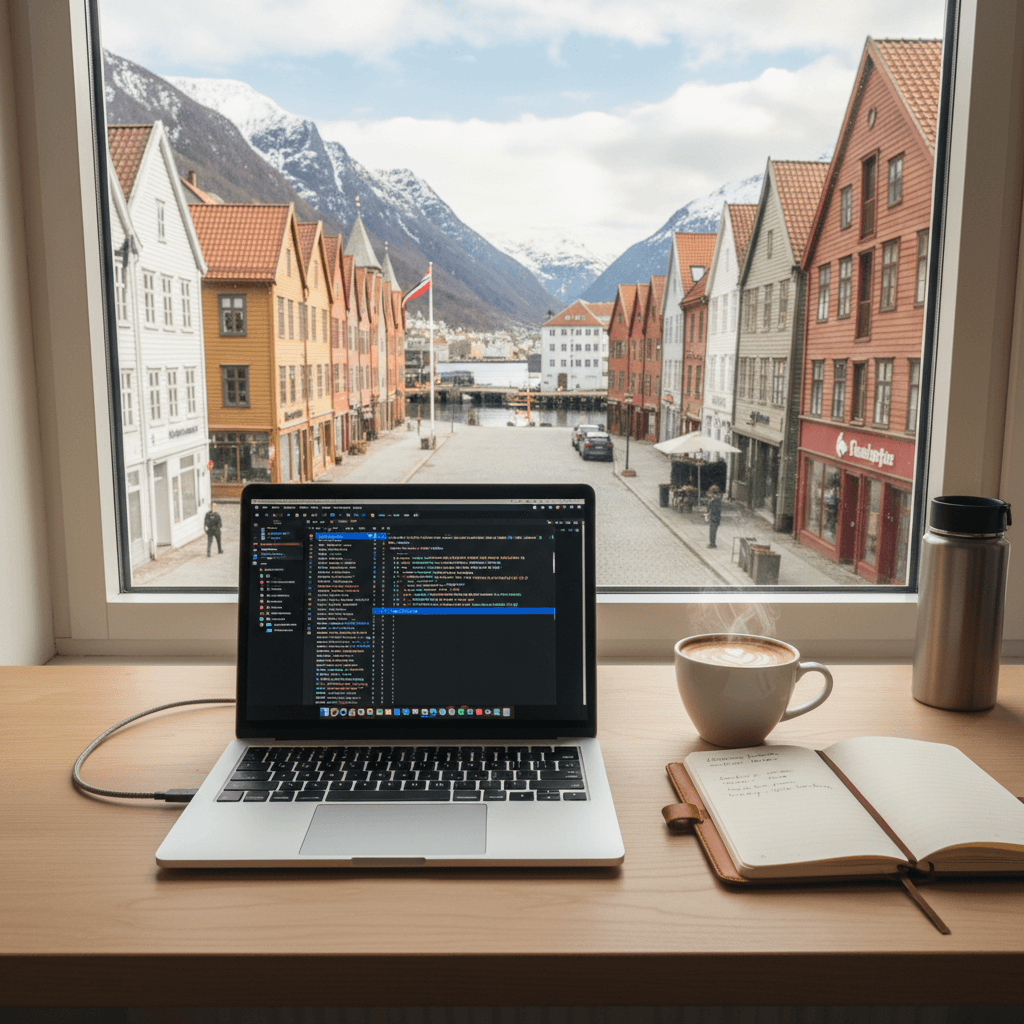
Bergen is the gateway to the fjords and offers a much more relaxed, coastal vibe than Oslo. It is famous for the colorful wooden houses of Bryggen and a culture that revolves around the mountains. If you do not mind a bit of rain, the hiking trails accessible right from the city center are a massive perk for outdoor enthusiasts.
The nomad scene here is smaller and tends to attract people who prioritize nature over nightlife. You will still find reliable coworking spots and cozy workspaces like Kaffemisjonen. It is slightly more affordable than the capital, but still maintains a very high safety index, usually sitting between 71 and 76.
- Monthly Cost: Around $3,500
- Mobile Internet: Average 202 Mbps
- Safety Index: 75
- Pros: World-class hiking, stunning scenery, and a welcoming, small-town feel.
- Cons: Frequent rainfall and fewer dedicated nomad events.
Trondheim
Trondheim is a historic university town that punches well above its weight in terms of technology. Because of the large student population, there is a youthful energy here that you do not always find in the northern reaches. This also means you get access to some of the fastest mobile internet in the world, peaking around 303 Mbps.
The city is a bit more budget-friendly than Oslo or Tromsø. Coworking spaces like Basecamp and local haunts like Dromedar provide plenty of desk space. It is a walkable city with a rich history, though the winters can feel particularly long and dark even by Norwegian standards.
- Monthly Cost: Around $3,200
- Mobile Internet: 303 Mbps
- Safety Index: 79
- Pros: Most affordable major city, top-tier internet speeds, and a lively student culture.
- Cons: Very cold winters and a smaller nightlife scene for non-students.
Tromsø
For those who want the full Arctic experience, Tromsø is the primary choice. Located far above the Arctic Circle, it serves as a hub for Northern Lights tours and polar adventures. Despite its remote location, the city is surprisingly cosmopolitan with a creative vibe, expat meetups, and dedicated spaces like Tromsø Coworking.
Living here is an exercise in extremes. You will deal with the polar night in winter and the midnight sun in summer. Costs are high because of the city's isolation, but the trade-off is a backyard filled with reindeer, mountains, and the aurora borealis.
- Monthly Cost: Around $3,800
- Mobile Internet: High-speed fixed broadband available
- Safety Index: High (Unranked but historically very safe)
- Pros: Unbeatable access to the Northern Lights and a unique, adventurous atmosphere.
- Cons: Extreme weather conditions and a sense of geographical isolation.
Connectivity Standards
Norway is a powerhouse when it comes to digital infrastructure. You won't just find basic internet here; you will find some of the fastest speeds on the planet. Whether you are tucked away in a fjord-side cabin or sitting in a high-tech hub in Oslo, the connection is rarely an issue. Fiber-to-the-home is the standard for over 70% of households, and nearly every home in the country has access to speeds of at least 100 Mbps.
If you are a power user, the numbers are impressive. Fixed broadband download speeds hover around 140 Mbps, but many providers offer packages that reach 325 Mbps or higher. For those who rely on mobile data, the 5G rollout is aggressive. In major cities, mobile download speeds often exceed 250 Mbps, making your phone's hotspot a perfectly viable backup for heavy video editing or large file transfers.
Top Coworking Spaces
The coworking scene in Norway is professional, design-forward, and expensive. You are paying for high-quality amenities and a networking culture that is actually productive. Here are the standout options for your base of operations:
- Rebel (Oslo): This is the crown jewel for tech nomads. A monthly pass is 7,499 NOK, which includes a legendary lunch buffet, unlimited coffee, and access until 22:00. It is more of a tech community than just a desk.
- Evolve (Multiple Locations): With over 15 centers across the country, this is the best choice for nomads on the move. Monthly plans start around 3,950 NOK and give you 24/7 access to all their locations.
- SoCentral (Oslo): A great pick for social entrepreneurs. For roughly 3,500 NOK, you get a fixed desk, 24/7 access, and access to pro bono advisors to help with your projects.
- Spaces & Regus (Oslo): These offer the most familiar corporate environment. Monthly passes start at 2,790 NOK. They are reliable, have great reception services, and offer day passes if you just need a professional spot for a few hours.
- Colab Larvik (Larvik): If you want to get out of the capital, this space offers a more affordable rate of about 2,800 NOK per month. It includes free parking and a full kitchen, perfect for a slower pace of life.
Cafes and Public WiFi
You will find free WiFi in almost every cafe, hotel, and airport in the country. There are tens of thousands of hotspots mapped across Norway. While the connection in a city center cafe is usually fine for checking emails or casual browsing, it is rarely the best choice for a full day of deep work. Public networks can be inconsistent, especially during peak hours. If you plan to work from a cafe, always have a local SIM or eSIM as a fallback.
Mobile Data and SIM Cards
Norway is not the place to hunt for "cheap" data, but the quality of service is exceptional. Telenor and Telia are the two giants. Telenor has the most extensive coverage, hitting 99.8% of the population, including many remote hiking trails. Ice is a third provider that is often cheaper, though their coverage can be spottier once you leave the big cities.
- eSIMs: This is the easiest path for most nomads. Providers like Nomad offer 1 GB plans for $4.50 USD or 50 GB plans for $45 USD. It is a seamless way to get online the moment you land.
- Local Prepaid SIMs: MyCall is a favorite for expats and long-term travelers because they make it easy to sign up without a Norwegian ID number. You can pick these up at convenience stores like 7-Eleven or Narvesen.
- Pocket WiFi: If you are traveling in a group or need to connect multiple devices while van-lifing, rentals like TravelWiFi or MIOWiFi cost between $7 and $9 USD per day for a portable 4G connection.
The 5G network is particularly robust in Oslo, Bergen, and Trondheim. Even if you are staying in a more rural area, the chances are high that you will still have access to a 4G signal strong enough for a Zoom call. Just keep an eye on your data caps, as high-speed data remains a premium commodity here.
Quality Standards: Public vs. Private
Norway's healthcare system is a gold standard for equity and medical excellence. The public system, funded through the National Insurance Scheme (Folketrygden), handles everything from routine checkups to complex surgeries with world-class tech. While the quality is high across the board, the public route often involves a waiting list for non-urgent procedures like physical therapy or elective surgery.
For nomads, the private sector is often the more practical choice. Facilities like Aleris and Volvat Medical Center in Oslo, or Bergen Private Hospital, offer nearly instant appointments and a high degree of personalized service. You won't find a difference in medical expertise between the two, but private clinics excel at speed and administrative ease for those without a long-term residency history.
Accessing the System
To fully plug into the public system, you need a Norwegian ID number (fødselsnummer), which requires formal residency registration. If you are just passing through on a shorter stint, you will likely rely on private clinics or your international insurance provider. English is the unofficial second language of Norwegian medicine; almost every doctor, nurse, and pharmacist you encounter will speak it fluently, making it easy to explain symptoms or understand prescriptions.
- Public Access: Requires residency and a national ID number.
- Private Access: Open to anyone, usually via out-of-pocket payment or international insurance.
- EU/UK Citizens: Your EHIC or GHIC card covers emergency public care, but it is not a substitute for full travel or health insurance.
Out-of-Pocket Costs
Norway uses a co-pay system where you pay a small fee until you hit a yearly cap. Once you reach that limit, you receive an exemption card, and the rest of your public care for the year is free. Private costs are significantly higher since they aren't subsidized by the state.
- GP Visit: Expect to pay NOK 179 to 350 in the public system. Private visits typically range from NOK 500 to 800.
- Specialist Consultations: Public specialists cost NOK 250 to 400, while private specialists start at NOK 1,000.
- Hospital Stays: Public stays are roughly NOK 300 to 500 per day. Private hospitalizations can quickly climb to NOK 5,000 or more per day.
- Lab Work: A standard blood test is about NOK 179 publicly, or NOK 300+ at a private lab.
Insurance Requirements
Since public coverage is tied to employment and tax residency, most digital nomads should carry a private international plan. Providers like Allianz, Cigna, or Bupa are well-regarded here. These plans are vital for covering private clinic fees, dental work, or medical repatriation. Annual private premiums generally start around NOK 3,000 to 10,000 depending on your age and the level of coverage you choose.
Pharmacies and Prescriptions
Local pharmacies, known as Apotek, are easy to find in every city and most large towns. While you can grab basics like ibuprofen or paracetamol over the counter, the Norwegians are strict about prescriptions. You will need a note from a local GP for most medications, including antibiotics. Many pharmacies in major cities stay open 24/7, and online ordering with home delivery is becoming a standard convenience for locals and expats alike.
Emergency Services
In a true medical emergency, dial 113. This service is free for everyone, including visitors. The response teams are highly trained, and in a country with Norway's rugged geography, they are experts in air ambulance and helicopter evacuations for remote areas. If your situation is urgent but not life-threatening, look for the nearest Legevakt (emergency clinic), which provides 24/7 care for injuries or sudden illnesses.
The Cashless Kingdom
Norway is one of the most digitized economies on the planet. You can go weeks without ever touching a physical banknote. Whether you are buying a coffee at a mountain lodge or paying for a bus ticket in Oslo, your card or phone will be the primary way you pay. However, getting your local financial ducks in a row requires a bit of paperwork and patience.
Traditional Banking and Identification
Opening a local bank account is a rite of passage for long term nomads. To get started, you need a Norwegian identification number. If you are staying for less than six months, you will apply for a D-number. For stays exceeding six months, you will need a National Identity Number.
Most major banks like DNB, Nordea, or SpareBank 1 will ask for a specific set of documents before they even talk to you. You should have these ready:
- Your valid passport
- A formal rental contract or utility bill as proof of address
- A passport-sized photo
- Your employment contract or proof of study
- A letter of recommendation from your current bank back home
Expect the process to take one to two weeks just for your ID number to be issued. Once you have that, the bank setup is relatively quick. Most Norwegian banks provide BankID, which is a digital signature used for everything from logging into taxes to signing a gym membership.
Digital Alternatives: Wise and Revolut
If you aren't staying long enough to justify a local account, digital banks are your best friends. Wise and Revolut are widely accepted throughout the country. Many nomads use a two-pronged strategy: they receive their foreign income into Wise to take advantage of mid-market exchange rates, then move "spending money" to Revolut for daily tap-to-pay transactions.
Wise is particularly helpful for larger transfers, often costing as little as $3.92 USD for a $1,000 transfer. Revolut offers excellent weekend spending rates, though you should watch the limits on their free plans to avoid small percentage markups on currency conversion.
Handling the Norwegian Krone (NOK)
The local currency is the Norwegian Krone (NOK). While exchange rates fluctuate, you can generally expect $1 USD to hover between 9.50 and 10.10 NOK. If you use a foreign card, your home bank will likely charge a 1% to 3% transaction fee on every swipe.
When you do need cash, ATMs are easy to find. Most charge minimal fees, usually between 10 and 75 NOK. The golden rule at any ATM or card terminal is to decline dynamic currency conversion. Always choose to be charged in NOK. If you let the ATM do the conversion for you, they will use an inflated rate that eats into your budget. Most machines allow withdrawals up to 10,000 NOK per transaction.
Moving Money Internationally
When you need to move larger sums into a Norwegian account for a security deposit or long term rent, skip the traditional wire transfers. They are slow and expensive. Instead, look at these options:
- Wise: The gold standard for low fees and transparent tracking.
- Revolut: Great for instant transfers between users and low-fee international sends.
- Western Union: Useful if you need to send money for physical pickup, though its digital rates are also competitive.
Crypto and Taxes
Norway treats cryptocurrency as a taxable asset rather than legal tender. The government has adopted the MiCA regulation framework, meaning the rules are clear but strict. If you are trading or earning in crypto while living in Norway, keep these points in mind:
- Profits are hit with a 22% capital gains tax.
- You must report all mining revenue, staking rewards, and trades.
- The tax filing deadline is April 30th.
- While capital gains are taxed, crypto payments are generally exempt from VAT.
Any exchange operating within the country must register with the Financial Supervisory Authority (FSA). If you plan to cash out large amounts of crypto into a Norwegian bank account, be prepared to show a clear paper trail to satisfy anti-money laundering checks.
Bringing the Family Along
Norway is widely considered one of the most family-friendly destinations for nomads, provided you meet the financial requirements. To bring children under 18, you must prove a pre-tax annual income of at least NOK 416,512. This threshold ensures you can support your dependents without relying on state welfare. You will also need to provide documentation of suitable housing and valid birth certificates. If you share custody with a parent staying behind, a notarized letter of consent is mandatory.
The application process goes through the UDI. While it can be paperwork-heavy, the system is transparent. For those with older children aged 18 to 21, the rules tighten significantly; they must be unmarried and usually need a history of residing with you to qualify for a dependent permit.
Education and International Schools
While the Norwegian public school system is excellent and free, many digital nomads prefer international schools to keep their children in an English-speaking or IB curriculum. Most of these institutions are clustered in urban centers like Oslo, Stavanger, and Bergen. Costs vary wildly based on whether the school receives government subsidies.
- Subsidized International Schools: These typically cost between NOK 24,500 and NOK 46,600 per year.
- Non-subsidized Private Schools: These can reach NOK 250,000 annually, plus registration fees of up to NOK 15,000.
- Additional Costs: Budget NOK 2,000 to NOK 10,000 for extracurricular activities and school trips.
Admission is often competitive. It is wise to start the application process several months before your planned arrival, as waitlists are common in the capital.
Childcare and After-School Programs
Norway makes childcare remarkably affordable through a "max price" (makspris) policy. For children aged 1 to 6, monthly fees for a barnehage (kindergarten) are capped between NOK 1,200 and NOK 2,000. You should also factor in a small food fee, usually NOK 200 to NOK 800 per month. If you are living in more remote northern regions like Finnmark, these costs are even lower or sometimes waived entirely to encourage residency.
For school-aged children in grades 1 to 4, the SFO (after-school program) provides a safe place for kids to stay while you finish your work day. Most municipalities now offer 12 free hours per week, with full-time care costing around NOK 3,000 to NOK 3,500 monthly. Sibling discounts are applied automatically in most districts.
The Healthcare Safety Net
One of the biggest perks of moving your family to Norway is the healthcare system. Medical care for children is universal and free at the point of use. Once you are registered in the National Registry, your children will be assigned a local GP, known as a fastlege.
This coverage includes routine check-ups, all standard vaccinations, and specialist referrals. There are no co-pays for children under 16. For those aged 16 to 18, small user fees may apply, but these are typically refunded once a yearly cap is reached. Emergency care is available 24/7 nationwide, and the quality of pediatric care is among the highest in the world.
Top Cities for Families
While Oslo is the obvious choice for its proximity to international schools and museums, other cities offer a different pace of life that might suit your family better.
- Oslo: Best for stroller-friendly infrastructure, the massive Frogner Park, and the highest concentration of expat families.
- Kristiansand: Known as the "cool" summer city, it features urban beaches and Dyreparken, a massive zoo and amusement park that is a rite of passage for Norwegian kids.
- Tromsø: Perfect for families who want an Arctic adventure, featuring midnight sun activities and a very safe, small-town feel despite its city status.
- Bergen: Offers a coastal lifestyle with easy access to mountains and fjords, though you should pack plenty of rain gear for the little ones.
Safety and Daily Life
Norway is an exceptionally safe environment. Crime rates are low, and the culture places a high value on child autonomy. It is common to see young children walking to school or playing in parks unsupervised. The country also maintains strict child protection laws that prioritize the well-being and voice of the child in all legal and social matters. Traffic safety is a major priority, so ensure you use R44 or i-Size compliant car seats, as police enforcement is strict.
Safety Standards and Crime
Norway is consistently ranked as one of the safest countries on the planet. For most digital nomads, the biggest "danger" you’ll face is a hefty fine for speeding or the price of a cocktail in Aker Brygge. Violent crime is remarkably rare, and you’ll often see locals leaving their expensive strollers or bikes outside shops without a second thought.
That said, keep your wits about you in high-traffic tourist hubs. Pickpocketing and petty theft occasionally happen around Oslo Central Station and busy shopping districts like Karl Johans gate. Solo travelers, including women, generally feel comfortable walking alone at night in cities like Bergen and Tromsø, which is a massive draw for the nomad community.
Digital and Local Scams
While physical theft is low, digital fraud is becoming more sophisticated. Keep an eye out for phishing emails or texts disguised as messages from Posten (the postal service) or tax refund alerts. These often ramp up during the holidays or tax season.
The most pressing risk for nomads is the rental market. In competitive cities like Oslo, "phantom rentals" pop up on social media. Never send a deposit before seeing a place or verifying the landlord through official channels. If a deal for a chic apartment in Grünerløkka seems too good to be true, it definitely is. In restaurants, double-check your bill; while overcharging isn't common, mistakes happen, and the high cost of dining means those errors add up fast.
LGBTQ+ Life
Norway is a global leader in equality. With strong anti-discrimination laws and a culture that values individual freedom, it is an incredibly welcoming place for LGBTQ+ nomads. Oslo Pride is a massive highlight of the summer, turning the capital into a sea of color and celebration.
You’ll find inclusive spaces and events in every major city. While the culture is generally reserved, there is a deep-seated respect for diverse identities. Whether you are looking for queer-friendly coworking spaces or nightlife, cities like Bergen and Tromsø offer safe, vibrant environments where you can be yourself without hesitation.
Social Norms and Etiquette
Understanding the Norwegian psyche helps you avoid awkward "tourist" moments. The culture is built on Janteloven, an informal social code that emphasizes humility and equality. Bragging about your startup's valuation or your "hustle" won't get you far here. Instead, aim for directness and modesty.
- Personal Space: Norwegians value their bubble. Avoid sitting next to someone on a bus if there are empty rows available, and keep your voice at a moderate level in public.
- Punctuality: If you meet a local for coffee at 2:00 PM, show up at 1:59 PM. Being late is seen as a lack of respect for their time.
- The Handshake: Stick to a firm handshake and eye contact when meeting someone new. Hugs are usually reserved for close friends.
- Skål: When toasted at dinner, make eye contact with the person who initiated it, take a sip, and make eye contact again before putting your glass down.
Language and Communication
You can easily survive in Norway without speaking a word of the local tongue. English proficiency is incredibly high, especially among people under 60. Most locals will switch to English the moment they hear you struggle, but don't let that stop you from learning the basics.
Learning simple phrases shows you aren't just a transient visitor. While Bokmål is the most common written form, prepare for a wild variety of spoken dialects as you move between regions. If you plan on heading to rural areas or the far north, English is still common, but your efforts to speak Norwegian will be met with much warmer smiles.
Building a Community
Norwegians are often described as "frozen pizzas" because they take a while to warm up, but once they do, they are friends for life. The best way to break the ice is through shared activities rather than small talk at a bar. The nomad scene is growing, particularly in Oslo, Bergen, and Stavanger, where coworking hubs act as the primary social anchors.
- Friluftsliv: Join a hiking or skiing group. "Outdoor life" is the national religion, and the trail is where locals are most talkative.
- Fredagspils: This is the tradition of "Friday beers" after work. It’s the standard way to transition from professional colleague to actual friend.
- Digital Groups: Use platforms like Expat.com or local Facebook groups to find meetups. The Arctic Digital Nomads community is a great resource if you're heading north to chase the Aurora.
The 183-Day Rule
Norway doesn't have a specific "digital nomad visa" with its own tax perks, so you fall under the standard residency rules. If you spend more than 183 days in any 12-month period, or more than 270 days over 36 months, the Norwegian Tax Administration (Skatteetaten) considers you a tax resident. They count partial days as full days, so even a quick weekend trip back and forth adds to your tally.
Once you cross that threshold, you are taxed on your worldwide income. If you stay under these limits, you generally only pay tax on income sourced directly from Norway. For most remote workers employed by companies abroad, staying under 183 days is the cleanest way to avoid becoming part of the Norwegian tax net.
Income Tax Brackets
Norway uses a dual-layer system for income tax. Everyone pays a flat 22% general tax on net income. On top of that, a progressive "bracket tax" (trinnskatt) kicks in based on how much you earn. Here is how those extra percentages look for the current tax cycle:
- NOK 0 to 208,050: 0%
- NOK 208,051 to 292,999: 1.7%
- NOK 293,000 to 670,000: 4%
- NOK 670,001 to 937,999: 13.6%
- NOK 938,000 to 1,500,000: 16.6%
- Over NOK 1,500,000: 17.6%
High earners can see their effective marginal tax rate climb above 40%. While these numbers look high, remember that the 22% base tax is calculated after various deductions, such as commuting costs or interest on debt.
Double Taxation and Treaties
Norway has signed tax treaties with over 80 countries to make sure you don't pay twice on the same dollar. These treaties usually include "tie-breaker" rules. If both your home country and Norway claim you as a resident, the treaty looks at where your "center of vital interests" lies, such as where your family lives or where your main home is located.
If you do end up paying tax in Norway, you can usually claim a credit against the taxes you owe back home. It is a paperwork-heavy process, but it prevents your remote salary from being gutted by two different governments.
Crypto and Wealth Taxes
Norway treats cryptocurrency as an asset rather than currency. You will pay a 22% capital gains tax on any profits when you sell, trade, or use crypto to buy goods. Buying crypto with cash isn't taxed, but you must keep meticulous records of your cost basis.
Norway also enforces a wealth tax. If your net global wealth (including crypto, stocks, and property) exceeds certain thresholds, you pay up to 1.1% in tax on those holdings annually. Mining and staking rewards are treated as ordinary income and are subject to the standard 22% base rate plus bracket taxes.
Reporting and Deadlines
The tax year runs from January to December. If you are a resident, you must file your tax return via the Skatteetaten portal by April 30th. If you are staying longer than 6 months, you are required to register your move with the National Registry.
Be aware of the "exit tax." If you become a tax resident and then decide to leave, Norway may tax unrealized gains on shares or crypto if your net gain exceeds NOK 500,000. It is designed to stop people from building wealth in Norway and fleeing to a tax haven to cash out.
Staying Connected
Norway is a digital powerhouse with some of the fastest mobile speeds in the world. Skip the hassle of finding a physical store and grab an eSIM before you land. Providers like Nomad and Simsolo are the go-to choices for nomads, with 1GB plans starting around $4.50 for a week. These activate via a quick QR code scan, letting you keep your home number active for WhatsApp while you use local 4G or 5G data for everything else. If you are staying long-term, local providers like Telia offer traditional SIM cards, but for most, the convenience of an eSIM is hard to beat.
Getting Around
Public transport here is incredibly efficient, but you will need a few apps to master the system. If you are basing yourself in the capital, the Ruter app is your lifeline for Oslo and Akershus. It handles tickets and real-time tracking for everything from the metro to the island ferries. For trips across the country, download Entur; it acts as a national travel planner that combines buses, trains, and even domestic flights into one itinerary. If you prefer the rails, the Vy app is best for booking trains and checking how crowded your carriage might be before it arrives.
Where to Set Up Your Desk
Oslo is the primary hub for nomads, and your choice of neighborhood defines your experience. Grünerløkka is the undisputed favorite for the creative crowd. It is packed with independent coffee shops, street art, and a high-energy vibe that makes networking easy. If you want something more refined, Frogner offers quiet streets and elegant architecture near the famous Vigeland Park. For those who want to be right on the water, Aker Brygge and Tjuvholmen offer luxury modern apartments with views of the Oslo Fjord. Residential spots like St. Hanshaugen and Majorstuen are also solid bets if you want a local feel with plenty of green space.
Finding Your Home
While Airbnb is the most famous option, it can be pricey for longer stays. Explore these platforms to find a better fit for your budget and workflow:
- Booking.com: Often has better long-term rates and helpful verified WiFi ratings.
- Flatio: Great for mid-term rentals because they provide legally binding agreements that can help with residency paperwork.
- Coliving.com: Best for solo travelers looking for a built-in community.
- The Homelike: Offers vetted, all-inclusive apartments that take the guesswork out of utility bills.
Ordering In
When you are deep in a work sprint and cannot cook, Wolt is the most popular delivery service. They usually get food or groceries to your door in about 20-30 minutes. Foodora is the other major player, with massive coverage in neighborhoods like Grünerløkka and Majorstuen. Both apps are user-friendly and let you track your rider in real-time.
The Language Gap
Almost everyone in Norway speaks English fluently, but learning a few phrases goes a long way. Babbel is excellent for practical, dialogue-based learning, while Taalhammer is the powerhouse for those who want to reach higher fluency levels quickly. If you just want to build a daily habit, Duolingo is a fun starting point for basic vocabulary.
Staying Safe
Norway is exceptionally safe, but you should always have the emergency numbers saved in your phone. Dial 112 for police, 113 for an ambulance, and 110 for fire services. If you need to call for help, say "Jeg trenger hjelp" (I need help) and clearly state your location.
Avoiding Common Pitfalls
The biggest shock for most nomads is the cost of living. Expect to spend between 20,000 and 40,000 NOK per month depending on your lifestyle. Eating out will drain your budget fast, so get used to shopping at local supermarkets. Another mistake is moving too fast; Norway is best enjoyed at a slow pace. Give yourself 2 to 4 weeks in each spot to actually see the sights without letting your productivity tank. Finally, never skip travel insurance. Local medical costs are high, and having a safety net is a requirement for peace of mind.
Latest Nomad News
More Guides from Europe
Stay Updated on Norway
Get notified about visa changes, policy updates, and new information for digital nomads in Norway.