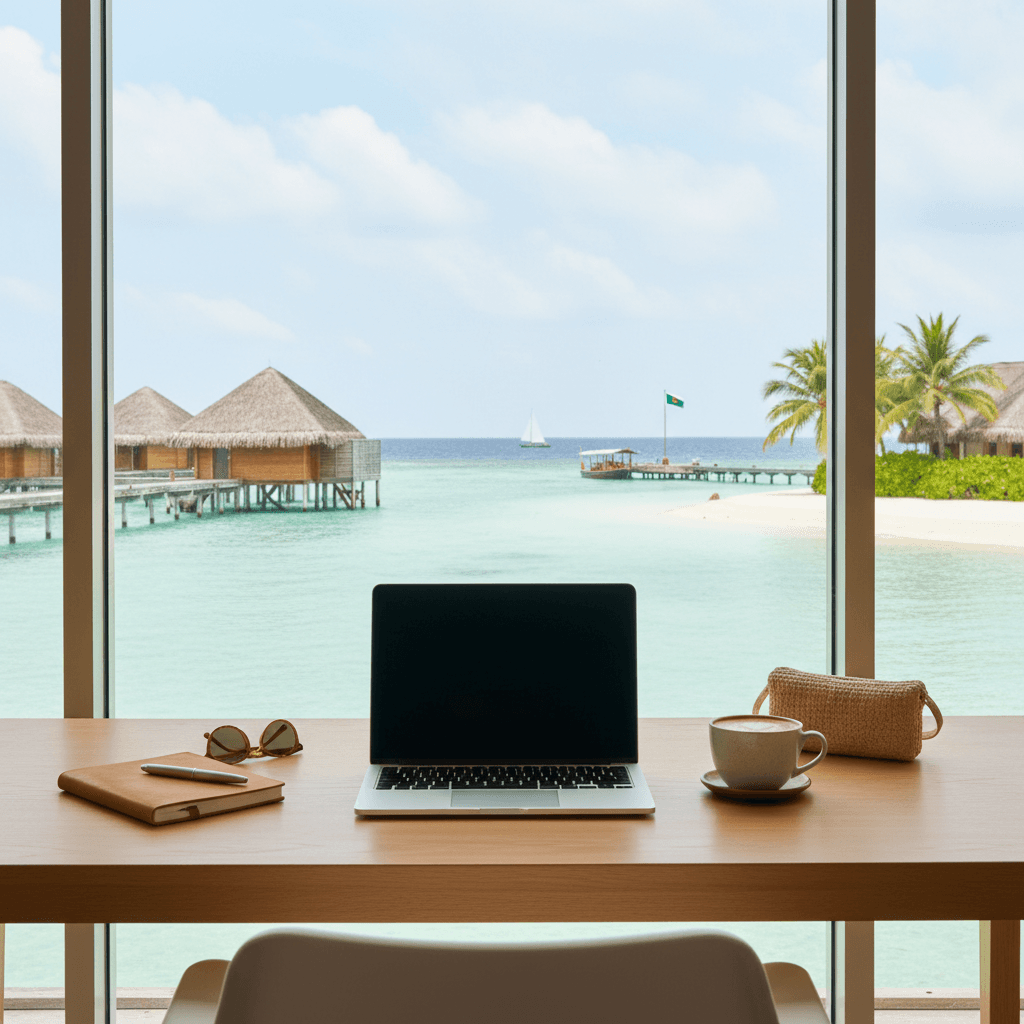
Maldives
Complete Digital Nomad Guide

Policy Stability
Stamped Nomad ExclusiveHow likely visa and immigration policies are to remain unchanged
Quick Facts
Nomad Visa Cost
N/A
Income Requirement
$5,000/mo
Max Stay
3 months
Renewable
No
Cost of Living
$1,400/mo
Avg Internet
30 Mbps
Safety Score
5/10
Healthcare
Medium
Coworking
Low
English Friendly
High
Time Zones
UTC+5
Entry Methods Available
Best For
The 30-Day Welcome
The Maldives makes it remarkably easy to get through the gates. Unlike many island nations that require complex paperwork, every single nationality receives a free 30-day tourist visa on arrival. There is no pre-approval process and no fee to pay when you land at Velana International Airport. You just need a passport with at least one month of validity, a return ticket, and proof that you have a place to stay or enough funds to cover your trip.
The only real "must-do" before you touch down is the Traveller Declaration. This is submitted via the IMUGA platform within 96 hours of your arrival. It is a quick digital form, but the airlines will check for your QR code before they let you board. If you are coming from a region where Yellow Fever is endemic, make sure you have your vaccination certificate handy too.
Staying Longer: The 90-Day Stretch
For nomads who find 30 days isn't enough to truly sync with the island rhythm, you can extend your stay. You are allowed to add another 60 days to your initial visa, bringing your total time in the Maldives to 90 days. This extension costs MVR 750 (roughly USD 50).
You will need to apply for this through the Immigration headquarters. Be prepared to show proof of your accommodation and that you have the financial means to support the extra two months. Keep an eye on your calendar; overstaying is a headache you want to avoid. Fines range from MVR 500 to MVR 3,000, and serious offenders risk being banned from returning to the islands.
The Digital Shift: E-Visas and Maldives 2.0
The system saw a major upgrade in late 2025 with the launch of the "Maldives 2.0" initiative. The country has moved toward a full e-visa system for all categories. This means less time waiting for physical stamps and more digital convenience. Most visas are now issued with a QR code that you can store on your phone.
If you are already in the country on an older physical visa, it remains valid until it expires. Any new applications or extensions now go through the IMUGA platform. This digital rollout has streamlined the process for nomads, making it much easier to manage your status without trekking to government offices for every minor update.
Business and Specialized Entry
If you are visiting for more than just sun and sand, there are specific lanes for different activities. These are handled through the Ministry of Economic Development’s Business Portal before being finalized by Immigration.
- Business Visa: This is a multiple-entry permit for people conducting business activities rather than standard employment. It requires a 6-month passport validity and a fee of MVR 750 every three months.
- Meeting Visa: Introduced recently, this is a 14-day non-extendable visa granted on arrival for conferences or professional meetings.
- Work Visa: If you actually land a job with a Maldivian entity, you enter on a 15-day permit and then transition to a full work visa via the Xpat Online system. This requires a medical report and insurance.
- Dependent Visa: For those bringing family, the cost is MVR 750 every three months, plus a small card fee.
Key Costs and Requirements
- Tourist Visa (Initial): Free for 30 days
- Tourist Extension (60 days): MVR 750
- Business Visa: MVR 750 per 3 months
- Overstay Fines: MVR 500 to MVR 3,000
- Passport Validity: 1 month for tourists; 6 months for business/work
The process is straightforward as long as you respect the boundary between "visiting nomad" and "local employee." Stick to the tourist or business tracks unless you have a formal contract with a local company. With the new digital system in place, managing your paperwork is now as breezy as the Maldivian coast.
The Reality of Remote Work in Paradise
If you are looking for a dedicated digital nomad visa with a catchy name and a multi-year residency permit, you will not find it in the Maldives. Unlike some of its neighbors in Southeast Asia or the Caribbean, the Maldivian government has not yet rolled out a specific "Remote Work" or "Digital Nomad" category. The archipelago remains focused on traditional tourism and strictly regulated local employment.
This does not mean you cannot work from a villa over the water. It just means you have to operate within the existing immigration framework. Most nomads who spend a month working from the islands do so as visitors, keeping their professional lives entirely separate from the local economy.
The 30-Day Entry Strategy
The standard route for any remote worker is the Tourist Visa. This is granted free on arrival to virtually every nationality, provided you meet the basic entry requirements. It gives you 30 days to enjoy the islands, which is usually the sweet spot for a nomad stay given the high cost of living.
To get that stamp in your passport, you need to have your ducks in a row before you land. You must have a passport valid for at least 1 month, a confirmed return or onward flight ticket, and proof of a hotel booking or enough funds to cover your stay. You also need to complete the IMUGA Traveller Declaration online within 96 hours of your arrival. It is a quick digital form, but they will check for it at the boarding gate and immigration.
Staying Legally Compliant
The legal line here is thin but clear. On a tourist visa, you are strictly prohibited from engaging in any local business or taking a job with a Maldivian company. Doing so requires a Work Visa, which is a complex, employer-sponsored process that is not designed for freelancers or remote employees.
Working for your own company back home or managing a remote team in a different timezone occupies a legal gray area. As long as you are not selling services to Maldivians or taking a local's job, the authorities generally treat you as a vacationer who happens to spend a few hours on a laptop. However, you should never claim you are there "to work" when speaking to immigration officers; you are there for a holiday.
Alternative Visa Types
While the tourist route is the most common, there are a few other categories that occasionally pop up in nomad circles, though they rarely fit the typical remote work lifestyle:
- Business Visa: This is for people attending meetings or conducting short-term business activities. It requires a letter of invitation from a local sponsor or company, making it impractical for independent nomads.
- Meeting Visa: This is a non-extendable 14-day permit specifically for conferences or sanctioned events.
- Marriage and Dependent Visas: These are only applicable if you have a legal family connection to a Maldivian citizen or a valid work permit holder.
The Hard Ceiling on Your Stay
One of the biggest hurdles for nomads in the Maldives is the lack of flexibility. The 30-day tourist visa is generally non-extendable for those just wishing to hang out longer. Unlike Bali or Thailand, where "visa runs" or extensions are a way of life, the Maldives expects you to leave when your time is up. Overstaying is a serious offense that can lead to heavy fines, deportation, or being blacklisted from returning to the country.
If you want to stay longer than a month, you typically have to leave the country and re-enter, though doing this repeatedly in a short window can sometimes raise red flags with immigration officials. Most nomads find that 30 days is plenty of time to soak up the sun before the high prices and limited infrastructure of the local islands make a move to a more nomad-friendly hub like Colombo or Kuala Lumpur look attractive.
The Basics of Entry
The Maldives keeps things remarkably simple for travelers. Most visitors don't need to apply for anything before they fly, as the country provides a 30-day tourist visa on arrival to almost every nationality. This is a free permit granted at the airport, provided you meet a few basic entry requirements. Note that as of early 2025, Israeli passport holders are currently restricted from entry.
To get your passport stamped, you need a machine-readable passport valid for at least one month beyond your intended stay. You will also need to show a confirmed return flight and proof of a prepaid booking at a registered tourist facility. While the Maldives is synonymous with luxury resorts, guesthouses on local islands also count as registered facilities for your stay.
The IMUGA Digital Portal
While the visa itself is free and issued at the border, there is one piece of digital paperwork you cannot skip. Every traveler must complete the IMUGA Traveller Declaration. This is a free online form that must be submitted within 96 hours before your arrival in Malé.
Once you submit the form, you receive a QR code. Keep a screenshot of this on your phone or print it out, as airline staff will check it before you even board your flight. In late 2025, the government expanded this digital ecosystem with a new e-Visa platform. While this digital system is primarily designed to streamline work and residency permits, it has made the entire entry process for long-stay visitors much more efficient.
Extending Your Stay
Thirty days is rarely enough time to truly settle into the island rhythm, especially if you are balancing a laptop and a surfboard. If you want to stay longer, you can apply for a visa extension that grants you an additional 60 days, bringing your total stay to 90 days.
You should submit your extension request at the Maldives Immigration Head Office in Malé before your initial 30 days expire. The process is straightforward, but you will need to provide a passport-sized photo and pay a fee.
- Initial Visa: Free for 30 days
- Extension Fee: MVR 750 (approximately USD 50)
- Maximum Stay: 90 days total
Overstays and Border Runs
Maldivian authorities take visa dates seriously. Overstaying your permitted time can lead to fines, typically starting around MVR 20 per day, and may result in deportation or being blacklisted from future visits. It is always better to pay for the official extension than to risk the penalty.
You might be tempted to try a "border run" by flying to nearby Sri Lanka or India for a weekend and returning for a fresh 30-day stamp. While there is no official law against this, immigration officers have full discretion at the border. If they suspect you are living in the country indefinitely on tourist permits without a proper residence visa, they can deny you entry. Because the 90-day extension is so affordable and easy to obtain, it is the much safer route for digital nomads.
Quick Entry Checklist
- Passport: Must have a Machine Readable Zone and 1 month validity.
- Proof of Funds: Sufficient balance to cover your stay.
- Health: A Yellow Fever vaccination certificate if you are arriving from an endemic country.
- Accommodation: A confirmed booking at a registered hotel, resort, or guesthouse.
- Declaration: Completed IMUGA form submitted within 96 hours of landing.
The Reality of Staying Long-Term
If you are dreaming of trading your home office for a permanent spot on a Maldivian sandbar, you need a reality check on the paperwork. The Maldives does not currently offer a dedicated digital nomad visa or a simple residency path for remote workers. Most visitors are capped at the standard 30-day tourist visa, which can sometimes be extended to 90 days, but beyond that, things get complicated.
For those who want to call these islands home for years rather than weeks, the government focuses almost entirely on high-value investors. There is no straightforward permanent residency for foreigners, regardless of how long you stay, unless you marry a local citizen. Even then, the process is rigorous and starts with a one-year renewable permit.
The Corporate Resident Visa
This is the primary route for anyone with significant capital who wants a 5-year renewable stay. It is designed for business owners and investors rather than the average freelancer. To qualify, you have to put your money where your mouth is through one of several investment tiers.
- Bank Deposit: A fixed deposit of USD 250,000 in a Maldivian bank for at least two years.
- Government Projects: Investing USD 250,000 into a project approved by the government.
- Business Investment: Investing USD 1 million into a local business, provided that 50 percent of the staff are Maldivian locals.
The perks are decent if you can afford the entry price. You get VIP airport service, duty exemptions on personal items, and the right to bring your spouse and kids under 18. However, the fees add up quickly. You are looking at an application fee of roughly USD 975, a foreign investment fee of USD 2,000, and annual expatriate health insurance that can cost around USD 6,500.
The Emerging Investor Residency Program
A newer "Golden Visa" style program launched recently to attract ultra-high-net-worth individuals. This program targets luxury real estate buyers and those willing to make massive contributions to the economy. While some reports suggest entry points as low as USD 250,000, most luxury developments associated with this residency require investments between USD 1 million and USD 50 million.
The draw here is that you do not actually have to live in the Maldives full-time to maintain the residency. It is a 5-year renewable status that secures your right to come and go as you please. Applications go through the Ministry of Economic Development, but you should expect to pay several thousand dollars in legal and professional fees on top of the investment itself.
Alternative Paths and Limitations
If you are not sitting on a quarter-million dollars, your options shrink significantly. The Maldives does not have a formal retirement visa, despite occasional rumors of permits for those over 55. If you see mentions of these online, proceed with caution, as they are rarely backed by official immigration policy.
- Work Visas: These are strictly for those with a local employer. If you find a job at a resort or a local company, they handle the sponsorship. This is not a viable path for self-employed nomads.
- Marriage Residency: Marrying a Maldivian citizen allows you to apply for a residency permit. It starts as a 1-year permit and can be extended to 5 years. After five years of marriage and residency, you may be eligible for an indefinite stay.
- Permanent Residency: This is almost non-existent for foreigners. It is typically reserved for exceptional cases or those who have lived in the country for over 12 years under very specific conditions, but there is no structured application process for it.
For most digital nomads, the best strategy remains "slow-mading" on a tourist visa extension or jumping between the Maldives and nearby hubs like Sri Lanka or Thailand. Unless you are ready to start a major business or buy into a luxury development, the Maldives remains a place for long holidays rather than a permanent relocation.
The Price of Paradise
Living in the Maldives as a digital nomad is a unique experience that balances the high costs of an island nation with the affordability of local life. While the world knows this archipelago for $2,000 per night overwater villas, the reality for a long-term remote worker is much more grounded. You can expect to spend anywhere from $1,500 to $2,500 on a tight budget, while a comfortable mid-tier lifestyle usually sits between $2,500 and $4,000 per month.
Most of your budget will be dictated by where you anchor yourself. Staying on a local island or in the urban hubs near the capital is the only way to make the numbers work. If you choose a premium lifestyle, expect your monthly burn to exceed $4,000, especially if you frequently visit resort bars for a drink or high-end dining.
Location Breakdown
The "nomad triangle" consists of Malé, Hulhumalé, and Maafushi. Each offers a different financial profile and vibe.
Hulhumalé (The Modern Hub)
- Budget Rent: $500 to $700
- Comfortable Rent: $700 to $1,000
- Premium Rent: $1,200+
- Overall Monthly Cost: ~$2,600
Maafushi (The Island Vibe)
- Budget Rent: $400 to $600
- Comfortable Rent: $600 to $900
- Premium Rent: $900+
- Overall Monthly Cost: ~$2,480
Malé (The Busy Capital)
- Budget Rent: $600 to $800
- Comfortable Rent: $800 to $1,200
- Premium Rent: $1,500+
- Overall Monthly Cost: ~$2,430
Hulhumalé is often the sweet spot. It feels less claustrophobic than Malé but offers better infrastructure than the smaller islands. Maafushi is the go-to for those who want to wake up and see the ocean every day, though your grocery options will be more limited there.
Eating and Drinking
Food costs vary wildly depending on whether you eat like a local or an expat. Local "short eats" and cafes serve meals for $5 to $10. If you prefer cooking at home, set aside $200 to $400 for groceries, though keep in mind that almost everything is imported, so prices for specific Western brands can be eye-watering.
- Budget: $250 to $350 (Markets and street food)
- Comfortable: $400 to $600 (Mix of home cooking and local cafes)
- Premium: $700+ (International restaurants and hotel dining)
Connectivity and Commuting
Getting around is surprisingly cheap if you stick to the public ferries. A single ride usually costs between $1 and $2. Taxis and rideshares in the city are available, but most nomads spend less than $60 a month on transport. If you want more freedom on a local island like Maafushi, renting a scooter is the premium choice.
Coworking spaces aren't a big thing here yet. You will mostly be working from your apartment or local cafes. A day pass at a cafe might cost $10, or you can find monthly arrangements for $50 to $150 in Malé or Hulhumalé. Most home internet connections hover around 25 Mbps, which is plenty for Zoom calls but maybe not for heavy video editing.
Health and Insurance
Don't skip on health coverage. While local clinics are fine for minor issues, serious problems often require a flight to Thailand or India. A basic nomad insurance plan will run you $50 to $150 per month. If you want comprehensive coverage that includes emergency evacuation back to your home country, expect to pay $300 or more.
Top Spots for Remote Work
The Maldives presents a unique challenge for the digital nomad. It is an archipelago of over 1,000 islands, meaning "urban life" is a relative term here. While you will find world-class connectivity in the capital, the real draw is the growing network of local islands that offer a middle ground between expensive resorts and crowded city streets.
Malé (The Capital)
If your priority is high-speed internet and professional infrastructure, Malé is the only true city in the country. It is densely packed and buzzing with energy. While it lacks the "toes in the sand" vibe of the outer atolls, it serves as the country’s primary business hub.
- The Setup: This is where you will find the best coworking spaces, such as SEED by BCC. It offers high-speed fiber, secure access, and a professional community.
- The Cost: Expect a monthly budget of around $1,461. This is quite affordable compared to major Western hubs, though space is at a premium.
- Internet: Speeds average 43-45 Mbps, which is the most reliable in the country for heavy video calls.
- The Vibe: It is a conservative, busy city. You won't find alcohol here, and the atmosphere is more about business and local culture than beach lounging.
Maafushi (Kaafu Atoll)
Maafushi is the pioneer of local island tourism. It is the perfect spot if you want to save money but still need a decent social life. It strikes a balance between local Maldivian living and the amenities tourists expect.
- Local Life: You will live among locals, giving you access to affordable guesthouses and authentic food that costs a fraction of resort prices.
- Connectivity: While it lacks formal coworking offices, most guesthouses have decent WiFi, and 4G coverage is strong.
- Adventure: It is the primary hub for excursions. You can spend your mornings working and your afternoons diving or visiting nearby sandbanks.
Thulusdhoo (Kaafu Atoll)
Thulusdhoo is the choice for nomads who prefer a surfboard under their arm. It is famous for its world-class surf breaks and a more artistic, laid-back community. The pace of life here is significantly slower than in Malé.
- Atmosphere: The island is known for its craftsmanship and surf culture. It feels more like a community and less like a transit hub.
- Work Environment: You will likely be working from your guesthouse or a local cafe. It is peaceful, making it ideal for deep work and creative projects.
- The Trade-off: Infrastructure is simpler. You should have a local SIM card as a backup for your guesthouse internet.
Dhigurah (Alif Dhaal Atoll)
For those who want to truly disappear into their work, Dhigurah is a long, narrow island known for its incredible forests and white sand. It is famous for whale shark sightings and a serene, quiet atmosphere.
- Focus: This is the place for "monk mode." There are very few distractions here, and the natural beauty is unmatched.
- Cost: Living costs are generally lower than the capital, though your options for dining out are more limited.
- Connectivity: It is remote. Travel times to get here are longer, and while 4G works, you should not expect the lightning-fast fiber speeds found in Malé.
The Nomad Essentials
Safety across the islands is excellent. Crime is remarkably low, and the local communities are famously hospitable. Most nomads find their social circles through guesthouses or online expat forums.
Regarding your stay, most visitors arrive on a 30-day tourist visa, which you can extend to 90 days. If you are looking for something more permanent, there is a remote worker permit, though it requires a proven monthly income of at least $5,000.
Budgeting is straightforward if you stay on local islands. A local SIM card with a solid data package will run you about $25 to $30 per month. While a luxury resort might charge $500 a night, a comfortable guesthouse on a local island can be found for $50, with local meals ranging from $5 to $30. Just remember that alcohol is strictly prohibited on local islands and is only available at licensed resorts.
Connectivity Realities
Working from a tropical archipelago used to mean sacrificing bandwidth for beach views, but the Maldives has closed that gap significantly. While the country is famous for its "one island, one resort" concept, the digital infrastructure now spans the entire inhabited chain. You can generally expect fixed broadband speeds to average around 19 Mbps download, which handles standard video calls and document management without much fuss. However, if you are looking for real speed, the mobile network is actually the superior choice, often hitting averages of 77 Mbps.
The most significant upgrade for nomads is the nationwide rollout of fiber optic technology. Providers like Dhiraagu and Ooredoo have achieved 100% fiber-to-the-home coverage across all inhabited islands. This means that even on smaller, local islands away from the capital, you can often find high-speed fixed access that supports more intensive remote work tasks. Just keep in mind that while the infrastructure exists, the stability can fluctuate once you leave the Malé urban area.
Coworking and Dedicated Workspaces
Traditional coworking spaces are still a rarity here. The primary hub for professional remote work is Your Space, located at CROSSROADS Maldives. It is a short ferry ride from Malé and offers a structured environment with hot desks, dedicated desks, and reliable Wi-Fi. They also provide perks like printing services and discounts on local amenities. Monthly passes typically range from $130 to $345 USD, though you will need to contact them directly for current daily or hourly rates.
In the capital city of Malé, dedicated spaces are harder to find. You will mostly be relying on business centers or informal setups. Most nomads rate the general availability of workspaces in the city at a low 30%. If you decide to set up shop in Malé, expect monthly costs for a desk to fall between MVR 2,000 and 5,000.
The Cafe Culture and Public Wi-Fi
Working from cafes is a mixed bag in the Maldives. While there are several aesthetically pleasing spots in Malé and Hulhumalé, they aren't always designed for long-term productivity. Power outlets are often scarce, and the Wi-Fi reliability sits at about 55%. It is best to treat cafes as a backup for light emails rather than your primary office.
Public Wi-Fi is generally unreliable and should not be counted on for anything beyond a quick message. Most nomads find that the most stress-free approach is to bring their own connectivity or ensure their guesthouse has a verified fiber connection before booking.
Mobile Data and SIM Options
Because mobile speeds often outperform fixed lines, getting a local SIM is the smartest move for any nomad. Dhiraagu and Ooredoo are the two main players, and both offer competitive tourist packages. You can pick these up right at the airport upon arrival.
- Dhiraagu Tourist Plan: 100GB to 125GB of data for $40 to $50 USD, usually valid for 30 days.
- Ooredoo Data Packs: Similar high-volume data packages with strong 4G/LTE coverage on most islands.
- eSIM Options: Nomad offers 1GB for $17 or 10GB for $35 to $55. MobiMatter provides rates starting around $7.70 per GB.
If you plan on island hopping, a local SIM card ensures you stay connected even when the local guesthouse Wi-Fi hits a snag. On most 4G-enabled islands, you can expect download speeds of roughly 70 Mbps, which is more than enough for seamless Zoom calls with a view of the Indian Ocean.
Public vs Private Quality
The Maldives presents a unique healthcare dynamic. While the public system, anchored by the Indira Gandhi Memorial Hospital (IGMH) in Malé, offers tertiary care, it is often stretched thin. You will likely find long wait times, crowded corridors, and a shortage of specialized doctors. For most nomads, the public system is a backup rather than a first choice.
Private facilities like ADK Hospital and Tree Top Hospital are the gold standard for expats. These hospitals boast modern diagnostic equipment, English-speaking medical teams, and amenities that feel more like a hotel than a clinic. If you value efficiency and comfort, the private sector is where you want to be.
Top International Hospitals
Most high-end medical care is concentrated in the Malé and Hulhumalé area. If you are staying on a remote resort island, you might need a speedboat or seaplane to reach these facilities.
- ADK Hospital: A favorite for emergencies, complex surgeries, and cardiology. They have a long-standing reputation for reliability in Malé.
- Tree Top Hospital: Located in Hulhumalé, this is the most modern facility in the country. They offer MRI/CT scans, intensive care, and specialized orthopedic departments.
- Medica Hospital: A smaller but efficient choice, particularly well-regarded for radiology and fertility services.
Keep in mind that while these hospitals are excellent for routine and intermediate care, the Maldives has its limits. For highly complex surgeries or life-threatening conditions, medical evacuation to India or Sri Lanka is a standard procedure.
Health Insurance Requirements
The local public insurance scheme, Aasandha, provides comprehensive coverage for Maldivian citizens but is generally unavailable to digital nomads and expats. Unless you are legally employed by a local company that pays into a specific plan, you are on the hook for your own bills.
You need a plan that specifically covers medical evacuation. Since the Maldives is an archipelago, getting from a remote atoll to a hospital in Malé can cost thousands of dollars without insurance. Popular nomadic options include:
- SafetyWing: Starts around $56 per month and is great for unexpected emergencies and evacuations.
- Genki: Offers global coverage starting at approximately €48 per month with a focus on flexible nomadic lifestyles.
- Cigna or AXA: Better for long-term residents who want customizable plans including outpatient care and maternity services.
Typical Healthcare Costs
Prices vary significantly between the public and private sectors. While public prices are lower, the convenience of private care is usually worth the premium for those earning in foreign currency.
- General Practitioner Visit: $10 to $20 (Public) vs. $50 to $100 (Private). A standard GP consultation in local currency is roughly MVR 300 to 600.
- Specialist Consultation: $20 to $50 (Public) vs. $100 to $200 (Private). Expect to pay MVR 500 to 1,000 for a specialist in a private clinic.
- Hospital Stay per Night: $100 to $200 in public wards; private rooms are significantly higher depending on the level of luxury.
- Diagnostic Imaging (MRI): Typically starts at $200 to $500 but can climb higher at premium facilities.
- Childbirth: A normal delivery ranges from $500 in public settings to over $1,000 in private hospitals; local rates sit between MVR 15,000 and 30,000.
Managing Your Prescriptions
Pharmacies are easy to find in Malé and Hulhumalé, and the staff usually speak excellent English. They will accept valid international prescriptions, but there is a catch. The Maldives imports almost all its medicine, and stockouts are common. Even basic medications can suddenly disappear from the shelves for weeks.
Pack a 3 to 6 month supply of any chronic medications you take. Always keep a copy of your prescription and a letter from your doctor. If you run out of something that isn't in stock locally, services like We Rescue can sometimes help import specific medications, but it is better not to rely on that in a pinch.
Emergency Response
In a crisis, you can dial 100 for an ambulance, 119 for the police, or 191 for the coast guard. The government has recently updated EMS guidelines to improve pre-hospital care and ambulance response times. However, geography remains the biggest challenge. If you are on a distant island, your "ambulance" might be a boat. This is why having insurance that covers sea and air transport is the most important part of your health kit.
Managing Your Finances in Paradise
Maldives is often pictured as a destination for short-term luxury, but staying longer as a digital nomad requires a bit more strategy than just carrying a credit card. While the local economy is heavily dollarized in the tourism sector, you will need a mix of Maldivian Rufiyaa (MVR) and US Dollars (USD) to navigate daily life on local islands without overpaying.
Opening a Local Bank Account
You can actually open a bank account here without being a full-time resident. While most traditional accounts require a work permit or a resident visa, the Maldives Islamic Bank (MIB) offers a specific Non-Resident Foreign Account. They even have digital onboarding to make the process smoother for arrivals.
If you decide to go the resident route with a work permit, the Bank of Maldives (BML) is the largest player in the country. To get started, you will generally need to provide:
- A valid passport and your current visa or work permit.
- Proof of address in the Maldives.
- A bank reference letter from your home country.
- Proof of income or an employment confirmation letter.
Non-resident accounts usually have an annual fee of around $100. Expect the processing time to take between 3 and 7 days for personal accounts. If you are trying to set up a business account, plan for a much longer wait as the vetting is significantly more intense.
Wise, Revolut, and Digital Banking
For most nomads, Wise is the MVP in the Maldives. It is available for residents and allows you to hold multi-currency balances, which is helpful for avoiding the poor exchange rates offered by local shops. You can use the Wise debit card at most major merchants and for ATM withdrawals.
Revolut is a different story. You cannot sign up for a new account using a Maldivian address or phone number. If you already have a Revolut account from home, your card will likely work for spending, but you will not be able to access local banking features or specific regional perks.
ATMs and Currency Logistics
The Maldivian Rufiyaa (MVR) is the official currency, but USD is widely accepted in resorts, guesthouses, and dive shops. However, for local cafes or small grocery stores on inhabited islands, MVR is your best bet. The exchange rate is pegged, but you will often get a better deal paying in the local currency.
Using foreign cards at ATMs comes with a price. Most banks charge a fee between MVR 30 and MVR 100 (roughly $2 to $6.50) per transaction. When the machine asks if you want to use its conversion rate, always decline. Let your home bank handle the conversion to avoid "dynamic currency conversion" traps that add hidden margins to your withdrawal.
Moving Money In and Out
If you need to move larger sums of money, you have a few reliable paths. Wise remains the cheapest option for bank-to-bank transfers. If you need physical cash in a pinch, Western Union and MoneyGram have a solid presence across the atolls for quick pickups.
Direct SWIFT wires to local banks are possible but can be slow and expensive. Local banks are generally happy to exchange USD or EUR for you, but stay away from the ATMs at the airport for your primary cash needs, as they often carry the highest fees and worst convenience margins.
The Crypto Situation
The Maldives is currently in a holding pattern regarding cryptocurrency. It is not banned, but it is not recognized as legal tender by the Maldives Monetary Authority (MMA). There are no licensed crypto exchanges operating within the country, so any trading you do is at your own risk.
While there is talk of a "blockchain free zone" being developed to attract tech investment, the current reality is unregulated. Do not expect to pay for your morning coffee or your villa rent with Bitcoin. Stick to traditional banking or established fintech apps for your living expenses.
Visas for the Whole Family
Moving your family to the Maldives requires some prep work before you touch down at Velana International Airport. If you are working in a professional category, your spouse and children under 18 years old can join you on a dependent visa. You will act as their official sponsor.
The process starts with a sponsorship declaration through the IMUGA portal, which you must submit at least five working days before your family arrives. Once they land, you have a three-month window to finalize the visa. Budget around MVR 750 for the initial fee. You will need to provide birth and marriage certificates, medical reports, and proof of health insurance for everyone.
Schooling and Education Costs
Most international families settle in Malé because that is where the top-tier schools are located. The curricula vary, but the quality is generally high. Keep in mind that beyond the monthly tuition, most schools charge a one-time security deposit equal to a month's fees, plus extra for books and uniforms.
- Finland International School Maldives: This is the premium option. Monthly fees for Grades 1-6 are MVR 8,230, rising to MVR 11,750 for Grade 10. They do offer sibling discounts if you are moving with a larger brood.
- Ghiyasuddin International School: A popular choice with slightly lower rates. You will pay MVR 4,143 for lower primary (Grades 1-3) and MVR 5,871 for the senior years (Grades 8-10).
- Preschool Options: For the little ones, Burooj and Kokkomen offer flexible hours. Monthly costs for toddlers range from MVR 700 to MVR 4,200 depending on how many hours they spend in the classroom.
Healthcare and Safety
Healthcare in the Maldives is a bit of a hub-and-spoke model. While the public system has made massive strides in maternal care, most expats prefer private insurance. This is non-negotiable for a family. You want a plan that covers pediatric specialists and, importantly, emergency medical evacuation to places like Singapore or Colombo for complex procedures.
Safety is one of the biggest draws here. Violent crime is extremely rare, especially on the resort islands. In Malé and Hulhumalé, the vibe is generally safe, though you should keep an eye on your belongings in crowded areas like the beach. If you ever need help, the emergency line for the police is 119.
Where to Live with Kids
Choosing the right neighborhood changes your entire experience. While Malé is the heart of the action, it can feel a bit cramped for families who need room to run.
- Hulhumalé: This is the top pick for digital nomads with kids. It is a modern, planned "smart city" with wider streets, more greenery, and a much more relaxed pace than the capital.
- Vilimale: Just a short ferry ride from the main city, this island is car-free. It feels like a quiet village with pristine beaches, making it perfect if you want a tranquil environment for your children.
- Maafushi: If you want to be away from the urban center, Maafushi is a 35-minute speedboat ride from the airport. It is geared toward tourism, meaning there are plenty of kid-friendly restaurants and water sports right at your doorstep.
Childcare is accessible but concentrated in the urban areas. If you are working remotely, enrolling your child in a local preschool like MindChamps can provide a great social outlet while you focus on your laptop. Registration fees for these programs usually hover around MVR 1,000.
Crime & Personal Safety
The Maldives is a tale of two environments when it comes to safety. In the resort islands and smaller guesthouses on islands like Thulusdhoo, crime is almost nonexistent. You can generally leave your flip-flops on the beach without a second thought, though you should still keep your laptop and passport in a room safe.
The urban centers of Malé and Hulhumalé require a bit more vigilance. While violent crime against foreigners is rare, property theft and petty crime have seen an uptick. Local crime indices sit around 57/100, with specific concerns regarding drug-related issues and corruption in the capital. Stay aware of your surroundings in crowded markets and avoid poorly lit areas late at night. If you stick to the well-trodden nomad paths, you are unlikely to encounter anything more serious than a misplaced charger.
Common Scams to Avoid
Most scams in the Maldives are opportunistic rather than aggressive. Digital nomads should be particularly wary of the following:
- Bogus Bookings: Fake luxury cruise websites and "too good to be true" resort packages are common. Always verify your booking directly with the property or a reputable travel agent.
- Transport Tricks: In Malé, some taxi drivers might "forget" to use the meter or claim it is broken. Agree on a price before the car moves.
- Tour Touts: You might be approached on the street for dolphin tours or jet ski rentals. These are often overpriced and lack proper insurance. It is better to book through your guesthouse or a certified dive center.
- ATM Skimming: Stick to ATMs located inside banks or major hotels in Malé and Addu to avoid card cloning devices.
LGBTQ+ Considerations
The Maldives is a conservative Islamic nation where Sharia law is in effect. Same-sex activity is technically illegal, and local attitudes can be restrictive. For digital nomads, this means practicing discretion. Public displays of affection are discouraged for all couples on local islands, but this is strictly enforced for the LGBTQ+ community.
Resorts operate as a legal and cultural bubble. These private islands are inclusive and offer total privacy, especially in overwater villas. If you plan to spend most of your time working from a resort, you will find a welcoming environment. On inhabited local islands, it is best to keep your private life private to avoid legal complications or social friction.
Cultural Etiquette & Language
Respecting local customs is the fastest way to integrate. When you are not on a resort or a designated "bikini beach," dress modestly. This means covering your shoulders and knees. Remove your shoes before entering someone’s home or a small local shop; you will see a pile of sandals at the door as a cue.
Daily life pauses briefly during prayer times. You might find shops closed for 15 to 20 minutes several times a day. Use the greeting "Assalamu alaikum" to break the ice with locals. While Dhivehi is the official language, English is spoken fluently in the tourism and business sectors. You will have no trouble communicating with shopkeepers, boat captains, or landlords. Learning "shukuriyaa" (thank you) goes a long way in building rapport with the community.
The Nomad Community & Integration
The expat population is surprisingly large, with roughly 103,000 foreigners living among the 529,000 locals. Most are based in Malé, but a growing number of digital nomads are gravitating toward Maafushi and Thulusdhoo for the balance of high-speed WiFi and surf culture.
- Online Hubs: Facebook groups and expat forums are the primary way to find community events, shared boat transfers, and apartment leads.
- Socializing: Integration happens best over food. Accept invitations for tea or "garudhiya" (fish broth) from guesthouse owners. During Ramadan, be mindful of fasting hours, but look out for evening "Iftar" feasts which are often communal and welcoming to outsiders.
- Coworking: While dedicated coworking spaces are still popping up, many nomads use "coliving" guesthouses that offer dedicated desk space and reliable backup generators, which are vital during tropical storms.
The 183-Day Rule
Maldives doesn't have a dedicated digital nomad visa, which means your tax status is tied directly to how long you stay in the archipelago. The magic number here is 183 days. If you spend more than 183 days in the country within any 12-month period, the Maldives Inland Revenue Authority (MIRA) considers you a tax resident.
This rule is a rolling window, not a calendar year. If you plan to stay beyond six months, you're technically liable for tax on your worldwide income. However, most nomads visiting on a tourist visa only stay for the initial 30 days or the 60-day extension, keeping them well under the residency threshold and safely in the non-resident category.
Tax Brackets and Rates
If you do trigger residency or earn income from a local Maldivian source, you'll fall under a progressive tax system. The rates are actually quite favorable compared to many Western countries, especially for middle-income earners. The brackets are as follows:
- 0% on income up to MVR 720,000 (roughly USD 46,000)
- 5.5% on income between MVR 720,001 and 1,200,000
- 8% on income between MVR 1,200,001 and 1,800,000
- 12% on income between MVR 1,800,001 and 2,400,000
- 15% on any income exceeding MVR 2,400,000
Temporary residents, defined as foreigners who meet the residency day-count but aren't married to a local, generally only pay tax on their Maldives-sourced income. This is a significant distinction for nomads working for overseas clients, as it often means your foreign salary remains untouched by local authorities.
Double Taxation and Treaties
The Maldives has a very short list of Double Taxation Avoidance Agreements (DTAAs). Currently, active agreements exist with the UAE and India, with a newer agreement with Bangladesh and a pending one with Malaysia. Because the treaty network is so small, most nomads will need to rely on the tax laws of their home country to avoid being taxed twice on the same dollar.
Crypto and Digital Assets
The local government hasn't rolled out a specific framework for cryptocurrency yet. It isn't banned, but it isn't regulated for business use either. For tax purposes, any gains you make from trading or payments received in crypto are treated as standard income. If you're a resident, you're expected to report these global gains; if you're a non-resident, your offshore crypto activity generally stays off the local radar.
Filing and Compliance
If you find yourself meeting the residency criteria, you'll need to register with MIRA. The system is surprisingly modern, with most filings handled through the MIRA Connect portal. You'll be expected to self-assess your income and file an annual return, usually by April of the following year. Even if you don't think you owe anything, keeping meticulous records for at least 5 years is the standard requirement here. Penalties for failing to register or file can be steep, so it's best to track your dates carefully if you're planning a long-term stint in the islands.
Staying Connected
Landing at Velana International Airport without a data plan is a rookie mistake that leads to long lines at the terminal kiosks. For an immediate 5G connection, set up an eSIM before you board your flight. Providers like Airalo, aloSIM, and Yesim offer plans ranging from 1GB to 50GB, utilizing the local Dhiraagu or Ooredoo networks. Prices typically fall between $7 and $50.
If your phone doesn't support eSIMs, you can still grab a physical SIM from the airport vendors, though you'll pay a premium for the convenience. These plans fully support hotspotting, which is your primary backup for remote work if your guesthouse WiFi decides to take a tropical nap. Yesim is particularly popular for nomads because it includes VPN options and phone number add-ons right in the app.
Getting Around the Atolls
In the Greater Malé area, skip the hassle of waving down cars and download Avas Ride or Salhiride. These are the local equivalents of Uber and work reliably in Malé and Hulhumalé. If you are heading from the airport to Hulhumalé, expect to pay between $5 and $10 for a taxi. For a more budget-friendly move, the public bus system connects the bridge islands for just 10 MVR.
Inter-island travel requires more planning. While ferries and speedboats link the local islands, you should book your spots through local terminals or dedicated apps to avoid getting stranded. Remember that while Malé is walkable, the tropical heat makes those 15-minute treks feel much longer; a quick taxi ride is usually worth the few dollars.
Where to Set Up Your Desk
Choosing the right island determines your entire experience. Hulhumalé is the gold standard for nomads. It offers modern apartments, paved roads, and reliable infrastructure that feels more like a city and less like a remote outpost. If you crave a high-energy urban environment, Malé’s Maafannu district puts you near the best services and the SEED co-working space.
For those who want the "postcard" life without the resort price tag, Maafushi or Thulusdhoo are the top picks. These islands have evolved to cater to travelers, meaning you'll find decent cafes with WiFi and lower rents, though you might sacrifice some connection speed compared to the capital.
Finding a Home
Forget the standard global real estate sites if you want a fair price. Check iBay.mv, which is the local classifieds site. You can find direct contacts for apartment rentals in Malé and Hulhumalé, often with photos and transparent pricing. For shorter stays or furnished spots, Airbnb and Nomadstays are better bets, especially if you can negotiate a monthly discount.
- One-bedroom apartment: Expect to pay $650+ per month.
- Local Islands: Significant savings on rent compared to the capital.
- Utilities: Always confirm if WiFi and electricity are included in your quote.
Daily Life and Logistics
When you don't feel like cooking, Foodies and Gaadiya Eats are the go-to delivery apps in the Greater Malé area. They offer everything from traditional Maldivian mas huni to international fast food with contactless delivery options. Be aware that delivery services are almost non-existent once you leave the main hub islands, so you'll be relying on local cafes or grocery runs.
While English is spoken widely in the tourism sector, learning a bit of Dhivehi goes a long way. Download Spark by MWM or Hello Maldives to practice the Thaana script and basic phrases. Being able to say a few words in the local tongue is the fastest way to build rapport with shopkeepers and boat captains.
Safety and Emergencies
The Maldives is generally very safe, but it pays to have the right numbers saved. Dial 119 for police and 102 for an ambulance. If you are out on the water and run into trouble, 191 connects you to the Coast Guard. For any serious medical issues, the Indira Gandhi Memorial Hospital (IGMH) in Malé is the primary facility, reachable at +960 3335335.
Nomad Pitfalls to Avoid
The biggest budget killer is failing to research transfer costs. A "cheap" guesthouse on a distant atoll can easily be offset by a $300 speedboat ride or an expensive domestic flight. Always check the ferry schedule before booking accommodation. Also, remember that local islands are dry; alcohol is strictly prohibited, and you should dress modestly by covering your shoulders and knees when walking through residential areas. Save the bikinis and beer for the private resort excursions or designated "bikini beaches."
Latest Nomad News
Maldives Prepares to Launch Dedicated Visas for Remote Workers
The Maldives government is planning to launch new visa categories specifically for remote workers and content creators. These initiatives aim to encourage longer stays and provide a formal legal framework for digital nomads working from the islands.
Maldives Waives Extension Fees for Travelers Stranded by Airspace Closures
Maldives Immigration is granting complimentary one-month visa extensions to travelers unable to depart due to Middle East airspace closures. This emergency measure assists those affected by flight cancellations at major regional transit hubs.
More Guides from South Asia
Stay Updated on Maldives
Get notified about visa changes, policy updates, and new information for digital nomads in Maldives.