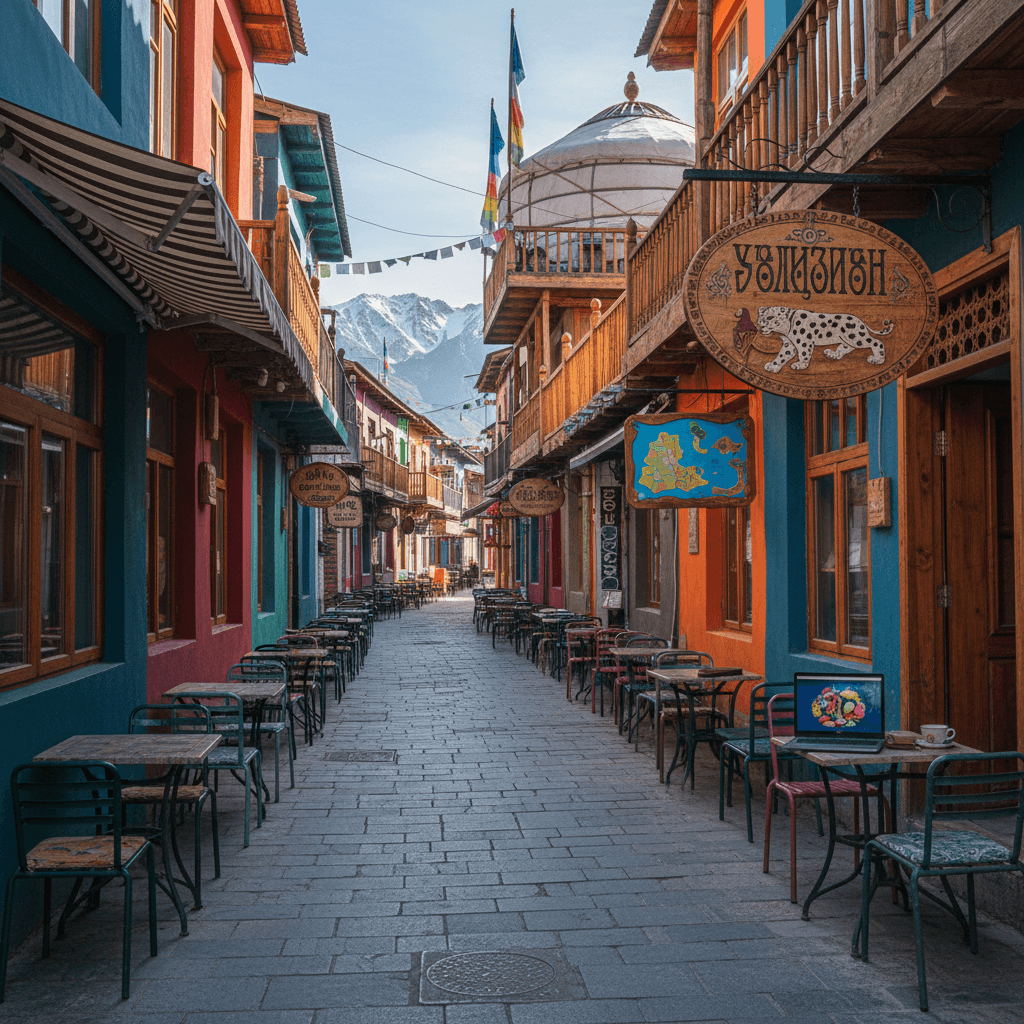
Ulaangom
🇲🇳 Mongolia
The Raw Frontier of the West
If you're looking for the polished nomad hubs of Southeast Asia or the trendy cafes of Tbilisi, Ulaangom will give you a serious reality check. This is one of the most remote outposts in Mongolia, sitting deep in the shadow of the Altai Mountains near the Russian border. It's a place where the 21st century feels like a thin veneer over a nomadic soul that hasn't changed in centuries. You don't come here for the infrastructure; you come here to disappear into a world of dust, wind, and incredible hospitality.
The vibe is slow, quiet, and intensely authentic. You'll share the streets with more livestock than luxury cars, and the "rush hour" usually involves a herd of goats crossing the road. It's a town that demands self-reliance. There are no expats to lean on and no coworking spaces to hide in. Instead, you'll find yourself working from basic hotel lobbies or small coffee bars, surrounded by locals who are genuinely curious about what you're doing with a laptop in the middle of Uvs Province.
Life in the Compact Core
Ulaangom is small enough that you'll know your way around within forty-eight hours. The heartbeat of the city is the central market and the main square. This is where the action happens, from herders selling wool to kids hanging out near the government buildings. Most nomads choose to stay right in this central pocket because it's the only place where you'll find reliable electricity and the occasional decent cup of coffee.
- Central Ulaangom: This is the most practical spot for a base. You're within walking distance of the shops, the best local eateries, and the few hotels that offer stable internet. It’s dusty and can get crowded on market days, but it’s where the life is.
- The Outskirts: These areas are dominated by ger districts. While it's a fascinating look at traditional living, it’s tough for a working nomad. Heating is a major issue in the winter, and the roads are often just dirt tracks that turn into mud pits after a summer rain.
The Cost of the Wild
Living here is incredibly cheap, mostly because there isn't much to buy. Your biggest expenses will likely be your flight from Ulaanbaatar and any private 4x4 tours you take into the mountains. Expect your daily spending to drop significantly compared to the capital. A $1,200 monthly budget will make you feel like royalty here, covering a private apartment, eating out for every meal, and hiring drivers for weekend trips.
- Budget Tier ($700 to $1,000 per month): Best for those staying in local guesthouses or shared gers, eating $2 street food like huushuur (fried meat pastries), and using local microbuses.
- Mid-range Tier ($1,200 to $1,800 per month): This covers a decent private apartment for around $400, dining at the few "upscale" local restaurants, and plenty of data for your hotspot.
- Comfortable Tier ($2,000+ per month): At this level, you’re paying for convenience. You’ll have the best available housing, private drivers for trips to Lake Uregnur, and frequent flights back to the capital for supply runs.
Connectivity and Survival
Don't expect fiber optics. You’ll be relying on 4G LTE, which is surprisingly decent in the city center but vanishes the moment you head toward the mountains. Most nomads grab a Unitel or Mobicom SIM card immediately. A 20GB data pack costs about 40,000 MNT (roughly $12) and will be your lifeline. Since there are no dedicated coworking spots, you'll become a regular at local cafes where a latte costs about $3.
The emotional payoff of Ulaangom is the silence. When the sun sets over the Altai, and the air turns crisp, the isolation feels like a superpower rather than a burden. It’s a place that forces you to disconnect from the digital noise and reconnect with the physical world. Just make sure you visit between June and August. If you show up in January, the -30°C temperatures will make your laptop battery, and your spirit, give up within minutes.
The Reality of Rural Living
If you are looking for the polished infrastructure of Southeast Asia or the digital hubs of Europe, Ulaangom will be a massive culture shock. This is deep Mongolia. Life here revolves around the seasons, the central market, and the vast Uvs Province steppe. Because it is so far from the capital, your dollars or euros will stretch significantly further than they would in Ulaanbaatar, but you will be trading convenience for that low price tag.
Budgeting for Ulaangom requires a "self-reliance" tax. While local costs are low, you might find yourself spending more on private drivers or high-end SIM cards to stay connected. Most travelers find that a monthly budget of $800 to $1,200 allows for a very comfortable life, while those living like locals in a traditional ger can easily get by on $700.
Monthly Budget Breakdown
- Budget Tier ($700 to $1,000): This covers a shared ger or a basic local hostel for about $200, eating almost exclusively at street stalls, and using the local microbuses. It is a raw experience, but incredibly cheap.
- Mid-range Tier ($1,200 to $1,800): This is the sweet spot for most remote workers. You can snag a private one-bedroom apartment near the center for roughly $400, eat out at decent local cafes, and afford the occasional private ride to Lake Uregnur.
- Comfortable Tier ($2,000+): At this level, you are living at the top of the local market. You will have a modern private apartment (around $600), eat at the best spots in town, and have a dedicated budget for regional flights back to the capital or guided expeditions into the Altai Mountains.
Housing and Neighborhoods
Ulaangom does not have "expat neighborhoods" or "digital nomad zones." The city is compact and centered around the main square and the central market. Most people choose to stay in the Central Area because it is walkable and close to the few cafes that have reliable power outlets. It is dusty and can get crowded on market days, but it is where the action is.
The Residential Outskirts are mostly made up of ger districts. While it is much quieter and offers a more authentic feel, it is not recommended for a first-time stay. The roads are often unpaved, and in the winter, the smoke from coal fires can make the air quality quite poor. If you are looking for an apartment, your best bet is to check local Facebook groups or ask around at the larger hotels, as traditional rental platforms like Airbnb are almost non-existent here.
Food, Connectivity, and Gear
Eating out is one of the biggest bargains. You can grab a plate of buuz (steamed dumplings) or tsuivan (fried noodles) for about $2 to $5. A coffee at a local bar will run you about $3. For groceries, stick to the central market for the freshest meat and dairy; just be prepared for a diet heavy on mutton and flour during the colder months.
Internet is the biggest hurdle. Do not rely on "hotel WiFi" to be fast enough for video calls. Most nomads pick up a local SIM card from Unitel or Mobicom. You can get 20GB of data for 15 days for about 40,000 MNT (roughly $12). If you need to work, your best office will be your own apartment or a quiet corner in a hotel lobby, as there are no dedicated coworking spaces in the province yet.
Practical Logistics
Getting around is simple but informal. There are no ride-hailing apps like Uber here, though some locals use the UBCab app with mixed results. Most people just stick their thumb out for a "shared taxi" and negotiate a price of about $0.50 for a short trip. If you are arriving at the Ulaangom Airport (ULG), expect to pay between $5 and $10 for a taxi to the city center. Always carry cash in Mongolian Togrog (MNT), as international cards are rarely accepted outside of the larger supermarkets and hotels.
The Central District (Main Square and Market)
If you are heading to Ulaangom, you'll likely spend most of your time within a few blocks of the central square. This isn't a city of sprawling suburbs; it's a compact provincial hub where the action revolves around the main market. For most visitors, this is the only practical place to stay if you want to be within walking distance of a hot meal and a decent data signal.
Living here means you're close to the local cafes where a latte goes for about $3 and a plate of buuz (steamed dumplings) costs around $2. The vibe is raw and functional. While you won't find dedicated coworking spaces, the hotels and small coffee bars near the square are your best bet for catching a few megabits of WiFi. Just be prepared for the dust during the spring and the crowded energy of the market, which is the heartbeat of the province.
Best for Nomads and Solo Travelers
Digital nomads usually gravitate toward the small cluster of apartment buildings and guesthouses near the center. You'll want to be close to the Unitel or Mobicom shops to top up your SIM card. For 40,000 MNT (roughly $12), you can grab 20GB of data, which is a lifesaver since hotel WiFi is notoriously flaky. Solo travelers find this area the safest and most convenient for catching a shared taxi or a marshrutka to explore the nearby Altai Mountains.
- Estimated Rent: $300 to $500 for a basic one bedroom apartment.
- Daily Life: Walking distance to the main grocery stores and the few bars in town.
- Connectivity: Best chance for 4G LTE coverage, though speeds rarely top 10 Mbps.
Best for Expats and Long-Term Residents
Expats in Ulaangom are a rare breed, usually working in education or NGOs. They often look for newer apartment builds just slightly removed from the immediate noise of the market but still within the central grid. These spots offer a bit more privacy and slightly better insulation, which is a big deal when winter temperatures plunge to -30°C. If you are staying long term, you'll likely use Facebook groups or local word of mouth to find a rental, as platforms like Airbnb haven't really taken hold here yet.
- Estimated Rent: $400 to $600 for a modern (by local standards) unit.
- Food: Close to mid range restaurants where a dinner for two runs about $15 to $20.
- Transportation: Easy access to the UBCab app for getting around when it's too cold to walk.
Best for Families
Families generally stick to the residential pockets near the city's schools and the provincial hospital. It's quieter than the market district and feels more like a community. While Ulaangom is generally safe, having neighbors nearby provides an extra layer of security. If you're bringing kids, being near the hospital is a practical necessity since medical services are basic and any serious issues require a flight back to Ulaanbaatar.
- Atmosphere: Low traffic and more open space for kids to run around.
- Cost of Living: A larger family sized apartment or house might run $600+ per month.
- Logistics: You'll definitely want to coordinate with a local driver for school runs or grocery trips during the snowy months.
The Ger Districts (The Outskirts)
On the fringes of the city, the landscape shifts into traditional ger districts. This is where you'll find the most authentic Mongolian experience, but it comes with a steep learning curve. There's no central heating or plumbing here; you'll be hauling water and stoking a coal stove. While it's incredibly cheap, it's not recommended for most nomads or families during the winter due to the intense smoke and physical labor required to keep the dwelling warm. It is, however, a fascinating place to visit during the Naadam Festival in July when the weather is perfect and the culture is on full display.
- Estimated Rent: $150 to $250 for a shared or private ger.
- Pros: Unmatched cultural immersion and proximity to the open steppe.
- Cons: No reliable internet, harsh living conditions, and far from central services.
If you are looking for a dedicated coworking space with ergonomic chairs and high speed fiber, you are in the wrong province. Ulaangom is deep in the Mongolian frontier, and the digital nomad infrastructure here is practically nonexistent. You will be trading 500 Mbps speeds for total immersion in a landscape where nomadic herding still dictates the pace of life. For the self reliant remote worker, it is a rewarding challenge, but you have to bring your own solutions.
Connectivity and Data
The local Wi-Fi at guesthouses and hotels is notoriously sluggish, often hovering between 2 and 5 Mbps. It is enough for basic emails and messaging, but video calls will be a struggle. Most travelers skip the hotel Wi-Fi entirely and rely on local SIM cards. Unitel and Mobicom are the most reliable providers in the Uvs Province. You can pick up a SIM at the airport or small shops in the city center for about 40,000 MNT ($12), which usually gets you 20GB of data for 15 days.
LTE coverage is surprisingly decent right in the center of Ulaangom, but it drops off the moment you head toward the Altai Mountains or Lake Uregnur. If you need to stay connected while exploring, a physical local SIM usually offers the best stability in these remote regions.
Where to Work
Since there are no formal coworking hubs, your "office" will likely be a local cafe or your hotel room. The coffee culture is slowly emerging, but it is still basic. Look for small coffee bars near the Central Market or the main square. A latte will set you back about $3, and while the owners are generally relaxed about you staying for an hour or two, power outlets are scarce. Always carry a fully charged power bank and a universal adapter for the 230V sockets.
- Central Ulaangom Cafes: Best for a few hours of light work; expect some noise from the market nearby.
- Hotel Lobbies: Often the quietest spots, though the furniture is rarely designed for long hours on a laptop.
- Mobile Hotspotting: Your most reliable bet for consistent work; just ensure you have a clear line of sight to a cell tower.
Cost of Remote Living
The trade off for the lack of infrastructure is a incredibly low cost of living. You can live comfortably here for a fraction of what you would spend in Ulaanbaatar. A budget traveler can get by on $700 to $1,000 a month, while a mid range budget of $1,200 to $1,800 allows for a private apartment and frequent dining out.
- Monthly 1BR Apartment: $300 to $500 (found mostly through local agents or Facebook groups).
- Street Food (Buuz/Khuushuur): $2 to $5 per meal.
- Local Transport: $0.50 per ride via microbus or shared taxi.
Practical Workflow Tips
Working from Ulaangom requires a bit of strategy. Most nomads recommend finishing your heavy uploads or downloads in the capital before heading this far west. Use Google Translate with the offline Mongolian pack downloaded; English proficiency is low, and you will need it to negotiate everything from data top ups to apartment leases. If your work involves sensitive data, a VPN is a must, though it may further slow down your already limited connection speeds.
Plan your heavy work days for the middle of the week and keep your weekends open for trips to Lake Uregnur. Just remember that once you leave the city limits, you are effectively off the grid. It is the perfect place for a digital detox, but a nightmare for a Monday morning deadline.
Staying Safe in the Wild West
Ulaangom is a far cry from the chaotic traffic and urban grit of Ulaanbaatar. Most travelers find the city remarkably safe in terms of crime. Petty theft is rare here, mostly because the community is tight knit and people generally look out for one another. That said, it's smart to keep your wits about you at the central market or during the Naadam Festival in July, where crowds can get thick.
The real danger in Uvs Province isn't people; it's the environment. If you're heading out to Lake Uregnur or the Altai Mountains, the weather can flip from sunny to life threatening in an hour. Expats recommend always traveling with a local guide or at least a reliable GPS if you're driving. If your vehicle breaks down in the steppe during winter, when temperatures regularly plunge to -30°C or -40°C, it becomes a survival situation very quickly.
- Emergency Numbers: Dial 102 for police and 103 for an ambulance.
- Solo Travel: It's generally safe for solo nomads, but walking alone in poorly lit outskirts at night isn't recommended due to stray dogs and the occasional intoxicated passerby.
- Stray Dogs: Be cautious around livestock and gers on the outskirts. Mongolian bankhars (guard dogs) are bred to be fierce and don't take kindly to strangers wandering onto their turf.
Healthcare and Medical Realities
Don't expect western style clinics here. Ulaangom has a provincial hospital that handles basic emergencies, broken bones, and common illnesses, but for anything serious, you'll be looking at a flight back to the capital. Most nomads keep a robust first aid kit and a supply of any personal medications, as local pharmacies might only stock Russian or Mongolian brands with labels you can't read.
Food and water safety is another factor to watch. While the local dairy and meat are as fresh as it gets, the richness of a traditional nomadic diet can be a shock to the system. Travelers often suggest sticking to bottled or boiled water, as the mineral content in local sources can cause stomach upsets for those not used to it. If you're prone to respiratory issues, be aware that air quality can dip in the winter months when coal burning for heat is at its peak.
Practical Health Tips
- Travel Insurance: Make sure your policy covers medical evacuation. If you need a specialist, you're going to be on a plane to Ulaanbaatar or even Seoul/Bangkok.
- Pharmacies: You'll find a few near the main square. Use Google Translate to show the pharmacist the active ingredients of what you need, rather than the brand name.
- Hydration: The air is incredibly dry. You'll need to drink way more water than you think to avoid altitude headaches and fatigue.
Navigating Local Norms
Safety also comes down to respecting local customs to avoid friction. If you're invited into a ger, never step on the threshold and always accept food or tea with your right hand. Being a respectful guest goes a long way in a place where hospitality is a core part of the culture. Most locals are incredibly welcoming to foreigners, especially since Ulaangom sees so few of them compared to the rest of the country.
The Logistics of Getting Around
Ulaangom is a compact, grid like provincial capital where your own two feet are often the most reliable way to get from a central apartment to the local market. The city center is manageable on foot, but the high altitude and dusty winds mean you will likely want a motorized backup plan for longer hauls or winter days. Unlike the chaotic traffic jams of Ulaanbaatar, the pace here is slow, predictable, and distinctly rural.
Public Transport and Microbuses
The backbone of local transit is the microbus, often referred to as a marshrutka. These vans follow loose routes around the main thoroughfares and usually cost around $0.50 per ride. They aren't on a fixed schedule; they generally depart when they are full. If you are trying to reach the further residential ger districts or the outskirts, these are your cheapest bet, though they can get cramped and dusty during the dry season.
The "Thumb Out" Taxi Culture
In Ulaangom, every car is potentially a taxi. It is common practice for locals to stand by the side of the road and hold out a hand, palm down, to signal for a ride. While it feels informal, it is a standard way to get around. You should negotiate the price before getting in, though most short trips within the city limits shouldn't exceed 2,000 to 5,000 MNT. For a more "official" experience, the UBCab app is the gold standard in Mongolia. While it is most dominant in the capital, it is worth having on your phone as more drivers in provincial centers are starting to use it to find passengers.
Getting to and from Ulaangom Airport (ULG)
The airport is located about 13 kilometers northwest of the city. Since there is no dedicated shuttle service, a taxi is your only real option. Expect to pay between $5 and $10 for the 20 minute drive into the center. Most guesthouses or local hosts can arrange a pickup if you coordinate in advance, which is often easier than haggling with drivers on the tarmac after a long flight.
Regional Travel and Day Trips
If you are planning to head out to the Altai Mountains or Lake Uregnur, you will need to move beyond standard city transport. Travelers typically use one of three methods:
- Shared Taxis: These congregate near the main market. Drivers wait for a full car before heading to nearby towns or scenic spots. It is affordable but requires patience.
- Private Hire: For $50 to $100 a day, you can often hire a driver with a 4WD vehicle. This is the preferred method for nomads who want to reach remote herder camps or specific trailheads without the stress of navigating unmarked dirt tracks.
- Intercity Buses: There are large, surprisingly comfortable buses that connect Ulaangom to Ulaanbaatar, though the journey takes over 24 hours. Most nomads opt for the 3 hour flight instead to save their sanity.
Winter Considerations
From December to February, the transport game changes. Temperatures can plummet to -30°C, making walking even short distances a genuine health risk. During these months, ride hailing becomes a necessity rather than a luxury. Vehicles are often kept in heated garages, so don't be surprised if there is a slight premium for on call services during extreme cold snaps. Always ensure your driver has a working heater before you commit to a long trip to the lake.
Practical Navigation Tips
- Download Offline Maps: Street names aren't always clearly marked, and 4G can be spotty. Google Maps works, but having an offline version is a lifesaver.
- Learn Cyrillic: Even if you don't speak Mongolian, being able to read "Улаангом" or "Дэлгүүр" (shop) on a sign helps you orient yourself.
- Carry Small Change: Drivers rarely have change for large 20,000 MNT bills. Keep a stash of 500 and 1,000 MNT notes specifically for transport.
The Language Landscape
In Ulaangom, your biggest hurdle won't be the lack of Wi-Fi, it'll be the language barrier. Unlike the capital, where English is increasingly common among the younger generation, Ulaangom remains a place where Mongolian is the only game in town. You'll find very few people who speak English beyond a few basic words, so you'll need to be self reliant from day one.
The local dialect is Khalkha Mongolian, written in the Cyrillic alphabet. If you can't read Cyrillic, even the simplest tasks like identifying a grocery store or reading a bus sign become a puzzle. Most travelers find that learning the alphabet before arrival is the single best thing they did for their sanity. It only takes a few hours to learn, and it makes using local apps much easier.
Digital Tools for Survival
Since you won't find many English speakers at the local market or the bank, your phone is your lifeline. Download the Mongolian language pack for Google Translate for offline use. The "camera translate" feature is a lifesaver for menus and supermarket labels, though it can struggle with stylized fonts.
For getting around, the UBCab app works best in Ulaanbaatar; in Ulaangom, shared taxis or thumb-out method are more reliable. You can set your destination on the map, which bypasses the need to explain complex directions in broken Mongolian. Just make sure you have a local SIM card from Unitel or Mobicom to keep the data running; a 20GB Unitel tourist SIM costs around 40,000 MNT for 30 days.
Key Phrases to Know
Mongolians are famously hospitable, but they appreciate when you put in the effort. Knowing a few phrases goes a long way in turning a cold interaction into a warm one. Here are the basics you'll use daily:
- Sain baina uu? (Hello/How are you?) - Use this for everyone, from shopkeepers to nomads.
- Bayarlalaa (Thank you) - You'll say this a lot; the "l" sounds are a bit softer than in English.
- Khotol buyu? (Where is...?) - Useful for finding the market or the hospital.
- Zugeer, zugeer (It's okay/No problem) - A very common phrase you'll hear in response to almost anything.
- Bi Oilgokhgui baina (I don't understand) - Your most honest and frequent sentence.
Communication Etiquette
Non-verbal communication is just as important as the spoken word here. When you're invited into a home or a ger, there are specific customs. Always receive items with your right hand, often touching your right elbow with your left hand as a sign of respect. If you accidentally kick someone's foot, it's customary to immediately shake their hand to show there's no ill will.
In the digital space, Facebook is the primary way locals communicate. If you're looking for an apartment or a driver for a trip to Lake Uregnur, look for local Ulaangom community groups. You'll need to use a translator to post, but it's the fastest way to get answers in a city without a formal expat infrastructure. Most business is done over Facebook Messenger or WhatsApp rather than email.
Connectivity Realities
Don't expect high speed fiber. Most nomads working from Ulaangom rely on 4G LTE hotspots rather than hotel Wi-Fi. In the city center, you can get speeds between 2 and 10 Mbps, which is enough for emails and Slack, but you might want to turn your camera off for Zoom calls. If you head into the Altai Mountains for a day trip, expect total silence; once you leave the city limits, signals disappear fast.
Survival of the Coldest
If you are planning a stint in Ulaangom, your calendar is your most important piece of gear. This part of the Uvs Province deals with some of the most dramatic temperature swings on the planet. You aren't just dealing with "chilly" weather here; you are looking at a true continental climate where the mercury behaves like a rollercoaster. Most travelers find that the window for a comfortable stay is incredibly narrow, making timing the difference between an epic Altai adventure and being trapped in a frozen room waiting for the pipes to thaw.
The Golden Window: June to August
Summer is the only time Ulaangom truly opens up for remote work and exploration. From June through August, the days are long and surprisingly warm, with highs averaging around 25°C (77°F). This is when the surrounding steppe turns green and the nearby Lake Uregnur becomes accessible for day trips.
- July is peak season: This is when the Naadam Festival takes place. It is the best time to see traditional wrestling and horse racing, but expect local guesthouses to fill up fast.
- Rainfall: July sees the most rain, though in this part of Mongolia, that usually means short, intense bursts rather than days of drizzle.
- Night temps: Even in the height of summer, the desert air loses heat fast. Expect nights to dip down to 10°C (50°F), so keep a jacket handy even if you spent the afternoon in a t-shirt.
The Shoulder Seasons: May and September
May and September are the "wildcards." You might get lucky with crisp, sunny days, or you might get hit with a sudden dust storm or an early blizzard. Most nomads who value their sanity avoid these months unless they are specifically looking for total isolation and don't mind wearing three layers of wool indoors. The Altai Mountains are stunning in the autumn light, but the infrastructure in town starts to wind down as the locals prepare for the "big freeze."
The Brutal Reality: November to March
Unless you are a glutton for punishment or a documentary filmmaker, stay away from Ulaangom in the winter. Winter temperatures from December to February often drop to -30°C, with averages around -20°C to -30°C. At these temperatures, basic logistics become a nightmare.
- Air Quality: Like Ulaanbaatar, Ulaangom struggles with air quality in winter as households burn raw coal for heat. Expect AQI levels to hit "unhealthy" ranges frequently.
- Travel Disruptions: Snow can block the few paved roads leading out of town, and flights to the capital are often delayed.
- Heating: Most local apartments and gers rely on heavy-duty coal stoves or aging central heating systems that can be temperamental.
What to Pack for Success
Since Ulaangom lacks the westernized shopping malls of the capital, what you bring is what you have. Travelers often say that high-quality base layers are more important than a heavy coat. For a summer stay, pack rugged hiking boots for the rocky terrain and a high-SPF sunscreen; the sun at this altitude is deceptive and will burn you quickly. If you are pushing your stay into September, bring a portable power bank, as the cold can drain phone and laptop batteries significantly faster than you are used to.
Best Time for Your Budget
While Ulaangom is significantly cheaper than Ulaanbaatar, prices for transport and accommodation do tick up during the July Naadam period. If you want the best balance of decent weather and low prices, aim for late August. The crowds have thinned, the mosquitoes near the lake have died down, and you can usually negotiate better long-term rates on housing before the winter sets in.
Survival Basics
Ulaangom is a frontier destination. If you are looking for the polished nomad infrastructure of Chiang Mai or even Ulaanbaatar, you won't find it here. This is a place where you trade high speed fiber for raw Altai mountain views and a pace of life that hasn't changed much in decades. You will need to be self reliant, patient, and ready to embrace a bit of dust.
Most travelers find the best way to handle the logistics is to carry plenty of cash. While you will find ATMs in the city center near the main square, they can be temperamental with international cards. Carry USD as a backup, but do your daily business in Mongolian Tugrik (MNT). For staying connected, don't rely on hotel WiFi. Grab a Unitel or Mobicom SIM card at the airport or a local shop. A 20GB data package for 15 days usually runs around 40,000 MNT, which is roughly $12. It is enough for emails and basic tasks, but don't expect to stream 4K video.
Cost of Living
Your dollar goes incredibly far here. Since Ulaangom sits far from the capital's price hikes, your biggest expense will likely be getting there rather than staying there. Most nomads can live comfortably on $1,200 to $1,800 a month, while those on a strict budget can squeeze by on $700 if they opt for local gers or basic guesthouses.
- Budget Tier ($700 to $1,000): Expect to stay in shared gers or local hostels for about $200 a month. You will be eating mostly street food like buuz (dumplings) for $2 a plate and using the local microbuses.
- Mid-range Tier ($1,200 to $1,800): This covers a private one bedroom apartment for around $400, a mix of local dining and the occasional "upscale" meal for $10, and regular use of taxis.
- Comfortable Tier ($2,000+): At this level, you are likely paying for the best available private rentals, taking frequent day trips to Lake Uregnur, and flying back to Ulaanbaatar when you need a break from the isolation.
Connectivity and Workspace
There are no dedicated coworking spaces in Ulaangom. Your office will be your guest house or one of the few coffee bars near the central market. Speeds are modest, usually hovering between 2 and 10 Mbps on LTE. It is workable for Slack and light browsing, but video calls can be hit or miss. If you have a critical meeting, head to a larger hotel in the center where the connection is usually more stable.
Getting Around
The city center is compact and walkable, though the dust can be intense in the summer and the ice treacherous in winter. For anything further out, use the UBCab app if you can get it to work, or simply use the local method: stick your hand out with your palm down. It is the universal sign for a ride. Negotiate the price before you get in; a cross town trip should only cost about $0.50 to $1.00.
When to Go
Timing is everything in Western Mongolia. The window for a pleasant stay is narrow. June to August is the sweet spot with temperatures between 15°C and 25°C. This is also when the Naadam Festival happens in July, featuring traditional wrestling and archery. Avoid the winter months of December through February unless you are prepared for -40°C nights and limited services. Most of the town effectively hibernates during the deep freeze.
Local Etiquette
Nomadic hospitality is legendary, but it comes with rules. If you are invited into a ger, always step over the threshold, never on it. Accept food or tea with your right hand, and try at least a small sip even if it's not to your taste. English proficiency is low, so download Google Translate for offline use in Cyrillic. A simple "Sain baina uu?" (Hello) or "Bayarlalaa" (Thank you) goes a long way in building rapport with the locals at the market.
Need visa and immigration info for Mongolia?
🇲🇳 View Mongolia Country GuideWild Card
Expect the unexpected