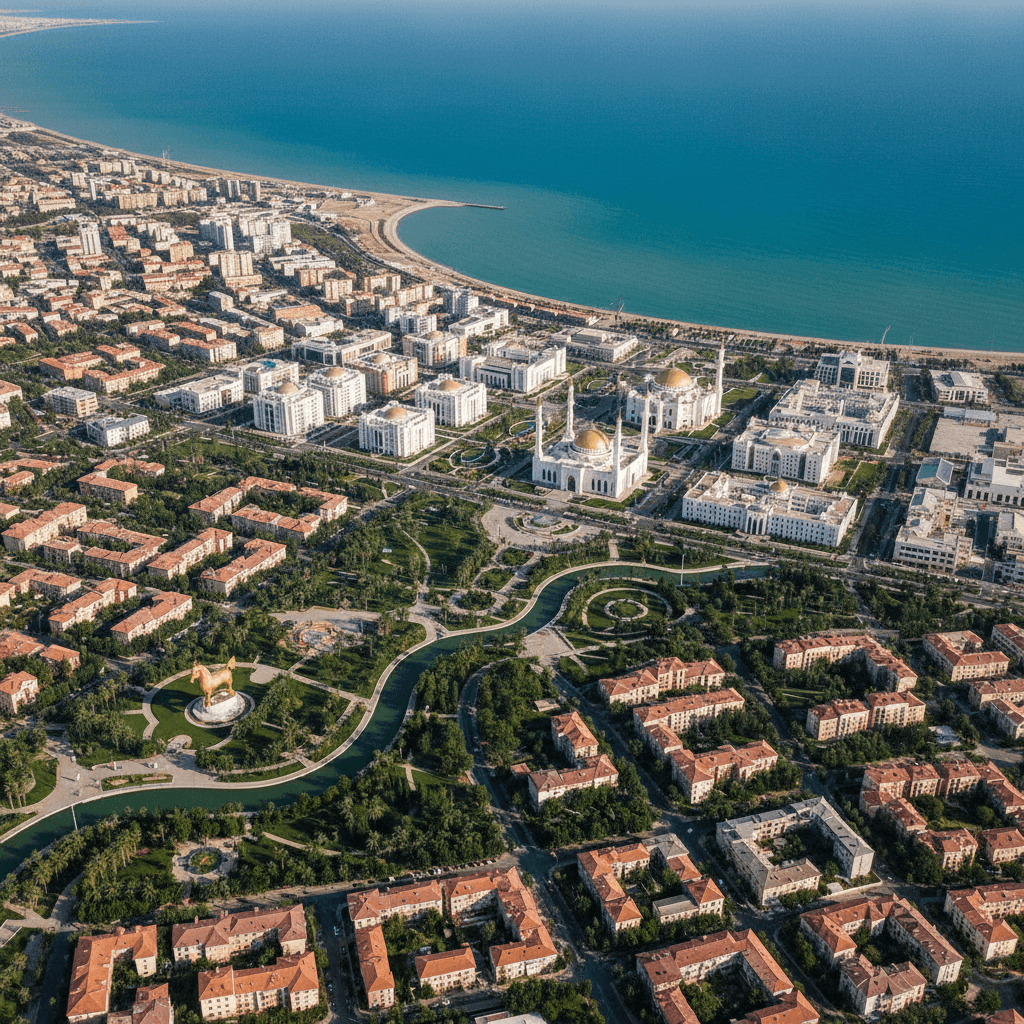
Türkmenbaşy
🇹🇲 Turkmenistan
The Anti-Nomad Oasis
If your idea of a remote work lifestyle involves high speed fiber and sipping oat milk lattes in a glass walled coworking space, Türkmenbaşy will be a massive reality check. This is not a destination for the casual digital nomad; it is a pilgrimage for those who want to disappear. Located on the eastern shores of the Caspian Sea, the city feels like a fever dream of Soviet remnants, white marble monuments, and vast desert silence. It is one of the most isolated urban environments on the planet, where the concept of being "online" is a luxury rather than a right.
The vibe here is slow, heavy, and deeply surreal. You are constantly aware of the state's presence, from the quiet streets to the mandatory guides who accompany almost every movement. There is a strange, quiet beauty in the contrast between the turquoise sea and the harsh, arid mountains that frame the city. Travelers often describe a feeling of being suspended in time, disconnected from the global news cycle and the frantic pace of the modern internet. It is a place for a total mental reset, provided you can handle the claustrophobia of the digital blackout.
The Reality of the Blackout
Let's be blunt: the internet in Türkmenbaşy is among the most restricted in the world. Most Western staples like Gmail, WhatsApp, Instagram, and Google are blocked. Even with a pre-installed VPN, you'll likely find yourself staring at loading screens in hotel lobbies, as mobile data is notoriously unreliable for foreigners. Most nomads who venture here treat it as a forced digital detox. You won't find a "laptop friendly" cafe culture here; instead, you'll find yourself leaning into the local ritual of tea and plov while your phone sits useless in your pocket.
Life revolves around the port and the nearby Avaza district, a multi-billion dollar resort zone that often sits eerily empty. While the infrastructure looks futuristic, the soul of the city remains in its nomadic roots and tribal traditions. Respecting local norms is the currency of a smooth stay. This means dressing modestly, avoiding any photography of government buildings or police, and accepting the ritualized hospitality that defines Turkmen culture. It is a place of unwritten rules, where a friendly "Salam" goes a long way, but a camera pointed in the wrong direction can end your trip early.
What You'll Spend
The economy is almost entirely cash-based, and you'll need to carry crisp, new USD bills to get anything done. There are no reliable ATMs for international cards, and the exchange rate can be a moving target. Because you'll likely be on a guided tour, much of your overhead is baked into your initial booking fee, but here is what to expect for daily life:
- Street food (shashlik or plov): $2 to $5
- Mid-range hotel dinner: $8 to $15
- Local taxi ride: $1 to $3
- Monthly studio rent (arranged via guide): $300 to $600
The Neighborhood Breakdown
Türkmenbaşy doesn't have the typical "cool" neighborhoods you'd find in Tbilisi or Bangkok. Instead, the city is divided by function and proximity to the water.
City Center & Port
- The Vibe: Gritty, functional, and authentic. This is where the Baku ferry docks and where you'll find the most interaction with everyday residents.
- Pros: Walkable, close to the train station, and the best place to find local markets.
- Cons: High surveillance, aging infrastructure, and very basic accommodation options.
Avaza District
- The Vibe: A surreal, high end "tourist zone" located a short drive from the center. It looks like Las Vegas but feels like a ghost town.
- Pros: Modern hotels, clean beaches, and the most reliable (though still censored) Wi-Fi in the region.
- Cons: Expensive, isolated from local culture, and requires a guide or permit for most movements.
The Emotional Payoff
Why come here? Expats and long term travelers say the draw is the sheer, unfiltered authenticity of the people once you get past the bureaucratic layers. There is a profound sense of peace in the desert fringe, and the hospitality rituals, involving heavy helpings of bread and tea, feel more genuine than anywhere else in Central Asia. You don't come to Türkmenbaşy to work; you come here to remember what life felt like before the smartphone took over. It is challenging, frustrating, and occasionally beautiful, making it a badge of honor for the most hardened travelers.
The Cash-Only Reality
Living in Türkmenbaşy is an exercise in old-school financial planning. You won't find Apple Pay here, and your Visa or Mastercard is essentially a plastic souvenir once you leave the airport. The economy runs entirely on cash, specifically U.S. Dollars. Local Manat is what you'll use for daily purchases, but you should bring crisp, unblemished $100 bills printed after 2009 to exchange. Any tear or mark on a bill will see it rejected at the exchange counter.
Because the internet is heavily censored and banking apps are blocked, you can't rely on digital transfers. Most expats and long-term travelers budget for the entire duration of their stay before they even land. It feels strange to carry a thick envelope of cash, but it's the only way to ensure you can pay for your room or your next meal.
Monthly Budget Tiers
While the city isn't "expensive" by London or New York standards, the lack of a competitive market for foreigners keeps prices higher than you might expect for such an isolated location. Most nomads find they spend significantly more here than in neighboring Uzbekistan or Kazakhstan because of the mandatory reliance on guides and specific hotels.
- The Budget Traveler ($900 to $1,200/month): This covers a basic room in a government-run hotel or a simple guesthouse, mostly eating street food like plov or shashlik, and using the infrequent local buses.
- The Mid-Range Expat ($1,600 to $2,600/month): This is the sweet spot for most. It covers a private apartment in the city center, dining out at hotel restaurants a few times a week, and hiring private taxis for errands.
- The High-End Resident ($3,200+ /month): This tier is usually reserved for oil and gas contractors. It includes "luxury" housing in the Avaza district, full-time guide services, and imported groceries.
Housing and Utilities
Finding an apartment isn't as simple as scrolling through an app. Since sites like Airbnb are blocked and local real estate portals don't exist for foreigners, you'll almost certainly have to go through your government-mandated guide. Most expats end up in the City Center or near the Port Area for convenience.
Typical Living Costs
- Central 1BR Apartment: $350 to $650 per month. Note that you'll likely pay this in USD cash directly to a landlord or through your agency.
- Utilities (Electric/Water): $20 to $40 per month. These are heavily subsidized by the government, making them the cheapest part of your stay.
- Internet: $50 to $100 per month. This is the biggest pain point. You're paying for incredibly slow speeds that still require a high-quality VPN to access basic sites like Gmail or WhatsApp.
Food and Dining
Eating out is affordable if you stick to the local staples. A plate of plov (rice, meat, and carrots) or a few sticks of shashlik at a roadside stall will only set you back about $2 to $5. If you prefer sitting in a proper restaurant, usually attached to a hotel, expect to pay between $10 and $20 for a meal with a drink.
Grocery shopping is a bit of a treasure hunt. Basic local produce like melons, bread, and tomatoes are dirt cheap at the markets. However, anything imported, like decent coffee, chocolate, or specific toiletries, comes with a massive markup. Most travelers recommend packing a three-month supply of your favorite snacks and specialty meds before arriving.
Transportation and Logistics
There are no ride-hailing apps in Türkmenbaşy. You'll either flag down a "gypsy taxi" (private cars acting as cabs) or use the city's aging bus system. A short taxi ride across town usually costs between $1 and $3. If you're heading out to the Avaza District, expect to pay closer to $10. Since you're likely on a guided tour, much of your long-distance transport will be baked into your initial tour package price, which can range from $150 to $250 per day including the guide's fee and vehicle.
Solo Travelers and Short-Term Nomads
If you're rolling into town via the Baku ferry or a desert transit, the City Center and Port Area is your only real home base. It's compact, walkable, and puts you right near the Caspian Sea views that make this place feel like the edge of the world. You won't find a digital nomad community here, but you will find the most authentic slice of local life.
- The Vibe: Soviet-era grit meets white marble. It's quiet, heavily surveilled, and a bit surreal.
- Rent: Expect to pay $300 to $600 USD for a basic studio if you're staying long enough to need one, though most solo travelers stick to hotel rooms arranged by their guides.
- Food: Street stalls offer shashlik and plov for $2 to $5. It's the best way to eat without a reservation.
- Pros: Easy access to the port, walkable streets, and the best chance to interact with locals at the bazaars.
- Cons: Internet is nearly nonexistent, and you're always under the watchful eye of the authorities.
Expats and Oil Industry Workers
Most expats in Türkmenbaşy aren't there for the lifestyle; they're there for the energy sector. For this crowd, the Avaza District is the primary destination. Located just a short drive from the city proper, this is a multi-billion dollar resort zone designed to look like a futuristic oasis. It's where you'll find the most modern infrastructure in the region.
- The Vibe: Ghost town luxury. It's filled with massive, high-end hotels and manicured beaches that are often eerily empty.
- Rent: Housing is usually covered by corporate contracts, but private stays can easily exceed $100 USD per night.
- Food: Hotel dining is the standard here, with mid-range meals costing $15 to $25.
- Pros: Consistent electricity, better security, and the only "western" style amenities in western Turkmenistan.
- Cons: It feels isolated from the "real" city, and you'll need a guide or private driver for every movement.
Families
Living in Türkmenbaşy with a family is a rare path, usually reserved for those on long-term diplomatic or industrial assignments. The Avaza District remains the top choice here because of the space and the proximity to the water. There are no international schools or playgrounds in the traditional sense, so life revolves around the home and private clubs.
- The Vibe: Extremely quiet and safe, but socially limiting.
- Costs: A comfortable lifestyle for a family, including a private guide and driver, will run $3,000+ USD per month.
- Pros: Low crime and a very slow pace of life.
- Cons: Lack of educational facilities and the "digital blackout" makes keeping kids entertained or connected to home nearly impossible.
What to Avoid
The Outskirts and Desert Fringe should stay off your radar for lodging. While the nomadic heritage and the "off-the-grid" feel are great for a day trip with your guide, these areas lack basic services like reliable water or transport. Taxis are hard to find out here, and without a ride-hailing app to help you, you'll be stranded. Stick to the center for the culture or Avaza for the comfort; anything else is just asking for a logistical headache.
The Connectivity Challenge
If you're planning to get any meaningful work done in Türkmenbaşy, you need to adjust your expectations immediately. This isn't a "work from the beach" kind of destination. The internet here is among the most restricted and sluggish on the planet. Most Western staples like Google, WhatsApp, Instagram, and Gmail are outright blocked by the state. While some travelers try their luck with VPNs, the local firewall is aggressive; even popular tools like Streisand rarely work once you're on the ground.
The city's digital infrastructure is basically limited to hotel lobbies and government offices. You won't find high speed fiber or reliable 5G. Most nomads who pass through use their time here for a forced digital detox, completing deep work tasks offline and only connecting to send brief "I'm alive" messages to family. Expect speeds to crawl, often dropping out entirely during peak hours or "digital blackouts" that can last for days.
Coworking and Cafe Culture
The concept of a dedicated coworking space doesn't exist in Türkmenbaşy. There are no trendy hubs with ergonomic chairs or community managers. Local cafes are for eating and socializing, not for sitting with a laptop for four hours. In fact, pulling out a laptop in a public eatery might draw unwanted attention from authorities or locals who aren't used to seeing remote work in action.
Your best bet for a "workspace" is the lobby of a mid range hotel in the City Center or one of the upscale resorts in the Avaza District. Even then, WiFi is rarely free or fast. It's usually filtered and requires a login that tracks your activity. Most expats working in the region's oil and gas sector rely on private satellite connections provided by their employers, which isn't an option for the average traveler.
Getting Online: SIMs and Connectivity
Buying a SIM card as a foreigner is a bureaucratic hurdle you probably won't clear on your own. TMCell is the primary provider, but cards are often unavailable to tourists or require mountain of paperwork. Most travelers rely on their mandatory government guide to provide a mobile hotspot. Even with a local SIM, roaming is non existent and data packages are expensive for what you actually get.
- Primary Provider: TMCell (Altyn Asyr)
- Estimated Cost: $15 to $30 for basic setup via a guide
- Availability: Extremely limited for independent travelers
- Best Tool: Maps.me (download the full country map for offline use before you arrive)
The Nomad Survival Strategy
Since you can't rely on the cloud, you have to go old school. Expats in the region recommend downloading every piece of documentation, entertainment, and work material before you cross the border. If you use a specific project management tool, make sure it has a robust offline mode. Many nomads find that the only way to stay productive is to treat Türkmenbaşy as a "write only" zone, where they produce content locally and wait until they reach Baku or Tashkent to upload it.
Don't count on international roaming or eSIMs like Airalo; they simply do not function here. If you absolutely must have a connection for an emergency, the Avaza resort hotels are your most consistent, albeit expensive, option. Just remember that even "high end" internet here would be considered "unusable" in most other parts of the world. Plan for total isolation, and you won't be disappointed.
The Reality of Local Safety
You'll find that Türkmenbaşy is one of the safest cities you'll ever visit in terms of street crime. Petty theft and muggings are almost unheard of here. The authoritarian nature of the country means there's a heavy police presence and surveillance is constant. While this creates a secure environment, it also means you're always being watched. Travelers often say the biggest "threat" isn't a pickpocket, but accidentally breaking a local law you didn't know existed.
The golden rule in Türkmenbaşy is simple: keep your camera away from anything official. Do not photograph military personnel, police officers, the airport, or any government buildings. Even the port area can be sensitive. Your mandatory guide will be quick to remind you, but a single wrong photo can lead to a long, uncomfortable interrogation and the deletion of your files. Stick to sunsets over the Caspian and the white marble architecture of the city center to stay out of trouble.
Socially, the city is conservative. You won't face safety issues if you dress modestly, but drawing unnecessary attention to yourself can lead to unwanted scrutiny from officials. Most nomads find that as long as they follow the rules and stay within the "compliant tourist" lane, the locals are incredibly hospitable and the streets are perfectly safe to walk at night.
Healthcare Infrastructure
Healthcare in Türkmenbaşy is basic at best. While there are local hospitals and pharmacies, the quality of care doesn't meet Western standards. Most expats working in the oil and gas sector rely on private clinics in Ashgabat or, more commonly, medical evacuation for anything serious. If you have a minor ailment, pharmacies carry a range of medications, though many will be Russian or Turkish brands you might not recognize.
- Emergency Services: Dial 03 for an ambulance, but don't expect the operators to speak English.
- Prescriptions: Bring a full supply of any regular medication. It is notoriously difficult to find specific Western brands here.
- First Aid: Always carry a basic kit with antibiotics, rehydration salts, and sterile needles if you're venturing into the desert outskirts.
If you're staying in the Avaza District, the high end hotels have better access to basic medical assistance, but they're still not equipped for emergencies. Travelers often recommend coordinating any medical needs through your guide, as they act as your primary liaison with local services. For anything beyond a cold or a scrape, you'll likely need to head to the capital or out of the country entirely.
Practical Health Tips
The Caspian climate is arid and punishing. During the summer months from June to August, temperatures regularly hit 40°C (104°F). Heatstroke is a genuine risk for those not used to the desert sun. Drink bottled water exclusively, as tap water quality is unreliable and can lead to stomach issues that will ruin your trip. Most mid range meals will cost you $8 to $15, and while the food is generally prepared fresh, stick to busy spots with high turnover to ensure everything is safe to eat.
Finally, make sure your travel insurance specifically covers Turkmenistan and includes medical evacuation. Because you'll likely be on a guided tour, your guide is responsible for your whereabouts. If you get sick, they are your first point of contact. They know which clinics have the best equipment and can navigate the bureaucracy of the local health system on your behalf.
The Reality of Transit
Movement in Türkmenbaşy is a study in contrasts. While the city center is compact enough to explore on foot, the broader region is governed by strict regulations and a lack of digital infrastructure. You won't find Uber or Yandex here; the internet blackout ensures that ride-hailing apps remain non-functional. Instead, you'll be relying on a mix of vintage Soviet-style logic and the constant presence of your mandatory guide.
For most travelers, your guide is your primary "transportation app." Under current regulations, almost all movement outside of very specific zones requires their supervision. They will typically arrange private cars for longer hauls, such as the trip from Türkmenbaşy International Airport or excursions into the desert. If you're looking for a bit of independence within the city limits, hailing a local taxi is the way to go, but keep your expectations in check and your cash ready.
Local Taxis and "Gypsy" Cabs
Official taxis exist, but many private cars also act as de facto cabs. You simply stand by the curb and extend your hand. Because there are no meters, you must negotiate the fare before you get in. A standard ride within the central port area usually costs between $1 and $3. Always carry small denominations of US dollars or local manat, as drivers rarely have change for large bills.
English is virtually non-existent among drivers. It is a good idea to have your destination written down in Russian or Turkmen, or better yet, have a pin dropped on an offline map like Maps.me. Since your phone's GPS might struggle without a data connection, landmarks are often more reliable than specific street addresses.
Public Buses and Marshrutkas
If you want to rub shoulders with the locals, the city operates a basic network of buses and minibuses, known as marshrutkas. They are incredibly cheap, usually around $0.50 per ride, but they are far from convenient. Schedules are more of a suggestion than a rule, and the routes aren't posted in English. Most expats and nomads find the language barrier and the lack of a fixed timetable too much of a headache for daily use, preferring the directness of a taxi.
Walking the Port and Center
The City Center and the area surrounding the Port are surprisingly walkable. The streets are wide, often lined with white marble buildings that give the city its surreal, sterile aesthetic. You can easily walk between the ferry terminal and the local markets. However, be mindful of where you point your camera. Photography of government buildings, police checkpoints, or the port infrastructure is strictly forbidden and can lead to uncomfortable interactions with authorities.
Reaching the Avaza District
If you're staying in the Avaza resort zone, don't expect to walk into the city. It's a separate, isolated world about 12 kilometers away. While the hotels there are modern, they are disconnected from the local pulse. You'll need to arrange a shuttle through your hotel or have your guide pick you up. Expect to pay a premium for these transfers, as they operate on a different pricing scale than the local city cabs.
Key Arrival and Departure Routes
Getting in and out of Türkmenbaşy is often the most complex part of the journey. The city is a major hub for the Caspian Sea ferry from Baku, Azerbaijan. This is a legendary route among overlanders, though it is notoriously unpredictable. Ferries don't run on a set schedule; they leave when they are full, which can mean waiting at the docks for days.
- Baku Ferry: Prices vary, but expect to pay in USD. It's a raw, industrial experience rather than a luxury cruise.
- Domestic Flights: Turkmenistan Airlines connects Türkmenbaşy to Ashgabat. Tickets are affordable but often sell out weeks in advance, so have your guide book these as early as possible.
- Overland to Ashgabat: A long drive through the desert. It's a fascinating way to see the landscape, but it requires a sturdy vehicle and, again, your guide's presence.
Practical Transit Tips
- Download Offline Maps: Do this before you cross the border. Google Maps will not work reliably without a VPN, which is often blocked.
- Carry New USD Bills: The economy is cash-only. Ensure your dollars are crisp and printed after 2006, as many places will reject older or worn notes.
- Forget Biking: There are no scooter or bike rental schemes. The heat in the summer makes cycling impractical anyway.
- Be Patient: Between police checkpoints and the lack of digital tools, everything takes twice as long as you think it will.
The Language Gap
If you're planning to spend any time in Türkmenbaşy, prepare for a linguistic environment that feels frozen in a different era. Turkmen is the official language, a Turkic tongue that sounds vaguely familiar if you've spent time in Turkey or Azerbaijan, but it has its own distinct rhythm and vocabulary. While it's the primary language of government and daily life, the city's history as a major Caspian port means Russian remains the lingua franca for almost everyone over the age of thirty. It’s the language of trade, the ferry docks, and most older locals you'll encounter in the markets.
Don't expect to hear much English. Outside of the professional guides mandated for your stay and a few staff members at high end hotels in the Avaza district, English proficiency is nearly non existent. Most travelers find that even basic interactions at a corner shop or with a taxi driver require a mix of pantomime and a few memorized phrases. If you speak some Russian, you'll have a much easier time navigating the social nuances of the city.
Communication and the Digital Blackout
Communication here isn't just about what you say, it's about how you connect, or rather, how you don't. The internet situation in Türkmenbaşy is among the most restrictive on the planet. Western staples like WhatsApp, Instagram, Gmail, and Google are blocked by a sophisticated national firewall. While some expats and long term travelers attempt to use VPNs like Streisand, the government actively hunts and shutters these servers. Most nomads who end up here treat the city as a forced digital detox because reliable connectivity is a fantasy.
For local communication, you'll likely rely on your guide's mobile hotspot or the agonizingly slow Wi-Fi in hotel lobbies. If you manage to secure a local SIM card from TMCell, be prepared for a bureaucratic process that usually requires your guide's assistance and a significant amount of cash. Even with a SIM, speeds are rarely enough for video calls or heavy uploads. Most people use domestic messaging apps or old school SMS to stay in touch with local contacts.
Navigating Social Etiquette
Communication in Turkmenistan is heavily influenced by a culture of ritualized hospitality and authoritarian caution. You'll find that locals are incredibly warm in private settings, often offering tea or bread the moment you sit down, but they can be guarded in public. There's an unwritten rule about what you can and cannot discuss. Avoid topics related to the government, politics, or the pervasive surveillance. If a conversation feels like it's veering into sensitive territory, it probably is.
Body language and presentation speak louder than words here. Dressing modestly is a form of non verbal communication that signals respect for the local conservative Islamic and tribal traditions. For men, this means avoiding shorts in the city center; for women, it means covering shoulders and knees. Direct eye contact is common and appreciated, but keep interactions with the opposite sex polite and somewhat formal to avoid misunderstandings.
Practical Tools for the Ground
Since your phone will likely be a brick for most of the day, you need to prepare your digital toolkit before you cross the border. Download the Google Translate offline pack for both Russian and Turkmen. You won't be able to fetch these once you're inside the country. Similarly, download the entire region on Maps.me so you can navigate the port area and city center without needing a data signal.
- Salam: Hello (The universal opener)
- Sag boluň: Thank you (Essential for the constant hospitality)
- Men turist: I am a tourist (A helpful phrase when questioned by local authorities)
- Hawa / Ýok: Yes / No
- Baha näçe?: How much? (Crucial for the cash only markets)
Most travelers find that carrying a small notebook with addresses and key phrases written in Cyrillic (for Russian speakers) and Latin script (for Turkmen) is more reliable than any app. When in doubt, let your guide handle the heavy lifting. They aren't just there for the history of the white marble buildings; they are your primary bridge to a world that is intentionally disconnected from the global grid.
The Best Windows for Your Visit
Timing your trip to Türkmenbaşy is everything, especially since the city sits on the edge of the Karakum Desert and the Caspian Sea. You want to aim for the sweet spots in April and May or October. During these months, temperatures usually hover between 20°C and 30°C (68°F to 86°F). It’s warm enough to enjoy the coastal breeze but cool enough that you won't melt while walking between the port and the city center.
Expats living in the region generally prefer the spring. The desert fringes see a tiny bit of green, and the air feels fresh before the summer dust settles in. If you’re planning to head out to the nearby Avaza resort district, May is perfect for catching the sun without the oppressive humidity that hits later in the year.
When to Stay Away
If you can help it, avoid July and August. The heat is relentless, often spiking between 35°C and 45°C (95°F to 113°F). Because Türkmenbaşy is an arid environment, this isn't just a "dry heat" you can ignore; the sun is punishing, and there isn't much shade when you're moving between government buildings or waiting for a taxi. Most travelers find that the extreme heat makes the mandatory guided tours feel like an endurance test rather than a vacation.
Winter, from December to February, isn't necessarily brutal, but it’s gray and lonely. Temperatures stay between 5°C and 15°C (41°F to 59°F). While it rarely gets freezing, the wind coming off the Caspian Sea can be biting. Since the city is already quiet due to strict local regulations and a lack of nightlife, the winter months can feel particularly isolating for anyone staying longer than a few days.
Seasonal Logistics and Planning
Since you’ll likely be arriving via the ferry from Baku or a flight from Ashgabat, keep in mind that weather can impact your transit. High winds on the Caspian can occasionally delay the ferry schedules, which are already notoriously unpredictable. Travelers often say that having a flexible two or three day buffer in your itinerary is the only way to stay sane during the shoulder seasons.
- Peak Season (April to May): Best for desert excursions and walking the city. Expect moderate prices and the best outdoor conditions.
- Shoulder Season (September to October): Great for visiting the Avaza beaches once the local crowds have thinned out.
- Off-Peak (November to March): Chilly and windy. Good for those who want total isolation, but many resort facilities in Avaza will be shuttered or running on skeleton crews.
What to Pack
Turkmenistan is conservative, so your wardrobe needs to balance the climate with local norms. Even in the heat of June, you'll want lightweight, breathable fabrics that cover your shoulders and knees. Most nomads recommend high quality linen or thin cotton. If you’re visiting in the spring or fall, bring a windbreaker for the evenings by the harbor. The temperature drops quickly once the sun goes down over the steppe.
Don't forget that this is a cash-only economy. Regardless of the season, you need to bring crisp, new USD bills to exchange for manat. The weather won't affect the exchange rate, but it will definitely affect your mood if you're stuck in 40°C heat trying to find a guide who can help you navigate the local banking hurdles.
Money and Banking
Turkmenistan is a cash only economy, and Türkmenbaşy is no exception. You won't find reliable ATMs that accept international cards, and credit cards are virtually useless outside of a few high end hotels in the Avaza district. Bring crisp, new USD bills printed after 2017. Any tears, marks, or folds might lead to a rejection at the exchange counter. Most travelers find that the unofficial market rate differs significantly from the bank rate, so check with your guide before changing large sums into Turkmen Manat.
Staying Connected
Internet access here is a test of patience. The government blocks almost every major Western platform, including WhatsApp, Instagram, Gmail, and Google. Traditional VPNs rarely work; if you must stay online, download Streisand or similar shadowsocks based tools before you cross the border. There are no coworking spaces or cafes with public WiFi. Most expats rely on hotel lobby connections or a hotspot provided by their guide, though speeds are often stuck in the early 2000s. For local mobile service, TMCell is the only provider, but getting a SIM as a foreigner is expensive and requires significant paperwork. Most nomads treat a stay here as a forced digital detox.
Daily Logistics
Getting around the city center is manageable on foot, but for anything further, you'll need a taxi or your guide's vehicle. Rides usually cost between $1 and $3, but since there are no ride hailing apps like Uber or Yandex, you will have to hail cars the old fashioned way. Expect to pay about $10 to $20 for a transfer from Türkmenbaşy International Airport. If you are arriving via the ferry from Baku, the port area is walkable but sparse. Make sure you have Maps.me downloaded for offline use, as live GPS navigation is unreliable due to data blocks.
Health and Safety
Physical safety is remarkably high, and violent crime against foreigners is almost unheard of. The real risks are legal and bureaucratic. Never take photos of government buildings, military personnel, or the port without explicit permission from your guide. Dress modestly to respect local norms; while Türkmenbaşy is a port city, it remains conservative. Long trousers and shirts that cover the shoulders are standard for men and women. Healthcare is basic at best. There are pharmacies stocked with Russian medications, but for anything serious, expats typically head to Ashgabat or evacuate to Istanbul. Always carry a small kit of personal prescriptions and basic first aid tools.
Language and Local Etiquette
While Turkmen is the official language, Russian is the lingua franca for business and logistics. English proficiency is nearly zero outside of professional guides. Learning a few phrases like Salam (Hello) and Rahmat (Thank you) goes a long way with locals. Hospitality is a point of pride here, but it is often ritualized. If you are invited for tea or a meal, it's polite to accept. Respect for elders is paramount, and social structures are still heavily influenced by tribal heritage. Always carry a physical copy of your Visa and Letter of Invitation (LOI), as police checks can happen, especially when moving between the city and the Avaza resort zone.
Quick Reference Guide
- Currency: Turkmen Manat (TMT). Bring USD cash for everything.
- Voltage: 220V using European style round pin adapters.
- Best Time to Visit: April to May or October to avoid the 40°C summer heat.
- Emergency Number: Dial 03 for medical emergencies, though calling your guide is usually faster.
- Key App: Google Translate with the offline Russian and Turkmen packs installed.
Need visa and immigration info for Turkmenistan?
🇹🇲 View Turkmenistan Country GuideWild Card
Expect the unexpected