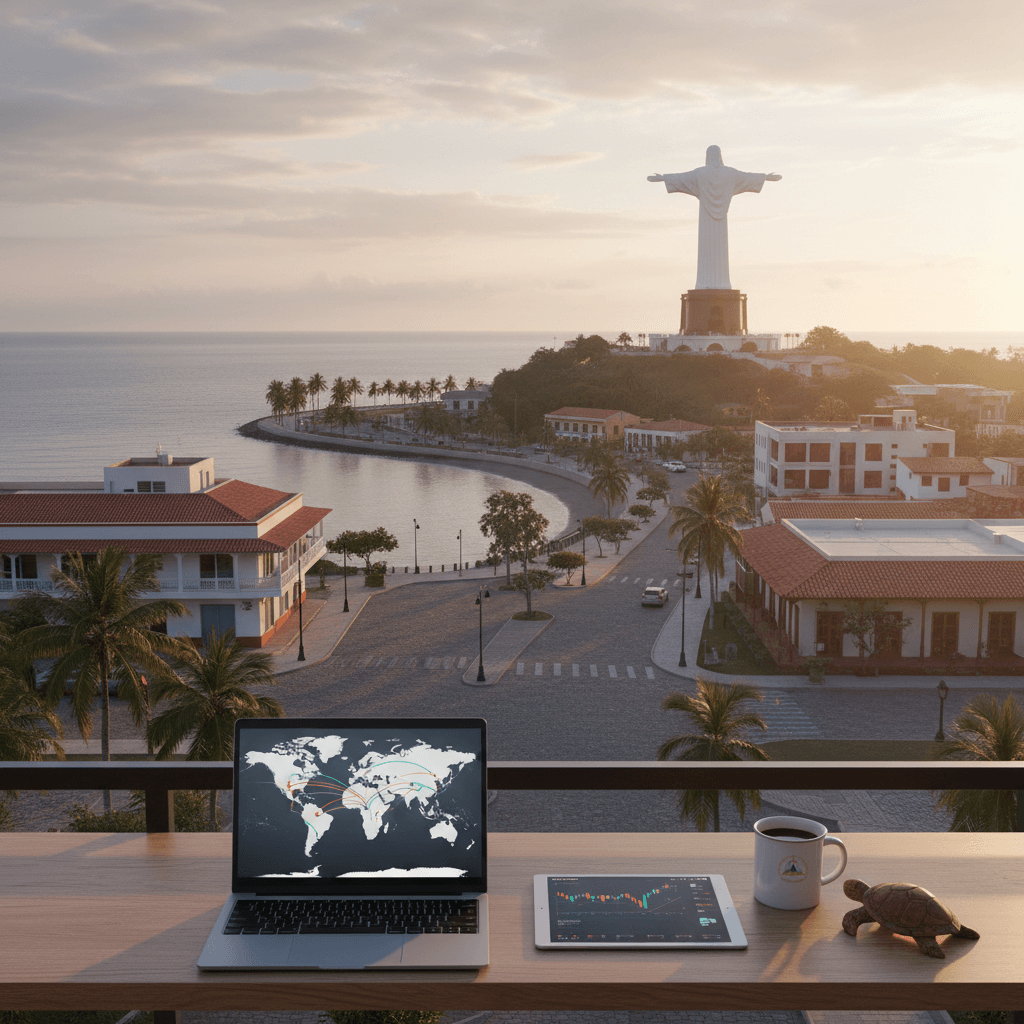
San Juan del Sur
🇳🇮 Nicaragua
The Pulse of the Pacific
San Juan del Sur is a sun-drenched horseshoe bay that feels like a collision between a sleepy fishing village and a high-energy surf camp. It’s a place where the day begins with the sound of offshore winds and ends with some of the most dramatic orange sunsets you’ll ever see. While it’s technically a port city, the vibe is decidedly rustic. You’ll find paved roads in the town center, but the dust and dirt of the surrounding hills remind you that you’re living on the edge of the Nicaraguan jungle.
The town has a split personality that nomads need to understand before booking a flight. During the day, it’s a focused haven for surfers and remote workers sipping coffee in breezy cafes. By night, the energy shifts toward a backpacker-heavy party scene. It’s loud, social, and unpretentious. If you’re looking for a polished, corporate nomad hub, this isn't it. San Juan del Sur is for those who prefer flip-flops to loafers and don't mind the occasional power flicker if it means being steps from the sand.
The Nomad Experience
Most nomads find that the community here is one of the biggest draws. It’s small enough that you’ll start recognizing faces at the local markets or the beach within three days. There’s a strong sense of camaraderie among the expat and nomad crowds, often centered around Selina, which serves as a de facto headquarters for those needing a reliable place to work and meet people. You’ll find a mix of professional nomads, surf bums, and retirees from North America, all blending together at the beach bars.
The lifestyle is undeniably affordable compared to the US or Europe, but it’s not the "dirt cheap" Nicaragua of a decade ago. While street food remains a bargain, the mid-range restaurants catering to expats often charge $10 to $20 for an entree. You’re paying for the convenience and the view. The real value comes in the slow pace. Life here forces you to relax; you’ll spend your afternoons hiking up to the Cristo de la Misericordia statue for a panoramic view of the bay or taking a $5 shuttle to nearby surf breaks like Maderas or Remanso.
Cost of Living Breakdown
Your budget in San Juan del Sur depends entirely on how much "Western comfort" you require. While a single person can scrape by on $1,200, a more realistic "comfortable" budget for a nomad who wants air conditioning and frequent dinners out is closer to $2,000 to $2,500 per month.
- Budget Living: $1,200+ per month. Includes a basic local-style apartment, cooking most meals, and limited nightlife.
- Mid-Range: $1,500 to $2,000 per month. This covers a nicer apartment with decent Wi-Fi, regular dining at cafes, and weekend surf trips.
- Upscale: $2,500+ per month. This buys you a North American-style villa in the hills with a pool and daily restaurant meals.
Connectivity and Infrastructure
The "work" part of being a nomad is surprisingly doable here, provided you choose your base wisely. Urban areas now boast fast internet speeds, and Nicaragua has made significant strides in connectivity. However, infrastructure remains rustic. Power outages can happen, especially during the rainy season from May to November. Most serious professionals stick to the town center or established coliving spaces to ensure they don't drop off a Zoom call in the middle of a meeting.
Mobile coverage is generally strong in town. Expats recommend grabbing a local SIM card immediately for backup data. While the town is highly walkable and bikeable, exploring the surrounding beaches requires a scooter or a rugged 4x4. The lack of ride-hailing apps means you’ll be relying on local taxis or the ubiquitous surf shuttles to get around.
Why Nomads Stay (and Why They Leave)
People stay for the 300 days of wind that keep the surf consistent and the heat bearable. They stay for the community and the ease of making friends. But the "Sunday Funday" party culture isn't for everyone. The constant thumping of bass from hostels can be a dealbreaker for those who need a quiet environment to focus. Additionally, the "foreigner tax" at restaurants can start to grate on your nerves if you’re staying long-term. If you can embrace the noise and the dust, you’ll find a beach town that offers a raw, authentic energy that’s hard to find in more developed hubs.
The Price of Paradise
San Juan del Sur occupies a unique spot on the nomad budget spectrum. While Nicaragua is often touted as the most affordable country in Central America, this specific surf town carries a "gringo tax" that can surprise the unprepared. You can live here on a shoestring if you eat like a local, but most professional nomads find themselves spending between $1,500 and $2,000 per month to maintain a comfortable, air-conditioned lifestyle.
For a single traveler sticking to a strict budget, it is possible to get by on $1,200 per month by prioritizing local markets and modest housing. However, if you want a modern kitchen, high speed internet, and regular dinners out, expect your costs to climb toward $2,500. Couples usually find a sweet spot around $2,050 total, benefiting from shared rent and utility costs.
Housing and Neighborhoods
The rental market is split between rustic Tico-style homes and upscale North American developments. Prices fluctuate wildly based on your proximity to the waves and how much "jungle" you are willing to tolerate. Most nomads prefer the town center for its walkability, though the constant party noise from backpacker bars can be a dealbreaker for deep work.
- Town Center: Best for solo nomads who want to be near the action. Rent for a basic studio or 1BR usually runs between $350 and $500. It is loud, but you will save on transport.
- The Hills (Talanguera and Pacific Marlin): This is where you will find the luxury villas and modern condos. Prices here jump to $1,500 or $2,000 per month. You will get incredible sunsets and peace, but you will definitely need a scooter or quad to get into town.
- Coliving: Selina is the primary hub for the digital crowd. It provides a reliable safety net for those who do not want to hunt for private rentals immediately.
Dining and Groceries
Eating out is where the budget usually breaks. While street food and local "fritangas" offer cheap plates of gallo pinto and grilled meat, the town's trendy cafes and surf bistros are surprisingly pricey. Most mid-range entrees at popular spots will cost you between $10 and $20, which is comparable to many mid-sized cities in the US or Europe.
Expats recommend doing the bulk of your shopping at the local municipal market for produce and fish. If you rely on imported goods from the supermarkets, your grocery bill will mirror what you pay back home. A typical monthly food spend for a nomad who cooks half their meals and eats out the rest is around $400 to $600.
Connectivity and Coworking
Internet reliability has improved significantly, and you can now find speeds fast enough for video calls in most urban rentals. Mobile coverage is solid throughout the town center, and getting a local SIM card is a cheap, mandatory move for backup data. While dedicated coworking spaces are still limited, the cafe culture is strong. You will find plenty of laptops open at places like Selina or the various beachfront cafes that offer decent WiFi for the price of a coffee.
Transport and Utilities
San Juan del Sur is highly walkable if you stay in the core. You can navigate the entire town center on foot or by bike without much effort. For exploring further beaches like Playa Maderas or Playa Hermosa, you will need to factor in the cost of shuttles or a rental.
- Electricity: This is often the most expensive utility. If you run your air conditioning 24/7, expect a monthly bill that can easily top $150. Always check if electricity is included in your rent.
- Scooter Rental: Monthly rates vary, but it is a common expense for those living in the hills.
- Water and Trash: These are generally affordable, often costing less than $30 per month combined.
Overall, San Juan del Sur offers a high quality of life for the price, provided you enjoy the slow, dusty, and occasionally loud rhythm of a Pacific surf town. It is not the dirt-cheap escape it was ten years ago, but for $1,800 a month, you are getting a lifestyle that would cost triple in California or Costa Rica.
Solo Nomads and Social Seekers
If you want to be in the thick of it, the town center is your best bet. This is the heart of the action where everything is walkable and the energy is high. Most nomads staying here gravitate toward Selina, which serves as a de facto community hub. It is one of the few places with a reliable coliving setup and a consistent cafe working culture, making it easy to meet people the second you drop your bags.
Living in the center means you are steps away from the beach and the town's famous orange sunsets. You will find plenty of mid range restaurants where an entree sets you back $10 to $20, though street food is available if you are sticking to a tighter budget. The trade off is the noise. San Juan del Sur is a party town, and the center can get loud, especially during the peak season from December to February. If you need total silence to hop on Zoom calls, the town core might test your patience.
- Rent: $350 to $500 for a basic studio; up to $1,000 for a modern apartment.
- Vibe: High energy, backpacker heavy, and extremely social.
- Connectivity: Best mobile coverage in the area; reliable WiFi at Selina and established cafes.
Professional Expats and Long Termers
For those who have outgrown the hostel circuit, the hills surrounding the bay offer a more polished experience. These residential areas provide a "North American style" of living with better amenities and significantly more peace. You will likely need a scooter or a bike to get around, as the walk up from town can be steep and taxing in the midday heat. Expats often prefer these zones because they offer a buffer from the backpacker crowds while keeping the town's amenities within a five minute drive.
This is where you will find the upscale villas and gated communities. Many long term residents report monthly expenses around $2,050 for a couple, which covers a comfortable lifestyle with a mix of dining out and home cooking. The internet in these hills is generally fast and reliable, though it is always smart to have a local SIM card as a backup for those occasional tropical power blips.
- Rent: $1,500 to $2,000+ for high end homes with views.
- Vibe: Quiet, private, and focused on the scenery rather than the nightlife.
- Transportation: Scooter or car rental is recommended for daily errands.
Surfers and Nature Lovers
If your workday revolves around the tide chart, look toward the beaches just outside the main bay. While the town beach is great for a sunset stroll, the real surf happens at spots like Playa Maderas. Staying out here is a different world. It is much more rustic and disconnected, which is perfect for soul searching but challenging for serious remote work. The infrastructure is thinner, and you will find fewer coworking options compared to the town center.
Nomads who choose the outskirts usually do so for the "chill" factor. You will find a small, tight knit community of surfers and eco conscious travelers. Just be prepared for higher logistics costs; getting into town for groceries or a social night out requires a shuttle or a private taxi, which adds up over time. If you can handle the slower pace and slightly more inconsistent utilities, the proximity to world class waves is an unbeatable perk.
- Rent: $400 to $800 for rustic beach bungalows.
- Food: Limited local options; most residents shop in town and cook at home.
- Best for: Dawn patrols, digital detoxing, and avoiding the party noise.
A Note on Families
San Juan del Sur leans heavily into its reputation as a surf and party hub, which means it isn't the most traditional family destination. However, families who do make the move typically settle in the quieter residential pockets away from the bars. The town is safe and the locals are famously friendly, but the lack of dedicated family infrastructure means you will be making your own fun at the beach or on day trips to the nearby Jesus statue hike. Most families find that the "comfortable" budget tier of $2,500+ per month is necessary to secure a home with enough space and reliable amenities.
San Juan del Sur has come a long way from its days as a spotty backpacker outpost. While it still feels like a rugged beach town, the digital infrastructure has caught up enough to make it a viable base for most remote workers. You can usually find stable, fast connections in the town center, though things get a bit more experimental once you head into the hills or toward the more remote surf breaks.
Connectivity and Speed
You can expect download speeds around 7-20 Mbps in well equipped spots, with national medians higher but local averages lower. While this is plenty for Zoom calls and uploading content, the town still suffers from occasional power flickers, especially during the rainy season. Most seasoned nomads recommend a backup power bank for your laptop and a local SIM card to use as a hotspot when the grid takes a breather.
For mobile data, the coverage is solid throughout the main bay. You will want to pick up a local SIM card immediately upon arrival. Most travelers lean toward Claro or Tigo, which offer affordable data packages that you can top up at almost any "pulperia" (small corner store) in town. Having a local data plan is a lifesaver when the cafe WiFi decides to take a siesta.
Coworking Spaces
The coworking scene here is intimate rather than corporate. You won't find massive, glass walled office complexes, but you will find community focused spaces that prioritize a work hard, play hard balance.
- Selina San Juan del Sur: This is the primary hub for the nomad community. It features a dedicated coworking area with reliable backup power and air conditioning. It is the best place to meet other professionals, though it can get lively in the evenings. Monthly memberships usually hover around $150 to $200, while day passes are available for those just passing through.
- The Art Warehouse: While primarily a creative space and cafe, it has become a favorite for those who need a quiet corner and a strong cold brew. It is less of a formal "office" and more of a sanctuary for deep work away from the party crowds.
The Cafe Culture
If you prefer a change of scenery, the town is packed with "laptop friendly" cafes. Most owners are happy to let you linger for a few hours if you are buying coffee and food. Just be mindful of the heat; many of these spots are open air, so you might find yourself sweating over your keyboard by 2:00 PM.
- Simon Says: Known for its lush garden setting and eclectic decor. The WiFi is generally reliable, and the smoothie bowls make for a great mid morning desk snack.
- Ding Repair Cafe: A classic surf town spot where you can grab a high quality espresso and knock out a few hours of emails while watching the street life go by.
- Dale Pues: Famous for their breakfast sandwiches and consistent internet, this is a staple for the morning work crowd.
Practical Workflow Tips
The biggest challenge to your productivity in San Juan del Sur isn't the internet; it is the noise. Between the Sunday Funday pool crawls, local parades, and construction, a pair of high quality noise canceling headphones is a mandatory piece of gear. Most nomads find that starting their day early, around 7:00 AM, allows them to finish their "deep work" before the midday heat and the afternoon party volume peak.
If you are looking for long term housing, always ask for a speed test screenshot before signing a lease. Some of the luxury villas in the hills rely on microwave or satellite internet, which can be hit or miss during heavy tropical rain. Sticking to the walkable center usually guarantees a more stable connection for those with demanding meeting schedules.
Staying Safe in the Surf Hub
San Juan del Sur feels more like a tight knit community than a typical tourist trap. Most nomads find the town generally safe, thanks to a healthy mix of friendly locals and a permanent expat population that keeps an eye out for one another. The vibe is laid back, and violent crime against travelers is rare. However, the town's reputation as a party destination brings in large crowds on weekends, which can lead to opportunistic petty theft.
Most safety issues happen after dark, particularly around the beach or near late night bars. Expats recommend keeping a close grip on your phone and wallet when walking through the central party zones. If you're staying in a hillside villa outside the town core, skip the midnight walk and grab a local taxi instead. It's a small price to pay for peace of mind when the streets get quiet.
- Solo Travelers: Walking around the main town center during the day is perfectly fine. At night, stick to well lit streets where the restaurants and bars are active.
- Personal Belongings: Don't leave your bags unattended on the sand while you're out surfing or swimming. This is the most common way nomads lose their gear.
- Home Security: If you're renting a standalone house rather than staying at a place like Selina, ensure your windows and doors have sturdy locks. Most upscale rentals include gated security for a reason.
Healthcare and Medical Services
For a small beach town, the medical infrastructure is surprisingly adequate for day to day needs. There are several local clinics and small hospitals in town that can handle minor injuries, infections, or surf related accidents. Pharmacies are easy to find and well stocked with most standard medications, often available without a complex prescription process.
If you face a serious medical emergency, you'll likely need to head to Managua. The capital is about 2.5 to 3 hours away and houses top tier private hospitals like Vivante Pellas, which meets international standards. Many nomads carry private health insurance to cover these potential costs, as local public facilities can be basic and crowded.
- Food and Water: Food safety is generally reliable in San Juan del Sur. You can enjoy the local street food without much worry, though it's best to stick to bottled or filtered water for drinking.
- Air Quality: The air quality is excellent here, thanks to the constant Pacific breeze and the lack of heavy industry.
- Emergency Contacts: Keep the number for your local clinic saved. While there isn't a high tech dispatch system, the local community is quick to help if you're in a pinch.
Practical Wellness Tips
The biggest health "threats" you'll likely face are the sun and the mosquitoes. The tropical sun is intense, especially between 10:00 AM and 3:00 PM, so high SPF sunscreen is a daily requirement. Since the town is surrounded by jungle, mosquitoes can be an annoyance during the rainy season. Most long term residents use repellent regularly to avoid the risk of mosquito borne illnesses.
For those focused on fitness, the town's walkability is a major plus. You'll get plenty of exercise just navigating the hills or walking to the beach for a sunset session. Between the clean air, fresh seafood, and active lifestyle, many nomads find their physical health actually improves after a few months in Nicaragua.
The Town Core: On Foot and Two Wheels
San Juan del Sur is remarkably compact. If you're staying in the town center, your primary mode of transportation will be your own two feet. Most nomads find they can walk from their apartment to their favorite cafe, the grocery store, and the shoreline in under 10 minutes. The streets are laid out in a grid, making it nearly impossible to get lost, even after a few Toñas at a beach bar.
For those who want to move a bit faster or live slightly further up the hills, bicycles are the local favorite. You can rent a cruiser for about $10 to $15 a day, though many long term expats just buy a used one to save money. Just be prepared for some serious incline if you're heading toward the Pelican Eyes area or the hills overlooking the bay. If you aren't keen on breaking a sweat, scooters and small motorbikes are available for rent starting around $25 to $35 per day, with better rates for weekly or monthly commitments.
Getting to the Surf Breaks
While the town beach is great for sunsets, the best surf is located at beaches like Playa Maderas, Playa Hermosa, and Playa Remanso. These aren't exactly walkable. Since ride hailing apps like Uber don't operate here, you'll rely on the local beach shuttles. These are usually converted trucks or vans that run on a set schedule from hostels like Selina or specific surf shops in town. Expect to pay about $5 to $10 for a round trip ticket.
If you prefer more flexibility, you can hire a private taxi. There isn't a formal meter system, so you'll need to negotiate the price before you hop in. A trip to a nearby beach usually costs between $15 and $25 depending on your haggling skills and the distance. Many nomads who stay for several months eventually rent or buy a rugged 4x4 vehicle, as the dirt roads leading to the best surf spots can become a muddy mess during the rainier months.
Public Transport and Regional Travel
For a truly local experience, the "chicken buses" (repurposed North American school buses) are the cheapest way to get around. They are loud, crowded, and slow, but they cost next to nothing. You can catch a bus to Rivas for less than $1. From Rivas, you can connect to ferries for Ometepe Island or buses heading north to Granada and Managua.
When you first arrive in Nicaragua, you'll likely land at Augusto C. Sandino International Airport (MGA) in Managua. Most travelers recommend booking a private shuttle in advance. It's a 2.5 to 3 hour drive, and a private car will run you about $80 to $120. Shared shuttles are a more budget-friendly nomad staple, usually costing around $25 to $40 per person, though they operate on fixed schedules and might require a bit of waiting at the terminal.
Navigation Tips for Nomads
- Download Offline Maps: Mobile coverage is solid in town, but it can get spotty once you head into the jungle or toward more remote beaches.
- Cash is King: While some upscale spots and hotels take cards, taxi drivers and shuttle operators only take cash. Keep small denominations of Cordobas or US Dollars on you.
- The "Address" System: Don't expect standard street addresses. Locals often give directions based on landmarks, like "two blocks south of the church."
- Night Safety: While the town is generally safe, expats recommend taking a taxi if you're heading to a hilltop villa late at night rather than walking poorly lit paths alone.
The Language Landscape
Spanish is the heartbeat of San Juan del Sur. While the town has transformed into a global surf hub, the local culture remains deeply Nicaraguan. You'll hear the distinct Nica accent everywhere, characterized by dropping the "s" at the end of words and a rapid, melodic pace. If you're coming from Mexico or Spain, it might take your ears a few days to adjust to the local flow.
Because the town caters to a massive influx of North American and European travelers, English proficiency is moderate within the tourism bubble. In the town center, at beachfront bars, or inside the Selina coliving space, you can usually get by with English. Most restaurant menus in the central grid are bilingual, and surf instructors almost always speak enough English to get you through a lesson.
However, that "tourist English" evaporates quickly once you step away from the main drag. If you're dealing with a local landlord for a long term rental, visiting the municipal market, or chatting with a taxi driver, you'll need at least basic Spanish. Most nomads find that while they can survive without Spanish, they can't truly thrive or negotiate fair prices without it. Knowing how to ask for the price (¿Cuánto cuesta?) and understanding numbers is the difference between paying local rates and the "gringo tax."
Communication & Staying Connected
Staying online is relatively straightforward in the urban core, but it requires a bit of strategy if you plan to work remotely. Nicaragua has two main mobile providers: Claro and Tigo. Most expats recommend Tigo for better data speeds in the San Juan del Sur area, though Claro often has better coverage in more remote surf breaks like Playa Maderas.
You can pick up a SIM card for about $2 to $5 at small "pulperias" (convenience stores) or the dedicated shops near the central park. Data packages are incredibly affordable; you can usually get a week of unlimited social media and several gigabytes of data for under $10. High speed fiber internet is becoming more common in modern villas and coworking spots, but it's always wise to have a local SIM as a backup for the occasional power flicker.
Essential Phrases for the Pacific Coast
To move beyond the basic "hola," try weaving in some local Nica slang. It goes a long way in building rapport with the locals who make this town run.
- ¡Dale pues!: This is the unofficial catchphrase of Nicaragua. It means "okay," "let's do it," or "go ahead." You'll hear it a dozen times a day.
- Chele / Chela: A term used for light skinned people or foreigners. It's rarely offensive; usually, it's just a descriptive shorthand.
- ¿Qué onda?: A casual way to say "What's up?" or "How's it going?"
- La Cuenta: When you're finished with your $15 entree at a mid range spot, ask for the bill. It won't usually be brought to you automatically.
Social Integration
The social scene is divided into two worlds that occasionally overlap. There is the high energy backpacker crowd that communicates almost exclusively in English and centers around the Sunday Funday pool crawls. Then there is the more permanent expat and nomad community that gathers at cafes like Simon Says or Art Warehouse.
If you want to bridge the gap, look for language exchange meetups. These are often hosted informally at local cafes or hostels. Engaging with the "Nica" side of town not only helps you secure better deals on everything from surfboard repairs to private shuttles, but it also opens up a side of San Juan del Sur that the average party traveler completely misses. Most nomads find the locals exceptionally patient with Spanish learners, so don't be afraid to make mistakes while ordering your Gallo Pinto.
The Dry Season Sweet Spot
If you are looking for those iconic, cloudless Pacific sunsets and bone-dry air, aim for the window between December and February. This is the peak of the high season, when the town is at its most energetic. The offshore winds, known locally as the Papagayo winds, kick into high gear during these months. For surfers, this is a dream because it keeps the waves groomed and hollow all day long. For everyone else, it means the heat feels a lot more manageable than the humid stickiness you find elsewhere in Central America.
The trade-off for perfect weather is the crowd. During these months, the town fills up with travelers from Managua and international backpackers. You will notice prices for short-term rentals tick upward, and the central bars get significantly louder. If you value a quiet workspace, you might want to find a spot slightly tucked away from the beach front during this peak period.
The Green Season Shift
The rainy season typically begins in May and stretches through November. Don't let the "rainy" label scare you off. Usually, it looks like sunny mornings followed by a massive, cinematic downpour in the late afternoon or night. The landscape transforms from a dusty brown to a deep, lush green almost overnight. Most nomads who stay long-term actually prefer this time of year because the dust settles, the air is cooler, and the town feels much more local and relaxed.
The wettest months are September and October. During this time, some of the dirt roads leading to the outer surf beaches like Playa Maderas or Playa Hermosa can become a muddy challenge. If you are planning to stay during the tail end of the rainy season, renting a 4x4 or a sturdy motorbike is a smart move. On the plus side, you can often negotiate much better monthly rates on high-end housing during these months.
Temperature and Packing Realities
Expect temperatures to hover between 75°F and 90°F year-round. It is a tropical climate through and through, so your wardrobe will mostly consist of linen, cotton, and swimwear. However, there are two things people often forget to pack:
- A light hoodie or windbreaker: The winds in January and February are surprisingly strong. If you are riding a scooter at night or sitting on a boat, you will actually feel a bit of a chill.
- Sturdy footwear: Even in the dry season, the terrain is rugged. While flip-flops are the daily uniform, you will want real shoes for the hike up to the Christ of the Mercy statue or for navigating muddy paths in October.
When to Visit for the Best Vibe
If you want the best balance of weather, social life, and cost, try November or March. These "shoulder" months sit right on the edge of the seasons. In November, the rain is tapering off but the hills are still green. In March, the holiday crowds have thinned out, but the weather is still reliably sunny before the humidity of April kicks in.
Keep an eye on the calendar for Semana Santa (Holy Week). The town transforms into a massive, non-stop party. It is an incredible cultural experience, but for a digital nomad trying to hit a deadline, the noise and the spike in prices can be a major headache. If you aren't there to party, that is the one week of the year you might want to head into the mountains of Matagalpa for some peace and quiet.
The Cost of Living Reality
San Juan del Sur has a reputation for being a budget destination, but the reality for nomads is a bit more nuanced. While you can certainly get by on $1,200 a month if you're cooking at home and living in a basic studio, most professionals find themselves spending between $1,500 and $2,000 to maintain a comfortable lifestyle. If you want a modern North American style condo with air conditioning and a view, expect to pay between $1,500 and $2,500 for rent alone.
Dining out is where the costs can surprise you. A mid-range entree at a popular spot in town usually runs between $10 and $20. While street food remains affordable, the "gringo price" is a real factor here. For a comfortable monthly budget, we recommend the following breakdown:
- Budget Nomad: $1,200+ (Local housing, market shopping, limited nightlife)
- Mid-Range: $1,800 to $2,200 (Comfortable apartment, frequent dining out, surf trips)
- High-End: $3,000+ (Luxury villa, daily AC use, private transport)
Connectivity and Remote Work
Working from this corner of Nicaragua is easier than it used to be, but it still requires a backup plan. Internet speeds in the town center are generally fast and reliable enough for video calls. However, power outages can happen, especially during the rainy season from May to November. Most serious nomads gravitate toward Selina, which offers the most consistent coliving environment and a reliable community of fellow workers.
The cafe culture is growing, and you'll find plenty of spots with decent WiFi to crank out a few hours of work. For mobile data, grab a local SIM card immediately upon arrival. Coverage is solid in the urban core but drops off quickly once you head into the hills or toward the more remote surf breaks. If your work depends on 100% uptime, look for rentals that specifically mention a backup power source or "battery backup" for the router.
Navigating the Neighborhoods
The town is small enough that the "center" is where most of the action happens. It is highly walkable and bikeable, meaning you won't need a car for daily errands. The trade-off for this convenience is the noise. San Juan del Sur is a party town at heart, and the backpacker crowds can be loud well into the early hours. If you value sleep, look for accommodations a few blocks back from the beachfront or up on the surrounding hillsides.
For those who want a quieter experience, the areas near Playa Maderas or Playa Hermosa offer a more relaxed, surf-focused vibe, though you'll be sacrificing the walkability of the town center. Most nomads find that staying in town for the first month is the best way to get a feel for the layout before committing to a longer lease in the quieter outskirts.
Getting Around and Safety
You won't find Uber here. Instead, you'll rely on local taxis, shuttles, and your own two feet. Taxis within the town are inexpensive, but prices jump for airport transfers or trips to distant beaches. Many expats choose to rent a scooter or a small motorbike to explore the coastline on their own terms. Just be mindful of the road conditions, which can get muddy and unpredictable during the wetter months.
Safety is generally not a major concern, as the locals are famously friendly. Petty theft can happen, particularly in the context of the nightlife scene, so keep an eye on your belongings at the beach and in crowded bars. Healthcare is accessible through local pharmacies and clinics that can handle minor issues, but for anything serious, you'll likely need to head to a larger hospital in Rivas or Managua.
When to Go
The high season runs from December to February. This is when the weather is at its best, the skies are clear, and the town is at its most social. It is also when prices for short-term rentals peak. If you prefer a bit more solitude and don't mind the occasional tropical downpour, the shoulder seasons offer better value and a more "local" feel to the town.
Need visa and immigration info for Nicaragua?
🇳🇮 View Nicaragua Country GuideEasy Landing
Settle in, no stress