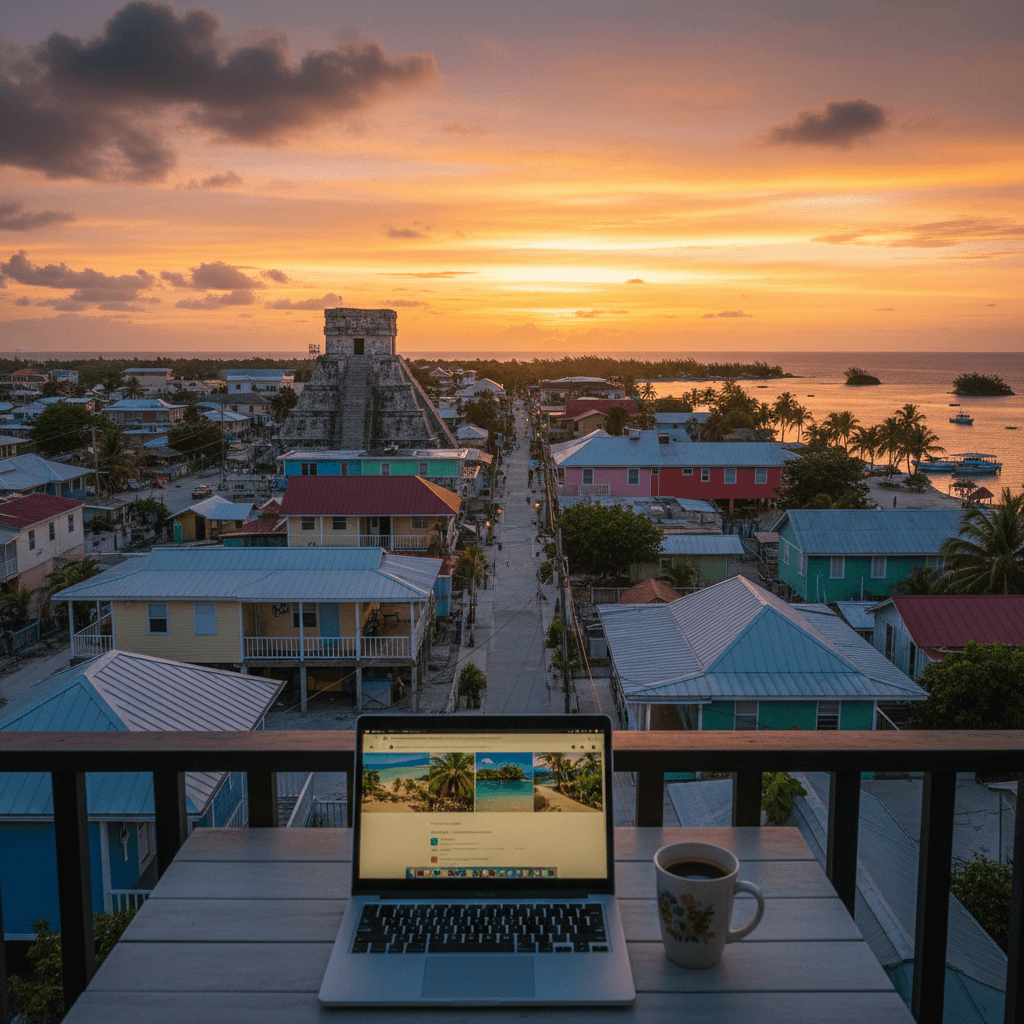
Placencia
🇧🇿 Belize
The Barefoot Vibe
Placencia doesn't feel like a typical nomad hub. While places like Tulum or San Pedro can feel over-curated, this narrow peninsula at the edge of the Caribbean remains a former fishing village at heart. It has a distinct "barefoot luxury" energy where you can close your laptop and be in the water in sixty seconds. The soul of the town resides on the Placencia Sidewalk, a narrow, pedestrian-only concrete path that snakes through the village. It's lined with colorful wooden houses, small cafés, and local art, creating a social corridor where you'll inevitably run into everyone you met the night before.
Most nomads find the pace here addictive. It’s a place where your Zoom background might include a pelican diving into the turquoise water while you sip a coffee made from local beans. The community is tight-knit but welcoming, largely revolving around a growing crowd of developers, designers, and creative entrepreneurs who have traded skyscrapers for sea breezes. You aren't just a tourist here; after a week, the barista at Above Grounds Coffee will likely know your order by heart.
Cost of Living Breakdown
Placencia sits in a moderate price tier. It’s more affordable than many US coastal cities but pricier than rural Southeast Asia or parts of mainland Belize due to its popularity and peninsula location. Travelers generally categorize spending into three tiers:
- Budget: $1,500 to $2,500 per month. This usually involves living a few blocks back from the beach, eating local street tacos for $5 to $10, and using a bicycle as your primary transport.
- Mid-range: $2,500 to $4,000 per month. This covers a comfortable apartment in the village or a long-term studio at a place like Ocean Breeze Beach Resort, with frequent dinners at spots like Cha Chi’s Pizzeria where meals run $15 to $25.
- Comfortable: $4,000+ per month. This tier is for those wanting high-end beachfront villas, upscale dining at Itz’ana, and regular weekend boat charters to the outer cayes.
The Neighborhood Layout
While the peninsula is small, where you plant your flag matters for your daily workflow. There aren't formal neighborhoods, but rather distinct zones that dictate your lifestyle.
The Village & Sidewalk
- Best for: Social nomads and solo travelers who want to be in the thick of it.
- The Experience: You’re steps away from the best bars like Tipsy Tuna and the most reliable coffee shops. It’s highly walkable, though the nightlife can be audible if your windows are open.
- Rent: Expect to pay $800 to $1,500 for a decent long-term setup here.
Beachfront Hubs
- Best for: Families and deep-focus workers who need quiet.
- The Experience: Areas near Umaya Resort offer more seclusion and direct private beach access. It’s serene and beautiful, but you’ll likely want a golf cart or scooter rental, which costs about $10 to $20 per day, to get into town for supplies.
- Rent: Prices often jump to $1,200 to $2,000+ depending on the proximity to the sand.
Connectivity and Workflow
The "work" part of being a nomad is surprisingly easy here. Fiber-optic internet from providers like SMART and DigiNet has rolled out across the peninsula, offering speeds between 50 and 180 Mbps. This is more than enough for heavy video calls or uploading large files. If you crave a structured office environment, Noma Collective, located in Maya Beach about 25-30 minutes away, is the go-to for coliving and coworking, offering private rooms and community events for around $538 per week.
For those who prefer "café hopping," the culture is very laptop-friendly. You can spend the morning at Chilpoint for a caffeine fix, move to The Shak Café for a beachfront smoothie, and finish the day at the Placencia Yacht Club with a view of the docks. Most expats recommend having a backup power bank or a local SIM card for a hotspot, as tropical storms can occasionally cause brief power outages.
The Reality Check
Life in Placencia isn't without its quirks. You have to be okay with the "island time" mentality; things move slower here, and getting frustrated by a late bus or a slow grocery checkout won't help. The rainy season peaks in October and November, which can bring humidity and mosquitoes, but the dry season from December to April is nearly perfect. If you can handle the occasional power flicker and the isolation of being on a narrow strip of land, the reward is a community that feels like family and a backyard that looks like a postcard.
The Price of Paradise
Living in Placencia puts you in a sweet spot. It is more expensive than the Guatemalan highlands or rural Mexico, but your dollar stretches significantly further here than in the US or Western Europe. Most nomads settle into a monthly budget between $2,500 and $4,000. This range covers a comfortable lifestyle where you aren't constantly checking your bank balance before ordering another round of ceviche at Tipsy Tuna.
The peninsula operates on a tiered system. If you're willing to live like a local in the village, eating $5 tacos for breakfast and biking everywhere, you can scrape by on $1,500. However, the true "nomad experience" usually involves beachfront views and air conditioning, which naturally pushes costs toward the higher end.
Monthly Budget Breakdown
- Budget Tier ($1,500 to $2,500): Best for solo travelers staying in village studios, eating street food, and using a bicycle as primary transport.
- Mid-Range ($2,500 to $4,000): The sweet spot for most digital nomads. This covers a modern 1-bedroom apartment, frequent dinners at spots like Cha Chi’s, and a few weekend snorkeling trips.
- Comfortable ($4,000+): High-end living at resorts like Itz’ana or Umaya, private golf cart rentals, and daily upscale dining.
Housing and Neighborhoods
Rent is your biggest variable. In the heart of the village, you can find furnished long-term rentals between $800 and $1,200. These spots put you right on the sidewalk, meaning you're seconds from the action but might deal with some late-night music from the bars. Most expats recommend looking for units near Ocean Breeze for a balance of beach access and village proximity.
If you prefer silence and space, look toward the peninsula outskirts near the yacht club. You'll likely need to budget $10 to $20 a day for a scooter or golf cart rental, as it is a bit far to walk into town for every meal. Beachfront 1-bedroom apartments in these quieter zones typically range from $1,200 to $2,000 per month for long-term stays.
Food and Social Life
Eating out is a way of life here. A casual meal of local stew chicken or street tacos will only set you back about $5 to $10. If you're craving international flavors, a wood-fired pizza at Cha Chi’s or a fresh smoothie at The Shak Café usually costs between $15 and $25. Upscale resort dining is where things get pricey, with dinner and drinks often exceeding $50 per person.
Groceries are a mixed bag. Local produce and seafood are affordable, but anything imported from the US comes with a hefty markup. Savvy nomads buy their fish directly from the docks and supplement with fruit from the sidewalk stands to keep costs down.
Connectivity and Coworking
Reliable internet used to be a headache, but fiber-optic lines have changed the game. You'll find speeds between 50 and 180 Mbps at most reputable rentals. If you need a dedicated community, Noma Collective offers a popular coliving setup. Their rates sit around $538 per week, which includes a private room, workspace, and a built-in social calendar. For a change of scenery, Above Grounds Coffee and Chilpoint are the go-to spots for a few hours of laptop work with a view.
The "Work Where You Vacation" Visa
Belize makes it relatively easy to stay legally. You can enter on a standard tourist visa and renew it every 30 days. For those staying longer, the "Work Where You Vacation" program is a great fit. The application fee is $250, and it grants you a 6-month residency. You'll need to prove an annual income of at least $75,000 if you're an employee, or $100,000 for a family, to qualify for this specific nomad track.
Placencia isn't a sprawling metropolis with distinct zip codes. It’s a skinny, 16 mile long finger of land where the vibe shifts from social and sandy to secluded and high end as you move north. Most people living here part time or full time choose their spot based on how much they want to rely on a golf cart versus their own two feet.
The Social Nomads: Placencia Village & The Sidewalk
If you want to be in the heart of the action, the Village is where you’ll land. This area is famous for its narrow pedestrian sidewalk, a concrete ribbon that serves as the town's main artery. It’s lined with colorful wooden houses, art galleries, and the kind of cafes where people actually know your name after two visits.
- Rent: Expect to pay $800 to $1,200 for a modest studio or one bedroom apartment tucked behind the main strip.
- The Vibe: High energy and walkable. You're steps from The Shak Café for a morning smoothie and Cha Chi’s Pizzeria for late night slices and live music.
- Best For: Remote workers who crave community and don't mind a little noise from the bars at night.
Nomads often gather at Tipsy Tuna Beach Bar for sunset drinks or trivia nights. Since the WiFi here is surprisingly solid, reaching up to 180 Mbps on fiber networks, you'll often see people working from their porch before heading to the beach. The biggest perk is the lack of cars; you can do your entire grocery run, banking, and socializing on foot.
The Long Term Expats: The North Peninsula & Maya Beach
Expats looking for a more permanent, quiet lifestyle usually drift north toward Maya Beach or the areas near the yacht club. This is where the peninsula widens slightly, offering more privacy and larger homes with actual yards. It feels less like a vacation hub and more like a residential community.
- Rent: Mid range houses and condos typically go for $1,200 to $2,000 per month.
- The Vibe: Serene and upscale. You’ll definitely need to rent a golf cart or a scooter for $10 to $20 a day to get into the village for supplies.
- Best For: Professionals and retirees who want a "neighborhood" feel rather than a "backpacker" feel.
Living out here means you’re closer to high end dining like the restaurants at Itz’ana. It’s common for expats here to join the Placencia Yacht Club to stay connected. While it's quieter, you're still only a 15 minute drive from the village center.
Families: Beachfront Resorts & Gated Enclaves
For families, the priority is usually safety, pool access, and proximity to the water. The beachfront stretches near Ocean Breeze or Umaya Resort are the go to spots. These areas offer managed properties that take the headache out of Belizean utility hurdles like occasional power outages, as many have backup generators.
- Rent: Fully furnished beachfront suites or villas can run $2,500 to $4,000 per month depending on the season.
- The Vibe: Safe, manicured, and breezy. Direct beach access means kids can play while parents hop on Zoom calls with a view of the Caribbean.
- Best For: Families who want a "soft landing" in Belize with amenities like housekeeping and security included.
Many families appreciate being near the resort hubs because they offer a sense of security and easy access to organized jungle tours or snorkeling trips. It’s a more controlled environment than the village center but offers way more space for kids to roam.
Solo Travelers: Coliving & Boutique Hubs
If you’re arriving solo and don't want to spend your first week staring at a wall, the coliving scene is the way to go. Located in Maya Beach, about 25-30 minutes from Placencia Village, Noma Collective offers private rooms and shared work spaces (not dedicated individual desks) for around $538 per week.
- Cost: Around $538 per week for a private room and shared work spaces.
- The Vibe: Instant network. You’ll be surrounded by designers, developers, and entrepreneurs from day one.
- Best For: First timers who want to skip the "lonely" phase of moving to a new country.
Solo travelers also frequent Above Grounds Coffee, a stilt house cafe that serves as a secondary office for many. It’s the best place to pick up local tips on which cayes are worth a boat trip or where to find the best $5 street tacos. The community is small enough that you'll start recognizing the same faces at the local gym or the pharmacy within a week.
Connectivity on the Peninsula
Placencia has come a long way from its roots as a quiet fishing village. While you might still see pelicans diving for breakfast during your morning Zoom call, the infrastructure behind the scenes is surprisingly robust. Fiber optic internet from providers like SMART and DigiNet has rolled out across the peninsula, offering speeds between 50 and 180 Mbps. This is more than enough for heavy video streaming or managing large file uploads without the lag often associated with Caribbean islands.
Most Airbnbs and boutique resorts like Ocean Breeze now treat high speed WiFi as a standard amenity rather than a luxury. However, the tropical setting does come with a caveat. Power outages can happen during heavy storms, so if your work is time sensitive, it is smart to have a backup. Many long term nomads invest in a local Belize SIM card to use their phone as a hotspot during these brief blips. You can pick one up for about $10 to $20 in the village center.
Coworking and Coliving
If you are looking for a structured work environment and an instant social circle, Noma Collective, located in nearby Maya Beach (about 25-30 minutes from Placencia Village), offers organized coworkations that include private rooms and dedicated desk space. It is a popular choice for developers and entrepreneurs who want to skip the logistics of finding a desk and jump straight into a community of like minded professionals.
For those who prefer a more DIY approach, the town is full of laptop friendly corners. There are no traditional cubicle-style coworking spaces in Placencia Village itself, though Noma Collective in nearby Maya Beach offers dedicated coworking facilities. The local café culture more than makes up for it; most spots are happy to let you linger over a coffee as long as you are ordering and being respectful of the space.
Best Work Friendly Cafés
- The Shak Café: Located right on the beach, this is the go to for a morning smoothie and a few hours of emails. The breeze keeps things cool, and the WiFi is generally reliable for light tasks.
- Above Grounds Coffee: Situated in a charming stilt house, this spot uses local beans and offers a quieter, more focused atmosphere than the beachfront bars.
- Chilpoint: A solid choice for those who need a caffeine fix and a stable connection in a modern setting.
- Cha Chi’s Pizzeria: While it is a popular lunch and dinner spot, nomads often flock here during the day for some of the fastest WiFi in the village.
- Placencia Yacht Club: If you want a view of the docks while you work, this is a great afternoon spot to set up shop before the sunset crowd arrives.
The Digital Nomad Visa
Belize makes it relatively easy to stay long term through their Work Where You Vacation program. This digital nomad visa is valid for 6 months and costs $250. To qualify, you will need to show proof of employment outside of Belize and an annual income of at least $75,000. If you don't meet those requirements, the standard tourist visa can be renewed every 30 days at the local immigration office, which is a common route for many expats living on the peninsula.
Most nomads find that the blend of English speaking locals and the easygoing "island time" pace makes for a low stress work environment. You might find yourself working fewer hours because the Caribbean Sea is calling, but when you do sit down to work, the infrastructure won't hold you back.
A Community Built on Trust
Placencia is widely regarded as one of the safest spots in Belize for long term stays. Because the peninsula is essentially one long, narrow strip of land, the community is tight knit. People know their neighbors, and the "village vibe" means locals generally look out for the nomads and expats living among them. You won't find the high pressure environment or "no go" zones common in larger Central American cities.
Most travelers feel perfectly comfortable walking the famous central sidewalk alone during the day. At night, the main village area remains social and well lit near spots like Tipsy Tuna and Cha Chi’s. However, common sense applies here just like anywhere else. Try to avoid walking alone in isolated, unlit stretches of the beach or the outskirts of the peninsula late at night. If you're staying at a resort further north like Itz’ana or Umaya, it's better to grab a taxi or use a golf cart for late night runs rather than trekking back on foot.
Practical Health and Medical Care
For minor ailments, the village is well equipped. You'll find several pharmacies right along the sidewalk that stock most standard over the counter medications and basic first aid supplies. For routine checkups or non emergency issues, there are local clinics in the village that serve both locals and the expat community.
If you face a serious medical emergency, things get a bit more complicated. Placencia doesn't have a full scale hospital. The nearest major facility is in Dangriga, which is about a 30 to 45 minute drive away. For specialized care or major surgeries, residents usually head to Belize City. Because of this distance, most seasoned nomads recommend carrying high quality international health insurance that includes emergency evacuation coverage.
- Emergency Services: Dial 911 for police or medical emergencies.
- Pharmacies: Multiple locations along the main sidewalk; usually open until 6:00 PM or 7:00 PM.
- Water Safety: While some expats drink the tap water, most nomads stick to the 5 gallon purified water jugs (Crystal Water) which are cheap and delivered throughout the village.
Infrastructure Quirks
Safety in Placencia also means being prepared for the elements. Since it's a low lying peninsula, tropical storms can occasionally knock out the power. While the fiber optic internet is surprisingly resilient, a total power outage means no WiFi. Many professional nomads invest in a small UPS (Uninterruptible Power Supply) or a backup battery for their router to stay online during brief flickers.
If you're visiting during the peak of the rainy season in October or November, keep an eye on weather reports. The community is very proactive about storm prep, but it's good practice to have a "go bag" and a power bank charged up just in case. Most high end rentals and coworking spots like Noma Collective have backup systems in place to keep your Zoom calls from dropping when the clouds roll in.
Solo Traveler Perspective
Solo female travelers often report feeling much more at ease here than in Belize City or even parts of San Pedro. The lack of heavy traffic and the pedestrian only nature of the sidewalk creates a relaxed atmosphere. Harassment is rare, though you might get some friendly "good mornings" from everyone you pass. It's the kind of place where you can leave your laptop on a table at Above Grounds Coffee to grab a refill without much anxiety, though we still recommend keeping an eye on your tech.
The Sidewalk and Beyond
Placencia is famous for having the world's narrowest main street, a pedestrian only concrete sidewalk that snakes through the heart of the village. For most of your daily life, your own two feet are the only transport you'll need. The sidewalk connects the best coffee shops, bars, and guest houses, making it easy to grab a morning brew at Above Grounds Coffee and wander down to the beach without ever seeing a car.
Most nomads choose to live in the village core precisely for this walkability. You can reach the Tipsy Tuna for a sunset drink or The Shak for a smoothie in under ten minutes from almost any central rental. It's a social way to live; you'll likely run into the same group of expats and remote workers every time you step outside.
Wheels for the Peninsula
While the village is compact, the peninsula itself is about 16 miles long. If you're staying further north near Umaya Resort or Itz'ana, or if you just want to explore the grocery stores on the outskirts, you'll want some wheels. Bikes and gas powered golf carts are the local preferred methods of transport.
- Bicycles: Most guesthouses provide these for free, but you can rent a cruiser for about $10 to $15 USD per day. It’s the best way to get some breeze while moving between the village and the quieter northern beaches.
- Golf Carts: These are the "cars" of the peninsula. Expect to pay around $50 to $75 USD for a 24 hour rental, though you can negotiate much better rates for weekly or monthly rentals.
- Scooters: A middle ground for solo travelers, usually costing around $20 to $25 USD per day.
Taxis and Transfers
Don't look for Uber or Lyft here; ride hailing apps haven't made it to the peninsula yet. Instead, you'll rely on local taxi drivers who are usually parked near the soccer field or the pier. They don't use meters, so always agree on the price before you hop in. A trip within the village usually costs around $5 USD, while a ride from the village to the Placencia Airport (PLJ) typically runs between $15 and $20 USD.
For getting to Placencia from Belize City, most nomads opt for a "puddle jumper" flight via Maya Island Air or Tropic Air. It’s a 30 minute flight with incredible views of the reef. If you're on a budget, the local bus (the "chicken bus") is an option, though it's a bumpy 4 to 5 hour journey that requires a transfer in Dangriga.
Water Taxis
Since Placencia is a gateway to the cayes, the water is as much a highway as the road. There is a regular water taxi service that runs between the Placencia Point and Independence/Mango Creek. This is mostly used by locals for commuting, but it's a handy shortcut if you're heading further south toward Punta Gorda. For island hopping or reaching spots like the Placencia Yacht Club, expect to pay around $5 to $10 USD for a quick boat shuttle.
Navigating Like a Local
The pace here is slow, and people generally don't rush. If you're meeting someone for a coworking session at Noma Collective or a meeting at Cha Chi's, give yourself an extra ten minutes just for the "stop and chat" culture. The peninsula is very safe to navigate at night, though the roads outside the village aren't always well lit, so keep a small flashlight or your phone handy if you're walking or biking after dark.
The English Advantage
One of the biggest draws for nomads landing in Placencia is the lack of a language barrier. Belize is the only country in Central America where English is the official language. You will find that government forms, street signs, and restaurant menus are all in English, which makes setting up your life here remarkably straightforward. Whether you are negotiating a long term lease at Ocean Breeze Beach Resort or asking for tech support from DigiNet, you can do it all without a translator app.
While English is the formal standard, you will quickly notice the local rhythm is defined by Belizean Creole (Kriol). It is an English based language that sounds melodic and fast paced. Most locals are bilingual and will switch to standard English the moment they realize you are a visitor, but learning a few Kriol phrases will definitely earn you some smiles at Tipsy Tuna. If you hear someone say "weh di go on," they are just asking what's up.
Multicultural Nuances
Because of its location and history, Placencia is a melting pot. You will hear plenty of Spanish, especially in the kitchens of local taco spots or among the diaspora from neighboring Guatemala and Honduras. In the southern parts of the peninsula, the Garifuna culture is strong, and you might hear the Garifuna language during local festivals or drum circles.
Expats and nomads often find that while everyone speaks English, the "island time" pace applies to communication too. Local business owners prefer a friendly chat over a cold email. If you need something done, walking over to the office or sending a WhatsApp message is usually more effective than an official inquiry. Digital nomads here rely heavily on WhatsApp for everything from ordering water delivery to joining community volleyball games.
Communication Tools and Connectivity
Staying connected is rarely an issue on the peninsula. Fiber optic internet is widely available, with speeds ranging from 50 to 180 Mbps. This is more than enough for high definition Zoom calls while watching pelicans dive into the Caribbean. Most nomads recommend getting a local SIM card immediately to stay in the loop.
- Primary Providers: SMART and Digi are the two main players. Most travelers find Digi has slightly better coverage on the peninsula.
- SIM Card Costs: Expect to pay between $10 and $20 USD for a starter SIM and a basic data package.
- Top Up Locations: You can buy "credit" at almost any small grocery store along the Placencia Sidewalk. Just look for the signs in the window.
If your Airbnb WiFi flutters during a tropical storm, the community is very vocal about it. There are several active Facebook groups like "Placencia What's Happening" where locals post real time updates on power outages or internet glitches. It’s the digital version of the village grapevine and is the best way to stay informed about local events or sudden changes in ferry schedules.
Social Etiquette and Networking
Communication here is informal and exceptionally friendly. It is common to greet people as you pass them on the narrow sidewalk, even if you have never met. This openness makes it one of the easiest places for solo nomads to build a social circle quickly. If you are looking for professional networking, spots like Noma Collective or Cha Chi’s Pizzeria act as unofficial hubs where developers and designers congregate.
While you won't need a translation app for basic survival, having Google Translate downloaded with the Spanish offline pack is still useful for day trips to the mainland or if you decide to explore the markets in nearby towns. For the most part, however, your biggest communication challenge in Placencia will simply be learning the local slang and getting used to the relaxed, unhurried way everyone speaks.
The Tropical Rhythm
Placencia operates on a simple calendar defined by the Caribbean sun and the occasional tropical downpour. Most nomads find the climate here incredibly consistent; you can expect daily highs between 75°F and 90°F year round. It is the kind of place where your wardrobe consists almost entirely of linen shirts and flip-flops, and the most important weather update you'll need is whether the breeze is strong enough to keep the sandflies away.
The Dry Season: December to April
This is widely considered the prime window for setting up your remote office on the peninsula. The humidity drops, the skies stay a brilliant blue, and the sea remains calm enough for those midday snorkel breaks. It is also the peak social season. If you are looking to network at Tipsy Tuna Beach Bar or join the Noma Collective community, this is when the village feels most alive.
- Whale Shark Season: If you arrive between March and June, you have a chance to dive with whale sharks near Gladden Spit. It is a bucket-list experience that many expats plan their entire year around.
- The Easter Peak: April is beautiful but crowded. Locals from Belize City head to the coast for the holiday, so book your long-term rentals at places like Ocean Breeze well in advance.
The Rainy Season: May to November
As May rolls around, the humidity starts to climb. The rainy season runs May through November, with September and October being the peak hurricane months. This period is often misunderstood by newcomers; it rarely means constant rain. Instead, you'll get short, heavy bursts in the afternoon or spectacular lightning storms at night. The landscape turns a lush, deep green, and the dust on the sidewalk finally settles.
Travelers often say that June and July are the sweet spots for budget-conscious nomads. You get the benefit of lower "low season" rates on beachfront apartments while still enjoying plenty of sunshine for morning Zoom calls from The Shak Café.
The Hurricane Window: September to October
This is the quietest time on the peninsula. Some restaurants and boutique hotels close for renovations or give their staff a break. While Belize doesn't get hit as often as some other Caribbean islands, October is the peak of the hurricane risk. If you are staying during this window, it is a good idea to have a backup power bank for your laptop, as tropical storms can occasionally knock out the local grid for a few hours.
When to Visit for Your Budget
Your monthly burn rate will fluctuate depending on the month you land in Placencia. Here is a breakdown of what to expect:
- High Season (Dec to Apr): Expect to pay top dollar. A comfortable 1BR near the village core will run $1,500 to $2,000 per month.
- Shoulder Season (May to Aug): This is the best value. You can often negotiate monthly stays at beachfront resorts for $1,200 to $1,500.
- Low Season (Sept to Nov): Prices drop significantly, sometimes below $1,000 for decent village spots, but you'll be dealing with more humidity and fewer open social venues.
Most long-term nomads recommend arriving in November. You'll beat the December price hikes, secure a prime spot with fiber-optic internet before the crowds arrive, and get to watch the village transition into its most festive state.
Connectivity and Workspace
Internet in Placencia has come a long way. Most rentals and cafes now run on fiber optic lines from DigiNet or SMART, delivering speeds between 50 Mbps and 180 Mbps. This is plenty for video calls, though you should always have a backup plan for the occasional tropical storm power outage.
For a dedicated professional environment, Noma Collective is the go-to. It is a coliving and coworking hub that hosts events and provides a structured community for about $538 per week. If you prefer the "laptop and a latte" approach, several local spots are very welcoming to remote workers.
- Above Grounds Coffee: A stilt house cafe serving local beans with a quiet atmosphere.
- The Shak Café: Perfect for beachfront views and fresh smoothies while you clears your inbox.
- Cha Chi’s Pizzeria: Known for having some of the fastest WiFi in the village and great pizza.
- Chilpoint: A reliable spot for a caffeine fix and a few hours of focus.
Cost of Living
Placencia sits in a moderate price bracket. It isn't as cheap as parts of Guatemala or Mexico, but it offers a high quality of life for the price. Most nomads budget between $2,500 and $4,000 per month for a comfortable mid-range lifestyle.
- Housing: A long term furnished studio at Ocean Breeze or similar village spots typically ranges from $800 to $2,000 depending on how close you are to the water.
- Dining: You can grab local street tacos for $5 to $10. A nice dinner at Itz’ana or Umaya Resort will run $30 or more.
- Transport: Since the village is walkable, your main cost will be bike or scooter rentals at $10 to $20 per day.
Getting Around
The heart of Placencia is famous for its narrow sidewalk, which is essentially the main street for pedestrians. You won't find Uber or Lyft here. Instead, you'll rely on your own two feet or a rented bicycle to get between the cafes and the beach. If you're staying further up the peninsula near the yacht club, you'll likely want a golf cart or a scooter to make the trip into the village center.
Taxis are available for longer hops, like getting to the Placencia Airport (PLJ), which usually costs between $20 and $50. For regional travel, local buses and water taxis connect you to the nearby cayes and mainland towns like Dangriga.
Visas and Logistics
Belize is famously friendly to remote workers. Most visitors enter on a 30 day tourist visa which can be renewed monthly at the local immigration office. If you want something more stable, the Work Where You Vacation program allows for a 6 month stay. You'll need to show an annual income of at least $75,000 and pay a $250 fee.
Pick up a local SIM card from SMART or Digi as soon as you arrive. A starter kit costs about $10 to $20 and is vital for using your phone as a hotspot if the power dips during a heavy rain. For banking, there are several ATMs along the main sidewalk that accept international cards, though carrying some cash is always smart for smaller vendors.
Safety and Health
Expats and solo travelers generally find Placencia to be one of the safer spots in the region. The community is tight knit and people look out for one another. Standard common sense applies, especially if you're walking in isolated areas late at night. For medical needs, there are pharmacies in the village for minor issues. For anything serious, you'll need to head to the hospital in Dangriga, about a 30 minute drive away, or fly into Belize City.
Weather and Timing
The best time to plant your flag here is between December and April. The weather is dry, the humidity is manageable, and it's peak whale shark season. The rainy season kicks in around May and lasts through November. October and November are the heart of hurricane season, so expect some gray days and potential travel disruptions if you visit during the autumn months.
Need visa and immigration info for Belize?
🇧🇿 View Belize Country GuideEasy Landing
Settle in, no stress