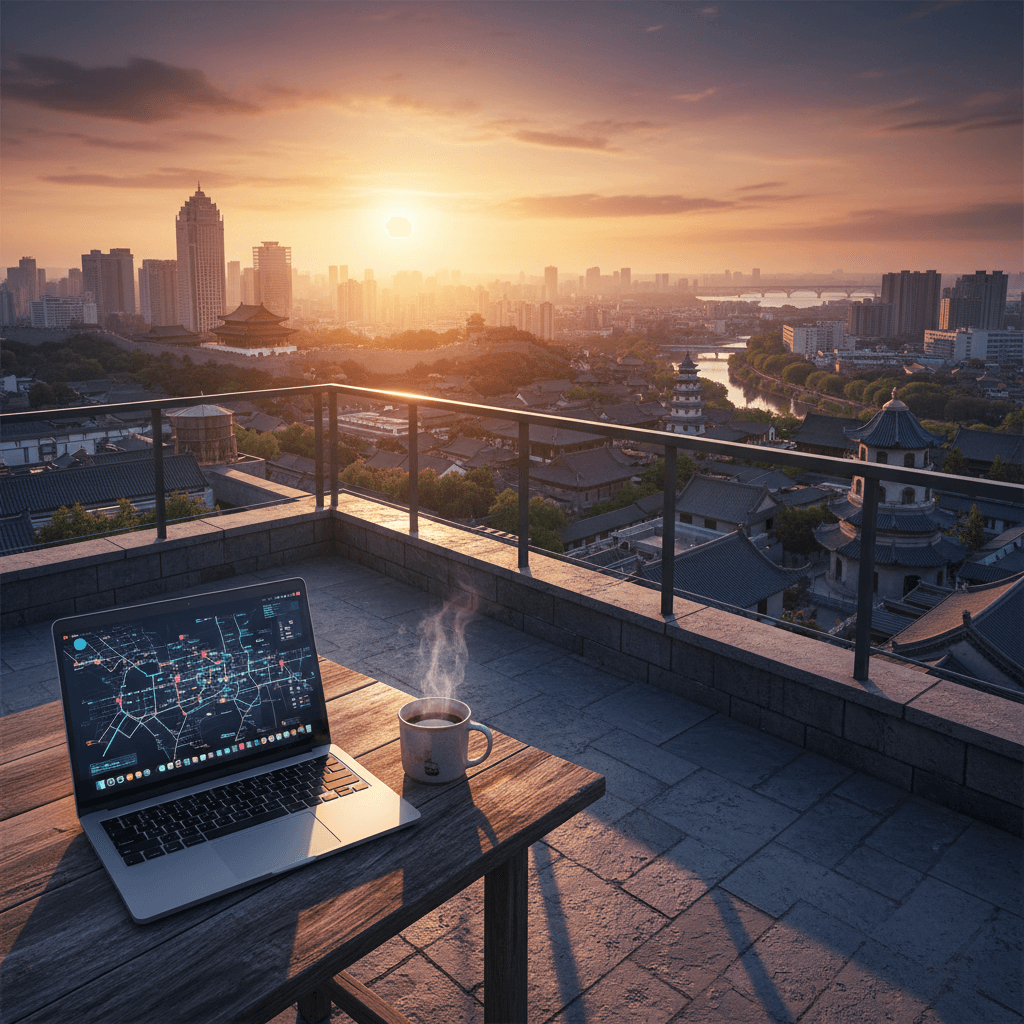
Nanjing
🇨🇳 China
Nanjing is where China’s imperial weight meets a surprisingly breathable urban pace. While Shanghai feels like it's sprinting into the next century, Nanjing takes a measured stroll. It’s a city defined by its dualities: the somber, reflective atmosphere of the Memorial Hall of the Nanjing Massacre contrasted with the neon-soaked joy of the Qinhuai River at night. Nomads usually find that while it lacks the sheer density of English-speaking expats found in the Tier 1 megacities, it compensates with a grit and soul that’s harder to find in more sterilized hubs.
The Local Vibe
Living here feels like being part of a living museum that hasn't forgotten how to party. You can spend your morning hiking the lush trails of Zijin Mountain to visit the Sun Yat-sen Mausoleum, then spend your evening at Yangying’s Firepit Live House listening to local indie bands. The pace is moderate; you’ll see people practicing Tai Chi near the world's longest ancient city wall remnants in the morning, then heading to the high-tech Deji Plaza for luxury shopping in the afternoon. Digital nomads often mention that the city feels "underrated," offering a chance to see authentic Chinese life without the crushing tourist crowds of Beijing.
Cost of Living Breakdown
Your budget will stretch further here than in the coastal giants, with a total monthly spend typically hovering around $1,500 to $1,600. It’s mid-tier affordable, meaning you can live quite well without stressing over every Yuan.
- Housing: Expect to pay 4,000 to 6,000 RMB for a solid mid-range studio in central hubs like Xinjiekou. If you head to the suburbs like Jiangning, that drops to 2,000 to 3,500 RMB.
- Dining: Street food in Fuzimiao or Laomendong is a steal at 10 to 20 RMB for snacks like duck blood soup or skewers. A nice sit-down dinner in a trendy cafe usually runs 50 to 100 RMB.
- Transport: The metro is world-class and costs between 2 and 10 RMB per trip. DiDi rides across town rarely exceed 30 RMB.
Where to Plant Your Laptop
Choosing a neighborhood depends on your noise tolerance and your need for caffeine. Most long-term expats recommend Xinjiekou for pure convenience; it’s the main metro hub and puts you within walking distance of everything. If you want more "soul," Laomendong is the winner. It’s filled with traditional architecture, tea houses, and modern cafes that serve as makeshift offices, though it gets lively and loud after the sun sets.
- Fuzimiao: Best for the "wow" factor. It’s touristy and crowded, but the boat cruises and night lights are unbeatable for a short-term stay.
- 1912 District: This is the social heart. It’s packed with bars and music venues near Jiming Temple, making it the go-to for networking and late-night drinks.
- Zijin Mountain: Ideal if you need nature. It’s quieter and better for families, though you’ll have a longer commute to the city center.
The Nomad Reality Check
It’s not all ancient gates and easy living. While you'll need a solid VPN and a local SIM from China Mobile or Unicom to function, the infrastructure is robust, with average speeds around 200-300 Mbps. Almost everything, from booking a table at Niushoushan to paying for a 30 RMB bike rental at Xuanwu Lake, happens through WeChat. Travelers often find the "WeChat dependency" a bit overwhelming at first, but once you’re synced up, the city becomes incredibly frictionless. You’ll find a deep sense of history and a community that’s genuinely curious about the people visiting their city.
The Price of the Ancient Capital
Nanjing sits in a sweet spot for nomads who want the perks of a Tier 1 Chinese city without the eye watering price tag of Shanghai. You can expect a total monthly burn of around $1,569 to live comfortably here. It is mid tier affordable, meaning your money goes significantly further than it would in the West, but you are still paying a premium for the city's historical prestige and modern infrastructure.
Most expats find that their biggest variable is housing. If you want to be in the thick of it near Xinjiekou or Deji Plaza, you will pay for the privilege. However, the metro system is so efficient that living slightly further out rarely feels like a sacrifice.
Monthly Budget Tiers
- The Budget Nomad (Under 5,000 RMB): This is doable if you stick to suburbs like Jiangning, eat exclusively at local noodle shops or Fuzimiao street stalls for 15 RMB, and rely on the 2 RMB bus fares.
- The Mid Range Professional (5,000 to 10,000 RMB): This is the sweet spot. You can snag a modern 1BR in a central district for 4,000 to 6,000 RMB and enjoy dinner at Laomendong cafes without checking your bank balance.
- The High Life (10,000+ RMB): This buys you a luxury high rise apartment, frequent DiDi rides, and upscale dining at Niushoushan where meals easily top 200 RMB.
Housing and Neighborhood Costs
Rent is your primary expense, and the market in 2025 remains competitive near the historic core. Most landlords expect a deposit and several months of rent upfront, so keep your initial cash flow in mind.
Xinjiekou (City Center)
- Rent: 4,500 to 7,500 RMB for a decent studio or 1BR.
- Vibe: High energy, luxury malls, and the main metro interchange.
- Food: A mix of expensive mall dining and quick basement level eats for 40 RMB.
Fuzimiao and Laomendong
- Rent: 4,000 to 6,000 RMB, though units are often older and more traditional.
- Vibe: Highly walkable and atmospheric, but you will deal with tourist crowds daily.
- Food: Endless street food options like duck blood soup or skewers for 10 to 20 RMB.
Jiangning District
- Rent: 2,000 to 3,500 RMB for much larger, newer spaces.
- Vibe: Quieter, suburban, and popular with long term families.
- Food: Mostly local markets and family style restaurants with lower price points.
Daily Essentials and Working
Eating out is often cheaper than cooking if you stick to local spots. A basic lunch at a "point and choose" cafeteria usually runs about 25 RMB. If you are craving Western comfort food, expect to pay 80 to 120 RMB for a burger and a beer in the 1912 District.
For work, dedicated coworking spaces like those near the Presidential Palace cost between 500 and 1,000 RMB for a hot desk. Many nomads save money by working from cafes in Laomendong, though you will need a solid data roaming plan or a local SIM, as public WiFi speeds often hover around a sluggish 9 Mbps.
Transportation is a bargain. The metro is your best friend, with rides capped at 10 RMB even for long distances. If you prefer the fresh air, renting a bike at Xuanwu Lake costs about 30 RMB per hour, while DiDi trips across the city center rarely exceed 30 RMB.
One hidden cost to prepare for is the digital lifestyle. You will need a local phone number to use apps like Meituan for food delivery or to queue at popular restaurants. Setting this up usually requires a small deposit and a monthly plan of around 100 RMB for enough data to bypass the spotty cafe connections.
For Digital Nomads: Laomendong and Xinjiekou
If you're looking for that perfect balance of high speed lifestyle and ancient aesthetics, Laomendong is your home base. It's a restored district filled with traditional architecture, but don't let the old school looks fool you. It's packed with modern cafes that serve as makeshift offices for the local nomad community. You'll pay around 4,000 to 6,000 RMB for a decent apartment nearby, putting you within walking distance of the city's best coffee shops.
For those who need to be in the thick of the action, Xinjiekou is the undisputed center. It's often called the "Times Square of Nanjing," anchored by the massive Deji Plaza. This is the place to be if you want reliable infrastructure and proximity to every metro line. While the average internet speed in the city hovers around 9 Mbps, the high end coworking spaces and luxury malls here offer the most stable connections you'll find. Expect to pay a premium for the convenience, with luxury studios starting at 7,000 RMB.
- Laomendong: Best for cafe hopping and "Old China" vibes.
- Xinjiekou: Best for networking, shopping, and central transit access.
- Pro Tip: Most nomads use WeChat for everything from booking desks to ordering 30 RMB lunches, so get your wallet set up early.
For Expats and Long-Termers: Jiangning
Expats who find the city center a bit too intense usually migrate south to Jiangning. It feels more like a self contained city than a suburb. It's quieter, the air feels a bit fresher, and your money goes significantly further. You can snag a spacious one bedroom for 2,000 to 3,500 RMB, which is a steal compared to the prices near the Qinhuai River.
The social scene here is surprisingly active. You've got live houses like Yangying’s Firepit for evening drinks and a fair share of international restaurants. The commute to the city center takes about 30 to 45 minutes on the metro, but many residents find they rarely need to leave the district for daily essentials. It's the best spot for a "local" life without the tourist crowds.
For Families: Zijin Mountain and Xuanwu Lake
Living near Zijin Mountain (Purple Mountain) is the closest you'll get to an urban forest. Families love this area for the immediate access to hiking trails, the Sun Yat-sen Mausoleum, and massive green spaces. It's a bit more hilly and requires more walking or DiDi rides, but the trade off is a peaceful environment for kids. The nearby Xuanwu Lake is another favorite, where you can rent family boats for 80 RMB or bikes for 30 RMB an hour.
The residential pockets around these parks are established and safe. You'll find plenty of grocery stores and pharmacies, and the proximity to the Presidential Palace area means you're never far from top tier healthcare. It's a slower, more deliberate way of living in Nanjing that avoids the neon chaos of the nightlife districts.
For Solo Travelers and Night Owls: Fuzimiao and 1912
If you're only in town for a few months and want to soak up the energy, Fuzimiao (the Confucius Temple area) is the place. It's famous for the Qinhuai River night lights and endless street food like 15 RMB skewers. It's touristy and can get loud, but the convenience for a solo traveler is unbeatable. You're steps away from boat cruises and the city's most iconic historical sites.
Just a short hop away is the 1912 District, the heartbeat of Nanjing's social life. It's a cluster of gray brick buildings filled with bars and clubs. Solo travelers often find it's the easiest place to meet people, especially at spots like Gone with the Wind jazz bar. While it's not the quietest place to sleep, it's perfect for those who want their Nanjing experience to be as social as possible.
- Fuzimiao: Best for street food, history, and being in the middle of the "action."
- 1912 District: Best for nightlife and meeting other travelers.
- Budget: Street food meals here cost between 10 and 20 RMB, making it very wallet friendly for solo explorers.
Connectivity Realities
Nanjing's digital infrastructure is a bit of a mixed bag. While the city's hardware is ultra modern, the actual speeds often feel like a throwback. Most nomads clock average WiFi speeds around 200-300 Mbps. That's fine for Slack or basic emails, but if you're pushing heavy 4K video files or running high stakes Zoom calls, you'll need a backup plan. Most expats rely on a solid 5G data plan to supplement spotty cafe connections.
Getting online requires jumping through a few hoops. You'll need a local SIM from China Mobile or China Unicom to access public WiFi, as most networks send a verification code via SMS to a Chinese number. If you're just landing, grab an eSIM before you arrive. It bypasses the WeChat registration barriers that often trip up fresh arrivals, though you'll still want a local number eventually to handle everything from DiDi rides to booking tickets at the Sun Yat-sen Mausoleum.
Best Areas for Deep Work
Nanjing doesn't have a massive "coworking" brand presence like Shanghai, but the local scene is functional if you know where to look. Most people end up working out of the Xinjiekou district. It's the central business hub, and while the pace is hectic, the office buildings here house several shared spaces. Expect to pay between 500 RMB and 1,000 RMB per month for a hot desk in a standard shared office, though premium spots near Deji Plaza can climb over 2,000 RMB.
- Xinjiekou: Best for those who need a professional environment and easy metro access. It's the heart of the city's commerce.
- Laomendong: Ideal for "laptop lifestyle" days. The traditional architecture and quieter morning vibes make it a favorite for writers, though it gets loud after 4:00 PM.
- Jiangning: A quieter, suburban alternative. It's further out but offers more modern, spacious cafes with fewer crowds than the city center.
The Cafe Culture Alternative
If you prefer the hum of a coffee shop over a sterile office, Laomendong is your best bet. It's packed with boutique cafes that offer a more relaxed atmosphere than the corporate chains in the malls. Just keep in mind that "free WiFi" in these spots usually requires that Chinese SIM card mentioned earlier. Travelers often look for spots with reliable tables and decent bread, which is a rarity in the sea of sugary local pastries.
For a more modern vibe, head to the 1912 District. While it's known for nightlife, the daytime is surprisingly quiet. You'll find plenty of spots to park your laptop for a few hours. Just be prepared for the "WeChat mini-program" hurdle. Almost every cafe requires you to scan a QR code on the table to order and pay. If your WeChat Pay or Alipay isn't set up, you might find it hard to even get a cup of coffee.
Practical Tech Tips
- Download Baidu Maps or Amap. Google Maps is notoriously inaccurate here and will show you standing in the middle of the Qinhuai River when you're actually on the sidewalk.
- Carry a high capacity power bank. Between the 200-300 Mbps speeds and constant GPS use, your phone battery will drain faster than usual.
- If you're staying long term, look for apartments in Jiangning. You can often get better home fiber optic deals there than in the older, cramped buildings of the historic center.
Personal Safety and Local Vibes
Nanjing is remarkably safe, even by the high standards of major Chinese cities. You'll find that walking through Xinjiekou or along the Qinhuai River at 2:00 AM feels as secure as it does at noon. Violent crime is extremely rare; the most common issues you might face are minor scams in heavy tourist zones like Fuzimiao, usually involving overpriced tea ceremonies or "art" sales. Just use your common sense and you'll be fine.
Expats and solo travelers often mention how family friendly the city feels. While there aren't any specific "no go" zones to worry about, the city can get incredibly crowded during national holidays. If you're near the Confucius Temple during the Lantern Festival, the sheer volume of people can be overwhelming. During these times, it's better to stick to the quieter residential pockets in Jiangning or the hiking trails of Zijin Mountain.
One thing to keep in mind is the local traffic. While the Nanjing Metro is world class, pedestrians don't always have the right of way, even with a green light. E-bikes are silent and everywhere, often zipping onto sidewalks. Always keep an ear out for that faint hum when you're walking in older neighborhoods like Laomendong.
Healthcare and Medical Services
If you get sick, you're in good hands, but the system works differently than in the West. Most locals head straight to large public hospitals for everything from a cold to a broken bone. For high quality care in the city center, the Jiangsu Province Hospital and Nanjing Drum Tower Hospital (Gulou Hospital) are the top choices. Many of these large facilities have "International Departments" where the doctors speak English and the wait times are shorter, though you'll pay a premium for the convenience.
For everyday needs, pharmacies are on almost every corner. Look for the green cross or the "药" (Yào) symbol. You can find basic Western medicine like ibuprofen or cold meds, but many pharmacists will first point you toward Traditional Chinese Medicine (TCM). If you need something specific, have the name translated into Mandarin on your phone beforehand.
Emergency Contacts and Essentials
In a pinch, you'll need to know these three numbers:
- 110 for the Police
- 120 for an Ambulance
- 119 for the Fire Department
Don't expect the dispatcher to speak English fluently. If you're in a hotel or a coworking space, ask a local to help you make the call. Most nomads find it helpful to download the "Welcome Guide to China 2025" app or check the Nanjing Government English portal for updated lists of expat friendly clinics. It's also worth noting that most hospitals require payment upfront via WeChat Pay or Alipay before they'll begin treatment, so keep your digital wallet topped up.
Environmental Health
Air quality in Nanjing has improved significantly over the last few years, but it still fluctuates. On "grey" days, locals and expats alike check the AQI (Air Quality Index) on apps like AirVisual. If the numbers climb above 150, you might want to limit your outdoor runs at Xuanwu Lake and stick to an indoor gym. Tap water isn't drinkable here; always boil it first or buy bottled water, which is cheap and available at every FamilyMart or 7-Eleven for about 2 to 5 RMB.
The Metro: Your Golden Ticket
Nanjing's metro system is a beast, in the best way possible. With 13 lines currently running, it ranks as one of the top ten largest networks on the planet. It's clean, air-conditioned, and incredibly cheap, with fares ranging from 2 to 10 RMB depending on how far you're heading. If you're staying near Xinjiekou, you'll find yourself at the ultimate hub where multiple lines intersect, making it the easiest base for daily commuting.
Most expats and nomads skip the physical transit cards and go straight for the phone. You can pay by scanning a QR code through Alipay or WeChat Pay. Just look for the "Transport" mini-app within either. It saves you from fumbling with coin machines or trying to translate ticket interfaces when you're in a rush.
Ride-Hailing and Taxis
While the metro is great, DiDi is the undisputed king of the road. It's the Chinese equivalent of Uber, and the English version of the app works quite well with international credit cards. A typical cross-town trip will set you back between 15 and 30 RMB. If you're feeling fancy or in a hurry, you can opt for the "Premier" cars, but the standard "Express" is usually perfectly fine.
Traditional taxis are still everywhere, but they can be a bit of a gamble if you don't speak Mandarin. Most drivers won't speak English, so have your destination written in Chinese characters on your phone. Even then, many travelers find it's just easier to stick to the app where the GPS does the talking for you.
Exploring on Two Wheels
Nanjing is surprisingly bike-friendly, especially around the scenic spots. Xuanwu Lake is a favorite for nomads looking to clear their heads after a few hours of deep work. You can rent a bike there for about 30 RMB per hour to cruise the perimeter. For something more leisurely, electric boats on the lake go for around 120-160 RMB.
For daily A-to-B trips, the city is littered with shared bikes from HelloBike or Meituan. You'll see them parked on almost every sidewalk. You just scan the QR code with your phone, ride to your destination, and lock it back up. It's a lifesaver for those "last mile" trips from the metro station to your apartment in Jiangning or a cafe in Laomendong.
Walking the History
If you're staying in the Fuzimiao or Qinhuai River districts, your best bet is often your own two feet. These areas are dense, historic, and often crowded, making cars more of a headache than a help. The ancient city walls also provide a unique "pedestrian highway" that connects various parts of the city. Walking atop the world's longest surviving city wall offers a perspective of the skyline you won't get from a car window.
Arrival and Regional Travel
Getting into the city from Nanjing Lukou International Airport (NKG) is straightforward. A taxi or DiDi to the city center takes about 45 to 60 minutes, but the airport metro line is a solid budget alternative. For those coming from Shanghai, the high-speed bullet train is the only way to fly. It's a 90-minute trip that drops you right at Nanjing South Railway Station, which is itself a massive transit hub connected to the local metro lines.
- Metro Ride: 2 to 10 RMB
- DiDi Trip: 15 to 30 RMB
- Bike Rental: 30 RMB per hour
- Bullet Train to Shanghai: Roughly 140 to 160 RMB
The Language Barrier
Nanjing isn't Shanghai. While you'll find English signage in the Nanjing Metro and at major tourist hubs like the Sun Yat-sen Mausoleum, daily life runs almost exclusively on Mandarin. Most locals under 30 have studied English in school, but they're often shy about using it unless they're working in high-end hotels or at luxury spots in Deji Plaza.
Expats living in Xinjiekou or Jiangning usually find that learning basic survival Mandarin is the difference between a frustrating week and a great one. You don't need to be fluent, but knowing how to say "I have a reservation" or "no spicy" will save you daily headaches. Most nomads rely heavily on translation apps to bridge the gap during face-to-face interactions.
Essential Apps for Survival
Communication in Nanjing happens through your smartphone. If you don't have these three apps downloaded before you arrive, you'll feel digitally stranded:
- WeChat (Weixin): This is non-negotiable. It's your messaging app, your wallet, and your ticket booking system. Many restaurants in Laomendong and Fuzimiao don't even have paper menus anymore; you scan a QR code on the table to order and pay.
- Alipay: Even if you prefer WeChat, keep Alipay as a backup for its built-in "Translation" and "TourPass" features, which are often more friendly to foreign credit cards.
- Pleco: The gold standard for Chinese-English dictionaries. It works offline, which is a lifesaver when your 200-300 Mbps connection decides to crawl.
- Baidu Maps or Amap: Google Maps is notoriously inaccurate in China. These local apps are in Chinese, but the interface is intuitive enough to follow the blue arrow to the nearest metro station.
The Local Dialect
You'll likely hear older residents speaking Nanjinese (Nanjinghua). It’s a variant of Mandarin but sounds much "harder" and more guttural to the untrained ear. Don't worry about learning it, as everyone understands standard Mandarin (Putonghua), but don't be surprised if the friendly vendor selling you 15 RMB duck blood soup sounds like they're shouting. They aren't angry; that's just the local cadence.
Professional Communication
If you're meeting local clients or networking at a coworking space in Xinjiekou, the etiquette is digital-first. Business cards are still used but are increasingly replaced by scanning each other's WeChat QR codes. It's perfectly acceptable, and actually expected, to conduct professional follow-ups via WeChat rather than email.
For those working remotely, remember that the "Great Firewall" impacts more than just your scrolling habits. It affects how you communicate with home. Standard tools like Slack, WhatsApp, and Gmail are blocked. Most nomads use a high-quality VPN or a roaming eSIM to stay connected to their teams. Travelers often recommend setting up these connections before landing in China, as many VPN websites are blocked once you're inside the country.
Key Phrases to Know
While translation apps do the heavy lifting, these few phrases will earn you a lot of respect from the locals:
- Nǐ hǎo: Hello.
- Xiè xie: Thank you.
- Tìng bù dǒng: I hear you, but I don't understand (invaluable for stopping a long explanation you can't follow).
- Mái dān: The bill, please.
- Zhège: This one (useful when pointing at street food in Fuzimiao).
Most travelers find that even with a total language gap, the people in Nanjing are patient. If you're stuck at a metro kiosk or trying to find a specific gate at Niushoushan, showing a picture or a written address on your phone will almost always get you a helpful finger point in the right direction.
The Four Seasons of the Southern Capital
Nanjing is famously known as one of the "Four Furnaces" of the Yangtze River. If you're planning a stint here, your timing will dictate whether you're enjoying a crisp hike up Zijin Mountain or hiding in a Xinjiekou mall to escape the humidity. The city experiences four distinct seasons, each bringing a massive shift in the local "vibe" and your daily comfort levels.
Spring and autumn are the undisputed champions for digital nomads and travelers. From late March to May, the city softens. You'll see cherry blossoms at Jiming Temple and lush greenery returning to the Xuanwu Lake perimeter. Temperatures usually hover between 15°C and 25°C, making it perfect for those 30 RMB hourly bike rides along the ancient city walls. It's the most pleasant time to work from a cafe terrace in Laomendong, though you'll want to pack a light jacket for the breezy evenings.
Autumn, specifically September to November, is perhaps even better. The humidity of the summer breaks, and the gingko trees turn a brilliant gold. Expats often recommend this window for visiting Niushoushan Cultural Park or the Sun Yat-sen Mausoleum because the air is clear and the hiking trails aren't yet biting cold. Expect daytime highs around 20°C, dropping to a cool 10°C at night.
Surviving the Extremes
Summer in Nanjing is a serious commitment. From June to August, the "Furnace" reputation earns its keep. Temperatures frequently climb above 35°C with oppressive humidity that makes a five minute walk to the Fuzimiao metro station feel like a marathon. Most nomads find themselves tethered to high powered air conditioning during the day, only venturing out after sunset when the Qinhuai River lights up and the temperature becomes bearable for a boat cruise.
Winter, running from December to February, is short but surprisingly sharp. While it rarely snows heavily, the damp cold sinks into your bones. Since many older buildings in southern China lack central heating, you might find yourself wearing a sweater indoors. Temperatures often sit between 1°C and 8°C. It's a quiet, moody time to visit the Memorial Hall of the Nanjing Massacre, but you'll definitely need a heavy coat and thermal layers.
Peak Dates and Crowds
When you're booking your stay, keep the Chinese public holiday calendar on your radar. If you can avoid it, don't arrive during Golden Week (the first week of October) or Chinese New Year (usually January or February). During these times, domestic tourism explodes. Prices for mid range hotels can double, and popular spots like Deji Plaza or the 1912 District become difficult to navigate. If you're here during a major holiday, nomads recommend staying in quieter suburban areas like Jiangning to avoid the Fuzimiao crush.
Best Time to Visit: The Verdict
- Gold Standard: October and November. The weather is dry, the colors are stunning, and the city is at its most walkable.
- Silver Medal: April and May. Great for outdoor photography and spring festivals, though keep an eye out for occasional rain showers.
- The Budget Play: Late February or early March. It's still chilly, but you'll find much better deals on long term rentals before the spring tourist rush begins.
- The "Avoid" List: July and August. Unless you love 95% humidity and soaring temperatures, save your Nanjing trip for the shoulder seasons.
Most long term expats suggest arriving in September. This gives you a few months of perfect weather to find your feet, set up your banking and WeChat accounts, and explore the hills before the winter chill sets in. By the time the summer heat returns in June, you'll already know which cafes have the best AC and the fastest WiFi.
Connectivity and the Digital Setup
Nanjing's internet scene is a bit of a mixed bag. While the city is tech-forward, speeds for international roaming and standard WiFi tend to hover around 9 Mbps. If you're doing heavy video uploads, you'll want to scout out specific cafes in Xinjiekou or Laomendong that cater to the laptop crowd.
Most expats recommend getting a local SIM from China Mobile or China Unicom immediately. You'll need your passport to register. For a smoother transition, look into eSIM options before you land, which help you bypass the initial hurdle of not having WeChat or Alipay set up. These two apps are non-negotiable; you'll use them for everything from booking a DiDi to scanning QR codes at Niushoushan Cultural Park to join a virtual queue for lunch.
Coworking hasn't exploded here like it has in Shanghai, but the cafe culture is strong. Expect to pay between 500 and 1,000 RMB per month if you find a dedicated desk in a shared space, though many nomads just camp out in the upscale malls like Deji Plaza where the AC is cold and the WiFi is stable.
Budgeting for the Nomad Life
Living here is significantly more affordable than the Tier 1 giants, but prices are creeping up in the historic districts. Most nomads find $1,569 a month covers a very comfortable lifestyle including a central apartment and frequent dining out.
- Housing: A modern studio in Xinjiekou runs 4,000 to 6,000 RMB. If you're on a budget, head to Jiangning where you can find decent spots for 2,000 to 3,500 RMB.
- Food: Street food in Fuzimiao costs 10 to 20 RMB for snacks. A mid-range meal in Laomendong usually hits the 50 to 100 RMB mark.
- Transport: The metro is a steal at 2 to 10 RMB per trip. Even a cross-town DiDi rarely exceeds 30 RMB.
Getting Around Town
The Nanjing Metro is world class. With 14 lines, it reaches almost everywhere you'd want to go. It's clean, efficient, and the signage is bilingual. For short hops in the historic center, walking is your best bet, especially between Fuzimiao and Laomendong where the alleys are too narrow for cars anyway.
If you want some fresh air, head to Xuanwu Lake. You can rent a bike for 30 RMB an hour or a boat for 80 RMB. It's the best way to see the ancient city walls without the crowds. For regional travel, the bullet train to Shanghai takes only 90 minutes, making it easy to pop over for a weekend of big-city lights.
Safety and Local Life
Nanjing is incredibly safe, even late at night. You'll see solo travelers and families walking around 1912 District or the Qinhuai River well past midnight. Standard common sense applies, but violent crime is almost non-existent. If you do run into trouble, the emergency number for the police is 110 and 120 for medical help.
Healthcare is high quality, especially in the central districts near the Presidential Palace. Most doctors in the international wings speak English, and pharmacies are on almost every corner. For 2025 and 2026, the city has released updated expat guides to help with everything from tax residency to finding a local "ayi" for cleaning, so check the government's English portal if you're staying long-term.
Social Scenes and Nightlife
When the sun goes down, the city shifts gears. The Qinhuai River area is the tourist heart, but for something more authentic, nomads head to Gone with the Wind for jazz or Yangying’s Firepit Live House for local indie music. If you're looking to meet people, the bars in the 1912 District are the standard expat haunt, though they can get loud and rowdy on Fridays.
For a more relaxed evening, travelers often recommend the traditional tea houses in Laomendong. You can even rent Hanfu (traditional clothing) for about 200 RMB an hour if you want to lean into the imperial history of the city while you explore the lanterns and folk crafts.
Need visa and immigration info for China?
🇨🇳 View China Country GuideHidden Gem
Worth the effort