Mérida
🇲🇽 Mexico
The White City Vibe
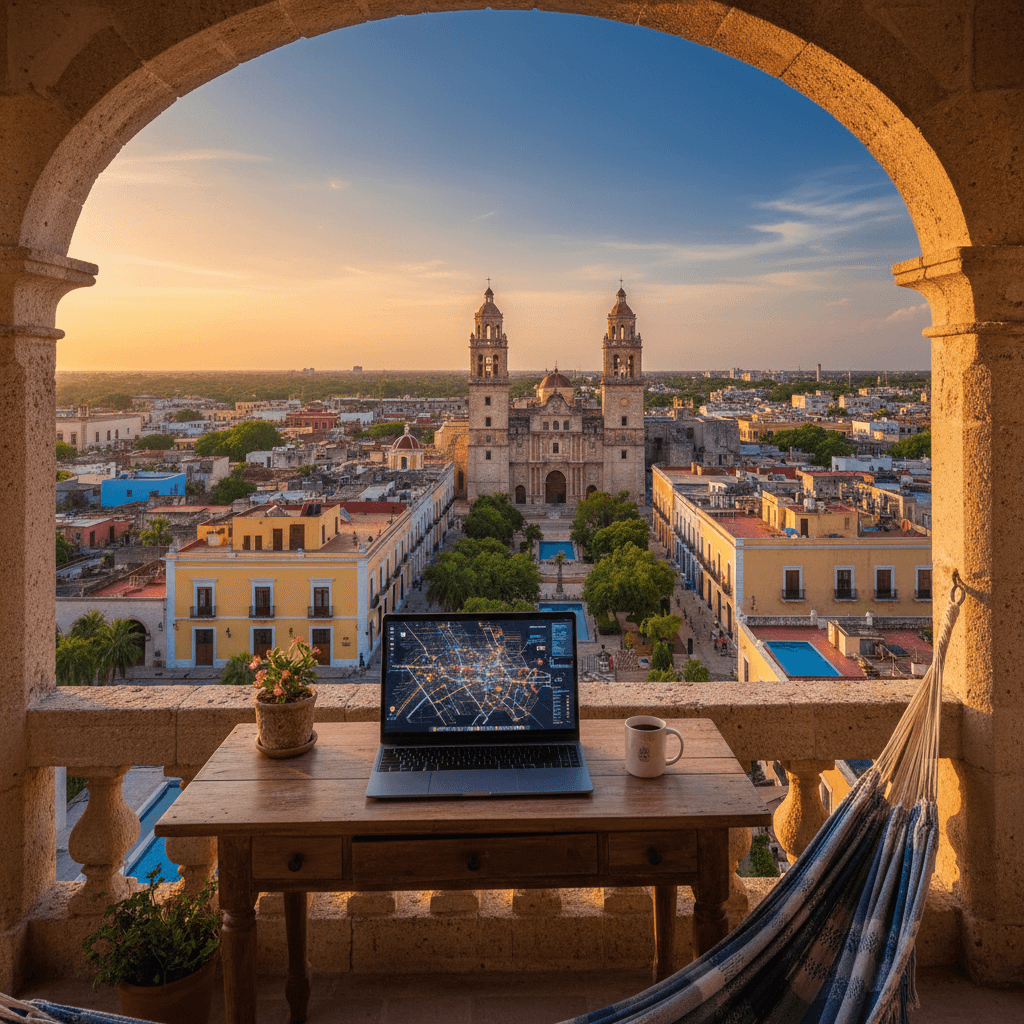
Mérida doesn't try to impress you with high rises or turquoise waves. Instead, it pulls you in with a slow, rhythmic pulse that feels remarkably grounded. Known as the White City, it’s a place where Mayan heritage and colonial elegance live side by side. You’ll find yourself walking past pastel limestone facades in the morning and sitting in a park listening to a live orchestra by sunset. It’s the kind of city where people still sit on their front porches to chat with neighbors after the heat of the day breaks.
For nomads, the appeal lies in its authenticity. Unlike the high energy of Mexico City or the tourist heavy atmosphere of Tulum, Mérida feels like a real community where you happen to be working. It’s exceptionally safe, arguably the safest city in Mexico, which creates a relaxed mental space that’s hard to find elsewhere. You’ll trade beach clubs for cenotes and rooftop parties for quiet courtyards filled with tropical greenery.
Living Costs & Logistics
Your money goes significantly further here than in the Riviera Maya. While prices are creeping up as more expats arrive, it remains a stronghold of affordability for those who want a high quality of life without the coastal markup. Most nomads find that a budget of $1,200 to $2,000 per month buys a very comfortable lifestyle, including a nice apartment and frequent dinners out.
- Housing: Expect to pay $400 to $600 for a modest studio in Centro, while modern apartments in the North range from $800 to $1,200.
- Dining: You can grab street tacos like cochinita pibil for $2 to $4, or enjoy a high end meal at places like Apoala for around $30.
- Connectivity: Fiber internet is standard now. Providers like Telmex and Totalplay offer speeds up to 1Gbps, and most dedicated workspaces provide 60 to 100 Mbps as a baseline.
The Neighborhood Breakdown
Where you land depends on whether you want charm or convenience. Centro Histórico is the heartbeat of the city. It’s walkable, packed with markets, and puts you right in the middle of the cultural action. However, the older buildings can be noisy and the infrastructure sometimes shows its age. Travelers often recommend staying near Paseo de Montejo or Santa Lucía for the best balance of aesthetics and amenities.
If you need high speed fiber and air conditioned malls, the Northern Zone (neighborhoods like Altabrisa) is the expat favorite. It’s modern and polished but feels more like a suburban sprawl; you’ll definitely need an Uber or a car to get around. For those who can’t live without the ocean, Progreso is about 40 minutes away. It’s quieter and more humid, making it a better fit for long term stays than for those who need a daily social fix.
Work and Social Scene
The nomad community is growing but isn't overwhelming. You won't find the massive "coworking retreats" typical of Bali, but you will find reliable hubs. Enter Work and The Urban Office in the North are the go to spots for serious deep work. In Centro, the culture is more about "laptop friendly" cafés. Manifesto and Márago Coffee are the unofficial headquarters for remote workers, where the WiFi is fast and the coffee is excellent.
Socializing happens naturally in the plazas. Every night of the week, there’s usually a free event in a different park, from traditional Jarana dancing to live jazz. Expats and locals mingle at the Plaza Grande markets on Sundays. If you’re looking to connect, Facebook groups remain the primary way to find meetups and housing leads in the city.
The Reality Check: The Heat
You can't talk about Mérida without talking about the sun. From May to October, the heat is intense, often hovering between 90°F and 95°F. It’s a dry heat compared to the coast, but it’s powerful enough to dictate your schedule. Most residents adopt a "siesta" mindset, doing their errands and movement in the early morning or after 5:00 PM when the breeze kicks in. If you aren't a fan of high temperatures, aim for a visit between November and April, when the evenings are genuinely cool and pleasant.
Ultimately, Mérida is for the nomad who wants to slow down. It’s for the person who prefers a $5 Uber ride to a cenote over a crowded beach club, and who values safety and cultural depth over a 24/7 party scene. It’s a city that asks you to linger, and most people find that once they arrive, they stay much longer than planned.
The Local Economy and Your Wallet
Mérida sits in a sweet spot for 2026. It is significantly more affordable than the skyrocketing prices of Mexico City or the tourist inflated menus of Playa del Carmen. While the influx of expats has nudged rents upward, your dollar still stretches remarkably far here, especially if you step away from the boutique hotels of Paseo de Montejo.
Most nomads find they can live a high quality life on a mid range budget of $1,200 to $2,000 per month. If you are sticking to a tighter budget, you can get by on $800 to $1,200 by eating at local mercados and choosing a modest studio in Centro. On the flip side, $2,500 a month buys a lifestyle that feels genuinely luxurious, including a house with a private pool to survive the Yucatecan heat.
Housing and Neighborhood Costs
Rent will be your biggest variable. Prices fluctuate based on whether you want the colonial charm of the historic center or the modern, air conditioned high rises of the North.
- Centro Histórico: This is where the action is. A standard 1BR apartment typically runs between $400 and $900. You are paying for walkability and character, though older homes might have higher electricity bills due to thick stone walls and dated AC units.
- The North (Altabrisa/Temozón Norte): This area is popular with families and those who need reliable infrastructure. Expect to pay $800 to $1,200 for modern builds. It is pricier and requires a car or frequent Ubers, but the fiber optic internet is rock solid.
- Progreso and the Coast: If you prefer the beach, you can find rentals for $1,200+. Just keep in mind the 45 minute commute into the city for major errands.
Eating and Drinking
Food is where Mérida shines. You can eat like royalty for very little if you follow the locals. A plate of three or four cochinita pibil tacos at a street stand or a local market like Lucas de Galvez will cost you about $2 to $4.
For a sit down dinner at a mid range spot in Parque Santa Lucía, expect to pay $10 to $15 per person including a drink. If you are heading to upscale fusion spots or trendy kitchens in the North, dinner can climb to $30 or $60. Most expats recommend budgeting about $300 to $500 a month for a mix of grocery shopping and frequent dining out.
Transport and Connectivity
Getting around is cheap. If you stay in Centro, your transport cost is basically zero because the city is so walkable. For longer trips, Uber and Didi are the gold standard. A 20 minute ride across town rarely exceeds $5. If you are really pinching pennies, the local buses cost pennies, though they lack AC.
For your work setup, a dedicated desk at a spot like Enter Work or The Urban Office costs between $150 and $250 a month. Many nomads skip the office and work from cafés like Manifesto or Marago Coffee, where a great latte costs about $3 and the WiFi is free. For your phone, a Telcel SIM card with a decent data plan is about $15 to $20 a month, while an unlimited Holafly eSIM for 2026 runs around $50.
The Hidden Costs: Electricity
The one "gotcha" in Mérida is the electricity bill. Because the city is famously hot, running your air conditioning 24/7 can lead to a nasty surprise. In a large house, your bill can jump by $100 or $200 if you aren't careful. Locals suggest using ceiling fans during the day and only kicking the AC on in the bedroom at night to keep costs manageable.
For Nomads and Solo Travelers
If you want to be in the thick of the action, Centro Histórico is your best bet. It is the city's walkable core where colonial architecture meets modern laptop culture. Most nomads gravitate toward the areas around Parque Santa Lucía and Paseo de Montejo, where you can hop between high-speed WiFi spots like Manifesto Café or Márago Coffee. The vibe here is social, with nightly cultural events and a high concentration of other remote workers.
- Rent: Expect to pay between $400 and $900 per month for a studio or one-bedroom, depending on how modern the renovation is.
- Connectivity: Reliable fiber internet is standard, with speeds typically ranging from 50-80 Mbps.
- Lifestyle: You won't need a car. Most markets, pharmacies, and bars are accessible on foot, and an Uber across town rarely costs more than $5.
- The Trade-off: It gets noisy. Between the traffic and the street festivals, it is rarely quiet, and the older buildings can struggle with the 95°F summer heat.
For Long-Term Expats and Professionals
The Northern Zone, specifically neighborhoods like Altabrisa and Montebello, feels like a different city entirely. This is where you'll find modern luxury apartments, massive shopping malls, and the most stable infrastructure in the state. Expats who plan to stay for a year or more often choose this area for the peace and quiet, as well as the proximity to high-end coworking spaces like Enter Work or The Urban Office.
- Rent: Prices are higher here, typically ranging from $800 to $1,200 for a quality furnished apartment.
- Infrastructure: This area boasts the most consistent power grid and the fastest internet, with 1Gbps options available through providers like Telmex or Totalplay.
- Lifestyle: It is very car-dependent. You'll trade the colonial charm for convenience, paved sidewalks, and proximity to top-tier healthcare at Star Médica.
- The Trade-off: It lacks the "Mexican soul" found in Centro. You'll spend more time in air-conditioned malls than in historic plazas.
For Families
Families often find a middle ground in neighborhoods like Colonia México or García Ginerés. These areas offer larger homes with yards and pools, which are lifesavers during the humid months from June to October. These spots are quieter than Centro but still feel more traditional than the far north. They are also closer to the city's best parks and private schools.
- Rent: Large family homes generally start around $1,200 and go up based on amenities.
- Safety: Mérida is already one of Mexico's safest cities, but these residential pockets are particularly secure and community-oriented.
- Lifestyle: You get a neighborhood feel where kids can play outside, yet you're only a 10 minute drive from the cultural museums in the center.
For Slow Travelers and Beach Lovers
If the city heat feels too intense, many travelers move 30 to 45 minutes north to Progreso or Chicxulub Puerto. Living by the Gulf of Mexico offers a much slower pace and a constant sea breeze. It is a popular choice for those who want a "work-cation" vibe rather than a city hustle.
- Rent: Beachfront properties vary wildly, but you can find solid long-term rentals for $1,200+.
- Connectivity: Internet can be spottier here than in the city. Always ask for a speed test before signing a lease.
- Lifestyle: Fresh seafood, morning walks on the pier, and a very laid-back expat community.
- The Trade-off: You are isolated. If you need a specific piece of tech or a specialty grocery item, you'll be driving into Mérida to find it.
Connectivity and Speed
Internet reliability in Mérida has taken a massive leap forward recently. Most of the city is now wired with fiber optic cables from providers like Telmex and Totalplay. Standard speeds typically range from 50-80 Mbps, with some providers offering up to 100+ Mbps in optimal conditions. While the connection is generally rock solid for Zoom calls and heavy uploads, the city's occasional power surges can knock things offline briefly. Most nomads recommend having a backup plan, like a local SIM or a portable hotspot, just in case.
For mobile data, Telcel remains the king of coverage. You can grab a SIM card at any OXXO for about $10 to $20 and top it up with "Amigo" packages that include unlimited social media. If you prefer to hit the ground running, Holafly offers eSIM plans starting at $64 per month for unlimited data. It saves you the hassle of hunting down a physical store when you land at the airport.
Top Coworking Spaces
If you need a dedicated office environment rather than a noisy café, you'll likely head to the northern part of the city. This is where the modern infrastructure lives, though it does require a bit more travel time if you're staying in the colonial center.
- Enter Work (North): This is a favorite for those who need a professional vibe. They offer shared desks and private offices starting around $150 to $250 per month. The coffee is included, and the air conditioning is always blasting, which is a lifesaver during the humid afternoons.
- The Urban Office (North): A boutique space that feels more like a high end design studio. It's quieter and more exclusive, making it ideal if you have a lot of sensitive client calls.
- Conexión (Centro): While smaller than the northern hubs, it caters perfectly to the nomad crowd living in the historic heart of the city.
Remote Work Cafés
Mérida has a thriving café culture where laptops are perfectly welcome. In the Centro Histórico and along Paseo de Montejo, you'll find plenty of spots with reliable WiFi and plenty of power outlets.
- Manifesto: Often cited as the best coffee in town, this spot is a quiet sanctuary for deep work. The WiFi is fast, and the atmosphere is focused.
- Márago Coffee: Located right on the main boulevard, this is a social hub for the local nomad community. It's great for networking, though it can get a bit loud during the lunch rush.
- Bengala Kaffeehaus: A smaller, more intimate spot with excellent pastries and a steady connection.
- Bistro Cultural Santiago: A popular morning spot where you can grab a full breakfast and work from the patio.
Practical Setup Tips
When you're hunting for an Airbnb or a long term rental, don't just take the host's word for it. Ask for a screenshot of a recent speed test. Infrastructure varies block by block in the older parts of Centro, where thick stone walls can sometimes act as a Faraday cage for your WiFi signal. If you're moving into a place for more than a month, check if the router is positioned in a central area or if you'll need a range extender.
Expats generally suggest staying in the Northern Zone neighborhoods like Altabrisa if your work requires 100% uptime, as the grid there is newer and less prone to the quirks of the historic district. However, if you can handle the occasional five minute reset, the charm of working from a 200 year old courtyard in the center is hard to beat.
A Peaceful Exception
Mérida holds a reputation as one of the safest cities in North America, and it's a title local residents take seriously. While other parts of Mexico struggle with security headlines, the Yucatán capital feels like a different world. You'll see families hanging out in Plaza Grande late into the evening and solo travelers walking through Centro Histórico without a second thought. It's the kind of place where the biggest danger is usually a loose cobblestone or a stray puddle after a tropical downpour.
That said, common sense still applies. Petty theft is rare but not non-existent in crowded markets or busy tourist corridors. Most nomads find that staying in the Northern Zone or well-lit parts of Centro provides total peace of mind. Locals recommend avoiding the far northern outskirts alone at night simply because they are less populated and poorly lit. If you're ever in a pinch, the Tourist Police in the city center are approachable and often speak a bit of English.
Healthcare Standards
If you need medical attention, you're in good hands. Mérida is a regional medical hub, attracting people from across Southeast Mexico for its specialized clinics. The private hospitals here are modern and often staffed by doctors who trained in the US or Europe. Expats and nomads generally head to Star Médica or Hospital Faro del Mayab in the north for high-end care and English-speaking staff.
- Emergency Number: Dial 911 for all urgent services.
- Hospitals: Star Médica is the go-to for most expats; it's modern and efficient.
- Pharmacies: You'll find a Farmacia Guadalajara or Farmacia del Ahorro on almost every major corner. Many have an adjacent "consultorio" where a doctor can see you for minor issues like flu or stomach bugs for about $2 to $5.
- Water Safety: Do not drink the tap water. Most residents use the 20-liter "garrafón" delivery services or have high-quality filtration systems installed.
Practical Wellness Tips
The heat is your primary health concern in Mérida. Between May and October, temperatures regularly soar above 95°F. Heat exhaustion is a real risk for newcomers who try to power through a walking tour at noon. Stay hydrated, wear sunscreen, and do what the locals do: retreat to the AC or a shaded patio during the hottest part of the afternoon.
Mosquitoes are another factor, especially during the rainy season from June to October. While the city works hard on fumigation, it's smart to use repellent if you're hanging out in garden cafes or near cenotes to avoid occasional cases of dengue. For daily prescriptions, you'll find that many medications that require a script back home are available over the counter here, though it's always better to bring a copy of your original doctor's note just in case.
Insurance and Costs
While out of pocket costs for a standard doctor's visit are low, usually around $30 to $60 for a specialist, a hospital stay can add up quickly. Most long-term nomads opt for international health insurance or a local private plan. If you're just passing through, travel insurance like SafetyWing or World Nomads is standard practice. For minor ailments, the ubiquitous pharmacies are your best friend; they are stocked with everything from electrolytes to high-grade antibiotics at a fraction of US prices.
The Walkability Factor
If you're staying in the Centro Histórico or near Paseo de Montejo, your own two feet are your best asset. These areas are laid out in a grid that makes navigation simple, and the sidewalks are generally well maintained compared to other Mexican hubs. You can easily bounce between your Airbnb, Manifesto Café for a morning meeting, and the local markets without ever needing a set of wheels.
The only real barrier to walking is the Yucatecan sun. Between 11:00 AM and 4:00 PM, the heat can be punishing. Most nomads learn quickly to schedule their errands for the early morning or after sunset when the city truly comes alive and the temperatures drop into a manageable range.
Ride-Hailing and Apps
For longer trips or mid-day escapes from the heat, Uber and Didi are the gold standard. They're incredibly affordable and safer than flagging down a random taxi on the street. A typical cross-town trip usually costs between $2 and $5 USD.
- Uber: Generally the most reliable for nomads. Expect to pay about $10 to $15 USD for a 20 to 30 minute ride from Manuel Crescencio Rejón International Airport (MID) to the city center.
- Didi: Often slightly cheaper than Uber, though the app interface can be a bit clunky. It's a great backup if Uber surge pricing kicks in.
- Indriver: Popular with locals because you can negotiate the fare, but most expats stick to Uber for the ease of card payments and GPS tracking.
Public Transit and Buses
Mérida has an extensive bus system that costs only a few pesos per ride. While it’s the cheapest way to get around, the older buses can be hot and crowded. However, the Va-y-Ven system is the modern exception. These are newer, air-conditioned buses that run on specific routes, including a very convenient line that connects the North to Centro.
For trips outside the city, the ADO bus station is your gateway to the rest of the peninsula. It's the most comfortable way to reach Valladolid, Campeche, or the beaches at Progreso. Tickets for these regional trips usually range from $10 to $20 USD depending on the distance and class of service.
Biking and Micro-mobility
Biking is growing in popularity, especially around Paseo de Montejo. On Sundays, the city hosts the Bici-Ruta, where major streets are closed to cars and thousands of people take to their bikes. For daily use, you can find bike or scooter rentals via local apps for roughly $5 USD per day. Just be cautious in the Northern Zone; while modern and safe, areas like Altabrisa are designed for cars and can be less friendly to those on two wheels.
Car Rentals and Driving
If you're planning to explore cenotes or ruins like Uxmal on your own schedule, renting a car is a smart move. Daily rentals start around $30 USD, but make sure to factor in the mandatory Mexican insurance which can double that price. Driving in Mérida is relatively low stress compared to Mexico City, but watch out for the Glorietas (large roundabouts) in the North, which have their own set of local right-of-way rules that can be confusing for newcomers.
The Linguistic Landscape
Spanish is the heartbeat of Mérida. Unlike the hyper-touristy corridors of Quintana Roo, Mérida maintains a deep connection to its Yucatecan roots. While the city is becoming a favorite for remote workers, English proficiency remains moderate at best. You will find English speakers in the trendy cafes of Paseo de Montejo or high-end hotels in Centro, but outside those bubbles, Spanish is the primary way to get things done.
You will also notice a unique local flavor to the speech here. Many locals are bilingual in Spanish and Yucatec Maya, or at least use Mayan loanwords in daily conversation. If someone describes something as pelaná or mentions a tuch, they are dipping into that indigenous heritage. It is a source of great pride for Meridanos, and showing interest in the local dialect goes a long way in building rapport.
Getting By and Leveling Up
You can survive with "survival Spanish" if you stick to the digital nomad hubs, but your quality of life improves drastically with a little effort. Most nomads find that learning basic phrases for the market or ordering cochinita pibil makes daily interactions much smoother. If you are planning to stay for a few months, consider enrolling in a local language school in Centro or Colonia Mexico to bridge the gap.
- Daily Essentials: Know how to ask ¿Cuánto cuesta? (How much?) and ¿Dónde está el baño? (Where is the bathroom?).
- Politeness Matters: Use por favor and gracias liberally. Mérida is a formal, polite society where these small gestures carry weight.
- The "Mande" Factor: If you don't hear someone, you will often hear locals say ¿Mande? instead of ¿Qué?. It is a softer, more polite way to ask someone to repeat themselves.
Digital Communication and Apps
In Mérida, WhatsApp is the undisputed king of communication. You will use it for everything from booking a hair appointment to chatting with your landlord or ordering water delivery. If a business has a phone number listed, it is almost certainly a WhatsApp account. Do not expect to use email for local services; it is often ignored in favor of a quick text.
For those moments when your Spanish fails, Google Translate is your best friend. Download the Spanish dictionary for offline use because while 5G is common in the Northern Zone, some thick-walled colonial buildings in Centro can be notorious dead zones for cellular signals. If you need a local number, grab a Telcel SIM card at any OXXO for about $10 to $20. It is the most reliable carrier for coverage when you are exploring cenotes or ruins outside the city.
The Expat and Nomad Social Scene
Mérida has a growing, friendly international community that is easy to tap into. Most social organizing happens in Facebook Groups like "Mérida Expats" or "Mérida Digital Nomads." These are great places to find English speaking doctors, reliable contractors, or just a group for weekend drinks.
If you prefer face to face networking, head to Manifesto Café or Márago Coffee. These spots are unofficial headquarters for the remote work crowd. You will hear plenty of English being spoken over laptops, making them ideal places to find your footing when you first arrive. Just remember that while the nomad community is welcoming, the real magic of Mérida happens when you step out of the English bubble and engage with the locals in their own language.
If you're planning a stint in Mérida, your biggest adjustment won't be the language or the currency; it'll be the sun. The city is famous for its heat, which locals and nomads alike treat with a mix of respect and strategic scheduling. Understanding the seasonal shifts is the difference between a productive stay and four months of hiding in front of an air conditioner.
The Sweet Spot: November to April
This is the window most nomads aim for. The humidity drops, and the evenings become genuinely pleasant, sometimes even requiring a light sweater. Daytime highs hover between 88°F and 93°F, but the air is drier than the coastal towns. This is the peak social season when the parks in Centro, like Santa Lucía and Santiago, come alive with free concerts and markets.
- Why it works: You can actually walk from your rental in Centro to a coworking space like Manifesto without needing a second shower by the time you arrive.
- The trade off: This is when the city is most crowded. Airbnb prices in neighborhoods like Paseo de Montejo often spike, and you'll need to book popular spots a few months in advance.
- Rainfall: Minimal. You'll see maybe 2 to 5 rainy days a month, usually quick afternoon showers that clear the dust.
The Heat Trials: May to September
May is notoriously the hottest month in the Yucatán. Temperatures frequently climb to 95°F or higher, and the humidity begins to ramp up. Many expats head to the coast or retreat to the Northern Zone where modern infrastructure and heavy duty AC are the standard. If you're sensitive to heat, this is the time to avoid the city or ensure your rental budget accounts for a $100 to $150 monthly electricity bill.
The rainy season kicks in fully by June and lasts through October. You can expect 10 to 15 days of rain per month. These aren't all day drizzles; they are massive, tropical downpours that can turn streets in Centro into small rivers for an hour. It's spectacular to watch from a café like Márago Coffee, but it makes commuting a challenge.
Hurricane Season and Humidity
While Mérida is inland and safer than Cancun or Playa del Carmen, hurricane season (June to November) still brings heavy tropical storms. The humidity during these months is the real hurdle for remote work. It can make the "feels like" temperature significantly higher than the actual reading. Most nomads who stay through the summer shift their schedules, doing their errands at 7:00 AM and staying indoors until the sun dips at 7:00 PM.
Seasonal Breakdown for Travelers
- Best for Weather: December to March. Expect clear skies, manageable heat, and the best conditions for weekend trips to Chichén Itzá or nearby cenotes.
- Worst for Comfort: May and June. The heat is relentless, and the breeze is non-existent. Unless you love a sauna, look elsewhere during these months.
- Best for Budget: September and October. As the rainy season winds down, you'll find the best deals on long term rentals, though you'll still be dodging the occasional storm.
Regardless of when you visit, make sure your accommodation has "Minisplit" AC units in both the bedroom and the workspace. Fans alone won't cut it from April through October. Most veterans of the city recommend living like a local: work in the cool morning, take a siesta during the 2:00 PM to 4:00 PM heat peak, and save your social life for the breezy Yucatecan nights.
Connectivity and Power
You won't have to hunt for a signal here. Most modern rentals in the Northern Zone or Centro come equipped with fiber optic internet from providers like Telmex or Totalplay. Speeds generally sit around 100 to 200 Mbps, though you can find 1 Gbps lines if you're doing heavy video work. Most nomads find 60 Mbps more than enough for Zoom calls and streaming.
For your phone, grab a Telcel SIM card at any OXXO convenience store for about $10 to $20. It's the most reliable network for day trips to cenotes or ruins. If you prefer the convenience of an eSIM, Holafly offers eSIM plans starting at $64 per month for unlimited data, or $49.90 for 25GB monthly plans, which saves you the hassle of swapping physical cards.
- Manifesto Café: A favorite in Centro for its quiet atmosphere and reliable WiFi.
- Enter Work: Located in the North, this is a professional hub with private desks for $150 to $250 a month.
- Márago Coffee: Great for casual networking and a social work environment.
- The Urban Office: A boutique spot in the North for those who need a more exclusive, quiet setting.
Budgeting for 2026
Mérida remains one of the more affordable hubs in Mexico, especially compared to the skyrocketing prices in Tulum or Mexico City. A single person can live comfortably on $1,200 to $2,000 a month, depending on how often they eat out or use air conditioning. Keep in mind that electricity can be a major hidden cost; running the AC all day in the summer can easily add $100 to your monthly bills.
- Studio Rentals: Expect to pay $400 to $700 in Centro or the North. High end furnished spots can hit $1,200.
- Daily Meals: Street tacos like cochinita pibil cost $2 to $4. A mid range dinner at a spot like Bistro Cultural runs $10 to $15.
- Transport: Uber and Didi rides around town usually cost between $2 and $5.
Staying Safe and Healthy
Mérida is famously safe. It's the kind of city where people leave their front doors open and walk home alone at night without a second thought. Petty theft is rare, though you should still keep an eye on your phone in crowded markets like Lucas de Galvez. If you run into any trouble, the tourist police in Plaza Grande are helpful and often speak some English.
For healthcare, Star Médica is the go to hospital for expats. The facilities are top tier, and many doctors are US trained. For minor issues, look for a Farmacia del Ahorro; they usually have a doctor on site for quick consultations that cost less than $5. Dial 911 for any emergencies.
Getting Around Town
If you live in Centro or near Paseo de Montejo, your feet are your best asset. The city is very walkable, though the heat will test your resolve between 12 PM and 4 PM. For longer distances, Uber and Didi are the most reliable apps. The local buses are cheap but can be a bit of a puzzle for newcomers; most expats stick to ride hailing or bikes.
For weekend escapes, the ADO bus station is your gateway to the rest of the peninsula. You can get to the beach in Progreso in about 45 minutes or reach Chichén Itzá in two hours for roughly $15 to $20. When you first arrive at MID airport, an Uber to your rental will only take about 20 minutes and cost around $10.
The Heat Factor
The weather is the one thing you can't negotiate. From May to October, the humidity and heat are intense, with temperatures often hitting 95°F. Most locals and experienced nomads retreat indoors during the afternoon. The "sweet spot" for a visit is November through April, when the evenings are cool enough for a light sweater and the humidity drops significantly. If you're staying through the summer, make sure your rental has a pool or a very efficient AC unit.
Need visa and immigration info for Mexico?
🇲🇽 View Mexico Country GuideEasy Landing
Settle in, no stress