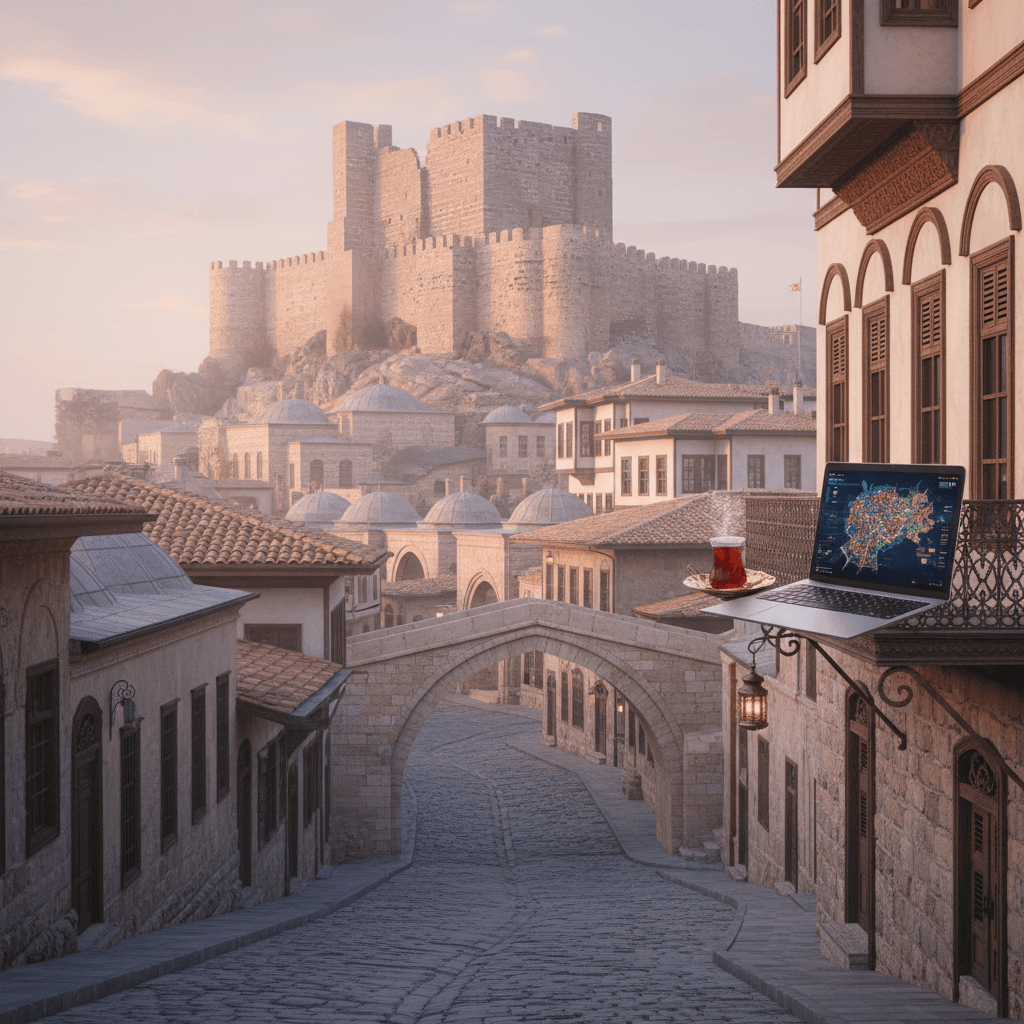
Gaziantep
🇹🇷 Turkey
The Culinary Soul of the Southeast
If you're looking for the polished, coastal vibe of Antalya or the high energy of Istanbul, you won't find it here. Gaziantep, or "Antep" as locals call it, is a city of grit, history, and an almost obsessive dedication to the dinner table. It feels grounded and ancient, with a personality shaped more by the Silk Road than by modern tourism. For a nomad, the draw isn't just the low cost of living; it's the chance to live in a place that feels entirely authentic and unapologetically Turkish.
The city moves at a different pace. Mornings start early with the smell of wood fired ovens and the sound of coppersmiths hammering away in the old bazaar. It’s a place where people take their hospitality seriously. Don't be surprised if a shopkeeper offers you tea and expects a twenty minute conversation before you even look at their goods. This isn't a "laptop on the beach" destination. It’s a "laptop in a 500 year old stone courtyard" destination.
The Food Obsession
You can't talk about the vibe of Antep without talking about the food. It is a UNESCO City of Gastronomy for a reason. The city lives and breathes pistachios, kebabs, and baklava. Most nomads find that their entire social schedule quickly begins to revolve around meal times. There is a local pride here that is infectious. You'll see people lining up at 6:00 AM for a bowl of Beyran, a spicy, garlicky lamb and rice soup that provides enough energy to power through a full workday.
The emotional experience of being here is one of constant discovery. One minute you’re walking past a modern shopping mall, and the next you’re lost in the narrow alleys of the Bakırcılar Çarşısı (Coppersmiths Bazaar), surrounded by the scent of roasting spices. It’s a sensory overload that manages to feel welcoming rather than overwhelming.
Living Like a Local
While the infrastructure is modern enough to support a remote work lifestyle, the city still feels like a well kept secret among the nomad community. You won't find many English menus or "digital nomad cafes" with avocado toast. Instead, you'll find third wave coffee shops in the Şahinbey district and quiet corners in historic caravanserais like Gümrük Hanı. It’s an affordable life where $1,300 USD a month allows for a very comfortable, even indulgent, lifestyle.
- The Pace: Intense during the day in the markets, but deeply social and relaxed in the evenings.
- The People: Conservative but incredibly warm. Learning five words of Turkish will make you a friend for life here.
- The Landscape: A mix of dusty, ancient stone architecture and rapidly developing modern apartment blocks.
Expect some challenges. The internet is reliable at around 130 Mbps download, but you’ll want a solid data plan as a backup. The city is also a gateway to the rest of Southeastern Turkey, making it a perfect base for weekend trips to places like Sanliurfa or the sunken village of Halfeti. If you want to experience a side of Turkey that hasn't been filtered for Instagram, Antep is where you go to find the real thing.
The Bottom Line
Gaziantep is one of the most wallet-friendly hubs in Turkey, especially when you compare it to the skyrocketing prices in Istanbul or the coastal resort towns. Most digital nomads find they can live a very comfortable, middle-class lifestyle here for around $1,300 USD per month. If you're coming with a stronger currency like Dollars, Euros, or Pounds, your purchasing power goes incredibly far because the local economy is geared toward Turkish salaries rather than tourist pockets.
Housing and Neighborhoods
Rent will be your biggest variable, but it's rarely a dealbreaker. Most expats and remote workers gravitate towards the Sahinbey district, particularly around the Gaziantep University area. It's lively, walkable, and packed with affordable cafes. You can usually find a modern, furnished 1+1 (one bedroom) apartment for between $400 and $600 USD per month. If you want something more historic near the old city center, prices might be lower, but the buildings are older and often lack modern heating or reliable insulation.
- University Area: $450 to $600 for a modern flat.
- Sehitkamil (Upscale residential): $600 to $850 for larger, family-sized apartments.
- Utilities (Electric, Water, Gas): Expect to pay $60 to $90 USD depending heavily on your AC use in the sweltering summer months.
The Food Budget
This is where Gaziantep shines. You're in the culinary heart of the country, and eating out is often as cheap as cooking at home. A massive local breakfast that will keep you full until dinner usually costs about $8 to $12 USD. A quick lunch of Lahmacun or a Beyran soup will set you back maybe $4 or $5 USD. Even at the more famous kebab houses like Imam Cagdas, a high-end dinner for two rarely exceeds $35 USD. If you stick to local markets for your groceries, $150 USD a month is plenty for a single person.
Connectivity and Coworking
While the city doesn't have a massive "coworking" scene like Bali or Lisbon, the infrastructure is solid. Home fiber internet is common in newer builds, typically offering speeds around 100-130 Mbps for about $15 USD a month. For working outside the house, nomads usually head to coffee shops like Kahve Dunyasi or local specialty roasters in the Sahinbey area. A latte generally costs around $2.50 to $3.50 USD. If you need a dedicated desk, look for shared office hubs in the business districts, though many find the vibrant cafe culture more than sufficient for a day's work.
Getting Around
The city is quite spread out, so you'll likely use a mix of the tram system and taxis. The Gaziantep Kart is the local transit card, and a single ride on the x-tram or bus is less than $0.50 USD. Taxis are everywhere and relatively cheap; a 15 minute cross-town trip usually costs under $7 USD. Most travelers find that staying in a central neighborhood makes the city very walkable, saving even more on transport costs.
Summary of Monthly Costs
- Total Estimated Budget: $1,200 to $1,400 USD
- Furnished Apartment: $500 USD
- Eating Out (Daily): $300 USD
- Groceries: $150 USD
- Transport and SIM Card: $60 USD
- Entertainment and Coffee: $200 USD
For Digital Nomads: Sehitkamil
If you're looking for the most modern infrastructure and a reliable connection, Sehitkamil is where you'll want to set up shop. This district represents the newer side of Gaziantep, featuring wide boulevards and contemporary apartment complexes. It's the commercial heart of the city, meaning you're closer to the few spots that resemble a laptop friendly environment.
Most nomads gravitate toward the Ibrahimli neighborhood within this district. It's the most affluent part of town, filled with upscale cafes where nobody will blink if you pull out a MacBook for a few hours. While dedicated coworking spaces are still a rare breed here, Mado or the local Starbucks in Ibrahimli serve as the de facto offices for remote workers. The internet speeds in this pocket of the city are generally the most stable, often exceeding 100 Mbps.
- Rent: expect to pay between $450 and $650 for a high end, modern one bedroom apartment.
- Vibe: polished, suburban, and quiet during the day.
- Best for: deep work, reliable Wi-Fi, and proximity to western style grocery stores.
For Expats and Long-Termers: Sahinbey
Sahinbey is massive and diverse, but for those staying more than a month, the area around Gaziantep University is the place to be. This is a high energy neighborhood that feels younger and more international than the rest of the city. Because of the student population, you'll find plenty of affordable housing, late night eateries, and a social scene that's easier to break into if you don't speak fluent Turkish yet.
Living here gives you the best balance of local life and convenience. You're well connected to the tram line, making it easy to zip into the old city without dealing with Gaziantep's often chaotic traffic. Expats often recommend the Karatas area for those who want more space and a family friendly atmosphere while still being in the Sahinbey orbit. It's affordable, safe, and feels like a real community rather than a tourist zone.
- Rent: budget around $300 to $450 for a decent flat near the university.
- Vibe: energetic, youthful, and very walkable.
- Best for: meeting people, cheap street food, and long term stays on a budget.
For Solo Travelers and Foodies: Bey Mahallesi
If you're in town for the legendary food scene and want to soak up the history, Bey Mahallesi is the only choice. This is the old city, characterized by narrow stone alleys and beautifully restored Ottoman era houses. It's incredibly atmospheric and puts you within walking distance of the Bakircilar Carsisi (Coppersmith Bazaar) and the city's most famous kebab houses.
Solo travelers usually find the boutique hotels and guesthouses here more welcoming than the sterile business hotels in the center. You'll be steps away from Tahmis Kahvesi, one of the oldest coffee houses in the world, where you can sip menengic coffee and watch the world go by. Just keep in mind that the buildings here are old; thick stone walls are great for the summer heat but can be a nightmare for your Wi-Fi signal.
- Accommodation: boutique guesthouses range from $40 to $80 per night.
- Vibe: historic, touristy but authentic, and visually stunning.
- Best for: photography, historic charm, and being in the center of the culinary action.
For Families: Osmangazi
Families moving to Gaziantep typically look for green space and safety, which makes Osmangazi a top contender. Located in the northern part of the Sehitkamil district, it's a newer residential area that's far enough from the city center to avoid the noise but close enough to commute. It's near the Gaziantep Botanical Garden and several large parks, which is a huge plus in a city that can feel quite concrete heavy.
The apartments here are generally larger, often 3 or 4 bedrooms, catering to Turkish families and the growing professional expat community. It's a car dependent area, so you'll likely want to arrange a rental or get comfortable with the local taxi apps. Most of the international schools and better private hospitals are within a short drive of this neighborhood.
- Rent: larger family apartments go for $600 to $900.
- Vibe: peaceful, residential, and very safe.
- Best for: those with kids, peace and quiet, and proximity to parks.
Connectivity and Speeds
In Gaziantep, you are looking at average download speeds of around 130 Mbps. While this isn't going to break any world records, it is plenty for video calls, uploading content, and general remote work. Most nomads find that the home internet in Airbnb rentals is reliable, though it is always smart to ask for a speed test before booking a long term stay. Fiber is becoming more common in newer apartment blocks, particularly in the more modern residential districts.
For a backup, mobile data is surprisingly good. Turkcell is the heavy hitter here, offering the best coverage across the city. You can pick up a local SIM card with a hefty data package for roughly $20 to $30 USD. If you prefer to hit the ground running, an eSIM is a solid move. Services like Nomad offer regional plans that cover Turkey and save you the hassle of finding a shop immediately after landing.
The Coworking Scene
Gaziantep is a bit of a frontier for the traditional coworking model. You won't find the massive global chains here yet. Instead, the city relies on local innovation hubs and shared office spaces that cater primarily to Turkish entrepreneurs and tech startups. This means you will get a more authentic local vibe, but you might need a translation app to navigate the initial signup.
- Gaziantep Teknopark: Located near the university, this hub hosts tech companies and innovation activities. While it is more focused on established companies, the surrounding area is packed with energy and people working on laptops.
Laptop Friendly Cafes
Since dedicated coworking spaces are sparse, the cafe culture is where most of the work happens. Gaziantep is famous for its coffee and tea, so you will never be short on caffeine. The trick is finding spots that don't mind you lingering for three hours with a laptop. Most nomads prefer the cafes near Gaziantep University or in the more modern Sehitkamil district.
- Espresso Lab: This is a reliable chain across Turkey for a reason. They have fast Wi-Fi, plenty of power outlets, and a "work friendly" atmosphere where you won't feel awkward for staying a while. Expect to pay about $3 to $4 USD for a solid latte.
- Bayazhan: While it is a historic venue, the courtyard and surrounding areas have several spots where you can enjoy a more traditional atmosphere. It is better for light admin work rather than intense meetings, as it can get lively in the afternoons.
Practical Tips for Working Remote
Power outages aren't a frequent problem, but they can happen. It is a good habit to keep your laptop and power banks charged. If you are planning to work from cafes, bring a universal adapter and a small power strip, outlets are in high demand and being the person who can share a plug makes you instant friends with other nomads.
The city operates on a slightly different rhythm than the West. Cafes fill up late in the evening as the local social scene kicks off. If you need total silence for a call, try to schedule it for the morning or early afternoon when the venues are much quieter. By 8:00 PM, most cafes turn into social hubs where the sound of clinking tea glasses might compete with your microphone.
General Safety and Street Smartness
Gaziantep is a surprisingly relaxed city for its size, especially given its location in the southeast. Most nomads find the city center, particularly around the Sahinbey and Sehitkamil districts, to be very safe for walking during the day and early evening. The local culture is deeply hospitable; don't be shocked if a shopkeeper offers you tea while you're just browsing. It's a genuine gesture, not a scam.
While the atmosphere is welcoming, you should stay aware of your surroundings. The city is about 60 miles from the Syrian border, which means you'll see a heavy security presence and occasionally police checkpoints on the roads leading out of town. This is routine and actually adds a layer of security for residents. Avoid the immediate border regions and stick to the city's main cultural and residential hubs. Like any city, pickpocketing can happen in crowded spots like the Bakircilar Carsisi (Coppersmiths Bazaar), so keep your phone and wallet tucked away.
For solo female travelers, Gaziantep is more conservative than Izmir or Istanbul. You'll feel more comfortable wearing modest clothing that covers shoulders and knees. While catcalling isn't a major issue, dressing locally helps you blend in and avoids unwanted attention. Stick to well lit main streets like Ataturk Boulevard if you're out after dark.
Healthcare Facilities
If you get sick, you're in good hands. Gaziantep is a regional medical hub with several high quality private hospitals that meet international standards. Expats usually head to Sanko University Hospital or Medical Point. These facilities are modern, clean, and often have English speaking staff in the international patient departments.
Public hospitals like the Gaziantep City Hospital are massive and well equipped, but the language barrier can be a struggle. Unless it's a major emergency, the private route is much faster and more comfortable for nomads. A standard consultation at a private clinic usually runs between $40 and $70 USD, which is quite affordable compared to Western prices.
Pharmacies and Medications
Pharmacies, known as Eczane, are everywhere. You can spot them by the glowing red "E" signs. They are your first stop for minor ailments like "Antep belly" (which can happen if you overindulge in spicy kebabs) or seasonal allergies. Pharmacists in Turkey have a lot of autonomy and can often recommend treatments without a doctor's note.
- Working Hours: Most are open 9:00 AM to 7:00 PM.
- Duty Pharmacies: On Sundays and late at night, only specific "Nobetci Eczane" (Duty Pharmacies) are open. You can find the list posted on the door of any closed pharmacy or via the Turkiye.gov.tr portal.
- Availability: Most common medications are available over the counter, but bring your specific prescriptions from home to show the pharmacist so they can find the Turkish equivalent.
Emergency Numbers
Turkey has streamlined its emergency services, so you only need to remember one number. It's a good idea to save this in your phone the moment you land.
- General Emergency: 112 (This covers Police, Ambulance, and Fire)
- Tourism Info and Complaints: 176
- Health Line: 184 (Useful for general medical questions or finding a doctor)
If you need to call 112, try to have a Turkish speaker nearby if possible, as the dispatchers might not always be fluent in English. Most major hotels and larger cafes will have someone who can help you translate in a pinch.
Navigating the City
Gaziantep is a city where your feet and your phone are your two best friends. It is surprisingly walkable in the center, particularly around the historic Eski Saray and the bazaar districts. If you are staying near the city center, you will find that most of the famous baklava shops and historic sites are within a 15 to 20 minute walk of each other. The streets are lively and generally safe for pedestrians, though the sidewalks in older neighborhoods can be narrow and uneven.
For longer distances, the city has a decent public transport network consisting of buses and a light rail system known as Gaziray. The tram is particularly useful for nomads because it connects the more modern residential areas with the historic core. You will need a Gaziantep Kart to use any public transport. You can buy these at kiosks near major stops and top them up with cash or credit cards. A single ride usually costs less than $0.50 USD, making it an incredibly cheap way to get across town.
Taxis and Ride-Hailing
While you won't find Uber operating here like it does in Istanbul, the local yellow taxis are everywhere. Taxis are metered, and drivers are generally honest, but it helps to have your destination pinned on Google Maps to show them. Most trips within the city limits will run you between $3 and $7 USD. If you prefer an app, BiTaksi is the go-to choice in Turkey and works well in Gaziantep, allowing you to see the estimated fare and track your driver.
Getting to and from the Airport
Gaziantep Oguzeli International Airport (GZT) is about 20 kilometers southeast of the city center. Most nomads opt for the Havas shuttle buses. They are timed to coincide with flight arrivals and departures, dropping passengers off at central points like the Gaziantep Otogar (the main bus station) or the city center. The shuttle costs roughly $3 to $4 USD and takes about 30 minutes depending on traffic.
If you have a lot of luggage or just want the convenience, a private taxi from the airport to a central hotel or Airbnb will cost around $15 to $20 USD. It is a flat, easy drive, and there is rarely a need to book this in advance as taxis wait right outside the arrivals terminal.
Regional Travel
If you are looking to explore further afield, the Otogar is your hub. Turkey has one of the best intercity bus systems in the world. Companies like Metro Turizm and Kamil Koc offer comfortable coaches with Wi-Fi and snack service. You can reach Mersin in about 3.5 hours or head north to the stunning landscapes of Cappadocia. For those who prefer driving themselves, car rentals are available at the airport and in the city center for about $30 to $40 USD per day, which is a great option if you want to visit the Zeugma Mosaic Museum or the nearby Euphrates River at your own pace.
- Gaziantep Kart: The essential rechargeable card for trams and buses.
- BiTaksi: The most reliable app for calling cabs.
- Havas: The most cost effective airport transfer service.
- Walkability: High in the historic center, lower in the sprawling suburbs.
The Language Landscape
In Gaziantep, you are stepping away from the multilingual bubbles of Istanbul or Antalya. English proficiency here is relatively low, especially among older generations and small business owners in the historic Sahinbey district. You will find that most interactions in the local markets or traditional baklavaci shops happen almost entirely in Turkish.
That said, the city’s university population and the presence of international NGOs working near the Syrian border mean you will encounter younger locals and professionals who speak decent English. Most nomads find that while they can get by with translation apps, learning the basics is the difference between being a tourist and feeling like a local. People here are incredibly hospitable; even a butchered "merhaba" (hello) usually earns you a wide smile and an extra piece of baklava.
Essential Turkish Phrases
While you don't need to be fluent, having a few "survival" phrases in your pocket is vital for daily life. Turkish is phonetic, so once you learn the sounds, it is easy to read signs and menus.
- Merhaba: Hello (The universal opener)
- Tesekkur ederim: Thank you (A bit of a mouthful, so many just say "Mersi")
- Hesap, lutfen: The bill, please
- Ne kadar?: How much?
- Cok guzel: Very beautiful or very delicious (You will use this constantly when eating)
- Ingilizce biliyor musunuz?: Do you speak English?
Communication Tools and Connectivity
To bridge the language gap, you will need a reliable data connection. Most expats recommend downloading the Google Translate offline Turkish pack immediately. The "camera" feature is a lifesaver for translating menus at local spots like Imam Cagdas where English menus might not exist.
For cellular data, you have three main options. Turkcell generally offers the best coverage in the southeast, followed by Vodafone and Turk Telekom. If you are staying less than 90 days, an eSIM is the easiest route. Nomad and Airalo provide regional plans that work seamlessly in Gaziantep for around $10 to $20 depending on the data package. If you are staying longer, head to a physical store with your passport to get a local SIM, but be aware that foreign phones are subject to a "registration tax" if used with a Turkish SIM for more than 120 days.
The Social Nuance
Communication in Gaziantep is often more about gestures and hospitality than perfect grammar. If you are invited for tea (cay), it is more of a social requirement than a suggestion. Accepting the tea is the best way to communicate respect. In business or formal settings, a slight nod of the head downward is a polite "yes," while a quick upward tilt of the head with a "tsk" sound actually means "no."
Digital nomads often find that joining local Facebook groups or WhatsApp communities for expats in the region helps with navigating more complex communication, like negotiating a lease or understanding a utility bill. While the nomad community is smaller here than in the west of Turkey, the people you do meet are usually very eager to help you get settled.
When to Pack Your Bags
Gaziantep sits in the transition zone between the Mediterranean and the dry heat of the Mesopotamian plains. This means the city experiences four distinct seasons, but they aren't all created equal for someone trying to get work done while exploring. You'll find the most comfortable balance between April and June, or September and October. During these windows, the air is crisp, the sun is out, and you can actually walk to a cafe without needing a shower the moment you arrive.
The shoulder seasons are perfect for Gaziantep's legendary outdoor breakfast culture. In May, temperatures usually hover around 25°C (77°F), which is ideal for sitting on a terrace with a plate of katmer and a coffee. By October, the intense summer heat has broken, leaving you with mild afternoons around 23°C (73°F) and cool evenings that require a light jacket.
The Summer Sizzle
If you visit between July and August, prepare for a dry, intense heat that often climbs above 37°C (100°F). Locals tend to disappear indoors during the afternoon, and you should probably do the same. This is the time to ensure your Airbnb or hotel has high quality air conditioning, as the sun in Southeastern Turkey doesn't play around. On the plus side, the dry heat is more manageable than the humidity of Istanbul or Antalya, and the evenings are lively as everyone emerges after sunset to eat and socialize.
Winter in the Culinary Capital
Winter runs from December through February and it's surprisingly chilly. Temperatures often dip toward freezing at night, and you might even see a dusting of snow on the old city's stone walls. Daytime highs stay around 10°C (50°F). While it isn't a beach destination, the cold weather provides the perfect excuse to dive into the city's heavy, spice forward cuisine. There's nothing quite like a steaming bowl of Beyran soup on a January morning to keep you going. Plus, since this is the low season, you'll find the best deals on long term rentals and boutique stone houses.
Seasonal Highlights for Nomads
- The Pistachio Harvest (September): This is arguably the most important time in the city. The region's famous "green gold" is harvested, and the energy in the markets is electric. It's the best time to see the city's food culture in full swing.
- Ramadan: The dates shift every year, but during this holy month, the city slows down during the day and explodes with life at night. Many restaurants offer massive "Iftar" feasts, though some smaller spots might close during daylight hours.
- Spring Blooms (April): The surrounding countryside turns green and the weather is perfect for weekend trips to nearby sites like Zeugma or the Euphrates river.
What to Pack
Because Gaziantep is more conservative and traditional than Izmir or Bodrum, your wardrobe should reflect that. Even in the heat of July, most locals opt for lightweight trousers or long skirts rather than short shorts. For a spring or fall trip, layers are your best friend. The temperature can swing 15 degrees between high noon and midnight. If you're coming in January, don't underestimate the wind; a proper coat and thermal layers are necessary for those late night walks back from the baklava shops.
Visas and Residency
Most nomads kick things off with a standard e-visa, which usually grants you 90 days within a 180 day period. If you’re planning to make Gaziantep your base for the long haul, look into the Turkish Digital Nomad Visa. You will need to be between 21 and 55 years old, hold a university degree, and prove an income of at least $3,000 USD per month. For those who don't meet those specific criteria, the short term residence permit, known as ikamet, is the traditional route for staying beyond three months.
Staying Connected
Internet speeds in the city hover around 23 Mbps. It is fast enough for video calls and standard remote work, but you might find it sluggish for heavy video editing or massive file uploads. Local cafes are your best bet for a change of scenery since dedicated coworking spaces are still sparse compared to Istanbul. For mobile data, grab a local SIM from Turkcell or Vodafone at the airport or in the city center. If you want to skip the kiosk lines, an eSIM like Nomad works well here and keeps you connected the moment you land.
Money and Budgeting
Gaziantep is significantly more affordable than the coastal tourist hubs. You can live comfortably on roughly $1,300 USD per month, which covers a decent apartment, plenty of eating out, and daily expenses. Cash is still king in many smaller baklava shops and local markets, so keep Turkish Lira on hand. While larger supermarkets and modern restaurants take cards, you will want coins for public transport and small street food purchases.
Local Logistics
Getting around is fairly straightforward. The city has a tram system and a network of buses that connect the newer residential areas to the historic center. If you’re arriving by air, the Gaziantep Oguzeli International Airport is about 20 kilometers from the city. You can hop on a Havas shuttle bus for a cheap and reliable ride to the city center, or grab a yellow taxi if you have heavy luggage. For daily errands, most nomads find that living near the Sahinbey district keeps them within walking distance of the best food and markets.
Cultural Etiquette
This is a more traditional corner of Turkey. While the locals are incredibly hospitable, it is a good idea to dress a bit more conservatively than you would in Antalya or Bodrum. Learning a few Turkish phrases goes a long way here. Most shop owners won't speak fluent English, but they are patient and often use translation apps to bridge the gap. A simple Merhaba (Hello) or Tesekkurler (Thank you) will earn you a lot of respect and maybe an extra piece of baklava.
Health and Safety
The city is generally safe for solo travelers and expats. Like any urban area, keep an eye on your belongings in crowded bazaars. For healthcare, private hospitals in the city offer high quality care at a fraction of Western prices. Pharmacies, marked by a red E sign, are everywhere and can help with minor ailments without a doctor's visit. If you need a pharmacy late at night or on a Sunday, look for the Nobetci Eczane (pharmacy on duty) signs posted in the windows of any closed pharmacy.
Need visa and immigration info for Turkey?
🇹🇷 View Turkey Country GuideOff the Radar
Pioneer territory